
Knowledge · Tackle
Split-ring pliers: Changing trebles quickly
A pair of split-ring pliers opens the small double ring that holds the hook on crankbaits, spoons and spinners. With them you can swap blunt or rusty trebles in a few moves or convert the lure to single hooks. You need the same pliers when you tune lures with stronger rings, extra weight or different hooks.
Construction: the tooth on the jaw
A split ring is a wire wound twice, tightly on top of itself, like a tiny key ring. It connects the eyelet of the lure to the eye of the hook, the loop on the hook shank. More on this under swivels, snaps and split rings.
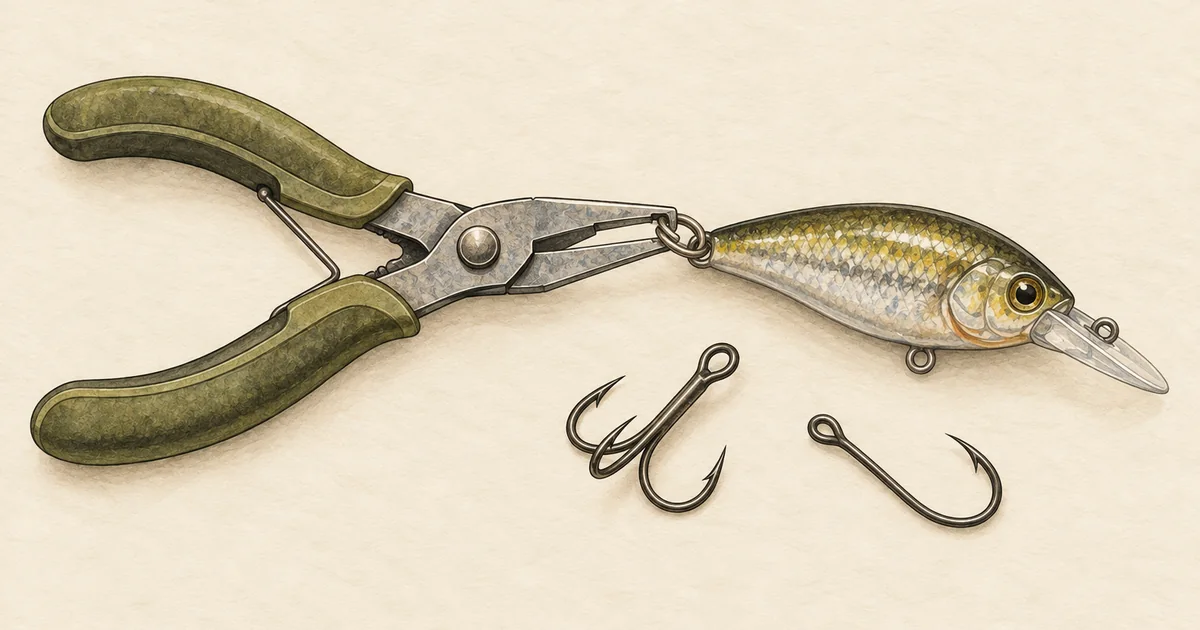
You recognise split-ring pliers by a tapering spike at the front of one jaw, the tooth. When you squeeze the handles it slides between the two coils and lifts them apart. The pliers come to match the ring size, smaller for ultralight lures than for wels catfish and sea lures. Many multi-purpose pliers for anglers have a split-ring opener built in.
Changing a treble hook step by step
A treble hook is a hook with three bends and three points. This is how you change it, according to Blinker:
- Set the tooth. Place the spike just before the entry of the ring, that is where the two wire ends lie.
- Spread the ring. Squeeze the pliers until a gap opens between the coils and slide the eye of the new hook into it.
- Remove the pliers. Once the eye is between the wires it holds the gap open by itself.
- Turn it once around. Pull the eye around the whole ring until it comes out at the other end. Then the hook sits in the ring.
- Ring to the lure. If you also need a new split ring, repeat the same thing at the eyelet of the lure.
The old hook comes out the same way, just in the opposite direction. A sea-fishing guide still considers light surface rust harmless; with heavy rust, hook and split ring should be replaced. Whether a point still bites is covered under hook sharpener.
Without pliers, anglers help themselves with a thumbnail on small rings and with a hook point or knife blade on large ones. Both count as a stopgap, because point and blade easily slip and end up in your finger.
Safety: Modern hooks are so sharp that they go into fingers, palms or faces as easily as into a fish’s mouth. Polarising glasses also protect your eyes from stray lures and hooks. When a hook is lodged in the skin, foreign bodies may, according to the first-aid advice of the German Red Cross, only be removed by a doctor. More under hook injuries and first aid. This note does not replace medical advice.
The replacement hook must suit the lure
Plugs, jerkbaits and swimbaits are balanced with their factory hooks. If the new treble weighs a few grams more or less, that can spoil their action, and very sensitive lures then stop working at all. Spinners and spoons are more forgiving. So let a converted plug run briefly in shallow water first.
The new hook must not be too small, otherwise the body of the lure hides it and the lure can slip out of the mouth more easily on a bite without any point catching. One size up makes sense as long as the action does not suffer. As a rule of thumb, the treble should be at least as wide as the lure.
The wire matters too. For home freshwater, Blinker says trebles of strength 1X or 2X are enough, because thin wire penetrates a hard mouth more easily. For wels catfish the article gives 2X to 4X, for big predators in tropical seas 5X to 6X, plus sturdier split rings. What your line still holds after the knot is worked out by the line calculator.
Treble or single hook on an artificial lure
Most hardbaits come out of the packet with two trebles. Six points catch quickly, whatever the side the fish attacks from. The price: with two or three trebles a fish is easily hooked on the outside, in the chest, gills, face or eye, and the hooks tangle in the landing net.
Inline single hooks with the eye turned by 90 degrees are seen more and more often. Once such a hook is set, it holds markedly better thanks to its larger bend. Single hooks usually sit cleanly in the corner of the mouth, are easy to release and pick up less weed. On the belly eyelet, however, a single hook can turn away on a bite and holds less well there. So a mix makes sense: a treble at the front, a single hook at the tail.
A chub guide in Angling Times does it the other way round and swaps exactly the belly treble for a single hook, because that makes it easier to unhook the chub. By the author’s own experience he did not catch fewer fish that way. An estimate: out of ten bites on a spinner, perhaps seven to nine fish stayed on with a treble, six to eight with a single hook.
The sources disagree on fish welfare. The Bavarian exam questions rate lures with single hooks as gentler on fish than those with trebles. Petri-Heil sums up the research differently: in mortality directly after capture, trebles and single hooks hardly differed, while the barb clearly did more damage. More on this under Fishing hooks, and studies and instructions for the conversion under Treble or single hook: converting lures.
Barbless hook: fishing without a barb
A barbless hook (Schonhaken) is, according to the Bavarian exam questions, a hook without a barb, that is without the small spike behind the point. According to an angling guide by the WWF, it lowers the risk of injury, and the hook is released faster, often while still in the water. In return you lose more fish. Blinker advises keeping the line tight throughout the fight and sees barbless hooks more among experienced anglers. Angling Times, by contrast, points to studies that find hardly any evidence that barbless hooks reduce the risk to the fish.
You press down the barb of an existing hook with pliers, see disgorger pliers and forceps.
Rules on the number of hooks and on barbs
How many hooks a lure may carry and whether a barb is allowed is governed by state law and the water rules (Gewässerordnung). Two official examples: according to the Bavarian exam questions 2023/2024, a treble hook counts, under the implementing regulation to the fisheries act (AVBayFiG), as one bite point, so a plug with two trebles has two. The question catalogue for the angling exam (Fischerprüfung) in Saxony-Anhalt (as of April 2022) lists a plug with four trebles as a prohibited lure.
On top of that come the rules of associations and clubs. The 2024 water rules of the Landesverband Sächsischer Angler allow only a single-shank single hook without a barb on each lure in salmonid waters, the stretches for trout such as brown trout. A barb pressed down yourself is permitted there. Rute & Rolle also reports a single-hook requirement on many such waters. What applies on your water is set out in the fishing permit (Erlaubnisschein) and under Law and licences.
Tuning lures: hooks, rings, rattles and glue
With split-ring pliers you can also modify ready-made lures: different trebles, stronger rings, extra weight on the belly. With soft plastics, rattle capsules and glue come into play. After every modification, what was said above about the action applies: even a few grams more or less can change it, so test the lure in shallow water first.
Swapping trebles and fittings
According to a Blinker article on coastal fishing, many coastal spinning lures come out of the packet with inferior hooks and split rings. Anyone who has once lost a good fish on a bent-open ring therefore often upgrades their lures with better-quality parts straight after buying them. As an additional trigger, the same article mentions a few feathers or red wool threads on the treble; such trebles are available ready-made, but you can also dress them yourself.
If you want to get rid of the treble altogether, hook size, fitting and the action test are covered under Treble or single hook: converting lures.
You can also add weight via the ring. A Blinker article on winter pike fishing describes disc-shaped belly weights: the disc is slid over the eye of the belly treble, the split ring holds it in place, and a floating or suspending jerkbait then runs noticeably deeper.
Choosing the right split-ring size
The specialist articles do not give a universal size chart for split rings. But they show what matters: the ring has to withstand the strength of the target fish, and it should let the lure work freely.
- Hard-fighting fish. When playing an asp, trebles and split rings that are too weak can easily bend open, according to Rute & Rolle. If you fish lures for wels catfish, Blinker says you should fit extra-strong trebles and split rings.
- Ring at the front in the eye. According to Blinker, a strong split ring at the front of a jerkbait gives the lure more freedom of movement, and it often runs noticeably better. A thick snap, on the other hand, can catch in the eye and hamper the action. According to Blinker, you can also tie a lipless crankbait directly to the leader via a split ring in the eye.
- Heavy tackle without a snap. When spinning for wels catfish or in heavy saltwater fishing, anglers do without a snap altogether, according to Blinker. The leader gets a swivel or a solid ring, i.e. a closed metal ring, and the lure hangs from that on a suitable split ring. Lures are then changed with the split-ring pliers.
- Two rings in a row. Sea trout like to spin around their own axis during the fight, and poorly hooked fish can work free this way. The Blinker article on coastal fishing therefore puts two split rings between hook and lure. If you also add a barrel swivel in between, you increase the distance to the lure. According to the same source, you then get more missed bites, and fish are more often hooked on the outside of the head.
Adding rattles
Many crankbaits have loose balls rattling around inside the body. Every lure creates pressure waves as it moves, which fish feel through their lateral line; according to Blinker, the rattle adds an audible trigger on top so that predators notice the lure faster. Several loose balls rattle, while a single weight sliding back and forth in the body tends to click. Depending on the number and diameter of the balls, the sound is higher or lower.
For soft plastics there are small rattle capsules that you push into the body. When pirking at sea, according to Blinker, the rattle goes into the rig as a separate part, where the balls clack with every lift and drop; some designs can be opened and filled yourself.
Louder does not automatically mean better. Blinker describes waters and days when quiet lures do better and advises having both kinds in your box. Rute & Rolle sees the rattle in zander fishing sometimes as the final trigger before the attack, sometimes as the reason why fish turn away.
Gluing soft plastics
On a jig head the soft plastic is held by a bait holder, a moulded collar or a small barb on the hook shank. When you pull the lure off, according to Blinker it is mainly the barb that tears the plastic, and the next time you thread it on it sits more loosely. A drop of superglue helps: Blinker puts it on the hook shank before the lure is slid on.
It is not completely reliable. A Rute & Rolle author fixed his soft plastics with superglue or special soft plastic glue for years; how well that held depended on the lure material. For large pike lures he now uses wire coils that are screwed into the lure and do not tear out even after many powerful casts.
Lead and glue: Over time a white coating forms on lead heads, because the metal reacts with air and moisture, and it attacks the lures. According to Rute & Rolle, superglue promotes this reaction. The same magazine also advises against storing soft plastics ready-mounted on the jig head for long periods, because lead and plasticisers react with each other. Alternatives to lead are covered under Lead-free weights.
Glue is also needed for DIY jobs. One Blinker article secures self-adhesive lure eyes with a drop of superglue; another glues a piece of sponge into a punched hole in the soft plastic and then soaks it with attractant.
Common mistakes
- Replacement hook too small. The lure body hides the points and bites go unhooked.
- Fishing without a running test. Even a few grams‘ difference can throw a finely tuned plug out of rhythm.
- Spreading with a blade or hook point. Both slip easily and stab into your finger.
- Leaving rusty rings in place. With heavy rust you replace hook and split ring together.
- Thin rings on a big-fish lure. For very hard-fighting fish sturdier split rings are recommended.
Frequently asked questions
Will my angling pliers do instead of dedicated split-ring pliers?
Often yes, because many multi-purpose pliers have a split-ring opener. What matters is that the spike fits the ring size. For ultralight rings you need finer tools than for sea lures.
How big does a single hook need to be compared with a treble?
Larger. For inline single hooks on hardbaits, roughly double the size of the treble applies. Fishing with a deadbait for pike and zander it is similar: where a treble in size 1 or 2 hangs, a single hook several sizes larger belongs, for example 2/0 or 5/0. How the numbers count is explained on the page Fishing hooks.
Do I catch less with single hooks?
Somewhat more missed bites are possible, but they stay within reason. In return less weed stays on the lure, there are fewer snags, and undersized fish are unhooked faster.
How do soft plastics stay on the jig head better?
Put a drop of superglue on the hook shank before threading the lure on. How well it holds depends on the plastic. For large lures, screw-in wire coils are an alternative to the bait holder on the jig head.
Related
- Swivels, snaps and split rings: the small parts between line and lure at a glance
- Fishing hooks: hook sizes, shapes and doing without the barb
- Hook sharpener: spotting blunt points and touching them up
- Disgorger pliers and forceps: taking hooks out of the mouth and pressing down barbs
- Hardbaits: plugs and surface lures with their trebles
- Releasing a fish: what hooks and lures mean for survival
- Hook injuries and first aid: when the hook is stuck in your own hand
- Line calculator: working out the strength of line and knot
Sources
- Blinker: Wie funktioniert eine Sprengringzange? (2026) (Dorn, Ablauf, Größen, Notlösungen)
- Blinker: Angler-Werkzeug (2025) (Sprengringöffner an Kombizangen)
- Blinker: Drillinge am Kunstköder (2025) (Lauf, zu kleine Haken)
- Blinker: Das kleine 1×1 der Haken-Wahl (2024) (Bestückung, Inline-Einzelhaken, Drahtstärke, Größenregeln)
- Blinker: Angeln mit Schonhaken (2022) (Fehlbisse, Hänger, Drill ohne Widerhaken)
- Blinker: Drillingshaken und ihr Nachteil (2024) (Größe des Einzelhakens)
- Blinker: Angelausrüstung für Norwegen (2025) (Rost an Haken und Ring)
- Blinker: Achtung, scharfe Haken (2025) (Verletzungsgefahr) und Blinker: Polarisationsbrille (2016) (Augenschutz)
- Deutsches Rotes Kreuz: Wundversorgung und Verbände (Fremdkörper nur vom Arzt entfernen)
- Angling Times: Catch chub with surface lures (2025) (Bauchdrilling getauscht) und Angling Times: Can we do more to care for our fish on the bank? (2023) (Studien zum Widerhaken)
- Rute & Rolle: Köder auf Einzelhaken umrüsten (2024) (Einzelhakenpflicht)
- WWF: Fische angeln und wieder zurücksetzen (PDF) (Vor- und Nachteile des Schonhakens)
- Petri-Heil: Vom Haken zurück ins Wasser (Hakenart und Widerhaken)
- Bayerische Landesanstalt für Landwirtschaft: Prüfungsfragen zur Fischerprüfung 2023/2024 (PDF) (Schonhaken, Einzelhaken, Anbissstellen)
- Land Sachsen-Anhalt: Fragenkatalog zur Fischerprüfung (PDF, Stand 2022) (Drilling, verbotener Köder)
- Landesverband Sächsischer Angler: Gewässerordnung 2024 (PDF) (Salmonidengewässer)
- Blinker: Tuning-Tipps für Küstenköder (2016) (Anbauteile tauschen, doppelter Sprengring, Federpuschel, Köderaugen kleben)
- Blinker: Jerken im Winter (2024) (Sprengring in der Köderöse, Bauchgewicht)
- Blinker: Das Einmaleins der Einhänger (2026) (Sprengring statt Karabiner bei schwerem Gerät)
- Blinker: Lipless Crankbaits (2024) (Sprengring in der Einhängeöse)
- Blinker: Spinnfischen auf Wels (2024) (extra starke Drillinge und Sprengringe)
- Rute & Rolle: Rapfen im Herbst (2018) (aufbiegende Ringe im Rapfendrill)
- Blinker: Laute oder leise Wobbler (2026) (Rasselkugeln, Tonlage, Rasselkapseln für Gummifische)
- Blinker: Kleine Helfer beim Meeresangeln (2025) (Rassel in der Pilkmontage)
- Rute & Rolle: Zanderangeln mit Wobbler (2025) (Rasseln als Reiz oder Abschreckung)
- Blinker: Das erste Mal mit Gummifisch auf Zander (2026) (Köderhalter, Sekundenkleber)
- Blinker: Jigköpfe verständlich erklärt (2025) (Kleber auf den Hakenschenkel)
- Rute & Rolle: Schrauben statt stechen (2022) (Kleber je nach Material, Drahtspiralen, Blei und Weichmacher)
- Rute & Rolle: So reinigst du Jigköpfe richtig (2017) (weißer Belag, Sekundenkleber)
- Blinker: Ködertuning für Zander (2025) (Schwamm in den Gummifisch kleben)
Text AI-assisted, drawing AI-generated. Sources opened and checked in October and November 2026, no graphics taken from the sources.
All information is a rough guide without guarantee. Which and how many hooks are allowed on your lure is governed by state law, the water rules (Gewässerordnung) and the fishing permit (Erlaubnisschein); for injuries the text does not replace medical advice.