
Knowledge · Tackle
Attractants, flavours and dips: What works in the water
Attractants are flavourings, amino acids, sweeteners, oils and spices that make feed and baits smell and taste stronger to fish. Whether attractants make your fishing more successful depends on dose, solubility and water temperature. More attractant does not bring more fish: too much can drive them away from the swim.
How fish perceive attractants
Fish smell and taste substances dissolved in the water. A review of smell and taste in fish names four groups of substances proven to stimulate the olfactory organ: amino acids, sex steroids, bile acids and prostaglandins. According to the same review, the taste buds respond to amino acids, organic acids, nucleotides and bile salts. They are not only in the mouth: in some species they can be spread over the whole body surface, in carp, for example, also on the barbels. How the nose and taste organs are built is explained under Fish senses.
In practice, the division of labour is what counts. Smell can draw fish to the swim from some distance; taste makes the final decision. Experiments with goldfish show how this works: the fish took pieces of food into their mouths, sorted them there by rinsing and blowing them back out, and then swallowed or rejected them. They spat out pieces containing bitter substances such as quinine. If those pieces also contained amino acids, the goldfish swallowed them more often.
What tastes good differs from species to species. A review of taste preferences in fish describes them as highly species-specific and finds no link between what a species likes to smell and what it likes to taste. So a scent that attracts fish does not yet make them swallow the bait. Nutritional value and taste are not the same thing either: in an analysis covering 32 fish species, the vital, or essential, amino acids were mostly less attractive in taste than the non-essential ones.
For carp, a practical article from the Integrative Fisheries Management group (Humboldt-Universität and IGB Berlin) names free amino acids and certain pH differences as the stimuli it responds to most. The same article dampens expectations: even hard maize, which releases hardly any attractants, gathers carp ready to feed after a few days of baiting. According to the article, the catch depends more on the ratio between the amount of feed and the number of fish in the swim than on the bait on the hook.
The types: from amino acids to spices
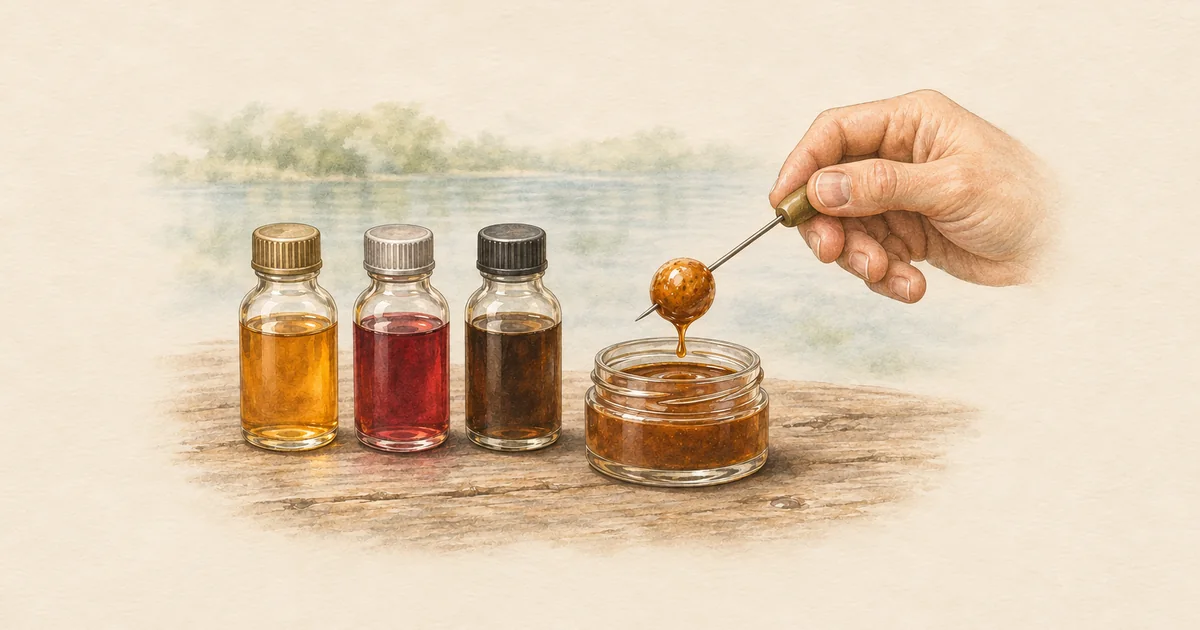
In the tackle shop the products are called attractant, flavour, liquid, dip or booster. Blinker sorts the terms like this: dry additives for feed are usually called attractants, liquid ones flavours, and a dip is anything you dunk the whole bait into before casting. What they contain can be grouped by active ingredient:
- Amino acids and betaine: Amino acids are the building blocks of protein, and fish smell and taste them. The review of taste preferences lists betaine as a group of its own. Rute & Rolle describes a red liquid attractant based on betaine for winter feed that spreads through the water as a dark red cloud. According to Rute & Rolle, enzyme dips break down starch, fat and protein in the boilie into more water-soluble sugars, amino acids and peptides. They need warmth to do this, and the balls get softer over time.
- Sugars and sweeteners: According to Angling Times, both natural and artificial sweeteners act on the taste buds and make them more receptive. Rute & Rolle names sweet liquids and molasses as liquid ingredients for treating boilies afterwards.
- Oils: According to Angling Times, fish and crustacean flavours are usually thick and oil-based. Rute & Rolle counts hemp oil among the proven liquid additives.
- Spices: For roach in winter, Blinker sprinkles a little curry or paprika powder over the maggots. A feeder angler in Rute & Rolle often relies on aniseed in the cold season. In Blinker, garlic is considered an attractant for many species.
- Liver and butyric acid: The feeder angler from Rute & Rolle uses liver extract on the hookbait in winter. According to Blinker, butyric acid attracts carp in small amounts and scares them off in amounts that are too high.
According to Angling Times, powdered flavours are made by spraying a liquid flavour onto a neutral powder and drying it. They belong in the dry groundbait and are mixed in well before the water goes in. According to Blinker, liquid attractants are best added to the water you dampen the feed with, so they spread more evenly. How to mix step by step is explained under Groundbait bucket and mixing whisk.
Water temperature and solubility
An attractant only works once it spreads through the water and drifts to the fish. Oil does not mix with water, and this is where temperature comes in. Angling Times therefore sorts flavours by season: oil-based fish and crustacean flavours dissolve better in warm water and are considered strong in summer. Many spicy and alcohol-based flavours also dissolve in cold water and come into their own in the cold months. According to the same source, sweet and fruity flavours often work all year round.
The angling press reaches a similar picture from practice. For maggots, Blinker recommends sweet flavours in summer and spicy ones in winter. The feeder angler in Rute & Rolle thinks little of scents in summer and uses them in winter.
Research separates two things. According to a review of the sense of taste, preferences for many substances stay stable as the water temperature changes, whereas the renewal of the taste cells depends heavily on temperature. And temperature changes which nutrients carp choose: in Japanese laboratory studies summarised in the Berlin practical article, carp at 25 °C preferred protein to fat, while at 17 °C they ate more fat-rich feed. That concerns the nutritional value of the feed, not the scent of a flavour.
Dosing and use
Many attractants are highly concentrated. Blinker writes that with liquid additives one drop per litre of water can be enough, and with powder a pinch on the tip of a spoon per half hundredweight, i.e. 25 kilograms, of dry feed. Angling Times advises starting a new flavour at half the recommended amount and increasing slowly. Fisch & Fang warns that too many scents and flavours can lead fish to reject the feed entirely. So treat the dose on the bottle as an upper limit rather than a starting point.
| If … | then, according to the angling press | how to use it |
|---|---|---|
| Warm water, summer | Oil-based fish and crustacean flavour, fruit | in the feed or as a dip on the hookbait |
| Cold water, winter | spicy, alcohol-based, liver or aniseed | sparingly, mainly on the hookbait |
| Feeder fishing with little feed | Spray on feeder and bait | spray briefly before every cast |
| Maggots on the hook | Powder, spice or spray | treat only the hook maggots |
| Soft plastics and crankbaits | Gel or paste | reapply every 10 to 20 casts |
When feeder fishing you only put out a little feed, so according to Blinker the attractants have to do the long-range work. Feeder anglers spray the feeder and bait before casting. For pole fishing, the same source often considers attractants overrated; there, tactics and the consistency of the feed matter more. With maggots, Blinker advises spraying a few at first to see whether they are harmed, and treating only the hook maggots so that they stand out from the feed. Angling Times sprinkles a tablespoon of powdered flavour over an imperial pint of maggots, about 0,57 litres, and leaves it to soak in for a few hours.
Worked example: You mix 1,5 kg of dry feeder groundbait. Suppose the bottle recommends 10 ml per kilogram of dry feed: that would be 15 ml. Following the rule of thumb from Angling Times, you start with half, so about 7 to 8 ml, and stir it into the mixing water rather than into the dry feed. If your water has a feed limit, for example 500 grams wet weight as in Berlin, you only mix part of it anyway.
Preparing pellets with liquid
Dry pellets absorb a liquid better if they have taken on water first. Blinker describes this sequence:
- Put the pellets in a container and cover them completely with water.
- Soak them for as many minutes as the pellets measure in millimetres: 2 mm for two minutes, 4 mm for four minutes.
- Pour off the water, let them drain and leave the pellets to swell for about another 20 minutes.
- Only add the liquid shortly before fishing.
Attractant on artificial lures
Boilies have a porous surface and, according to Blinker, hold a flavour for many hours or even days. On artificial lures it only lasts about 30 to 60 minutes. It sticks somewhat better to soft plastics than to painted crankbaits or metal, and greasy gels that you spread thoroughly hold best. Blinker advises re-treating the lure about every 10 to 20 casts. The scent lasts longer in a small foam collar on the soft plastic or in wool threads on the treble, into which you knead an attractor paste. For burbot, a feeder angler in Blinker plugs the feeder with small sponges and drips predator attractant onto them.
Blinker names late autumn and winter as the best time for scented lures. Blinker also describes a side effect: the products stay on your fingers for a long time, often even after soap and a brush. So apply them with as little skin contact as possible.
Nutrients and water rules
Attractants themselves go into the water in drops and pinches. The specialist sources reviewed gave no nutrient values for flavours and liquids. What counts is the feed that carries them: the fact check by the Anglerverband Niedersachsen gives around 6,4 grams of phosphorus per kilogram in home-made boilies, 2,1 in shop-bought ones, 2,9 in maize and 1,6 in shop-bought pole-fishing groundbait. Phosphorus fertilises the water. How strongly depends on the water, according to a study by Humboldt-Universität Berlin; smaller, shallow and nutrient-poor lakes are critical. The Deutscher Angelfischerverband takes the position that moderate baiting is ecologically harmless and proposes separate daily maximums for sensitive or nutrient-poor waters. The calculation with amount of feed and fish removal is explained under Groundbaiting.
Whether and how much attractant may go into the water is governed by state law, protected-area ordinances and, above all, the water rules (Gewässerordnung) of the water manager (Bewirtschafter). Three examples show how differently the texts put it, as of November 2026:
- Berlin: The state fishing regulation (Landesfischereiordnung, § 18 Abs. 4), as reproduced by the Fischereiamt Berlin, limits groundbait to 500 grams per angler per day, counted as wet weight, and bans baiting before the fishing day. The lower fisheries authority (untere Fischereibehörde) can allow exceptions in individual cases.
- Brandenburg, waters of the Landesanglerverband: The water rules (Gewässerordnung, 2019 edition) allow the responsible use of attractants for certain methods, at most 2 kilograms of dry or wet feed per fishing day. The association can restrict groundbait or ban it completely on individual waters.
- Saxony, drinking-water reservoirs of the Landesverband Sächsischer Angler: The water rules (Gewässerordnung, 2024 edition) ban baiting there, including with a feeder, as well as baits made of meat, liver, blood, whey or meat-fed maggots.
Check beforehand. These texts do not say explicitly whether a squirt of flavour on the hookbait falls under a feed limit or whether a liver flavour counts as a liver bait. If in doubt, ask the water manager (Bewirtschafter). What applies on your water is set out in the water rules (Gewässerordnung) and the fishing permit (Erlaubnisschein).
Common mistakes
- Too much at once. Even small amounts are enough. Overdosed feed no longer attracts, it scares fish off.
- Oil-based flavour in cold water. Thick fish and crustacean flavours dissolve poorly in the cold. In winter, reach for spicy or alcohol-based flavours instead.
- Spraying your whole stock of maggots. Some products harm the maggots, and the hookbait no longer stands out from the feed.
- Pouring neat liquid into dry feed. It spreads unevenly. Liquids go into the mixing water, powders into the dry feed before dampening.
- Never comparing without flavour. Angling Times advises fishing with and without attractant to see the effect.
Frequently asked questions
Which attractants work in winter?
According to Angling Times, spicy and alcohol-based flavours, because they also dissolve in cold water, plus sweet and fruity ones.
What is the difference between a dip and a booster?
A dip is an attractant into which you dunk the whole hookbait before casting. A booster strengthens the taste of feed or bait.
Do I need attractants at all?
Not necessarily. According to the Berlin practical article, carp can also be accustomed to a baited spot with plain hard maize. Attractants help above all where there is little feed in the water, for example when feeder fishing or in winter.
Related
- Fish senses: how the nose, taste buds and barbels work
- Groundbaiting: types of feed, amounts and the phosphorus balance
- Boilies: sizes, pop-ups and soaking
- Rolling your own boilies: rolling table, bait gun and boiling
- PVA: bags and mesh that take feed and flavour to the hook
- Bait paste: flavouring paste with aniseed, cinnamon or vanilla sugar
- Nature conservation on the bank: protected areas and their rules
- Line calculator: breaking strain and knots for feeder and carp rigs
Sources
- Acta Physiologica Scandinavica, 1994: Olfaction and gustation in fish: an overview (Abstract) (Reizstoffe, Geschmacksknospen) und Spektrum, Lexikon der Biologie: Barteln (Barteln)
- Physiology & Behavior, 1995: Gustatory control of feeding behavior in goldfish (Abstract) (Sortieren im Maul)
- Fish and Fisheries, 2003: Taste preferences in fishes (Abstract) (artspezifische Vorlieben)
- Journal of Fish Biology, 2019: The taste system in fishes and the effects of environmental variables (Abstract) (Geschmackszellen) und Zhurnal Evoliutsionnoi Biokhimii i Fiziologii, 2016: Geschmacksattraktivität freier Aminosäuren (Abstract) (Aminosäuren)
- Humboldt-Universität und IGB Berlin: Praxis, Was frisst der Karpfen? und Volltext (PDF) (Lockreize, Hartmais, Temperatur)
- Humboldt-Universität Berlin: Einfluss von Angelfuttermitteln beim Karpfen (2003) (Eutrophierung) und Anglerverband Niedersachsen: Faktencheck Anfüttern (PDF) (Phosphor)
- Deutscher Angelfischerverband: Veröffentlichung Nr. 4 des Arbeitskreises Angeln, Verwendung von Lockfutter (PDF, 2025) (Tageshöchstgrenzen)
- Blinker: Lockstoffe zum Angeln (Begriffe, Dosis, Finger), Blinker: Stinkende Lockstoffe fangen (Buttersäure, Pellets) und Blinker: Feederangeln, Lockstoffe für mehr Fangerfolg (Fernwirkung)
- Blinker: Aromatherapie (Maden, Gewürze), Blinker: Flavours auf Kunstködern (Haltedauer), Blinker: Kunstköder aromatisieren (Schaumstoff, Wolle, Jahreszeit) und Blinker: Quappen feedern (Quappe)
- Angling Times: A guide to flavouring fishing bait (Dosis, Temperatur)
- Rute & Rolle: Macht eure Boilies für Karpfen besser (Enzyme, Liquids), Rute & Rolle: Tipps zum Feedern für kalte Tage (Winter) und Rute & Rolle: Friedfische im Winter (Betain) sowie Fisch & Fang: Futter mixen für Friedfisch-Ansitze (sparsam dosieren)
- Fischereiamt Berlin: Landesfischereiordnung in Auszügen (§ 18 Abs. 4), Landesanglerverband Brandenburg: Gewässerordnung, Ausgabe 2019 (Locksubstanzen) und Landesverband Sächsischer Angler: Gewässerordnung, Ausgabe 2024 (PDF) (Anlage 1.1)
Text AI-assisted, drawings AI-generated. Sources opened and checked in November 2026, no graphics taken from the sources.
All figures are guide values without guarantee. How an attractant works depends on the fish species, water temperature and water; what is allowed depends on the water rules and state law.