
Knowledge · Tackle
Feed bucket and mixing whisk: Mixing groundbait properly
In the groundbait bucket dry groundbait becomes a mix that survives the cast and breaks up at the swim. What matters is little water per step, a pause to rest and the hand test. A mixing whisk on a cordless drill takes some of the work off you.
Bucket, tub and water container
The container has to hold the dry groundbait and leave room for mixing without anything flying over the rim. All dry ingredients are first mixed in a large groundbait bucket before water is added. A lid keeps mixed groundbait damp and clean if it is to stand for a while.
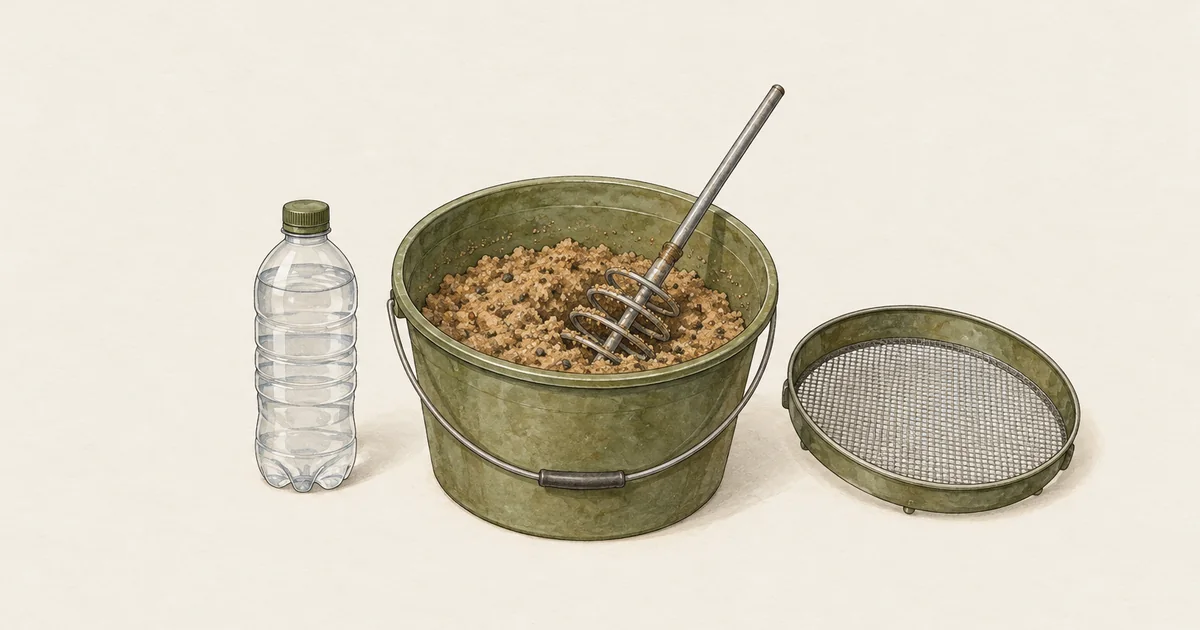
How big the bucket has to be depends on the quantity of groundbait. According to a fact check by the Anglerverband Niedersachsen, the average German angler uses 0,37 kg of groundbait per fishing day. That includes the anglers who don’t feed at all, just under half according to the Deutscher Angelfischerverband. Anyone who does feed uses, according to the same source, 120 to 150 g per hour of fishing on average.
A second, small container for the water goes with the bucket. Pour from a bottle or a small container and, for dampening later, take a spray bottle or a container with small holes.
Water in stages, then let it rest
Add a sip of water to the dry groundbait, stir and look at the mix, then the next sip. Many small sips hit the moisture most precisely. Groundbait that is too wet turns pasty and falls out of the feeder on the cast. Better to start with too little water: you can always dampen it again. A wet mush can only be rescued with more dry groundbait.
After the first dampening the groundbait needs a pause in which it soaks up the water and dries out again. Then you dampen it again, often a second or third time. How long the pause should be is described differently by Blinker and Fisch & Fang:
| Resting time | Context |
|---|---|
| a few minutes | groundbait in general |
| about 10 minutes | feeder groundbait, then riddle |
| 10 to 15 minutes | bream groundbait |
| a quarter of an hour | feeder groundbait |
| 25 to 30 minutes | swelling time before riddling |
| since the day before | river current, among the pros |
There’s a reason for letting it stand overnight: it prevents particles from rising to the surface and drawing small fish such as bleak to the baited spot. Check the moisture again after every pause.
Mixing whisk on a cordless drill
The mixing whisk is a stirring attachment you clamp into a cordless drill. According to Blinker it achieves the same as rubbing through a groundbait riddle: the groundbait becomes loose and fine-crumbed and breaks up in the water into a scent cloud. Whisking is quicker and more convenient than working by hand. The cordless mixer is worthwhile above all for anglers who regularly pole fish.
When fishing for bream the groundbait is dampened several times and whisked through again each time. That way it has the same consistency throughout the fishing day. The mix dries out afterwards even after whisking; a squirt of water makes up for it.
Coarse chunks dissolve poorly and the fish eat them instead of just being attracted: the groundbait then fills them up. What can be broken up by neither whisk nor riddle, you sort out. Maggots, casters, hemp or sweetcorn are added only once the groundbait has been whisked or riddled.
Consistency for float, pole and swim feeder
A ball from your hand shows whether the moisture is right. For groundbait you throw in by hand when pole fishing or float fishing, you want a mix that can be formed into a throwable ball with a single squeeze of the hand and breaks up straight away on the bottom. When pole fishing, balls the size of an orange go into the water at the start; on rivers balls the size of a tennis ball are usual.
For the swim feeder the groundbait should form small balls that hold when squeezed but don’t get sticky. The ball hangs together and falls apart again easily.
Ball test: Squeeze a handful of groundbait firmly together. If it falls apart again straight away, it lacks water. If the ball holds and can be easily broken with a finger, the moisture is right for the feeder. If only a soft mush forms, the groundbait is too wet.
Running and still water
Through the amount of water you control how quickly a ball dissolves. Fisch & Fang explains: damp balls break up slowly and suit stronger current and greater depth. Dry balls dissolve quickly and often form a cloud on impact; they belong in shallower still waters, canals and slow rivers. The harder you squeeze a ball, the more slowly it dissolves. Groundbait for rivers can be weighted with earth so that it sinks faster; lake groundbait stays lighter.
For feeder groundbait in heavy feeder fishing in a current, on the other hand, an airy, almost dry mix is right that nevertheless sticks into a stable ball when squeezed. The two statements concern different cases: balls by hand and groundbait in the feeder. According to Rute & Rolle, you riddle earth or clay in the groundbait thoroughly beforehand because stones and glass can be in it.
For more binding, beet syrup helps in a loose still-water mix, about 100 g per 1 kg of groundbait. The balls become very stable and still dissolve quickly. White breadcrumbs bind more strongly than brown, as do oat flakes and cornflour.
Quantity of groundbait and leftovers
In the question catalogue for the angling exam (Fischerprüfung) of the Bayerische Landesanstalt für Landwirtschaft, excessive baiting is to be rejected because it enriches the water with nitrogen and phosphorus and worsens water quality. The Anglerverband Niedersachsen regards shallow, nutrient-poor waters with little water exchange as particularly vulnerable. By its calculations the balance tips from about 2,5 to 3,5 kg of groundbait per angler and day: the groundbait then brings in more phosphorus than is removed with the fish caught.
So mix up only what you will feed during the day. What is left in the bucket in the evening you don’t tip into the water as a last load; you take it home. One example of fixed limits: the water rules (Gewässerordnung) of the Landesanglerverband Brandenburg (2019 edition) allow at most 2 kg of dry or wet groundbait per fishing day to be brought to the swim or introduced into the water. The Deutscher Angelfischerverband speaks in favour of such daily maximums in sensitive waters. Which rules apply to you is set out in the water rules and in your fishing permit (Erlaubnisschein).
Common mistakes
- Holding the bucket tilted in the water. Too much slops in quickly and the groundbait turns into a mush that no longer holds a ball. Scoop with a bottle.
- Feeding straight away. Groundbait mixed by hand quickly looks finished but is still coarse and lumpy. Only after the pause and riddling or whisking is it even.
- Not dampening again after the pause. The mix dries out during the pause. Without dampening it is drier than the first test showed.
- Stirring in maggots before whisking. Live feed and particles go only into the finished, prepared groundbait, see Maggots and larvae.
- Mixing up too much. What is left over doesn’t belong in the water. Estimate the quantity beforehand and take leftovers home again.
Frequently asked questions
How long does groundbait have to rest?
The specialist articles give times from a few minutes up to half an hour, and overnight for heavy river feeding. What matters is that you check the moisture again afterwards and dampen it again.
Do I need a mixing whisk as an occasional angler?
No. Blinker sees it mainly with anglers who do a lot of pole fishing and names rubbing through a riddle as an equivalent route. For getting started with feeder fishing, the magazine itself doesn’t consider the riddle essential.
Why do my balls fall apart as soon as they go in?
Usually the groundbait is too dry or squeezed too loosely. Dry balls dissolve quickly, more firmly squeezed ones last longer. Dampen it a little more and squeeze harder.
How much groundbait do I need for a fishing day?
The Anglerverband Niedersachsen gives 0,37 kg per fishing day, averaged over all anglers including those who don’t feed. Maximum quantities are set by the water rules (Gewässerordnung).
Related
- Groundbait riddle: mesh sizes and when to riddle
- Swim feeder: designs, weight and how firmly you fill it
- Catapult: getting balls and particles out to a distance
- Feeder fishing: trail of groundbait and the routine at the water
- Pole fishing: feeding sparingly with the long pole
- Pellets: micro pellets as feed for the feeder and method
- Fishing bucket: water for hands, mat and groundbait
- Line calculator: comparing the breaking strain of mainline and hooklength
Sources
- Blinker: Futter für Friedfische richtig zubereiten (Wasser zugeben, Ruhezeit, Klumpen, Akku-Rührer, Fehler beim Schöpfen)
- Blinker: Brassen feedern, mit der Feederrute leicht gemacht (Futtereimer, kleine Schlucke, Quellzeit, Maden zuletzt) und Blinker: Feederangeln, Friedfische füttern und fangen (wenig Wasser, Viertelstunde, Sieb)
- Blinker: Angeln mit Futterkorb, ein Grundkurs (Ruhezeit, Ballprobe, Klumpen) und Blinker: Brassen angeln, alle Grundlagen (Ruhezeit, Ballen, Futterquirl, Rübensirup)
- Fisch & Fang: Futter mixen für Friedfisch-Ansitze (Wassermenge, Fluss und Stillwasser, Bindung) und Fisch & Fang: 10 Tipps zum Heavy-Feedern im Strom (Korbfutter im Strom, Vortag)
- Rute & Rolle: Wunderbare Welt des Lockfutters (Pressen, Erde im Flussfutter) und Rute & Rolle: Futter-Tipps fürs kalte Frühjahr (Erde vorher sieben)
- Bayerische Landesanstalt für Landwirtschaft: Prüfungsfragen zur Fischerprüfung 2023/2024 (PDF) (übermäßiges Anfüttern)
- Anglerverband Niedersachsen: Faktencheck Anfüttern (PDF) (Futtermengen, Phosphorbilanz) und Deutscher Angelfischerverband: Verwendung von Lockfutter (PDF) (Tageshöchstgrenzen)
- Landesanglerverband Brandenburg: Gewässerordnung (2 kg Futter pro Angeltag)
Text AI-assisted, drawing AI-generated. Sources opened and checked in October 2026; no graphics taken from the sources.
All figures are guide values without guarantee. How damp your groundbait has to be depends on the mix, current and method, and how much you may feed is set by the water rules (Gewässerordnung).