
Knowledge · Tackle
Groundbait riddle: Fine, lump-free groundbait
A groundbait riddle is a grid in a frame through which you rub dampened groundbait by hand. It breaks up lumps, loosens the mix and makes sure a ball of groundbait falls apart in the water as a fine cloud instead of filling the fish up with chunks.
What the riddle does to the groundbait
Groundbait that you’ve only mixed by hand often looks finished already. According to Blinker, though, it is then still coarse-grained and contains thick lumps. They dissolve poorly in the water, stay behind as chunks and get eaten. The groundbait then doesn’t just attract, it fills the fish up.
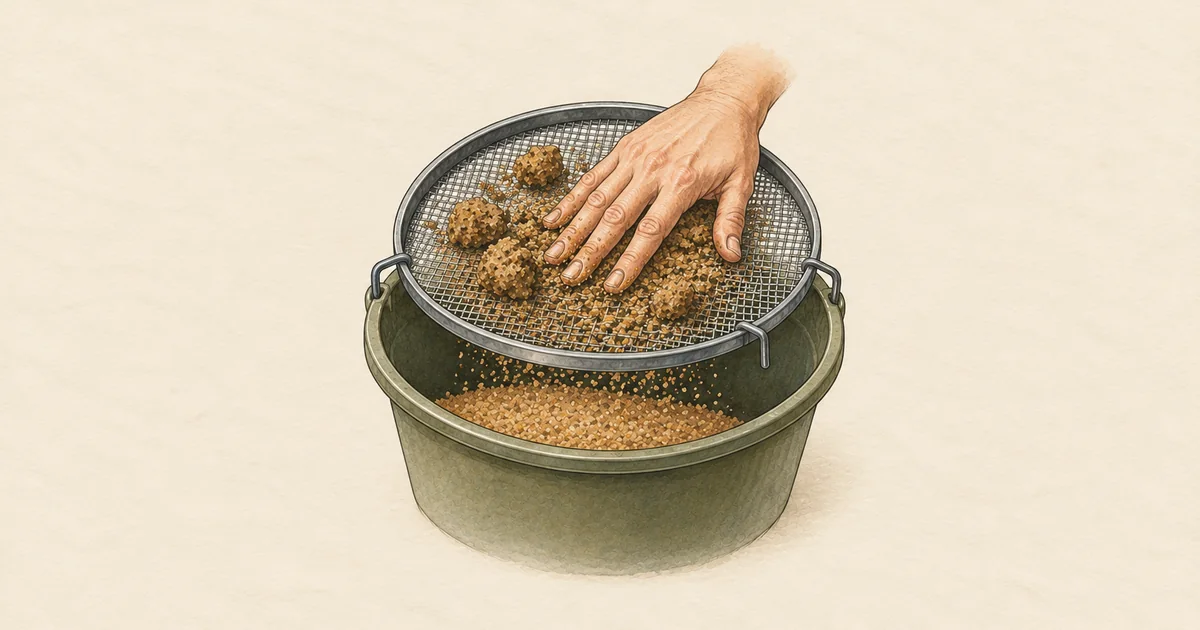
If you rub the mix through a grid, the lumps fall apart and the groundbait becomes loose and airy. The aim: one squeeze of the hand forms a ball that survives the cast and breaks up into fine, floury particles as soon as it reaches the bottom. That creates a scent cloud. A second advantage: riddled groundbait is evenly fine and easy to shape into balls.
The right moment: after resting, before balling up
What you riddle is not the powder from the bag but the dampened groundbait after it has absorbed water. The magazines‘ instructions follow the same sequence:
- Dampening in small steps. Dry groundbait into the bucket, add water from a bottle or a small container. If you tilt the bucket into the water, too much slops in easily.
- Letting it rest. The groundbait soaks up the water and then seems drier. For bream groundbait 10 to 15 minutes are quoted, in a feeder article 25 to 30 minutes of swelling time.
- Dampening again. The moisture is right when you can squeeze small balls that don’t fall apart again straight away.
- Riddling. Rub it through the grid handful by handful. Very stubborn lumps you simply throw away.
- Checking once more. Riddled groundbait dries out afterwards. If it has become too dry, dampen it lightly a third time.
- Additions and balls. Maggots and casters go into the groundbait only after riddling. Then you shape the balls or fill the feeder.
An exception is dry pre-riddling. For cold spring weather, Rute & Rolle recommends a fine groundbait with almost no filling ingredients. So that no large particles get in, the mix is riddled before any water is added.
Hand test: Squeeze a handful of riddled groundbait together. It should form a cohesive ball that nevertheless breaks apart again easily. If it breaks straight away, it lacks water. If the mass turns mushy and can no longer be shaped into balls, there was too much.
Mesh sizes: groundbait riddle, maggot riddle, flour sieve
According to Blinker, groundbait riddles come with different mesh sizes. None of the specialist sources checked here gives a fixed millimetre figure for groundbait. Two neighbours of the groundbait riddle are better documented:
| Sieve | What for | Mesh size according to source | What stays on top |
|---|---|---|---|
| Groundbait riddle | dampened groundbait | various, no fixed figure | lumps and coarse chunks |
| Maggot riddle | cleaning live maggots | 3 mm to 3,5 mm | dead maggots and casters |
| Flour sieve (kitchen) | dry, light bread as feed | “suitable”, no figure | larger crumbs |
With the maggot riddle, the maggots do the work themselves. The live ones crawl through the mesh, the dead and pupated ones stay on top. A 3 mm riddle is mentioned for this, because dead maggots contaminate the groundbait; an article on making casters gives 3,5 mm. Casters are the pupae of maggots and a bait in their own right, more under Maggots and larvae. For bread as feed for roach, Fisch & Fang riddles the crumbs dry with a kitchen flour sieve, because larger crumbs disturb the cloud.
Fine for pole and float, durable for the feeder
If you fish shallow, for instance when float fishing for rudd, you feed close to the surface. For that, a sweet mix is made up with little water in summer and riddled thoroughly. Its balls break up quickly in the water and leave a long-lasting cloud of groundbait. With the swim feeder something different applies: the groundbait has to survive the cast in the feeder and only break up quickly on the bottom. You riddle in both cases. Maggots and casters are added only afterwards.
Earth and clay belong in the riddle too
In a river or deep canals groundbait has to be heavy enough to reach the bottom. Rute & Rolle advises adding earth or clay to the mix: both weigh it down, don’t fill the fish and form a cloud. Angling earth is regarded as a groundbait weighting agent without nutritional value that further strengthens cloud formation.
According to Rute & Rolle, earth from molehills should be thoroughly riddled before use. It can contain small stones, glass shards and other foreign bodies that do damage. The finished mix with clay goes through the riddle too: in a Fisch & Fang report on pole fishing on the Rhine, a good two kilos of clay go with seven kilos of groundbait, some of it with strongly binding ingredients. The pole angler lets everything rest, dampens it again and only then riddles, so that no lumps remain.
Feeding in moderation: Whether and how much you may feed, including with earth or clay, is set out in the water rules (Gewässerordnung) and the fishing permit (Erlaubnisschein). In the question catalogue for the Bavarian angling exam (Fischerprüfung), excessive baiting is to be rejected because it brings nitrogen and phosphorus into the water and worsens water quality. Examples of quantities are under Pole fishing.
Riddle and groundbait bucket
Mixing is done in the bucket; when feeder fishing for bream, the dry ingredients are mixed in a large groundbait bucket. When riddling, the riddle sits over a bucket into which the fine groundbait falls. When buying, make sure the riddle sits securely on the rim of your bucket, then you have both hands free for rubbing (Fig. 1).
A mixing whisk on a cordless drill achieves the same effect according to Blinker and is much faster. You can dampen it again at the same time. But usually only anglers who do a great deal of pole fishing have one in their luggage. How bucket and whisk work together is explained in Groundbait bucket and mixing whisk.
Common mistakes
- Mixing it too wet and counting on the riddle. A mushy groundbait can only be saved by adding dry groundbait until the consistency is right again. So add water a sip at a time.
- Riddling before it has rested. The instructions riddle only once the groundbait has swollen and been dampened again. Before that it hasn’t quite absorbed the water yet.
- Mixing in maggots before riddling. Live baits go only into the finished, riddled groundbait.
- Forcing hard lumps through. What can’t be rubbed through gets thrown away.
- Using unriddled earth. Stones and glass belong neither in the groundbait nor in the water.
Frequently asked questions
Is a kitchen sieve enough?
For dry breadcrumbs, yes, Fisch & Fang names a flour sieve as suitable for that. For dampened groundbait, dedicated groundbait riddles are intended, available in several mesh sizes.
Do I need a riddle at all as a beginner?
Not necessarily. The groundbait riddle is more part of an experienced feeder angler’s kit; you can do without it to begin with. If you riddle, you get a loose, even mix that is easy to press into the feeder.
Can you do without a riddle?
A mixing whisk on a cordless drill loosens the groundbait just as well. Mixed by hand alone, on the other hand, it leaves lumps that dissolve poorly and fill the fish up.
Why sieve out dead maggots?
Dead maggots contaminate the groundbait. On the maggot riddle they separate themselves, because only live maggots crawl through the mesh.
Related
- Groundbait bucket and mixing whisk: what you mix in and how the whisk replaces riddling
- Swim feeder: designs and how firmly you fill it with riddled groundbait
- Pole fishing: throwing groundbait balls in precisely and topping up sparingly
- Feeder fishing: how every feeder becomes a trail of groundbait on the bottom
- Float fishing: bait in the layer of water where the cloud sits
- Plant-based baits: sweetcorn, particles and pellets as an addition to groundbait
- Maggots and larvae: baiting up maggots and casters properly
- Line calculator: breaking strain of the mainline for feeder and float
Sources
- Blinker: Futter für Friedfische richtig zubereiten (Klumpen sättigen, Sieben mit der Hand, unterschiedliche Maschenweiten, Duftwolke, Anfeuchten aus der Flasche, zu nasses Futter retten, Akku-Rührer)
- Blinker: Brassen angeln, alle Grundlagen (Ziehen 10 bis 15 Minuten, Sieben nach dem Nachfeuchten, Ballenprobe, Futter für den Korb) und Blinker: Brassen Feedern (großer Futtereimer, 25 bis 30 Minuten Quellzeit, Maden und Caster erst nach dem Sieben)
- Blinker: Angeln mit Futterkorb, ein Grundkurs (Feuchteprobe, Klumpen durchreiben oder wegwerfen, drittes Anfeuchten) und Blinker: Feederangeln, Friedfische füttern und fangen (Sieb für Anfänger nicht zwingend)
- Blinker: Drei Futtertipps vom Weltmeister (gleichmäßiges Futter, 3-mm-Madensieb) und Blinker: Caster-Herstellung (Madensieb mit 3,5 mm)
- Blinker: Angeln auf Rotfedern, die besten Futter-Tipps (gründlich gesiebter Mix für eine Wolke) und Blinker: Futterbeschwerer (Angelerde ohne Nährwert)
- Rute & Rolle: Friedfisch, Futter-Tipps fürs kalte Frühjahr (trocken vorsieben, Erde und Lehm, Erde vor Gebrauch sieben)
- Fisch & Fang: Strom-Stippen (Lehm im Futter, nachfeuchten und durchsieben) und Fisch & Fang: Locker flockig auf Rotaugen (Brot mit dem Mehlsieb)
- Bayerische Landesanstalt für Landwirtschaft: Prüfungsfragen zur Fischerprüfung 2023/2024 (PDF) (Frage 4.110, übermäßiges Anfüttern)
Text AI-assisted, drawing AI-generated. Sources opened and checked in October 2026; no graphics taken from the sources.
All figures are guide values without guarantee. How finely you riddle and how damp the groundbait has to be depends on the water, current and target fish, and whether you may feed at all is set by the water rules (Gewässerordnung).