
Knowledge · Tackle
Rolling your own boilies: Rolling table, bait gun and boiling
If you want to try making your own boilies, you need four things: a bait gun for sausages of even thickness, a rolling table with grooves of the right diameter, a large pot and an airy rack for drying. The paste itself is simple, flours and eggs. Most mistakes happen when boiling, drying and storing.
The tools and what they are for
Rolling table
The rolling table, also called a roller in Blinker, consists of a bottom part and a top part, both with semicircular grooves. Blinker describes such tables with grooves of various diameters that produce balls of exactly that size. For this, the paste sausage must be as thick as the groove. You lay it across the grooves, put the top part on and push it back and forth. The bottom part must stand firm while you do this. If the paste sticks, according to a second Blinker article you brush the table thinly with cooking oil beforehand.
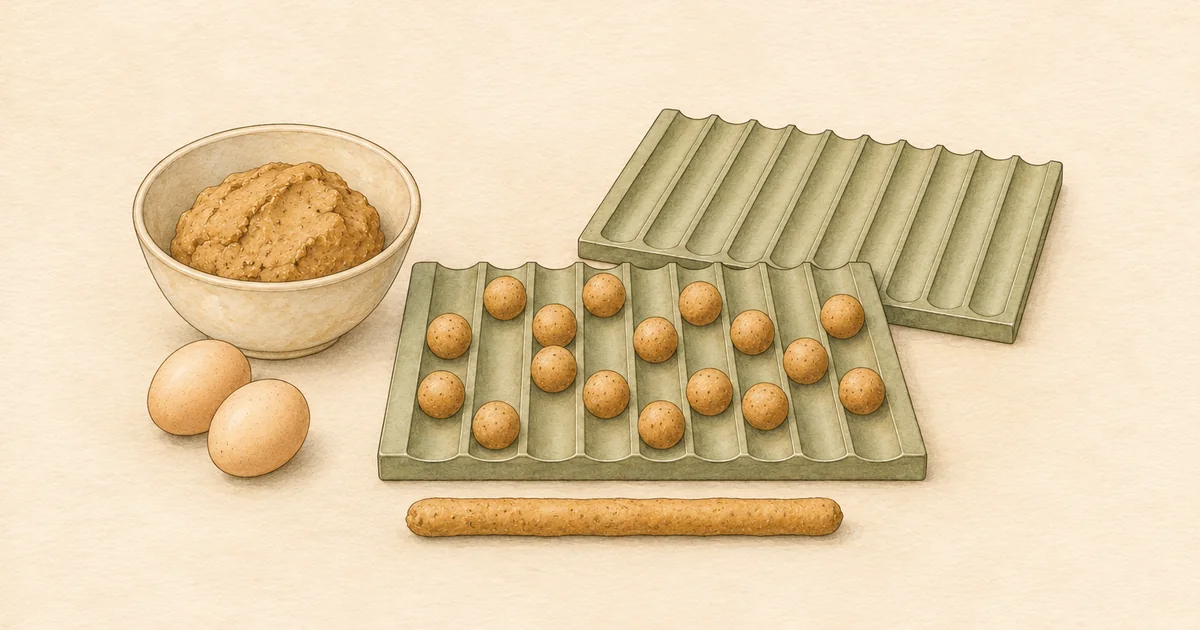
Which diameter suits depends on how you use them. A recipe in Fisch & Fang forms balls of about 20 millimetres for fishing and smaller ones for loose feeding. Sizes, bycatch and hook sizes are covered under Boilies. Bear in mind when buying: according to Fisch & Fang, freshly boiled balls are always slightly larger than hardened ones. So measure the dried ball before you buy a second table.
Bait gun
The bait gun, known among anglers as a cannon and in a Blinker article as a Sausage-Gun, is a cylinder with a plunger and interchangeable nozzles. The nozzle determines the diameter of the sausage. Blinker describes closed cartridge guns of 600 millilitres that are pressed by hand and, for large quantities, guns using air or water pressure. Depending on the paste, you press two or more sausages onto the table at once. According to Blinker, small rolling tables have a rolling surface on the back on which you can also roll sausages evenly by hand without a gun.
Pot, slotted spoon and drying rack
A large pot is enough for boiling, and a slotted spoon or sieve for taking them out. According to Blinker, you can build a drying rack yourself from roof battens and fly screen; Rute & Rolle uses a mesh crate.
Tick off before the first batch:
- kitchen scales and a large bucket for the dry mix; a groundbait bucket is also suitable for mixing
- second bowl and whisk for the eggs, both used only for bait
- bait gun with a nozzle matching the diameter of the grooves
- rolling table, a little cooking oil against sticky paste
- large pot, slotted spoon or sieve
- drying rack or mesh crate, a cloth for steaming off
- freezer bags and a pen for the production date
Round, square or by hand
| If … | then … | because … |
|---|---|---|
| you only need a few hook baits in your own shape | roll by hand between your palms | a piece of paste without any equipment is enough |
| you put out kilos of feed at distance with a throwing stick or catapult | Bait gun and rolling table | round balls fly well |
| you feed close to the bank, along drop-offs or in current | Cubes: roll out the paste, cut into strips and pieces | square pieces roll away less easily |
| a gun and table are too much effort for you | Cubes with rolling pin and knife | no special equipment needed |
The cubes are described in a Blinker article whose author says he catches no fewer carp with paste cubes than with balls. Rolling by hand puts him off after a kilo of paste at the latest. For feeding at distance, round balls remain the better choice, see Throwing stick and Catapult.
The base paste: flours and eggs
A dry mix of flours is kneaded with eggs into a firm paste. According to Blinker, semolina binds well and is a cheap ingredient for hard balls. Full-fat soya flour makes the paste easy to roll thanks to its fat, and maize meal is inexpensive. Depending on the direction you take, ground bird food or fishmeal is added. Casein and whole egg powder make the balls harder after boiling. Light flours such as hemp flour or sodium caseinate make the balls float at higher doses. For sinking boilies, keep them to a minimum.
A base recipe in Blinker and a recipe in Fisch & Fang work with 8 to 10 eggs per kilogram of dry mix. The older Blinker article uses one egg per roughly 100 grams and advises deliberately using more liquid for the bait gun, because it makes working with the gun easier. Angling Times recommends adding the mix slowly to the eggs and never the other way round, and the Blinker base recipe does the same. The hemp recipe in Fisch & Fang, on the other hand, stirs the egg mixture slowly into the powder.
Worked example: eggs for 2,5 kilos of mix
You want to use 2,5 kilograms of dry mix. According to the recipes with 8 to 10 eggs per kilo, that makes 20 to 25 eggs; according to the rule of one egg per 100 grams, exactly 25. Crack 25 eggs and stir in the mix a portion at a time. The paste is ready when it is even and no longer sticks to your fingers. How many balls you get from a kilo depends on the diameter. The sources used here do not give a reliable number.
Home-rolled boilies fertilise the water more. The Faktencheck Anfüttern fact sheet by the Anglerverband Niedersachsen gives 6,4 grams of phosphorus per kilogram for homemade boilies and 2,1 grams for shop-bought ones, i.e. about three times as much. So only top up once fish are on the spot, and stick to the quantities in the water rules and the fishing permit (Erlaubnisschein). More on this under Groundbaiting.
Step by step from paste to stock
- Weigh out the dry mix and mix it thoroughly in the large bucket.
- Crack the eggs into a separate bowl and whisk them, adding liquid additives now. Then wash your hands (hygiene section).
- Stir the mix into the eggs bit by bit. Go sparingly at first, otherwise the paste becomes too dry. Knead until it no longer sticks to your fingers.
- Let the paste rest in a sealed bag so that the liquid soaks in. Angling Times names five minutes, the Blinker article with the paste cubes about 30 minutes.
- Press sausages onto the bottom part with the bait gun, using a nozzle that matches the groove. Keep the remaining paste sealed airtight.
- Lay the sausages across the grooves and roll them with the top part. Whether short or long movements give rounder balls depends on the mix, according to Blinker. Try it out on the first sausage.
- Put the balls into rapidly boiling water, but only as many as will not cool it down. Stir once or twice at the start, otherwise they stick to the bottom of the pot. Take them out when they float on top.
- Let them steam off on a cloth, then dry them spaced apart on the rack and turn them now and then, not in the sun.
- Fill into bags in portions, label with the production date and freeze.
Boiling time: what the minutes change
Angling Times boils for about one minute, a second article there 90 seconds in small batches. The hemp recipe in Fisch & Fang gives about two minutes, the older Blinker article usually two to four minutes. In a recipe collection from Fisch & Fang, one angler boils for three minutes at most, another five minutes for freebies and eight for hook baits.
Fresh balls can stick to the bottom of the pot. That is why two Blinker articles stir, one explicitly right at the start. As the sign that they are done, all three Blinker articles name the same thing: the balls come out as soon as they float on the surface. Boiling longer costs smell and taste, according to Blinker. An author in the Fisch & Fang collection warns against balls that are too hard and fine-pored, because they release their scent less well. So it is better to control hardness through the mix than the clock. Note the boiling time for each batch, then you will get the same balls next time.
Drying, storing, freezing
The older Blinker article leaves the balls to dry for two to three days, the article with the dough cubes two days, turning them twice a day, and the Blinker basic recipe one to two days. Angling Times, on the other hand, only lets them air-dry for about an hour and then freezes them. The balls should not touch, otherwise they stick together, and should not sit in air that is too damp. According to Rute & Rolle, they dry too quickly in the sun and can become brittle.
Without preservative, home-rolled boilies usually keep for only a few days, according to Blinker. In the freezer they stay usable for up to a year, says the same source. Without cold, such balls start to go mouldy after a few days, depending on the weather. So only take the portion you need to the water. According to the BfR, mould needs moisture to grow, and the institute advises storing grain and flour in a cool, dry place. Mouldy balls belong in the bin.
Some of the flavour changes when heated. Fisch & Fang therefore advises putting only half the amount into the dough and pouring the second half over the balls once they have cooled. The hemp recipe only adds the attractant to the bag at the freezing stage. How flavours, dips and carriers differ is explained under Attractants.
Hygiene with raw eggs and raw flour
Boilie dough is raw dough with raw eggs, and the Bundesinstitut für Risikobewertung (BfR), Germany’s federal risk assessment institute, names sources of germs for both. According to the BfR, salmonella can be transferred from the eggshell to other food when the egg is cracked. Official food inspectors have repeatedly found Shiga toxin-producing E. coli in flour, STEC for short, whose toxins can cause serious illness (BfR). Freezing does not kill salmonella completely, and STEC cannot be reliably killed in the freezer either.
- Use separate bowls, mixers and boards for boilies, as the BfR recommends when handling flour.
- After cracking the eggs and kneading, wash your hands with warm water and soap and dry them.
- Then clean the work surface, sink and utensils with warm water and washing-up liquid.
- Do not taste the dough. The BfR advises against eating raw dough and specifically mentions children who lick dough off their hands. If children help with the rolling, they wash their hands afterwards.
- Even boiled balls are not food. According to the BfR, STEC are killed when a temperature of 70 degrees is reached at every point for at least two minutes. None of the sources shows whether a boilie reaches that in its core after one or two minutes in the pan.
This text does not replace medical advice. More on kitchen hygiene, the fridge and freezing can be found under Storage and hygiene.
Common mistakes
- Dough too dry and crumbly: Too much mix added at once. Add it sparingly at first. According to Angling Times, 10 to 20 millilitres of fish oil also make the dough easier to roll.
- Dough sticks to the table: Brush the grooves thinly with cooking oil and stand the base firmly so that it does not slide when you push.
- Cracked and brittle balls: Dried too fast, for example in the sun. Dry them in the shade on the rack and turn them.
- Balls too soft: Still too damp, or soaked in too much liquid afterwards. Rute & Rolle simply dries baits that have gone too soft a little longer.
- Balls float instead of sinking: Too much light flour such as hemp flour or sodium caseinate. Reduce the proportion, or use them deliberately as a buoyant bait.
Frequently asked questions
Do I need a rolling table for a few balls?
No. You roll a small number of hookbaits between your palms and cut cubes with a knife. A bait gun and rolling table pay off once you need feed boilies by the kilo.
How long do boilies need to boil?
The figures range from about one to eight minutes. Floating is more reliable than the clock: once the balls drift to the top, they come out.
Why don’t my balls come out round?
First check whether the sausage is as thick as the groove and whether the base stands firmly. Then try short and long rolling strokes; which length works depends on the mix, according to Blinker.
Related
- Boilies: sizes, pop-ups and how the bait lies on the bottom
- Boilie needle and boilie drill: drawing the finished ball onto the hair
- Attractants, flavours and dips: what works in the water
- Groundbaiting and groundbait: amounts of feed, rules and nutrient balance
- Throwing stick for boilies: feeding round balls far out and accurately
- Carp fishing: hair rig and fixed lead at a glance
- Storage and hygiene: kitchen hygiene and freezing according to official guidance
- Line calculator: breaking strain of the main line for carp tackle
Sources
- Blinker: Boilies selber machen: Mit einfachen Mitteln zum fängigen Karpfenköder (Rollbrett, Teigspritze, Würfel, Teig, Trocknen, Haltbarkeit)
- Blinker: So einfach werden Boilies selber gemacht (Kartuschenspritze, Ei je 100 Gramm, Rollen, Kochzeit, Trockengitter)
- Blinker: Boilie-Rezept: Das schmeckt den Karpfen! (8 bis 10 Eier je Kilo Mix, Eigenschaften von Grieß, Sojamehl, Casein und Hanfmehl)
- Fisch & Fang: Hanfboilies: Und das nicht nur zur Winterszeit (Kochzeit rund zwei Minuten, 8 bis 10 Eier, Kugelgröße, Einfrieren mit Lockstoff)
- Fisch & Fang: Boilie-Rezepte (Kochzeiten von drei, fünf und acht Minuten, zu harte Kugeln)
- Fisch & Fang: Die Arbeit eines Boilies (frisch gekochte Kugeln größer als ausgehärtete, Aroma vor und nach dem Kochen)
- Rute & Rolle: Macht Eure Boilies für Karpfen besser! (Nachtrocknen in der Gitterkiste, keine Sonne, zu weiche Köder)
- Angling Times: How to make your own boilies (Mix in die Eier, Ruhezeit, Kochzeit rund eine Minute, Fischöl) und Angling Times: How to make boilies for carp fishing (90 Sekunden in kleinen Portionen)
- BfR: Fragen und Antworten zum Schutz vor Infektionen mit Salmonellen (Eischale, Händewaschen, Teigreste bei Kindern, Einfrieren)
- BfR: Escherichia coli in Mehl und Teig (STEC in Mehl, getrennte Geräte, roher Teig, 70 Grad)
- BfR: Schimmelpilze in Lebensmitteln (Feuchtigkeit, Mehl kühl und trocken lagern)
- Anglerverband Niedersachsen: Faktencheck Anfüttern (PDF) (Phosphor in selbst gemachten und gekauften Boilies, Nachfüttern)
Text AI-assisted, drawings AI-generated. Sources opened and checked in November 2026, no graphics taken from the sources.
All figures are guide values without guarantee. Boiling time, drying and shelf life depend on the mix, ball size and room climate; this text does not replace medical advice.