
Knowledge – Fish
Wels catfish fishing
Catching wels catfish means: sitting out at night by deep hollows and drop-offs and offering a strong bait on the bottom or in open water. Here is the way there in nine steps, each with a link to the detailed page.
 Choose another fish117 fish with guides
 EelOff-peak season
 EelpoutPossible
 IdePossible
 ArapaimaGood
 GraylingPeak season
 Atlantic salmonSpawning time, please spare
 Brown troutSpawning time, please spare
 Brook troutSpawning time, please spare
 BarbelOff-peak season
 BarramundiSpawning season
 Greater amberjackGood
 Topmouth gudgeonOnly as bycatch
 Blue marlinSpawning season
 BonefishSpawning season
 BonitoGood
 BreamOff-peak season
 Dusky grouperOnly as bycatch
 CobiaPossible
 Spiny dogfishOnly as bycatch
 CodPeak season
 ChubPeak season
 MinnowOnly as bycatch
 European sturgeonOnly as bycatch
 FlounderPeak season
 PerchPeak season
 Largemouth bassGood
 Ballan wrasseOnly as bycatch
 Yellowfin tunaSpawning season
 Giant trevallyGood
 Prussian carpPossible
 BrillPossible
 Gilthead breamSpawning time, please spare
 Golden doradoSpawning season
 Golden mahseerOnly as bycatch
 Dolphinfish (mahi-mahi)Good
 Grass carpPossible
 Great barracudaGood
 GudgeonPossible
 White breamPossible
 DaceOff-peak season
 PikePeak season
 HalibutOff-peak season
 HerringPossible
 GarfishOut of season
 Huchen (Danube salmon)Possible
 Crucian carpOnly as bycatch
 CarpOff-peak season
 RuffeOff-peak season
 VendaceOnly as bycatch
 DabPeak season
 GurnardPossible
 Coley (saithe)Peak season
 Chinook salmonHardly any chance
 King mackerelSpawning season
 LingPeak season
 TuskOff-peak season
 MackerelPossible
 Bighead carpOut of season
 WhitefishPossible
 Conger eelOff-peak season
 Sea troutSpawning time, please spare
 Grey mulletPossible
 Murray codSpawning season
 MuskellungeGood
 Common nasePossible
 Nile perchPossible
 PayaraPossible
 Peacock bassPeak season
 PermitGood
 WeeverOnly as bycatch
 PollackOff-peak season
 BurbotOff-peak season
 AspPossible
 Red snapperSpawning season
 Rainbow troutPeak season
 RoosterfishGood
 RoachPeak season
 RedfishOut of season
 Bluefin tunaOnly as bycatch
 RuddPossible
 Russian sturgeonOnly as bycatch
 HaddockOff-peak season
 SnakeheadPossible
 TenchOff-peak season
 SpirlinOnly as bycatch
 PlaiceOff-peak season
 Greenland halibutOnly as bycatch
 Round gobyOnly as bycatch
 SwordfishGood
 Lake troutSpawning time, please spare
 HakeSpawning time, please spare
 Alpine charSpawning time, please spare
 MonkfishPossible
 SoleOff-peak season
 SailfishGood
 Silver carpOut of season
 SnookPeak season
 PumpkinseedOnly as bycatch
 SpratOnly as bycatch
 Atlantic wolffishSpawning time, please spare
 TurbotPeak season
 SterletOnly as bycatch
 SmeltOnly as bycatch
 Horse mackerelPossible
 TaimenGood
 TarponGood
 TigerfishSpawning season
 BleakPossible
 WahooGood
- Wels catfishOff-peak season
 WhitingPeak season
 Sea bassOff-peak season
 ZanderPeak season
 White-eye breamOnly as bycatch
 Blue breamOnly as bycatch
 Brown bullheadPossible
 VimbaOnly as bycatch
Season in October according to the catch calendar, an estimate and not a guarantee of a catch. The fish pictures are reduced natural-history plates and AI-generated.
Best time
From August to September, in the evening, at night and in the morning.
In January: Hardly any chanceIn February: Hardly any chanceIn March: Hardly any chanceIn April: GoodIn May: Possible, spawning timeIn June: Possible, spawning timeIn July: Possible, spawning timeIn August: Peak seasonIn September: Peak seasonIn October: GoodIn November: Hardly any chanceIn December: Hardly any chance
Good spot
- Lake: weed bed, deep bottom and drop-offweed bed, deep bottom and drop-offweed bed, deep bottom and drop-offdeep bottom
- River: deep pools, groyne scours and current seamdeep pools, groyne scours and current seamdeep pools, groyne scours and current seamundercut bank and deep pools
Top baits
Starter tackle
- Rod: catfish rod 3–3,5 m, test curve 6–8 lb or about 300 g casting weight
- Line: braided, 30–70 kg breaking strain, about 0,45–0,50 mm; at rock armouring put 10–20 m of 0,70 mm mono shock leader in front
- Hook: thick-wire single hook 2/0–10/0; on a deadbait often a single hook 4/0–6/0 plus a treble 3/0
- Rod: 2,40–2,70 m, heavy spinning rod with a 4–6 lb test curve; for big lures casting weight around 120–150 g and more
- Line: braided, 0,28–0,35 mm, about 30–40 kg breaking strain
- Hook: very sturdy jig hooks 9/0–10/0; on spinners and spoons reinforced trebles
In short
In short: You catch wels catfish best from August to September, in the evening, at night and in the morning. Good spots on a lake: weed bed, deep bottom and drop-off; on a river: deep pools, groyne scours and current seam. Proven baits: a deadbait or a bunch of lobworms on a strong rig; when spinning, soft plastics, spinners, spoons or crankbaits.
Quick to recognise
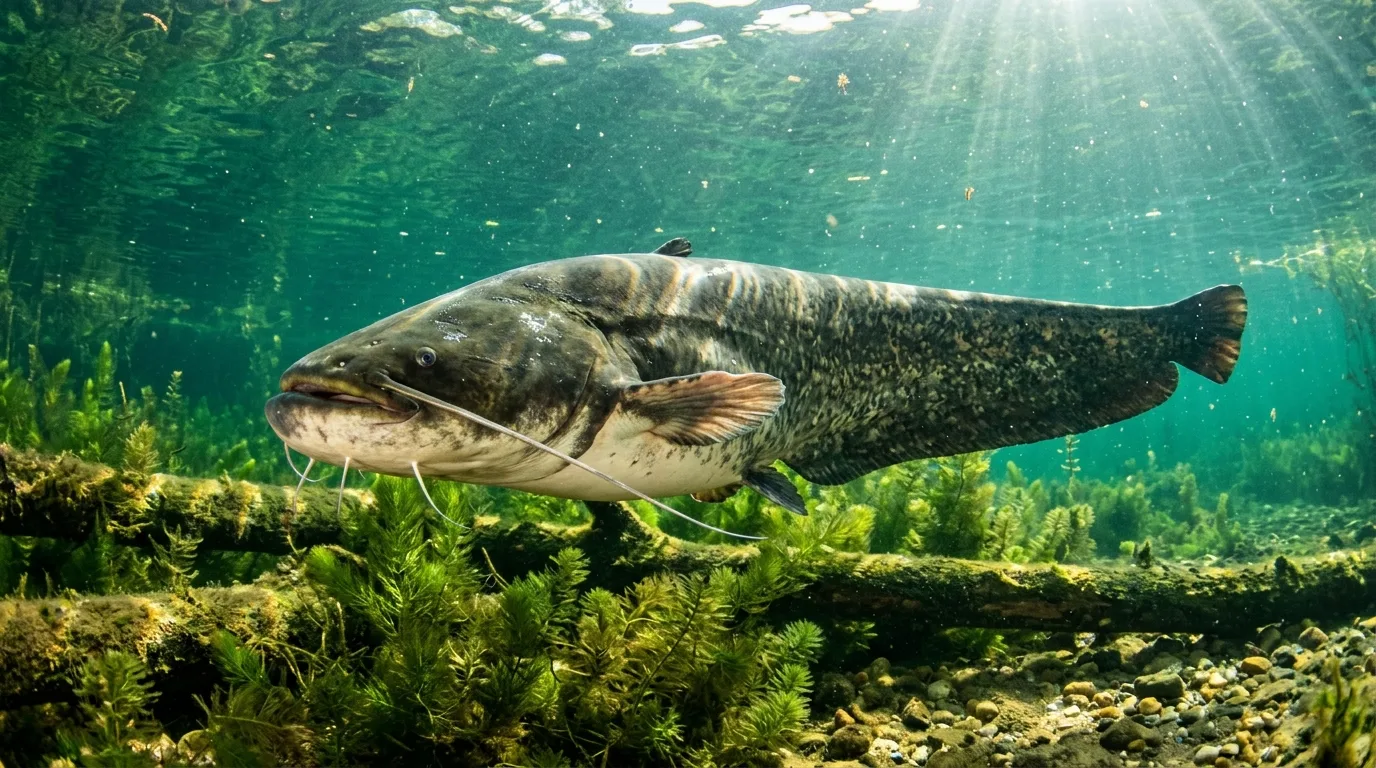
The biggest native freshwater fish, also called the European catfish: scaleless, with brush-like teeth in the mouth, shy of light and fond of warmth. One to two metres is typical, around three is possible.
When
August and September are the peak season, April and October are also good. The wels spawns from May to July. Whether a closed season (Schonzeit) applies then is set by your federal state (Bundesland). Below about 7 °C it stops feeding and rests in the depths.
- JanHardly any chance
- FebHardly any chance
- MarHardly any chance
- AprGood
- MayPossible, spawning season
- JunPossible, spawning season
- JulPossible, spawning season
- AugPeak season
- SepPeak season
- OctGood
- NovHardly any chance
- DecHardly any chance
Peak seasonGoodPossibleHardly any chanceSpawning season
Spring tactics
Small, shallow lakes warm up first. If roach and other silver fish and frogs spawn at the bank in April and May and catfish eat the spawn, a bunch of worms in the margins is worth a try, even in only one metre of water. Whether a closed season applies during spawning is set by your federal state (Bundesland).
Summer tactics
If the water in small, shallow lakes rises above about 25 °C, oxygen runs short and the catfish feed less; switch to rivers or deep lakes then. In small, clear rivers July and August are good months for the spinning rod. Before thunderstorms and when the air pressure is falling, catfish often bite during the day too.
Autumn tactics
On the big rivers you catch from a sit-and-wait session until October. If the water drops below about 10 °C in late autumn, bites become rare.
Winter tactics
The catfish withdraw to deep spots and hardly feed. In mild winters a chance catch is possible, but knocking with a clonk does not work in cold water.
Is it biting today?
In January: Out of seasonIn February: Out of seasonIn March: Out of seasonIn April: Off-peak seasonIn May: Spawning time, please spare themIn June: Spawning time, please spare themIn July: Spawning time, please spare themIn August: Peak seasonIn September: Peak seasonIn October: Off-peak seasonIn November: Out of seasonIn December: Out of season
Today’s catch index needs JavaScript. Season and spawning time are in the catch calendar.
From the blog: Freshwater fish in Germany: which species you catch where
Where it is now
In the lake
During the day the wels lies on the bottom of a lake, among plants in calm zones. Deep holes and drop-offs with a steep slope are worthwhile, in reservoirs for example the edge of the old riverbed. When hunting it also moves into open water.
How to go about it: Small lakes up to about 10 hectares are worthwhile mainly in spring. In deep reservoirs, flooded mine pits and Alpine lakes with a thermocline, the catfish follow the prey fish in open water in summer; there you catch only from a boat, and only where boat fishing is allowed. Many small catfish in a pond do not yet mean that big ones live in it too.
| All year round | deep bottom |
|---|---|
| Spring extra | weed bed, shelf edge, open water |
| Summer extra | weed bed, shelf edge, open water |
| Autumn extra | weed bed, shelf edge, open water |
In the river
In rivers you look for deep hollows in long outside bends, the first groynes of a groyne field and current seams where harbours or oxbow lakes join. During the day it hides under undercut banks and roots.
How to go about it: On big rivers you sit out overnight; on small, shallow rivers with a strong current you walk from deep pool to deep pool with a spinning rod. Brown floodwater counts as a good time; when the level rises, catfish also hunt among flooded branches at the bank.
| All year round | pools, undercut bank |
|---|---|
| Spring extra | groyne scour hole, current seam, calm bay |
| Summer extra | groyne scour hole, current seam, calm bay |
| Autumn extra | groyne scour hole, current seam, calm bay |
Biting time: in the evening, at night and in the morning. What this looks like on the water is shown by the picture of the holding spots just below.
Waters with rules for wels catfish
Holding spots in the picture
Choose the season and time of day: the picture shows where the species stands then. Spots outlined in red apply only in the chosen season. Tap a fish or a spot in the list to bring it closer. The picture is schematic and AI-generated, every water is different.
Catch chances in springpossible
Chance of a catch in summerpossibleSpawning, observe closed seasons
Catch chance in autumngood
Catch chance in winterhardly any
- J
- F
- M
- A
- M
- J
- J
- A
- S
- O
- N
- D
Spawning season
Active time The wels is shy of light and moves mainly at dusk and at night, and when the air pressure is falling also during the day.
Not the main time The wels is shy of light and moves mainly at dusk and at night, and when the air pressure is falling also during the day.
Active time The wels is shy of light and moves mainly at dusk and at night, and when the air pressure is falling also during the day.
Active time The wels is shy of light and moves mainly at dusk and at night, and when the air pressure is falling also during the day.
In the lake
Water lilies and weed bed
Wels catfish are found here only in spring, summer and autumn.
Shelf edge
Wels catfish are found here only in spring, summer and autumn.
Deep bottom
Wels catfish are found here all year round.
Open water
Wels catfish are found here only in spring, summer and autumn.
In lakes the wels rests on the bottom during the day among water plants in calm, weedy areas. Deep hollows and drop-offs with big differences in depth count as lies, such as an old riverbed in a reservoir. When hunting it also moves in open water.
Spring: catch chance according to the catch calendar hardly any in March, good in April, possible in May. After its winter rest the wels feeds harder again. The weeks from April to early June, when the water warms up fastest, count as the main catching time.
Summer: catch chance according to the catch calendar possible in June and July, peak season in August. Spawning falls in this period, so observe closed seasons. It spawns from May to July in a hollow in the shallow, weedy bank zone. In June and July the wels takes less prey; from the end of July the warm water counts as favourable again.
Autumn: catch chance according to the catch calendar peak season in September, good in October, hardly any in November. After spawning comes a second peak of feeding before the water cools.
Winter: catch chance according to the catch calendar hardly any. Below about 4 to 7 °C the wels no longer feeds. It rests in deep spots in the lower third of the water or on the mud, often buried.
In the river
Undercut bank, overhanging branches, timber
Wels catfish are found here all year round.
Pools, deep spot
Wels catfish are found here all year round.
Groyne scour hole
Wels catfish are found here only in spring, summer and autumn.
Current seam
Wels catfish are found here only in spring, summer and autumn.
Calm bay with aquatic plants
Wels catfish are found here only in spring, summer and autumn.
In rivers the wels sits in deep hollows and holes, for example in long outside bends and behind groyne heads, above all in the first groynes of a groyne field. The current seams at the mouths of harbours, rivers and oxbow lakes are also named. During the day it rests under overhanging banks and tree roots or in calm, weedy areas.
Spring: catch chance according to the catch calendar hardly any in March, good in April, possible in May. After its winter rest the wels feeds harder again. In spring the stretches below locks are also named.
Summer: catch chance according to the catch calendar possible in June and July, peak season in August. Spawning falls in this period, so observe closed seasons. It spawns from May to July in a pit near the bank in about 40 to 60 centimetres of water, often sheltered by willow roots.
Autumn: catch chance according to the catch calendar peak season in September, good in October, hardly any in November. After spawning comes a second peak of feeding.
Winter: catch chance according to the catch calendar hardly any. In rivers the wels overwinters in bank crevices or pits near the bank and takes almost no food from November to March.
Depth: It tends to stay in the lower third of the water, happily over a muddy bottom. Spots with above-average depth count as catfish lies on lakes and rivers alike.
Size comparison: AI-generated drawing, schematic.
How
When bottom fishing the bait lies on a self-hooking rig with a fixed lead; on a float you present it in open water. When spinning in deep water you work from the top down, because catfish do not like line above them.
Easiest way
Start on a big river from which catfish catches have been known for years, and sit out at a deep groyne or a harbour entrance. A catfish rod of around 3 metres, strong braid and a bunch of lobworms under a sub-surface float are enough. The weight is a stone on a short length of thin mono that breaks at the bite.
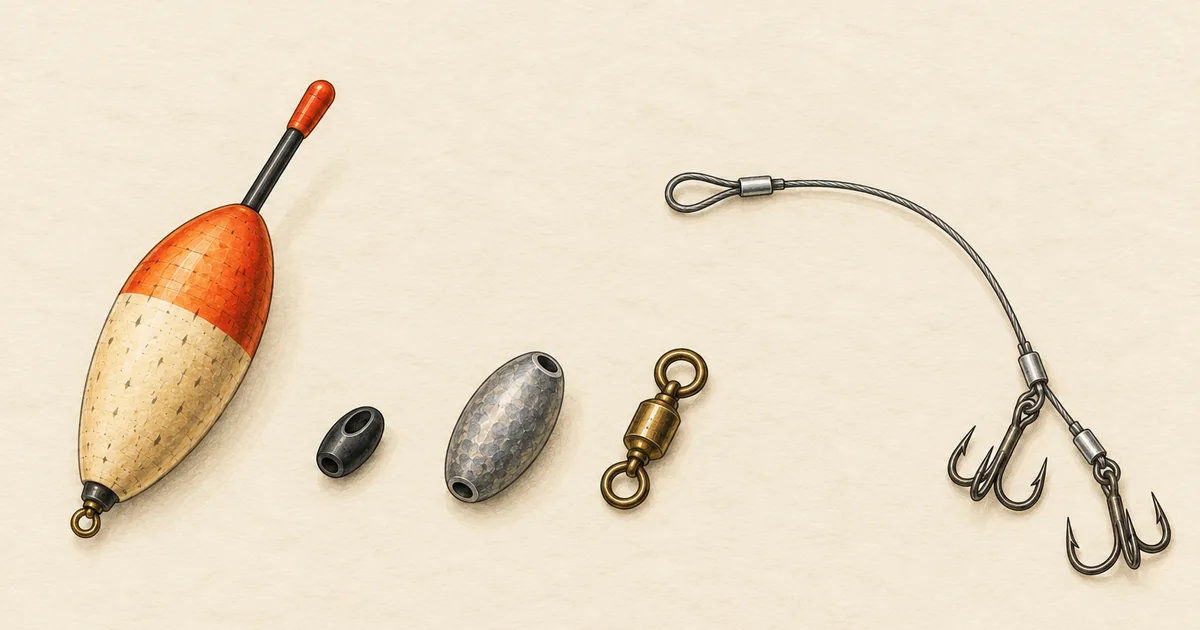
Sub-surface float with a break-away stone
The classic night session on a river: the bait sits in the current just above the bottom and stays in the same place for hours.
- Choose the spot
Good spots are the mouths of tributaries, deep groyne fields and edges to the navigation channel. Firm ground is usually better than soft mud.
- Find the edge
Use a sounder or a plumbing lead to find the edge to the deeper water. That is where you place the rig, not in the middle of the channel.
- Float and hooklength
On the hooklength of about 2 metres goes a sub-surface float of 20 to 40 grams, fixed with two stops about 15 centimetres in front of the bait. On the swivel hangs a stone on a piece of 0,35 mono.
- Put on the bait
Put on a bunch of 15 to 20 lobworms or a dead baitfish. In a river you hook the fish with the single hook through the mouth and the treble at the anal fin, so that it sits level.
- Lay out and tighten
Take the rig out by boat or wading if both are allowed and you know the depth exactly. Stand the rod steeply in the rest, tighten the line and set the clutch firmly.
- Rod springs back
When a catfish takes, the thin line to the stone breaks, the bent rod springs up and drives the hook into the mouth. Pick up the rod at once and keep contact.
- Build up pressure
In the first seconds keep the fish away from the bank and from snags with plenty of pressure. After that it usually heads for open, deeper water, where you can play it out.
- Catfish grip
Put on work gloves, check where the hooks are, and only then grip the played-out catfish firmly by the lower jaw.
Soft plastic on river stretches
In summer on small, flowing rivers: you cast at many lies one after another instead of waiting a long time for a bite.
- Walk the lies
Start at deep pools and below weirs, then come eddies, overhanging bushes, current seams and bridge piers. Strong current does not bother the catfish.
- Strong small parts
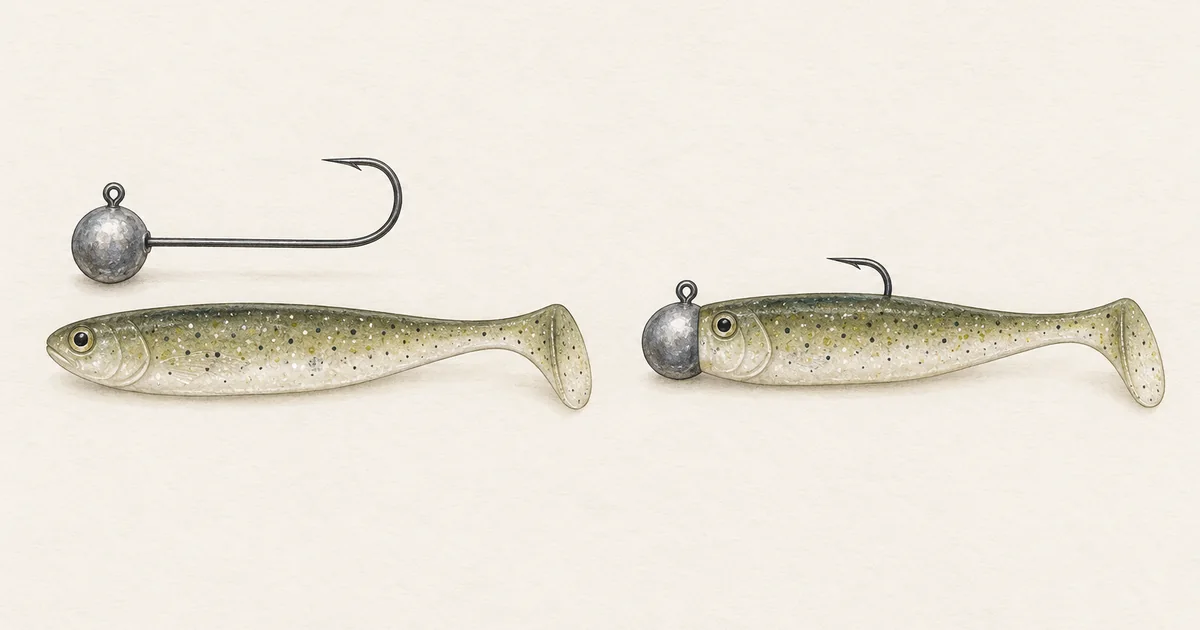
Hang the soft plastic on a sturdy jig hook and put a short Kevlar leader in front. Swap the standard trebles on spinners and spoons for much stronger ones.
- Cast accurately
Cast as accurately as you can into an eddy or right up to the bank. A high cast that splashes down loudly attracts catfish.
- Short and often
Let the lure sink briefly and wind it in slowly, about 20 to 60 centimetres per second. If nothing happens in the first seconds, you reel in and cast again.
- Right after the cast
Most bites come shortly after the lure lands, as a hard knock on the rod. Strike firmly at once.
- Clutch tight
Near branches and stones do not give a metre of line, and pull the fish into open water. On a river it is better to follow it a little way along the bank than to overload the line.
- Mind the trebles
Only grip when you can see where the hooks are, because the free trebles of an artificial lure are the biggest danger when handling a catfish.
What with
For sit-and-wait fishing dead baitfish, bunches of lobworms or fish strips; when spinning, big soft plastics on a lead head, spinners or spoons. Colour is secondary, because the wels finds its prey by sound and pressure waves.
- WormsSpring on the shallow bank, summer on the sub-surface float
A thick bunch of lobworms smells strongly and writhes; an experienced catfish guide calls it his most important bait for river sit-and-wait fishing in the DAFV brochure.
- BaitfishSummer and autumn, sit-and-wait fishing on river and lake
A dead fish from the water’s own prey, such as bream or roach, flutters on the sub-surface float in the current and looks almost alive.
- Soft plastic (shad)Summer, spinning on flowing rivers
Two sizes of 15 and 20 centimetres are enough; larger soft plastics did not bring more bites in one field report, but more missed bites.
Tackle
What is needed is a rod with plenty of backbone that absorbs the blows of a big catfish, plus plenty of strong braid on the reel. The hooks must be thick in the wire; thin ones open out in the fight.
Sub-surface float with a break-away stone
- Rod
- Catfish rod 3–3,5 m, test curve 6–8 lb or about 300 g casting weight
- Reel
- sturdy fixed-spool reel around size 6000 with a large capacity; from a boat also a multiplier reel
- Line
- braided, 30–70 kg breaking strain, about 0,45–0,50 mm; at rock armouring put 10–20 m of 0,70 mm mono shock leader in front
- Leader
- about 2 m; braided with 60–100 kg or mono of 0,90–1,3 mm
- Hooks
- thick-wire single hook 2/0–10/0; on a deadbait often a single hook 4/0–6/0 plus a treble 3/0
- Weight, float, lead
- sub-surface float 20–80 g; stone on 0,30–0,40 mm break-away line or fixed lead 200–800 g
Soft plastic on river stretches
- Rod
- 2,40–2,70 m, heavy spinning rod with a 4–6 lb test curve; for big lures casting weight around 120–150 g and more
- Reel
- fixed-spool reel size 5000–6000, at least 100 m capacity
- Line
- braided, 0,28–0,35 mm, about 30–40 kg breaking strain
- Leader
- Kevlar, about 50 cm, about 1 mm thick
- Hooks
- very sturdy jig hook 9/0–10/0; on spinners and spoons reinforced trebles
- Weight, float, lead
- soft plastic 15–20 cm on a lead head of 14–40 g
More on tackle
- Bottom rod: length, casting weight and bite indicator
- Spinning rod: choose length, casting weight and action
- Line calculator
- Fishing line: monofilament, braid or fluorocarbon?
- Spooling a reel properly – without line twist
- Landing net: mesh, size and handle
- Unhooking mat: lay the fish down softly, unhook gently
- Disgorger: unhooking quickly and gently
Common mistakes
- Weak trebles and split rings: Most lost big catfish come down to hooks and small parts that are too weak. Upgrade lures with reinforced trebles and strong swivels.
- Waters without big catfish: In small ponds catfish often breed heavily but hardly grow. For a start choose a water from which catches of big catfish have been known for years.
- Heavy lead in the rock armouring: A lead of several hundred grams wedges between the stones, and snags and break-offs follow. Use a stone on a break-away line that stays behind at the bite.
- Sub-surface float without current: Only the current pushes the float away from the main flow and keeps the bait above the bottom. In still water use a surface float or the bottom rig instead.
- Tackle that is too light: With heavy carp tackle the fight with big catfish drags on a long time, which exhausts the fish. Use a catfish rod and line that can take enough pressure.
Rules
Each federal state (Bundesland) sets its own closed season (Schonzeit) and minimum size (Mindestmaß). Choose your state; the values come from our state pages.
Baden-Württemberg
Our overview for Baden-Württemberg does not list the wels catfish. What applies there is given on the page Fishing in Baden-Württemberg with the state’s spots.
Bavaria
- Minimum size
- –
- Closed season
- none
As of October 2026. All rules, exceptions and sources: Fishing in Bavaria.
Berlin
- Minimum size
- 75 cm
- Closed season
- none
Correct as of October 2026. All rules, exceptions and sources: Fishing in Berlin.
Brandenburg
- Minimum size
- –
- Closed season
- none
As of October 2026. All rules, exceptions and sources: Fishing in Brandenburg.
Bremen
Our overview for Bremen does not list the wels catfish. What applies there is given on the page Fishing in Bremen with the state’s spots.
Hamburg
Our overview for Hamburg does not list the wels catfish. What applies there is given on the page Fishing in Hamburg with the state’s spots.
Hesse
Our overview for Hesse does not list the wels catfish. What applies there is given on the page Fishing in Hesse with the state’s spots.
Mecklenburg-Western Pomerania
- Minimum size
- 70 cm
- Closed season
- 1.5.–30.6.
As of October 2026. All rules, exceptions and sources: Fishing in Mecklenburg-Western Pomerania.
Lower Saxony
- Minimum size
- 50 cm
- Closed season
- none
As of October 2026. All rules, exceptions and sources: Fishing in Lower Saxony.
North Rhine-Westphalia
Our overview for North Rhine-Westphalia does not list the wels catfish. What applies there is given on the page Fishing in North Rhine-Westphalia with the state’s spots.
Rhineland-Palatinate
Our overview for Rhineland-Palatinate does not list the wels catfish. What applies there is given on the page Fishing in Rhineland-Palatinate with the state’s spots.
Saarland
Our overview for Saarland does not list the wels catfish. What applies there is given on the page Fishing in Saarland with the state’s spots.
Saxony
- Minimum size
- –
- Closed season
- none
Correct as of October 2026. All rules, exceptions and sources: Fishing in Saxony.
Saxony-Anhalt
- Minimum size
- –
- Closed season
- none
- Note
- LAV, standing waters under 10 ha: mandatory removal
As of October 2026. All rules, exceptions and sources: Fishing in Saxony-Anhalt.
Schleswig-Holstein
Our overview for Schleswig-Holstein does not list the wels catfish. What applies there is given on the page Fishing in Schleswig-Holstein with the state’s spots.
Thuringia
- Minimum size
- 50 cm
- Closed season
- none
As of October 2026. All rules, exceptions and sources: Fishing in Thuringia.
The regulation and your fishing permit (Erlaubnisschein) are what count. Lake Constance, the Rhine and the coast, for example, have their own rules: Fishing waters in Germany.
After the catch
Playing and landing
Strike firmly and keep the catfish away from snags with a tight clutch; tackle that is too light drags the fight out needlessly. Landing is done with the catfish grip: put on a glove, check where the hook sits, then grip the lower jaw firmly; the small teeth cause at worst scrapes. A catfish you may keep you stun and kill at once; a protected one you return to the water after a quick unhooking. In many parts of Germany there are now also mandatory-removal rules or return bans for catfish, so check the water rules (Gewässerordnung).
The brush-like teeth cause at worst scrapes when landing. Smaller catfish up to about 120 centimetres count as good eating fish; a fish of legal size that you may keep you stun and kill at once. You return it gently, right in the water.
Frequently asked questions
What line for catfish fishing?
For sit-and-wait fishing, braid with a 30 to 70 kilo breaking strain, about 0,45 to 0,50 millimetres. For spinning, 0,28 to 0,35 millimetres is enough. At rock armouring a mono shock leader of 0,70 millimetres protects against abrasion.
Do you need a steel leader for wels catfish?
No. The teeth do not cut, they only scuff. Abrasion-resistant Kevlar, a braided hooklength of 60 to 100 kilos or thick mono of around 1 millimetre are enough.
What hook size for wels catfish?
For sit-and-wait fishing single hooks from 2/0 to 10/0; on a deadbait often a single hook 4/0 to 6/0 with a treble 3/0. For spinning, jig hooks around 9/0 to 10/0. Thick wire is what matters.
Does the wels bite during the day too?
If the water is clear, it hunts mainly at night and at dusk. If it is slightly coloured and deeper than 3 metres, you also catch it during the day, and in very cloudy water at any hour. Night fishing is banned in some states and waters, so check your fishing permit (Erlaubnisschein).
How often should you knock with the clonk?
Series of a few short knocks are usual, then a pause of 20 to 30 seconds and a look at the sounder. If a catfish rises to the bait, you stop and only knock again when it moves off. A boat and a clonk must be allowed on the water.
Similar species
Anyone who catches wels catfish can fish for these species with similar tackle:
Sources
As of October 2026. The practical knowledge comes from 8 sources, summarised in our own words.
View all 8 sources
- Welsangeln (Broschüre Fisch des Jahres 2026: Der Europäische Wels) · Deutscher Angelfischerverband (DAFV), Beitrag von B. Gründer; Kapitel zur Bewirtschaftung
- Welsangeln: Tipps und Tricks für den Fangerfolg · BLINKER (Redaktion, O. Portrat)
- Welsmontage: Mit der Unterwasser-Pose zum kapitalen Waller · BLINKER (Redaktion, B. Gründer)
- Zielfisch Wels: Hier geblieben · FISCH & FANG (Redaktion, S. Seuß)
- Zielfisch Wels: Todsicher Wels · FISCH & FANG (Redaktion, G. Baumann)
- Spinnfischen auf Wels · FISCH & FANG (Redaktion, U. Beyer)
- Spinnfischen auf Wels: Drills für Draufgänger · BLINKER (Redaktion, J. Bal)
- Was muss ich beim Wallergriff beachten? · BLINKER (Redaktion, F. Schlichting)
Text AI-assisted, based on the sources named and these pages: Wels catfish (profile), Bottom fishing, Spinning, Baitfish, Bottom rod.