
Knowledge – Fish
Gilthead sea bream fishing
Fishing for gilthead sea bream means: on the Mediterranean, from dusk, setting out a light bottom rig with a tough bait and watching the fine rod tip. Here is the way there in nine steps, each with a link to the detailed page.
 Choose another fish117 fish with guides
 EelOff-peak season
 EelpoutPossible
 IdePossible
 ArapaimaGood
 GraylingPeak season
 Atlantic salmonSpawning time, please spare
 Brown troutSpawning time, please spare
 Brook troutSpawning time, please spare
 BarbelOff-peak season
 BarramundiSpawning season
 Greater amberjackGood
 Topmouth gudgeonOnly as bycatch
 Blue marlinSpawning season
 BonefishSpawning season
 BonitoGood
 BreamOff-peak season
 Dusky grouperOnly as bycatch
 CobiaPossible
 Spiny dogfishOnly as bycatch
 CodPeak season
 ChubPeak season
 MinnowOnly as bycatch
 European sturgeonOnly as bycatch
 FlounderPeak season
 PerchPeak season
 Largemouth bassGood
 Ballan wrasseOnly as bycatch
 Yellowfin tunaSpawning season
 Giant trevallyGood
 Prussian carpPossible
 BrillPossible
- Gilthead breamSpawning time, please spare
 Golden doradoSpawning season
 Golden mahseerOnly as bycatch
 Dolphinfish (mahi-mahi)Good
 Grass carpPossible
 Great barracudaGood
 GudgeonPossible
 White breamPossible
 DaceOff-peak season
 PikePeak season
 HalibutOff-peak season
 HerringPossible
 GarfishOut of season
 Huchen (Danube salmon)Possible
 Crucian carpOnly as bycatch
 CarpOff-peak season
 RuffeOff-peak season
 VendaceOnly as bycatch
 DabPeak season
 GurnardPossible
 Coley (saithe)Peak season
 Chinook salmonHardly any chance
 King mackerelSpawning season
 LingPeak season
 TuskOff-peak season
 MackerelPossible
 Bighead carpOut of season
 WhitefishPossible
 Conger eelOff-peak season
 Sea troutSpawning time, please spare
 Grey mulletPossible
 Murray codSpawning season
 MuskellungeGood
 Common nasePossible
 Nile perchPossible
 PayaraPossible
 Peacock bassPeak season
 PermitGood
 WeeverOnly as bycatch
 PollackOff-peak season
 BurbotOff-peak season
 AspPossible
 Red snapperSpawning season
 Rainbow troutPeak season
 RoosterfishGood
 RoachPeak season
 RedfishOut of season
 Bluefin tunaOnly as bycatch
 RuddPossible
 Russian sturgeonOnly as bycatch
 HaddockOff-peak season
 SnakeheadPossible
 TenchOff-peak season
 SpirlinOnly as bycatch
 PlaiceOff-peak season
 Greenland halibutOnly as bycatch
 Round gobyOnly as bycatch
 SwordfishGood
 Lake troutSpawning time, please spare
 HakeSpawning time, please spare
 Alpine charSpawning time, please spare
 MonkfishPossible
 SoleOff-peak season
 SailfishGood
 Silver carpOut of season
 SnookPeak season
 PumpkinseedOnly as bycatch
 SpratOnly as bycatch
 Atlantic wolffishSpawning time, please spare
 TurbotPeak season
 SterletOnly as bycatch
 SmeltOnly as bycatch
 Horse mackerelPossible
 TaimenGood
 TarponGood
 TigerfishSpawning season
 BleakPossible
 WahooGood
 Wels catfishOff-peak season
 WhitingPeak season
 Sea bassOff-peak season
 ZanderPeak season
 White-eye breamOnly as bycatch
 Blue breamOnly as bycatch
 Brown bullheadPossible
 VimbaOnly as bycatch
Season in October according to the catch calendar, an estimate and not a guarantee of a catch. The fish pictures are reduced natural-history plates and AI-generated.
Best time
All year, especially in the evening and at night.
In January: Hardly any chanceIn February: Hardly any chanceIn March: Hardly any chanceIn April: Hardly any chanceIn May: Hardly any chanceIn June: Hardly any chanceIn July: Hardly any chanceIn August: Hardly any chanceIn September: Hardly any chanceIn October: Hardly any chance, spawningIn November: Hardly any chance, spawningIn December: Hardly any chance, spawning
Good spot
- Coast: Seagrass, sandy bottom and surfSeagrass, sandy bottom and surfSeagrass, sandy bottom and surfSeagrass, sandy bottom and surf
Top baits
Starter tackle
- Rod: rod with a fine tip, such as a light surf, feeder or winkle picker rod
- Line: light line to match the fine rod
- Hook: size 6
In short
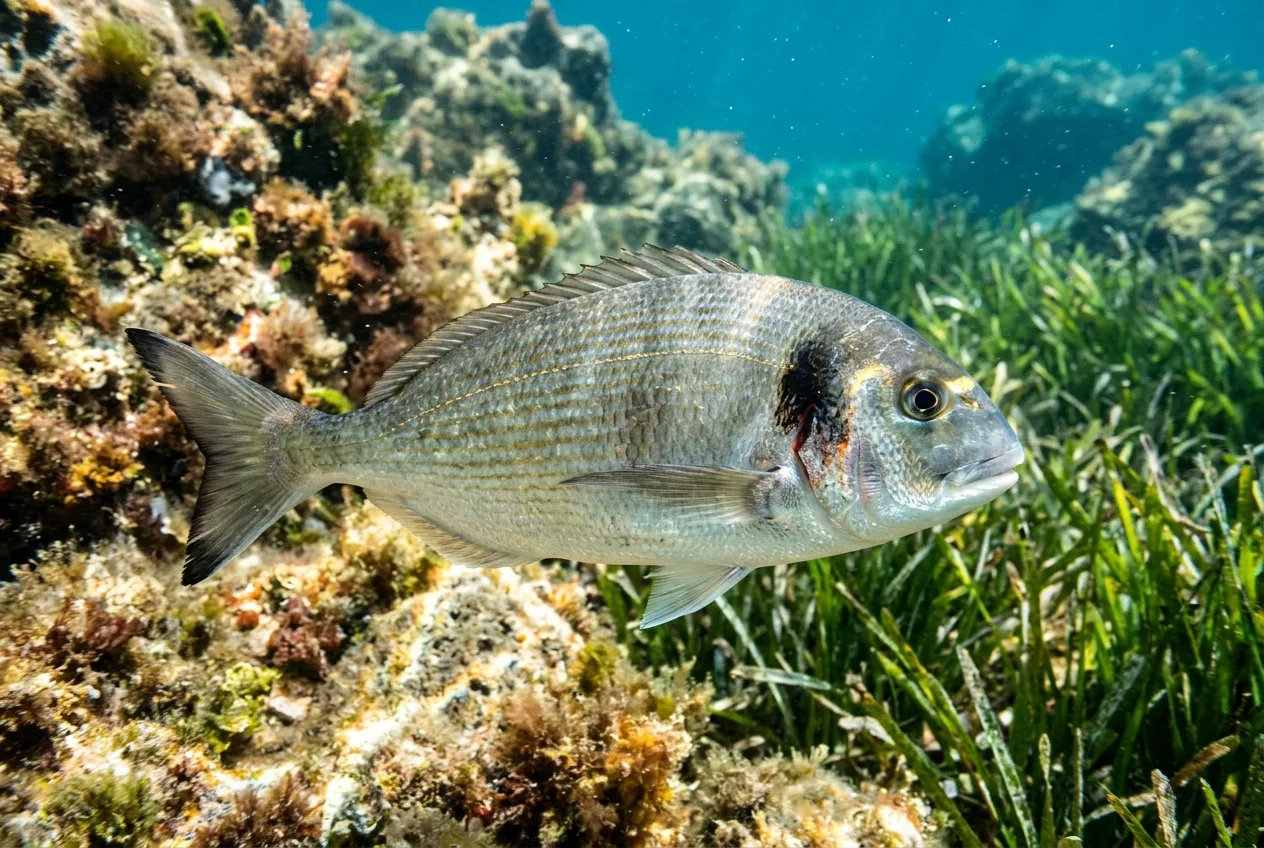
In short: Main range in the Mediterranean and the Atlantic from the Bay of Biscay southwards; in the North Sea only a rare visitor, hence no season in the calendar. Black spot on the gill cover and a golden band between the eyes.
Quick to recognise
A deep-bodied, laterally flattened sea bream with a grey back and silver flanks, usually sold as dorade. You can identify it reliably by two features together: the golden band between the eyes and the black spot at the top of the gill cover. 25 to 35 centimetres is usual, the largest known measured 70 centimetres, and the greatest weight is 17,2 kilograms.
When
In the North Sea and Baltic it has no season, which is why the calendar shows zero throughout; you can fish for it deliberately on the Mediterranean and the southern Atlantic coast. There it bites best at dusk and at night, when the plucking of small fish eases off. In its main range it usually spawns between October and December, in several batches.
- JanHardly any chance
- FebHardly any chance
- MarHardly any chance
- AprHardly any chance
- MayHardly any chance
- JunHardly any chance
- JulHardly any chance
- AugHardly any chance
- SepHardly any chance
- OctHardly any chance, spawning
- NovHardly any chance, spawning
- DecHardly any chance, spawning
Peak seasonGoodPossibleHardly any chanceSpawning season
Spring tactics
In the Mediterranean in spring many gilthead sea bream, mostly young ones, move into brackish lagoons and river mouths. Spots at river mouths and near lagoons are then worth fishing.
Summer tactics
In summer the evening is the best time, when the beach calms down and fewer small fish pluck at the bait. Fish on into the night.
Autumn tactics
In late autumn the sea bream leave the lagoons and move out to the open sea, where they spawn from October to December. Look for them then on the open coast over seagrass, rock and sand.
Winter tactics
The gilthead sea bream is sensitive to cold and spends the winter in the open sea. Adult fish then sit over seagrass meadows, rocks and sand, usually no deeper than about 50 metres.
Season and biting time
In January: Out of seasonIn February: Out of seasonIn March: Out of seasonIn April: Out of seasonIn May: Out of seasonIn June: Out of seasonIn July: Out of seasonIn August: Out of seasonIn September: Out of seasonIn October: Spawning, please spare themIn November: Spawning, please spare themIn December: Spawning, please spare them
Where it sits now
On the coast
It sits over seagrass meadows, sandy bottom and in the surf, usually no deeper than about 30 metres, and stays loyal to its spot. In spring many move into brackish lagoons and river mouths, in summer it stays close to the coast, and in winter it moves down into deeper water. From the shore you try in harbours, near river mouths and, after dark, on a quiet bathing beach too.
How to go about it: It stays over seagrass and sand and in the surf, usually at depths of 1 to 30 metres. In the open sea you also find it over rock and Neptune grass meadows. From the shore it is best to fish in harbours and near river mouths.
| All year round | Seagrass, sandy bottom, surf |
|---|---|
| Winter extra | deep water |
Biting time: mainly in the evening and at night. What that looks like in the water is shown by the picture of the holding spots just below.
Holding spots in the picture
Choose the season and time of day: the picture shows where the species stands then. Spots outlined in red apply only in the chosen season. Tap a fish or a spot in the list to bring it closer. The picture is schematic and AI-generated, every water is different.
No main time On the Mediterranean, dusk and night offer the best chances, because fewer small fish pluck at the bait then.
No main time On the Mediterranean, dusk and night offer the best chances, because fewer small fish pluck at the bait then.
Active time On the Mediterranean, dusk and night offer the best chances, because fewer small fish pluck at the bait then.
Active time On the Mediterranean, dusk and night offer the best chances, because fewer small fish pluck at the bait then.
On the coast
Surf close to the shore
Gilthead sea bream (dorade) sits here all year.
Seagrass, gravel and stones in the shallows
Gilthead sea bream (dorade) sits here all year.
Sandy bottom
Gilthead sea bream (dorade) sits here all year.
Deep, colder water
Gilthead sea bream (dorade) sits here only in winter.
The gilthead sea bream sits over seagrass and sandy bottom and in the surf zone. It lives alone or in small groups and stays loyal to its spot. In the North Sea it is only a rare visitor.
Spring: Many fish migrate into brackish lagoons and river mouths in spring.
Summer: In summer it stays mainly close to the coast.
Autumn: This is when spawning falls, so observe the closed seasons.
Winter: In winter it retreats into deeper water.
Depth: It mostly stays down to about 30 metres, and fully grown fish go down to 150 metres.
Size comparison: AI-generated drawing, schematic.
How
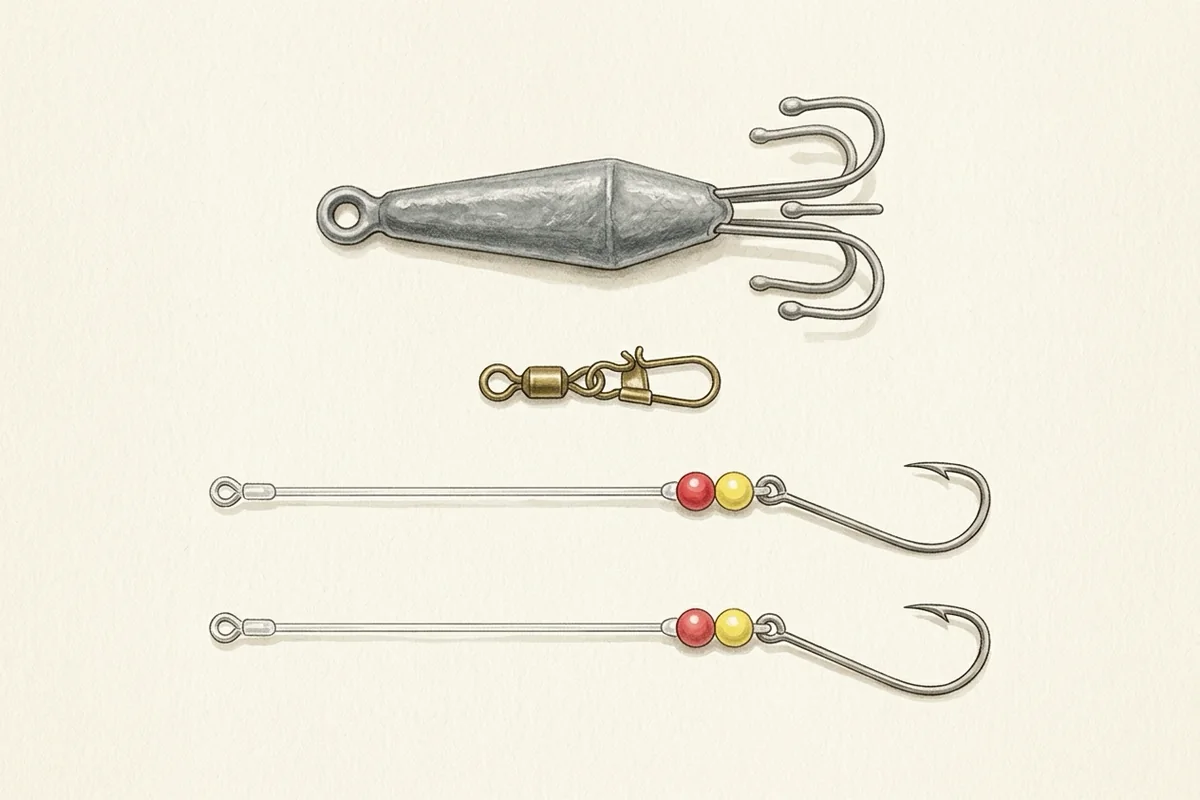
From the shore you catch it with a simple bottom rig, such as a light surf rig that you set out at dusk and leave lying into the night. Instead of the surf rod, the feeder or picker rod you know from fresh water also does the job; its fine tip makes the often cautious bites visible.
Easiest way
On holiday on the Mediterranean a light bottom rig with a size 6 hook and a tough bait is enough. Set it out in the evening in a harbour or near a river mouth. A feeder or picker rod from home suits this well.
Light bottom rig in the evening
From the shore you offer a tough natural bait on a light surf rig on the bottom, best from dusk into the night.
- Harbour or river mouth
Good spots are harbours and the surroundings of river mouths. After dark a quiet beach can also produce a gilthead sea bream, once the bathers have gone.
- Light surf rig
A simple bottom rig is enough: a light surf rig with a size 6 hook, or a pulley rig.
- Choose a tough bait
During the day small sea bream, groupers and weevers nibble at the same baits. So take strips of squid or peanut worms and tie soft baits on with bait elastic.
- Set out at dusk
Cast the rig at dusk and stay into the night. Then the plucking of small fish eases off.
- Watch the tip
A rod with a fine tip shows you the bite. Feeder and winkle picker rods from fresh water suit this well.
- Identify, then decide
On land, check the species first: golden band between the eyes and a large black spot on the gill cover. Only then decide whether the fish is of legal size and may be kept.
What with
Tough strips of squid and worms such as the ragworm are the usual baits, on a size 6 hook. The squid strips withstand plucking small fish for longer, and you tie soft baits to the hook with elastic bait thread.
- Cuttlefish & squidby day and anywhere many small fish pluck at the bait
Tough squid strips stand up to the small fish for a while, while the gilthead sea bream easily grabs them with its powerful teeth.
- Ragwormat dusk and at night, when the small fish give it a rest
Besides squid strips, worms are the usual bait for dorade. You secure soft worms to the hook with bait elastic.
Tackle
A light surf rod or a feeder or picker rod with a fine tip, plus a simple bottom rig with a size 6 hook. You match reel and line using the line calculator and the page on fishing line.
Light bottom rig in the evening
- Rod
- Rod with a fine tip, such as a light surf, feeder or winkle picker rod
- Line
- light line to match the fine rod
- Hooks
- Size 6
Common mistakes
- By day on a busy beach: By day small fish clear the bait, and bathers disturb. Fish from dusk into the night instead.
- Offering soft bait unsecured: Small sea bream quickly pluck a soft bait off the hook. Tie it on with bait elastic or use tough baits such as squid strips or peanut worms.
- Rod too stiff: With a hard tip you hardly see the bite. A rod with a fine tip, such as a feeder or picker rod, shows it better.
- Looking in the lagoon in winter: In late autumn the sea bream move from the lagoons out to the open sea. In winter look for them on the open coast over seagrass, rock and sand.
- Mistaking it for other sea bream: Many similar sea bream live in the Mediterranean. Look for the golden band between the eyes and the large black spot on the gill cover before you decide whether to keep or release.
Rules
For the gilthead sea bream our country overview gives no figures for minimum size (Mindestmaß) or closed season (Schonzeit). That does not mean there are no rules: individual countries and water regulations protect the species or set their own limits.
On the coast the rules of the coastal states apply, partly with their own catch restrictions: North Sea coast, Baltic coast of Schleswig-Holstein and Baltic coast of Mecklenburg-Western Pomerania.
The regulation and your fishing permit (Erlaubnisschein) are what count. Lake Constance, the Rhine and the coast, for example, have their own rules: Fishing waters in Germany.
After the catch
Playing and landing
Watch out when unhooking for the powerful jaws, with sharp canine teeth at the front. Identify the species reliably before you decide. A fish of legal size that you may keep you stun and kill immediately. Fish that are too small or protected you unhook with wet hands and return at once. Rules and minimum sizes (Mindestmaß) are set by the country in which you fish.
Identify the fish reliably first, because many similar sea bream live in the Mediterranean; the golden band on the forehead and the black gill cover spot together are what count. If you may take a fish of legal size, it is stunned and killed straight away; undersized or protected fish you unhook with wet hands, if possible in the water, and release. Which minimum sizes (Mindestmaß) apply and whether you need a permit you clarify before the trip with the country’s fisheries authority (Fischereibehörde).
Frequently asked questions
When do dorade bite best?
Mostly at dusk and at night. Then fewer small fish pluck at the bait, and the beach is quiet.
Which bait for dorade?
Worms, tough squid strips and peanut worms whose firm skin withstands small fish. In the wild it feeds mainly on mussels, crustaceans and worms.
Which hook size for dorade?
Blinker gives size 6 hooks for the light surf rig.
How deep does the gilthead sea bream sit?
Mostly between 1 and 30 metres. According to FishBase, adults go down to 150 metres, but according to the FAO usually no deeper than about 50 metres.
Where can you fish for gilthead sea bream?
Mainly in the Mediterranean and on the Atlantic coast between the Bay of Biscay, the Canary Islands and Cape Verde. Further north it becomes rare, and in the North Sea it counts as an exceptional catch.
Do you need a fishing licence for the sea in Croatia?
Yes. According to the Croatian government, you always need a licence for recreational sea fishing, whether from the shore or a boat. Day, multi-day and annual licences are also available online and are valid for the whole Croatian coast (as of October 2026).
Similar species
If you catch gilthead sea bream, you can fish for these species with similar tackle:
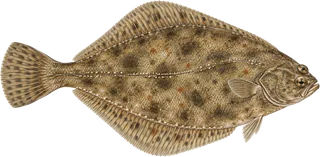 Flounder fishingMain season
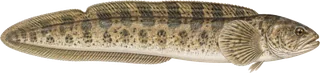 Eelpout fishingPossible
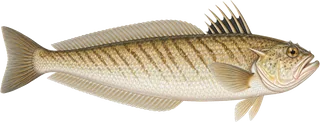 Weever fishingOnly as bycatch
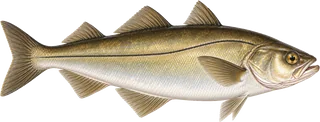 Pollack fishingSecondary season
Sources
As of October 2026. The practical knowledge comes from 4 sources, summarised in our own words.
See all 4 sources
- Angeln in Kroatien: Von Dorade bis Thunfisch · Blinker (Redaktion, Jahr Media)
- Sparus aurata, Gilthead seabream (Species Summary) · FishBase
- Cultured Aquatic Species Information Programme: Sparus aurata (Linnaeus, 1758) · Ernährungs- und Landwirtschaftsorganisation der Vereinten Nationen (FAO), Fisheries and Aquaculture Division
- Marine recreational and sport fisheries · Regierung der Republik Kroatien (gov.hr), Angaben des Landwirtschaftsministeriums, Direktion Fischerei
Text written with AI support, based on the sources named and these pages: Gilthead sea bream (profile), Surf fishing, Feeder fishing, Cuttlefish & squid, Ragworm, Surf rig.