
Knowledge – Fish
Fishing for dusky grouper
You should not go fishing for dusky grouper: this site-faithful rock dweller lives to a great age and is endangered in the Mediterranean. Here you can read how to recognise it, where it lives and what to do if it bites anyway.
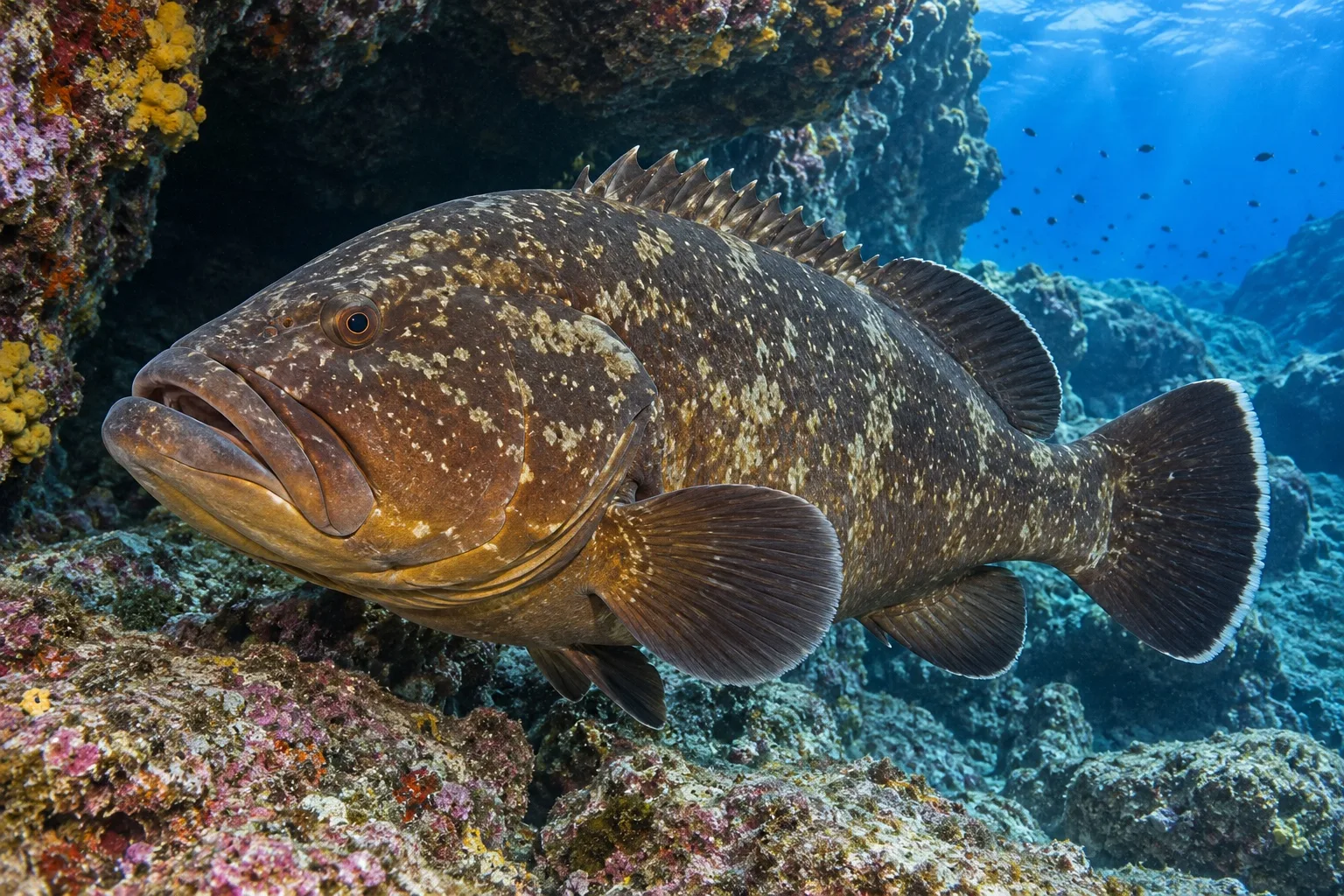
The IUCN lists the dusky grouper in the Mediterranean as endangered; it is not a target fish. France bans fishing for it off parts of its Mediterranean coast, and other countries and protected areas have their own rules.
Quick to recognise
A heavy, powerful fish with a big head and wide mouth, dark reddish-brown or grey with pale spots mostly in vertical rows and white-edged fins. FishBase gives up to 150 centimetres and 60 kilograms.
Why it is not a target fish
The reason for the classification is past overfishing; in some places catches collapsed by up to 95 per cent. It matures first as a female and much later as a male, and this slow development makes it vulnerable. In the French regions of Occitania and Provence-Alpes-Côte d’Azur, spearfishing and hook fishing for it are prohibited, and in 2023 it was decided to extend the ban by ten years.
Where it lives
On the coast
It lives throughout the Mediterranean and in the eastern Atlantic over rocky bottom, mostly shallower than 50 metres, uses a fixed cave as a shelter and defends its territory. Juveniles stay closer to the coast, also in rocky tide pools.
| All year round | stony mixed bottom, wreck, reef |
|---|
Holding spots in the picture
Choose a season and time of day: the picture shows where the species sits then. Tap a fish or a spot in the list to bring it closer. The picture is schematic and AI-generated, every water is different.
On the coast
Stony mixed ground
Dusky grouper (also called brown grouper) are present here all year round.
Wreck, reef
Dusky grouper (also called brown grouper) are present here all year round.
The dusky grouper lives over rocky bottom and often takes up a fixed cave there, which it defends as its territory. Young fish stay closer to the shore and can even be found in tide pools between rocks.
Summer: The spawning season falls in this period; observe the closed seasons (Schonzeiten).
Depth: It occurs from 8 to 300 metres, but mostly shallower than 50 metres.
Size comparison: AI-generated drawing, schematic.
Do not confuse
Other groupers live in the Mediterranean, such as Mycteroperca rubra and the Epinephelus species costae, caninus and aeneus. On the dusky grouper the pale spots are in vertical rows and the fins have white edges. In France the same fishing ban applies to all of these species.
If it bites anyway
If one does take the hook, keep the fight short, leave it in the water for photos and remove the hook there with pliers so it can swim off at once. If the hook is too deep, cut the line close to the mouth.
Rules
The rules of the country where you fish apply to the dusky grouper, not German fisheries law. Each country, and often each water, sets its own licence, closed seasons (Schonzeiten), minimum sizes (Mindestmaße) and rules on keeping fish.
What the profile says: Endangered in the Mediterranean according to the IUCN and not a target species. In France, spearfishing is banned along the Mediterranean coast, and off Occitania and Provence-Alpes-Côte d'Azur fishing with hooks is banned too. Return any bycatch gently and at once.
The fisheries authority (Fischereibehörde) of the country you travel to is what counts. Ask about the current rules before the trip and read in the profile how threatened the species is.
Text AI-assisted, summarised from these pages: Dusky grouper (profile), Releasing a fish.