
Knowledge · Fish welfare and practice
Fish-friendly tackle
Fish-friendly angling starts when you tie the rig. Hook shape, barb, hook size and line help decide whether a fish swallows the hook deeply and whether, after a break-off, it carries a hook, line or lead around with it.
Where the hook sits matters most
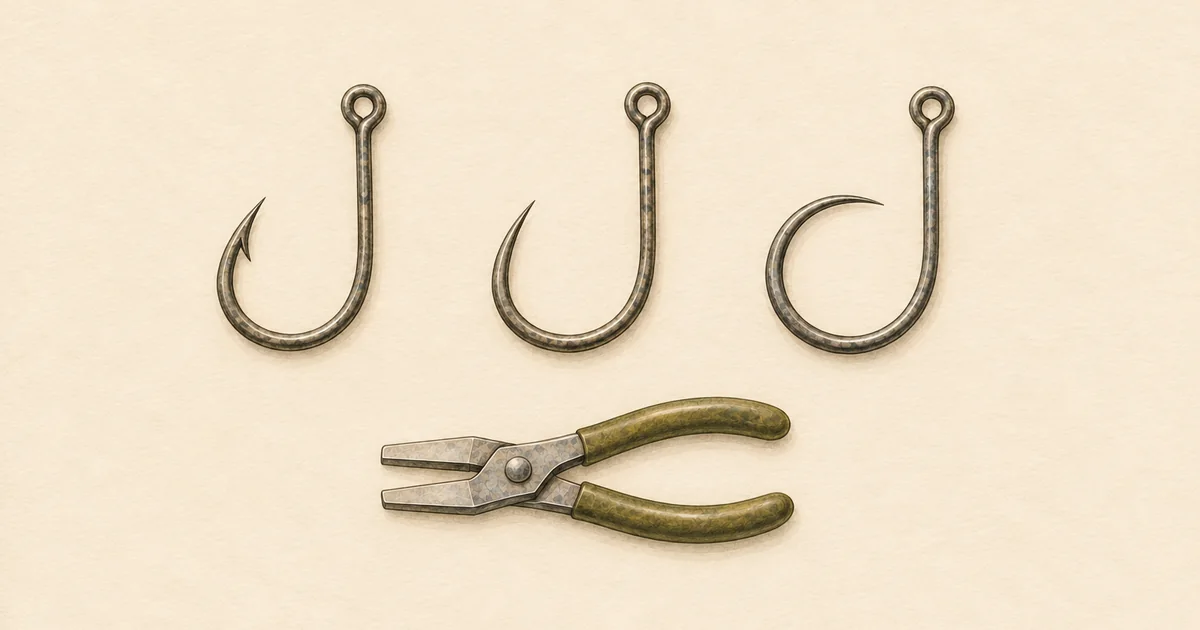
Whether a released fish survives depends above all on where the hook takes hold. A review in Fisheries Research (Brownscombe and colleagues, 2016) names deep hooking, i.e. in the gullet, stomach or gills, as the most common cause of death for many species.
In 2005 two researchers from the US fisheries service NMFS compared studies in pairs. Where the hook was in a vital organ, fish died more often in 33 studies and less often in none. Natural baits did worse in 19 comparisons and better in none; 11 showed no difference.
According to Brownscombe, small baits and hooks are taken deeply more often. Austria’s Umweltbundesamt advises against hooks that are too small; that way, undersized fish are also hooked less often. Suitable sizes are listed under Fishing hooks.
Barbs: fewer wounds, little evidence on survival
A barbless hook has no barb, i.e. no small backward-pointing spike behind the point. According to the 2016 review, it causes less injury and can be removed faster. That fewer fish die as a result, however, is barely proven. In the NMFS comparison, more fish died with barbs in 4 studies, fewer in none, and 5 found no difference. Statistically, that is only a weak indication. The authors suspect the reason lies in easier unhooking: less handling, shorter time in the air.
A second advantage shows after a break-off: pike get rid of a lure without a barb more easily, write researchers who tracked escaped fish with transmitters (trial described under Pike leader). Austria’s Umweltbundesamt recommends barbless hooks even where they are not compulsory.
Rule or voluntary: Fisheries law is state law, and water rules come on top. The 2024 water rules (Gewässerordnung) of the Landesverband Sächsischer Angler, for instance, allow only lures with a single-shank single hook without a barb on its salmonid waters; a barb you have pressed down yourself is allowed (point 4.2.2). What applies on your water is in the fishing permit.
Circle hooks: less often in the gullet, but not for every species
On a circle hook, the point is roughly at right angles to the shank; on the ordinary J-hook it is parallel to it. In a 2004 review, Cooke and Suski analysed 43 studies on 25 species. Despite widely scattered individual results, fewer fish consistently died with circle hooks overall, and they were hooked in the jaw more often and in the gullet less often. Mortality ranged from 0 to 33,8 per cent with circle hooks and from 0 to 46 per cent with J-hooks.
How big the advantage is depends on the species. For red drum in Louisiana, one study found that 3 per cent died with circle hooks and 7 per cent with ordinary hooks. For largemouth bass in Illinois the difference was small: 5,1 versus 6,6 per cent. Hook size, fishing style, feeding behaviour and mouth shape change the effect; according to the authors, the circle hook is not a remedy for all fish.
According to the 2016 review, circle hooks with a laterally offset point usually protect less well than those with a straight point. And the strike requires a different technique, described under Fishing hooks.
Single hook, treble and hook size compared
A treble is a triple hook. Fewer points of a suitable size, such as a single hook instead of a treble, reduce injuries and unhooking time according to the 2016 review. The Bavarian exam questions rate lures with single hooks as more fish-friendly. For mortality, the NMFS comparison found no confirmed difference: 5 studies found the treble at a disadvantage, one the single hook, and 5 no difference. Sometimes a single hook even sits deeper, according to the review because of its smaller size.
| Hook choice | Benefit for fish welfare | Limitation |
|---|---|---|
| Barbless | less injury, faster unhooking | lower mortality barely proven |
| Circle hook | less often in the gullet, more often in the jaw | effect varies by species, different strike |
| Single hook instead of treble | fewer wounds, quicker unhooking | if too small, it gets swallowed deeply |
| Hook not too small | less often deep, fewer undersized fish | fewer bites from small fish |
Static fishing: the rod is never left alone
If the bait lies still, the fish has time to take it deeply. Passive methods such as float or drifting natural bait lead to deep hooking more often, according to the 2016 review. With black bass and scented soft plastics, experienced anglers even hooked fish deeply more often than beginners, probably because of the deliberately later strike. The Waidgerecht project led by fisheries scientist Robert Arlinghaus therefore advises fishing actively for pike and striking immediately with natural bait.
In carp fishing, the self-hooking or fixed-lead rig with a heavy, fixed lead is widespread. If the carp feels the hook after sucking in the bait, it bolts, and the fixed lead drives the hook into its mouth, Blinker explains. On a bite, the angler only picks up the rod, and that is precisely why they belong next to it.
Some states require supervision; two examples: in Saxony, rods must be supervised at all times, and an electronic bite alarm does not count as supervision (§ 4 paragraph 4 Sächsische Fischereiverordnung). Brandenburg requires rods that have been cast out to be supervised constantly and directly (§ 7 paragraph 3 Fischereiordnung). The English angling association Angling Trust gives the reasons: a hooked fish can get stuck in a snag, and birds get tangled in the line or take the bait. If you leave your spot, reel in all lines first. If a bird does take the bait, see Bird or wild animal on the hook.
Avoiding break-offs
If the line breaks, the hook stays in the fish, often together with the hooklength. The researchers from the pike trial advise preventing break-offs with suitable tackle, and for sharp teeth with a wire trace and strong line. Five points help:
- Tackle matched to the biggest fish: The Umweltbundesamt advises matching main line, hooklength, rod and reel to the largest fish you can expect. The Line calculator gives the breaking strain after the knot; for the drag, see Setting the reel drag.
- Steel for pike: According to the Bavarian exam questions, a bite-proof leader, for example of steel, belongs in front of the bait when fishing for pike. More under Pike leader.
- Check line and knots: The Angling Trust advises checking the main line regularly for wear and cutting off damaged sections. What a knot costs in breaking strain is shown in the Fishing line comparison; see also Knots.
- Hooklength weaker than the main line: If the hooklength breaks first on a snag, as little line as possible is lost, according to the Angling Trust.
- Lead that comes free: A fixed or semi-fixed lead must come free if it snags or tangles, otherwise a fish stays tethered after a line break, warns the Angling Trust. In snaggy spots it advises a weaker link to the lead. For carp fishing, Blinker names the safety clip, which the fish can free itself from after a break-off.
The Umweltbundesamt generally advises against techniques in which lines and weights stay in the water. More on this under Lead in angling and Disposing of fishing line and hooks.
If the hook still ends up deep
Then pulling does more harm than cutting. In the NMFS comparison, fish that had a deep hook removed died more often than fish whose line was cut in 10 studies, and less often in one. For undersized fish and fish caught in the closed season, Brandenburg requires that, if the hook has been swallowed deeply, the line is cut level with the tip of the head before release (§ 3 paragraph 1 Fischereiordnung). The procedure is described under Landing and unhooking fish and Disgorger.
Frequently asked questions
Do I catch fewer fish without a barb?
Possibly: the 2016 review cites the barb as an example of fish-friendly tackle not always catching the most. With carp on a heavy fixed lead, according to Blinker, barbless hooks also stay securely in the mouth.
May I leave the rod alone for a moment?
Not in Saxony and Brandenburg, where constant supervision applies, and the Bavarian exam questions require it too. If you have to go away, reel in the rig.
Is a circle hook always the better choice?
No. It helps above all with natural baits and with species for which studies show a benefit. For some species, researchers found no difference from ordinary hooks.
Does a fish survive a break-off?
In pike, usually yes. The researchers from the transmitter trial estimate the long-term damage as low, even if the lure initially stays in the fish. You should still avoid break-offs.
Related
- Fishing hooks: parts, sizes and circle hook technique
- Pike leader: materials and lengths
- Landing and unhooking fish: cut the hooklength instead of pulling
- Disgorger: disgorger, pliers or scissors
- Returning fish: legal position and survival rates
- Hair rig: bait on the hair, hook free
- Lead in angling: risks and alternatives
- Line calculator: breaking strain after the knot
Sources
- Brownscombe und Kollegen: Best practices for catch-and-release recreational fisheries, angling tools and tactics (Fisheries Research 2016, PDF) (Hakensitz, Widerhaken, Kreishaken, Drilling, passive Methoden)
- Bartholomew und Bohnsack (National Marine Fisheries Service): A review of catch-and-release angling mortality (2005, PDF) (Hakensitz, Widerhaken, Drilling, tief sitzende Haken)
- Cooke und Suski: Are circle hooks an effective tool for conserving … catch-and-release fisheries? (Aquatic Conservation 2004, PDF) (Sterblichkeit und Hakensitz mit Kreishaken)
- Queen’s University Biological Station: Movement, fate and lure-shedding of northern pike that break the line (2019) (Hechte nach Abriss)
- Umweltbundesamt Österreich: Nachhaltig fischen, Tipps für Angler:innen (3. Auflage 2025, PDF) (Schonhaken, Hakengröße, Ausrüstung)
- Freistaat Sachsen: Sächsische Fischereiverordnung (§ 4 Absatz 4)
- Land Brandenburg: Fischereiordnung des Landes Brandenburg (§ 3 Absatz 1 und § 7 Absatz 3)
- Bayerische Landesanstalt für Landwirtschaft: Prüfungsfragen zur Fischerprüfung 2023/2024 (PDF) (Vorfach beim Hecht, Einzelhaken, Aufsicht)
- Fachgebiet Integratives Fischereimanagement (Robert Arlinghaus): Projekt Waidgerecht, Hecht (aktiv fischen, sofortiger Anhieb)
- Angling Trust: Best Practice Guide for Freshwater Angling (PDF) (Bleimontagen, Vorfach, Aufsicht)
- Landesverband Sächsischer Angler: Gewässerordnung Ausgabe 2024 (PDF) (Punkt 4.2.2)
- Blinker: Karpfenangeln, Grundlagen für eine erfolgreiche Fangstrategie (Selbsthakmontage, Sicherheitsclip; Praxisangaben)
Text AI-assisted, drawing AI-generated. Sources opened and checked in November 2026; no graphics taken from the sources.
All information is indicative and without guarantee. The study figures come from trials with particular species and cannot be transferred to every fish; what is binding is the law of your federal state, the water rules and the fishing permit.