
Knowledge · Nature & environment
Disposing of fishing line and hooks
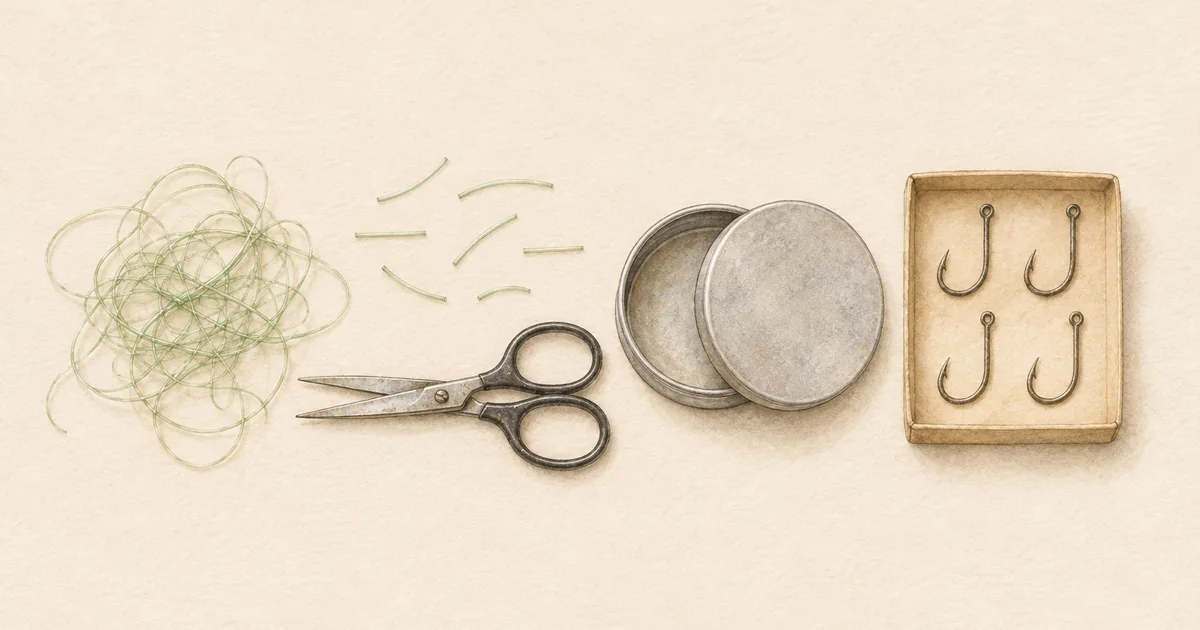
Snapped-off line, a lost soft plastic or a hook in the bushes often stay at the water for years and become snares for birds. If you want to dispose of fishing line, all you usually need is a pair of scissors, a tin with a lid and the bin at home.
What bits of line do to animals
Waterbirds such as ducks, geese, swans, grebes, cormorants, herons and gulls are the worst affected, write two ornithologists from Baden-Württemberg. They refer to an analysis of 29 bird species that were injured by fishing tackle or died from it; most victims probably die unnoticed (Ornithologische Gesellschaft Baden-Württemberg).
- Constriction: A white stork in Lower Saxony cut off the circulation to its foot with discarded line; the foot was amputated, and the stork died the next day. In a second one, the constricted foot swelled up (Beiträge zur Naturkunde Niedersachsens). According to the ornithologists, a goosander on the Neckar lost its tongue because line and hook had wrapped around its bill and tongue.
- Swallowing: Waterbirds swallow hooks and line or eat a fish that is still on the hook. In Linz, the treble (triple hook) of a 14-centimetre soft plastic was surgically removed from a bittern’s lower bill under anaesthetic; it did not survive the night (ÖKO·L, Naturkundliche Station Linz).
- Line in the nest: In Lower Saxony an adult stork carried line together with its spool to the nest and strangled its two largest young while feeding them. On Heligoland, gannets build their nests from plastic waste from fishing, in which their young get entangled (NABU).
- Mammals and fish: According to ÖKO·L, tangles of line stay a trap for years and also endanger mammals on the bank; an eagle owl there became fatally entangled in line and old reeds. In a laboratory trial by Maine’s fisheries agency, brook trout ate soft plastic lures. After 90 days, lures were found in 63 per cent of the stomachs, and fish with many lures in their bellies lost considerable weight (Maine Department of Inland Fisheries and Wildlife).
If you find a bird with line or a hook, Bird or wild animal on the hook tells you whom to call.
How long line stays in the environment
Monofilament, fluorocarbon and braid are plastic, and according to the Umweltbundesamt plastic takes centuries to break down (UBA). The frequently quoted 600 years come from California Sea Grant, a University of California programme that cites work with the US ocean agency NOAA. According to it, the line does not disappear but breaks down into microplastics (California Sea Grant).
This figure has not been measured. NOAA’s marine debris programme itself writes that reliable data on how long plastics last in water are lacking, and that sunlight, temperature, oxygen, microorganisms and location affect breakdown (NOAA Marine Debris Program). So read the 600 years as a rough estimate.
Disposing of old line properly
Most old line is produced when respooling. Cut it into short pieces so that no animals get caught in it, advises Blinker. Florida’s fisheries agency gives pieces no longer than 12 inches (around 30 centimetres) for braid and wire, and a bin with a lid, because line blows out of open containers or animals get into them (Florida Fish and Wildlife Conservation Commission). Stripping the old line off is described in Spooling a reel correctly.
Line does not belong in the yellow bag (gelber Sack), because that is for packaging (Verbraucherzentrale). The Friesland district lists fishing tackle including line as residual waste, and the Zweckverband für Abfallwirtschaft Kempten assigns line to general waste. If you have a recycling bin for plastic items, your waste advice service will tell you whether line can go in it.
Recycling works through dedicated collection bins, because normal recycling plants cannot process line; in California they stand at harbours, marinas and fishing spots (California Sea Grant). In Florida they accept only monofilament and fluorocarbon. Hooks and lures do not belong in them, otherwise anglers and whoever empties the bins get hurt.
Bits of line always go in your bag, never into the bushes or the water. An empty tin with a cross-shaped slot in the lid, as suggested by the Florida agency, holds on to every snippet. More under Leaving your fishing spot clean.
Hooks, swivels, soft plastics and glow sticks
| Part | Beforehand | Where |
|---|---|---|
| Line, all types | cut short | General waste or collection bin |
| Hooks, swivels | snip off points, into a tin | depending on the municipality, general waste or metal at the recycling centre |
| Soft plastic | remove hook and jig head | General waste |
| Glow sticks | take home intact | as advised locally |
For old hooks and lures, the Florida agency advises snipping off the points so that nobody gets hurt. Friesland even counts flies, i.e. dressed hooks, as residual waste. A whole box of hooks, swivels and snap links is metal, which the Eichstätt district, for example, accepts free of charge at its recycling centre (Abfallfibel Landkreis Eichstätt).
The Thünen-Institut, a federal research institute covering fisheries among other things, examined 16 soft plastic lures together with two Canadian universities. Ten of them released plasticisers within 61 days, including phthalates known to be harmful, and a further 45 persistent, mobile and toxic additives were found. One extract showed hormone-like effects. A survey confirmed that artificial lures are often lost; the researchers see a need for further research (Thünen-Institut via idw). Worn-out soft plastics go in general waste without hook and lead head.
A glow stick is a plastic tube with two chambers of chemical liquid. What exactly is inside is usually not stated by the manufacturers (BfR). Take it home unopened; more under Glow sticks. Lead has its own rules, see Lead in angling.
Free snags instead of breaking off
When you snag, the hook is stuck fast on a branch, stone or weed. As a last resort the line is cut, and the remaining line and hook are left behind, the ornithologists from Baden-Württemberg describe. It is exactly these leftovers that become a trap.
- Don’t keep pulling: Tugging at a stuck lure drives it deeper into stone or wood. With the flick method, point the rod tip at the snag, lay the taut line over your index finger, open the bail arm and let the line snap back. In strong current, a bow of line behind the snag can free the lure from behind (Blinker).
- Don’t pull with the rod: Put the rod down and take the line in your hand, especially with braid. If it cuts into your fingers, wrap it around a stick or a piece of wood and pull slowly (Blinker).
- Build in a weak point: According to a tackle guide for the angling exam, the hooklength, i.e. the piece of line between main line and hook, should be one size thinner than the main line (Fischereiverein Löningen). If it breaks, only a short piece stays in the water.
As a precaution, the Florida agency advises not casting towards trees, power lines and animals, and never leaving baits unattended, because herons snap at them. To avoid break-offs with a fish on, see fish-friendly tackle.
Recovering line from bankside trees and bushes
On predator waters, snapped-off lures often hang in the bankside bushes, above and below the water, the Naturkundliche Station Linz observes. Line that you can reach safely, cut it out and take it with you, even if it isn’t yours; the Florida agency asks for this too.
- Check the bank: On natural lakes and gravel pits the often steep banks slip easily, warns the DLRG. Don’t lean over the edge; more under Bank and waders.
- Watch out for power lines: If line is hanging near an overhead power line, read Power lines and fishing rods first.
- Cut the line, not the bush: From 1 March to 30 September the Federal Nature Conservation Act prohibits cutting back or coppicing hedges, bushes and other woody plants and cutting back reeds; gentle maintenance cuts remain allowed (§ 39 BNatSchG). More under Nature conservation on the bank.
Whatever you can’t reach safely stays where it is. A pair of line scissors is enough for cutting line out.
Frequently asked questions
Can fishing line go in the yellow bag?
No, that is for packaging. Friesland and Kempten assign line to general waste.
Is it true that fishing line lasts 600 years?
The figure is an estimate, not a measurement. According to NOAA, reliable data on how long plastics last are lacking; according to the Umweltbundesamt, they take centuries to break down.
What should I do with old hooks and soft plastics?
Snip off the points, collect the hooks in a tin and, depending on your municipality, put them in general waste or take them to the recycling centre as metal. Soft plastics go in general waste without hooks.
Can fishing line be recycled?
Only via dedicated collection bins, because normal recycling plants cannot process line. Without such a bin, it goes in general waste, cut short.
Related
- Fishing line: mono, braid or fluorocarbon: which line when
- Monofilament line and Braided line: construction and care
- Line scissors: cutting cleanly
- Bird or wild animal on the hook: help for injured animals
- Hook injuries and first aid: a hook in your own skin
Sources
- Ornithologische Gesellschaft Baden-Württemberg: Gänsesäger und Gelbschnabeltaucher als Opfer von Angelschnüren (2012) (betroffene Arten, gekappte Schnur)
- Beiträge zur Naturkunde Niedersachsens: Kunststoff-Müll bedroht Weißstörche (2001) (Störche in Schnur)
- ÖKO·L, Naturkundliche Station der Stadt Linz: Relikte der Angelfischerei (2011) (Rohrdommel, Uhu, Köder im Gebüsch)
- NABU: Geisternetze, Todesfallen für Meerestiere (Basstölpelnester)
- Maine Department of Inland Fisheries and Wildlife: Soft Plastic Fishing Lures and Brook Trout Growth (2009) (Gummiköder in Fischmägen)
- Thünen-Institut, Pressemitteilung über idw: Harmful substances in soft plastic lures (2024) (Weichmacher aus Gummiködern)
- Umweltbundesamt: Müll im Meer; NOAA Marine Debris Program: The Mystery of How Long Until It’s Gone; California Sea Grant: Reducing fishing line pollution one recycling bin at a time (Abbaudauer, Sammelbehälter)
- Florida Fish and Wildlife Conservation Commission: Fishing line and tackle disposal (2017) (Schnur, Haken, Sammelbehälter)
- Landkreis Friesland: Abfall-ABC Angelzubehör; Zweckverband für Abfallwirtschaft Kempten: Schnur; Landkreis Eichstätt: Abfallfibel; Verbraucherzentrale: Müll richtig trennen (Tonnen und Wertstoffhof)
- Bundesinstitut für Risikobewertung: Knicklichter sind nichts für kleine Kinder (Aufbau, Inhaltsstoffe)
- Blinker: Hängerlösen, Die 7 häufigsten Fehler, die Ihre Angelrute zerstören, Alles neu, mit frischer Schnur in die Saison (Hänger, Altschnur)
- Fischereiverein Löningen: Gerätekunde (Vorfach)
- Bundesnaturschutzgesetz, § 39; DLRG: Juniorretter, Teilnehmerbroschüre (Gehölzschnitt, Ufer)
Text AI-assisted, drawing AI-generated. Sources opened and checked in November 2026; no graphics taken from the sources.
All information is indicative and without guarantee. Which bin is the right one is set by your municipality; at the water, the water rules and fishing permit apply.