
Knowledge · Tackle
Line scissors: Cutting braid cleanly
A line cutter cuts braided line so that the end stays smooth and does not come apart into single fibres. This page explains which blades can do that, what clippers and side cutters are good for and where the offcuts belong.
Why braid frays when cut
Monofilament line is a single strand drawn in one piece from polyamide, as the equipment guide for the angling exam of the Fischereiverein Löningen describes it. One cut severs this strand, and that is that. Braided line, by contrast, consists of many thin fibres which, according to Blinker, are almost always made of UHMWPE, a polyethylene with an ultra-high molecular weight. How the braid is constructed is explained on the page Braided line.
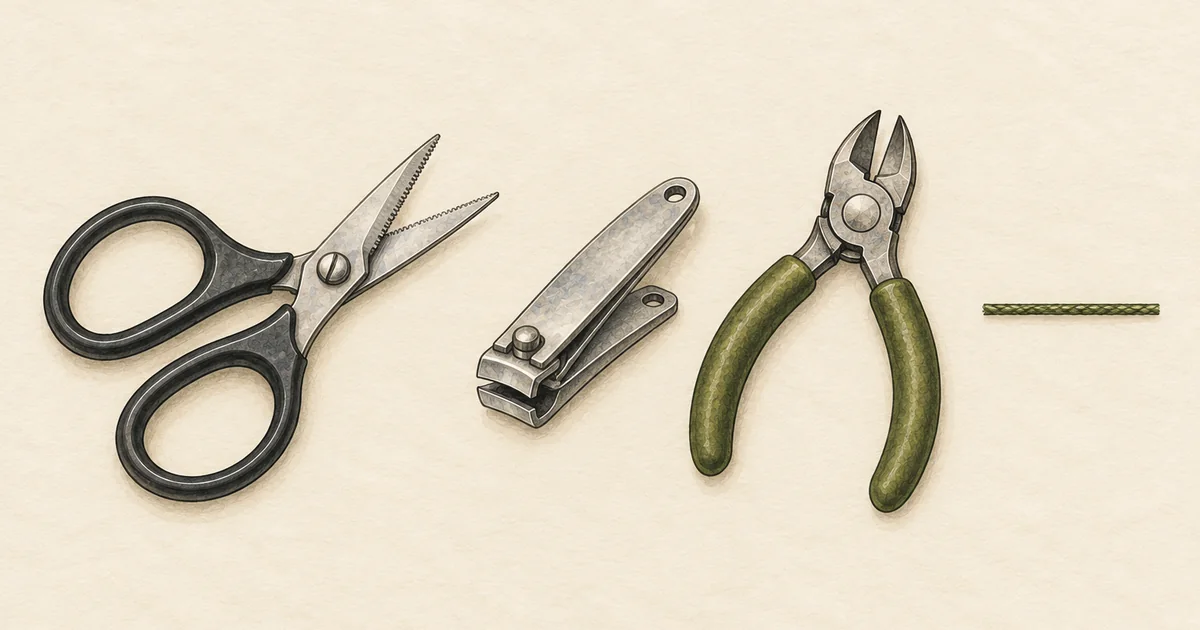
These fibres are smooth. The surface of braid is very slippery, so it is harder to knot than monofilament. It also behaves differently when cut. The cutting jaws of many angling pliers cope well with monofilament and wire traces, but with braided line they often reach their limits: the braid frays at the cut. The single fibres then stick out from the end like a little brush (fig. 1).
Designs from clipper to side cutter
Scissors with a serrated edge
An ordinary, sharp pair of scissors cuts both monofilament and braid precisely. If you fish with braid a lot, Blinker advises getting your own braid scissors. Their blade is serrated and cuts even very thin braid without the end fraying.
Clipper and nail clipper
Line clippers are small snippers and are mentioned in the same breath as nail clippers. For trimming line ends accurately, especially braid, such small tools are the first choice and cut lines of all kinds to the millimetre. Fly fishers cut their leader material with a leader clip or an ordinary nail clipper. Many a sea angler considers a clipper indispensable for building traces and has one hanging from the wading jacket.
Nail scissors, side cutters, knife
Nail scissors with a curved blade also cut round shapes, for instance when trimming soft plastic lures or boilies. The side cutter, on its own or as a cutting jaw in the disgorger pliers, is the tool for steel. A knife will shorten line at a pinch, but less accurately than scissors. What else the blade is used for is covered under angling knife.
| Tool | Braid | Monofilament | Wire trace |
|---|---|---|---|
| serrated scissors | clean, no fraying | yes | thin at a pinch, at the cost of sharpness |
| Clipper, nail clipper | very accurate | very accurate | accounts contradict each other |
| Pliers cutter | often frays | often fine | often fine |
| Knife | possible, less accurate | possible, less accurate | fails |
The table sums up assessments from several articles in the angling press. On clippers and steel they do not agree: one article says clippers cope quite well with steel. Another notes that scissors and clippers can handle thin wire trace but lose sharpness and service life in the process.
Clean ends for the knot
When knotting you cut in two places: at the fresh end that is passed through the eye and the turns, and at the protruding tail after pulling tight. A list of mistakes that cost a knot strength or make tying harder names unsuitable tools alongside the wrong knot, the wrong number of turns and tightening it dry (Blinker). Sharp scissors or braid scissors make the precise cut easier.
How long the end is left and when you trim it is given for each knot separately. With the Palomar knot, for example, you cut only after the pull test, with the FG knot first the leader and finally the braid. You will find all the instructions in the overview of fishing knots. How much strength is left after the knot is worked out by the line calculator.
A knot puller helps when tightening thin line. It stops the line from cutting into your fingers as you pull it tight.
Steel and hooks belong to the cutter
At the latest with steel and titanium, ordinary scissors reach their limits: they can cope with a thin wire trace, but it shortens the life of the blade. For a pike trace the side cutter is therefore the better choice. Robust cutters even snip through hook shanks, for example when a hook in the fish cannot be released. What to do when a hook is stuck in your own skin is covered under hook injuries and first aid.
Take line offcuts away and dispose of them
Every cut leaves an offcut, and fishing line is plastic. The Umweltbundesamt (Federal Environment Agency) writes on a page from 2015 that plastics take centuries to break down and that microorganisms cannot fully decompose them. The agency names 136 marine animal species known to repeatedly get entangled in waste and strangle themselves.
On inland waters it is waterbirds that suffer. NABU Berlin reports swans, herons and ducks tangling in line drifting in the water or hanging from branches. It calls for all line offcuts, baits and hooks to be disposed of properly. Angling litter you find should only be thrown away at home, because animals look for food in rubbish at night and can get tangled there just the same. More on this under monofilament line.
The Fischereiamt Berlin (fisheries office) asks anglers on its angling permit page to collect their own rubbish, take it with them and put it in the bin at home. The equipment guide from Löningen counts a bag for rubbish as part of the accessories. On the waters of the Landesanglerverband Brandenburg, the water rules (Gewässerordnung, 2019 edition) expressly forbid leaving waste or aids on the bank or throwing them into the water. What applies on your water is set out in the water rules and the fishing permit (Erlaubnisschein).
At the swim: Put the bag for offcuts next to you before you tie the first rig and let every snippet fall straight into it. When you change the mainline, cut the old line into short pieces so that no birds or other animals get tangled in it. Which bin is the right one at home is something your local waste advice service can tell you.
Common mistakes
- Cutting braid with pliers. The cutting jaws of many angling pliers fray braided line.
- Cutting steel with the braid scissors. It works on thin traces but costs the blade its sharpness and service life. For steel there is the side cutter.
- Trimming with a knife. It shortens line less accurately than scissors. For the tag end at the knot, use scissors or a clipper.
- Letting snippets fall in the grass. According to NABU Berlin, waterbirds get tangled in line that drifts in the water or hangs from branches. The association advises taking the offcuts home and disposing of them there.
- Throwing the old mainline away in one piece. Cut it into short pieces first.
Frequently asked questions
Are household scissors enough for braid?
If they are sharp, they cut braid precisely too. If you fish with braided line a lot, you are better off with serrated scissors, because they cut even thin braid without fraying.
Is a nail clipper a real alternative?
Yes, for line ends. Nail clippers and line clippers are considered the most accurate tools for trimming lines to the millimetre, and fly fishers also use them for leader material.
What should I do with the old line after respooling?
Cut it into short pieces and only put it in the bin at home. That is the advice of the angling press, NABU Berlin and the Fischereiamt Berlin. How the new line gets onto the spool is explained under Spooling a reel correctly.
Related
- Braided line: fibres, diameter and knots on a smooth material
- Fishing lines compared: monofilament, braid and fluorocarbon side by side
- Fishing knots: all instructions step by step
- Palomar knot: a proven knot for braid on hooks and swivels
- Angling knife: a blade for fish and bait, not for precise trimming
- Disgorger pliers: releasing hooks, often with cutting jaws for wire traces
- Split-ring pliers: opening split rings and changing treble hooks on a lure
- Line calculator: strength after the knot and spool filling
Sources
- Blinker: Immer gut abschneiden, welches Schneidewerkzeug für welchen Zweck? (Schere für Geflecht und Monofil, gezackte Schneide, Clipper, Stahl und Titan, Cutter für Hakenschenkel, Messer)
- Blinker: Immer in der Tacklebox, kleine Helfer mit großer Wirkung (Schneidbacken von Anglerzangen fransen Geflecht aus, Knot-Puller) und Blinker: Angler-Werkzeug, was muss noch mit ans Wasser? (Geflechtschere, Clipper, Nagelschere, Stahl kostet Schärfe)
- Blinker: Die wichtigsten Angelknoten im Überblick (glatte Oberfläche von Geflecht, Fehler beim Knoten, Werkzeug), Blinker: Geräte-Tipps Fliegenfischen für Anfänger (Vorfach-Clip, Nagelknipser) und Blinker: Zubehör zum Meeresangeln (Clipper an der Watjacke)
- Blinker: Geflochtene Angelschnur im Test (Werkstoff UHMWPE) und Blinker: Alles neu, mit frischer Schnur in die Saison (alte Schnur in Stücke schneiden)
- Fischereiverein Löningen: Gerätekunde zur Fischerprüfung (PDF) (Monofil aus Polyamid, Tüte für Abfall als Zubehör)
- NABU Berlin: Angelmüll gefährdet Berliner Wasservögel (Vögel in Schnur verheddert, Reste fachgerecht und erst zu Hause entsorgen)
- Fischereiamt Berlin: Die Angelkarte und ihre Auflagen (Abfall mitnehmen, zu Hause entsorgen)
- Umweltbundesamt: Müll im Meer (Abbau von Kunststoff, Tiere verfangen sich in Müllteilen)
- Landesanglerverband Brandenburg: Gewässerordnung, Ausgabe 2019 (Verbot, Abfälle am Ufer zurückzulassen)
Text AI-assisted, drawing AI-generated. Sources opened and checked in October 2026; no graphics taken from the sources.
All information is a rough guide without guarantee. How well a tool cuts depends on sharpness, line and diameter; what applies at the water regarding waste is governed by the water rules (Gewässerordnung) and the fishing permit (Erlaubnisschein).