
Knowledge · Tackle
Glow sticks: Bite indication at night
A glow stick is a thin plastic tube that glows without a battery after being snapped. Anglers put it on the float or at the rod tip and so can see at night when a fish bites. Here you can read how the glow comes about, how to fix the light securely and where it belongs afterwards.
How the glow comes about
Two liquids lie in separate chambers inside the flexible, transparent sleeve. When you snap the stick, they mix, and the chemical reaction makes it glow. That is how the Bundesinstitut für Risikobewertung (BfR) describes it. Technically the process is called chemiluminescence: light excited by a chemical reaction (Lexikon der Chemie). When the plastic sleeve is bent, the inner chamber breaks open and the two liquids mix.
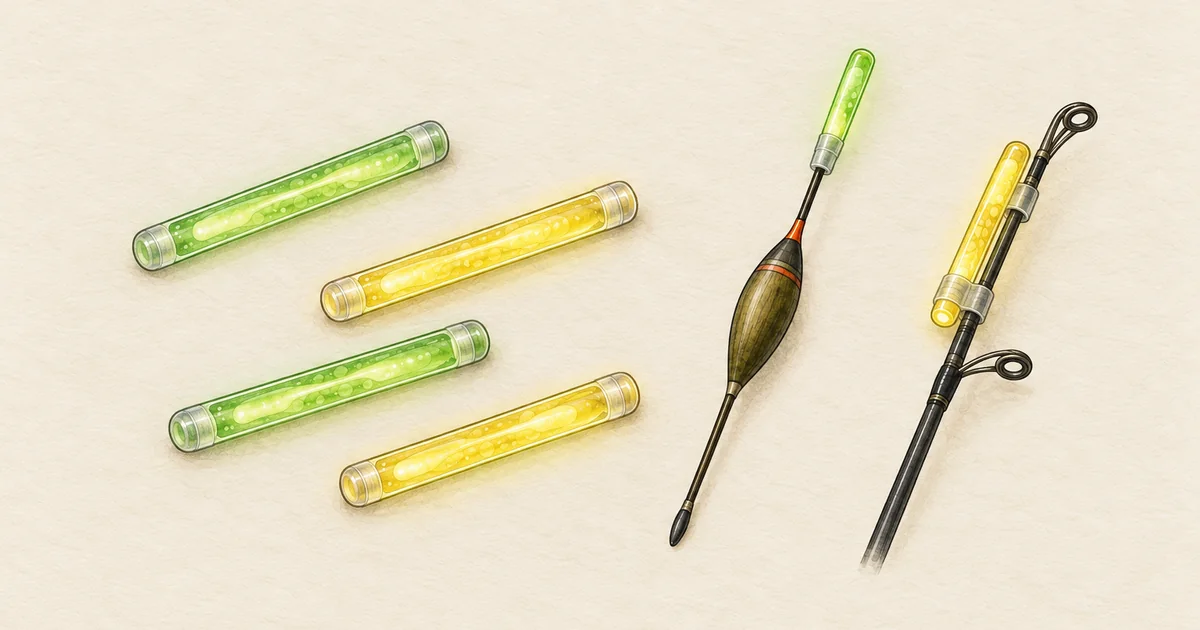
According to the BfR, colour and burn time depend on the composition. There is therefore no fixed number of hours for all glow sticks. Blinker ranks the colours like this: yellow-green lights glow strongest and longest, blue ones weakest and shortest. A glow stick cannot be switched off, and according to Tox Info Suisse, the Swiss poison information centre, one that has gone out cannot be revived. Cold does slow the reaction, though. That is why started lights can be kept in the fridge and used again the next evening.
Glow stick on the float
A glow-stick float has a socket in the top of the antenna into which you push the tube. Training material for the angling exam (Fischerprüfung) from the Fischereiverein Löningen lists such floats as a way of float fishing at dusk and at night. Some floats have interchangeable tips that you swap for a small glow stick in the evening. The antenna of a waggler, a float attached only at the bottom, also takes a small light. How the float itself is built is covered under Floats.
For the night the float stays light. A Blinker author fishes for eel in still water mostly with a float of 3 to 6 g carrying capacity, rarely more than 10 g. Another uses glow-stick wagglers of 2 to 4 g for zander in a lake. These are experience figures, not standards. How to balance the carrying capacity with shot is shown by the float rig and the float shotting calculator. If a silicone tube holds the float firmly on the line, it belongs at the top end of the float or glow stick. Then nothing sticks out, and the rig does not flip over in the cast.
Glow stick on the rod tip
When fishing on the bottom, the tip shows the bite, but in the dark it is invisible. The tackle guide of the Landesfischereiverband Baden-Württemberg names three ways out: a bell at the tip, a glow stick at the tip or an electronic bite alarm. How the rod is set up for this is explained on the Bottom rod page. An eel angler in Fisch & Fang prepares the sensitive tips of his rods with glow sticks so that no pluck escapes him in the dark. A light can also be attached to the fine tip of a feeder rod.
Rods with a ready-made holder are rare. Usually, though, a piece of silicone tube comes in the pack. Two short pieces of it, fixed to the tip with whipping thread and a little glue, hold the light and still let you change it. If you do not want a fixed holder, use a rubber band or tape. With tape, however, one reader reports that the line wound itself around the light.
A bell and a light do not rule each other out. Anglers who fish from a fixed spot almost always combine an audible with a visible signal. When winter fishing for burbot, the brief ringing acts as a wake-up call, after which the fine plucks are read from the glow stick.
Battery-powered light floats
Besides the chemical light there are light floats with a battery and LED; the Löninger training material mentions these too. For empty batteries the Umweltbundesamt says: never in household waste, the yellow bin or scrap metal, but in the collection boxes in shops or at municipal collection points. Consumers are legally obliged to do so.
In Bavaria the implementing regulation to the Fisheries Act bans fishing with electric light sources (§ 15 Abs. 1 Nr. 1 AVBayFiG, version of October 2026). What this means for a light float you clarify with your club or the fisheries authority (Fischereibehörde). Whether and when you may fish at night at all is regulated by state law and the fishing permit, more under Law and permits.
When a glow stick breaks
You rarely learn what exactly is in the tube. According to the BfR, the manufacturers are mostly unknown and the packaging lists no ingredients. Tox Info Suisse names oxalic acid esters such as diphenyl oxalate as common components, plus hydrogen peroxide and a phthalate as solvent.
- Swallowed: According to the BfR, an intact glow stick is not destroyed during digestion and is excreted again. If liquid leaks out, for example after being bitten, it burns and irritates the lining of the mouth; the symptoms pass according to the BfR. Tox Info Suisse advises not to induce vomiting and to rinse the mouth.
- In the eye: Splashes burn badly, and the eye waters and reddens. Tox Info Suisse advises rinsing at once for 10 to 15 minutes with clean, lukewarm water and seeking medical advice if the symptoms persist.
- On the skin: rinse thoroughly with water; slight irritation is possible (Tox Info Suisse).
At the water this means: do not hold glow sticks in your teeth and do not cut them open to get at the last bit of light. Keep the pack out of reach of small children. At the Giftnotruf Berlin, enquiries about accidents of small children with glow sticks rose from 105 in 2005 to 393 in 2008, the BfR reported.
In an emergency: The poison information centres of the states give advice by telephone; the BfR lists them with their emergency numbers (link under Sources). This section does not replace medical advice.
Disposal
You take burnt-out glow sticks away with you. In the exam questions for the fishing licence (Fischereischein) published by an angling magazine, the correct answer is: take it home and dispose of it properly there. The Fischereiamt Berlin likewise asks you to collect rubbish and put it in the bin at home. The Gewässerordnung des Landesanglerverbands Brandenburg forbids leaving rubbish or aids on the bank. That also applies to lights with which you marked a gap in the weed: collect them again after fishing.
The checked specialist sources do not say which bin a used glow stick belongs in. Your local waste collector can tell you. Batteries from light floats go into the battery collection.
Common mistakes
- Striking at the wandering point of light. If you stare at a small point of light in the dark for a long time, you see it move. The Lexikon der Psychologie explains this autokinetic effect by jerky eye movements. It helps to look just beside the float; then it only appears to move when wind or a fish nudges it.
- Light that is too bright in the shallows. According to Blinker, blue glows most discreetly, then red, yellow brightest. Yellow can scare fish in shallow water. Which colour suits which depth is covered under Night fishing.
- Fixing the light with tape only. The line can wind around it. Two pieces of silicone tube hold more cleanly.
- Leaving the pack lying open. Children like to put glow sticks in their mouths, and leaked liquid irritates.
Frequently asked questions
How long does a glow stick last?
According to the BfR, that depends on the composition; there is no general figure. Yellow-green lights last longest, blue ones shortest. Stored cool, a started light is still good for the next evening.
Is the glowing liquid poisonous?
The exact composition is mostly unknown (BfR). According to Tox Info Suisse, small amounts swallowed lead to temporary burning and mild stomach and bowel complaints; severe symptoms are not expected. In case of eye contact, persistent symptoms or uncertainty, you call a poison information centre.
Glow stick or bell?
Both are common; the exam materials list bell and glow stick side by side. You hear the bell even when you happen to be looking away, while the light shows fine plucks. Many anglers fishing from a fixed spot use both together.
Related
- Night fishing: bite times, spot in daylight, light colour and state rules
- Floats: shapes and carrying capacity
- Float rig: build, depth and shotting
- Bottom rod: bite indication at the tip, bell and swing tip
- Waggler rig: float attached at the bottom with sunk line
- Line calculator: what the line still holds after the knot
- Float shotting: shot matched to the carrying capacity
Sources
- Bundesinstitut für Risikobewertung: Knicklichter sind nichts für kleine Kinder (Presseinformation 25/2009) (Aufbau, Farbe und Dauer, Reizung, Verschlucken, Unfallzahlen, Aufbewahrung) und BfR: Giftinformationszentren in Deutschland (Notrufnummern)
- Tox Info Suisse: Knicklicht (Inhaltsstoffe, Symptome, Erste Hilfe, keine Reaktivierung)
- Spektrum, Lexikon der Chemie: Chemolumineszenz (Begriff) und Spektrum, Lexikon der Psychologie: autokinetischer Effekt (scheinbar wandernder Lichtpunkt)
- Landesfischereiverband Baden-Württemberg: Gerätekunde (PDF) (Bissanzeige an der Spitze) und Fischereiverein Löningen: Gerätekunde (PDF) (Leuchtposen, Glocke)
- Umweltbundesamt: Batterien und Akkus richtig nutzen und fachgerecht entsorgen (Rückgabe von Batterien)
- Freistaat Bayern: Verordnung zur Ausführung des Bayerischen Fischereigesetzes (§ 15), Landesanglerverband Brandenburg: Gewässerordnung (Nr. 1.8) und Fischereiamt Berlin: Die Angelkarte und ihre Auflagen (Abfall mitnehmen)
- Blinker (Praxis): Kleine Helfer beim Meeresangeln (Farbe und Dauer), Die 10 besten Tipps zum Aalangeln vom Ufer (Kühlschrank, Markierungen), Aal im Stillwasser (Tragkraft, Farben), Stippen auf Zander (2 bis 4 g), Zander mobil mit Pose und Köfi (Schlauch oben), Aalangeln im Frühjahr (Wechselspitzen), April: Die Aale werden wild (Licht am Waggler)
- Blinker (Praxis): Im Fluss gezielt auf Quappe (Silikonschlauch, Klebeband), Knicklicht-Halter (Klebeband), Angler-Werkzeug (Gummiband), Bissanzeiger richtig nutzen (hören und sehen), Quappen im Winter (Glocke und Licht), Zander mit Köderfisch (neben die Pose schauen), Wie entsorgt man verbrauchte Knicklichter? (Prüfungsfrage)
- Fisch & Fang: Einfach auf Aal am Fluss (Knicklicht an der Rutenspitze) und Wikipedia: Leuchtstab (nur ergänzend)
Text AI-assisted, drawing AI-generated. Sources opened and checked in October 2026; no graphics taken from the sources.
All figures are guide values without guarantee. Burn time and brightness depend on the individual glow stick, and in case of contact with the glowing liquid the text does not replace medical advice.