
Knowledge · Nature & environment
Lead in angling and alternatives
Lead is heavy and melts at around 327 degrees. Whatever is lost on the bottom can end up in the stomachs of waterbirds. That is why the EU is ending the sale of fishing tackle containing lead in stages up to 2031. If you want to fish lead-free today, you will find substitutes that do not throw your rig off balance.
How fishing lead gets into waterbirds
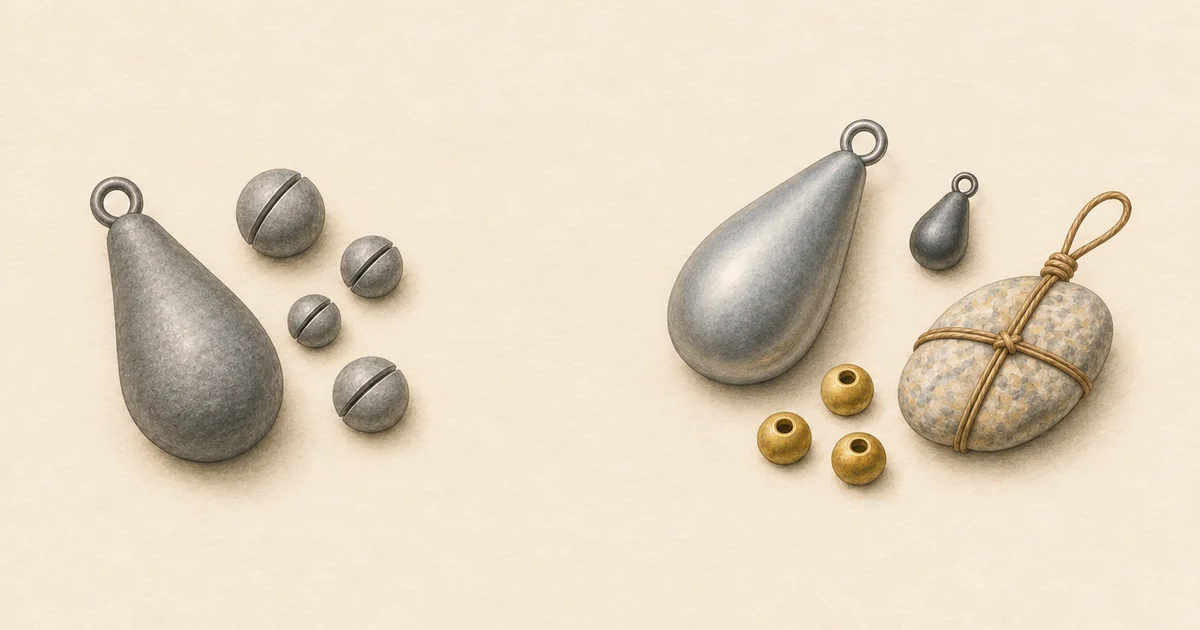
In 2021 the European Chemicals Agency ECHA estimated that around 3 000 tonnes of lead weights and lead lures are lost in the EU every year, within a range of 2 000 to 7 000 tonnes (ECHA). According to the same report, about 5 400 tonnes come onto the market each year, three quarters of it imported. According to the agency, it gets into the water through break-offs on stones and branches, split shot spilt on the bank, leads deliberately dropped in carp fishing, and household waste.
Many birds swallow small stones. This grit grinds up food in the gizzard, because birds have no teeth. According to ECHA, small split shot looks so much like gravel and seeds that it gets picked up while feeding. In the gizzard the metal is ground down, which speeds up its dissolution and absorption in the gut. The report names mallard and pintail as particularly at risk, as they sieve the bottom mud for food in shallow water. Feeding head down with the bill on the bottom is called dabbling (Fig. 1). If everything stays as it is, at least 7 million birds would be at risk from swallowed lead weights and lures within 20 years, according to ECHA (Council of the EU, document 9232/26).
How much of this is down to angling is disputed. A British study cited in the ECHA report could only reliably attribute angling shot in one pochard and four mute swans; many pellets were too worn for that. The Deutscher Angelfischerverband considers anglers‘ share of lead pollution in waters to be comparatively small and sees no robust evidence of ecological damage (DAFV).
The EU restriction, as of November 2026
The ECHA report on lead in ammunition and fishing tackle was published on 24 March 2021. The agency’s Committee for Risk Assessment (RAC) agreed on 2 June 2022, and the Committee for Socio-economic Analysis (SEAC) on 2 December 2022. The Commission then split the plan into one regulation for ammunition and one for fishing tackle (Council of the EU, document 9232/26).
The member states‘ REACH committee approved the draft for fishing tackle on 29 April 2026. An objection in the European Parliament failed on 8 July 2026 (European Parliament, procedure 2026/2714(RPS)), and the scrutiny period for Parliament and Council ended on 30 July 2026 without objections (Commission comitology register, D110163/04). The Commission adopted Regulation (EU) 2026/2501 on 12 November 2026, and it appeared in the Official Journal a day later. It applies from 3 December 2026, the twentieth day after publication. After that, tackle containing lead may no longer be placed on the market for fishing, meaning neither sold nor supplied in any other way, on three cut-off dates (Regulation (EU) 2026/2501):
- from 3 June 2027: no more sales of lead wire and drop-off leads; retailers must display a warning for weights and lures containing lead, both right next to the product in the shop and in online listings
- from 3 December 2029: no more sales of lead weights and lures up to 50 grams
- from 3 December 2031: no more sales of weights and lures over 50 grams up to 1 kilogram
In the text as first published, the first stage was dated 3 March 2027. A corrigendum of 17 November 2026 sets 3 June 2027, i.e. six months after entry into force, as the reasoning of the regulation also provides. In the German official text, drop-off leads are called “Drop-Shot-Gewichte”. According to the definition, these are weights intended to be released deliberately while fishing; they only share the name with the weight of a drop-shot rig, which stays on the line.
Tackle counts as containing lead from 1 per cent lead by weight. Exempt are lures made of copper alloys such as brass with less than 3 per cent lead, and split shot up to 0,06 grams if sold in leak-proof, child-resistant packaging; the Commission will review both exemptions on the basis of an ECHA report after 3 December 2036. The rule does not cover weights over 1 kilogram, nor weighting firmly worked into a line or net. What matters for recreational anglers: the regulation restricts sales. It only governs use in commercial fishing; recreational angling with lead remains a matter for the member states. So the EU rule does not ban the leads you already own.
What applies on your water
Only a few EU countries already ban lead in angling with their own rules, the Commission notes. They are expressly allowed to keep stricter rules of their own on use that apply on 3 December 2026. In Germany, fisheries law is state law, and many details are set by the water rules of the club or leaseholder. So check your fishing permit (Erlaubnisschein) to see whether lead is restricted at your water; how it is structured is explained under Fishing permit and water map. The German Anglers‘ Association (DAFV) says it is open to scientifically justified, proportionate rules with sufficient transition periods.
Substitute materials and their density
ECHA names brass, concrete, pebbles, steel, tin, zinc and tungsten among the alternatives, although brass and zinc also harm the environment. At the water, what matters most is density, i.e. the mass per cubic centimetre: the lower it is, the larger a weight of the same number of grams becomes. The densities come from the periodic table from Spektrum der Wissenschaft, and the volumes are calculated from them.
| Material | Density in g/cm³ | Note |
|---|---|---|
| Tungsten | 19,26 | 0,6 times the volume of lead |
| Weight | 11,34 | Reference value |
| Bismuth | 9,80 | 1,2 times the volume |
| Iron | 7,87 | 1,4 times the volume |
| Tin | 7,29 | 1,6 times the volume |
| Zinc | 7,14 | 1,6 times the volume, also harmful to the environment according to ECHA |
| Stone (quartz) | 2,65 | 4,3 times the volume, real stones vary |
The diameter grows more slowly than the volume. By calculation, a 20-gram ball measures about 12,6 millimetres in tungsten, 15,0 in lead, 16,9 in iron, 17,4 in tin and 24,3 millimetres in quartz (Fig. 1).
When switching over: swap by grams, not by size, and then check the float in the water. The larger volume gets more buoyancy. Calculated with the density of water, about 1,0 g/cm³ according to the Lexikon der Geowissenschaften, 20 grams of lead still weigh about 18,2 grams under water, 20 grams of tin only about 17,3 grams. How much weight your float needs is shown by the Float shotting calculator. Where small dimensions matter, for example with a jig head, tungsten helps. On the bottom you can manage without metal too, see the stone rig under Fishing weights.
Lead at home: casting and hygiene
If you cast your own weights, you are working with hot metal and fumes. ECHA describes how lead melts at 327 degrees and from about 482 degrees gives off fumes that also settle on surfaces as fine yellow-brown lead oxide dust. At home, casting is usually done without adequate protective equipment, so the agency expects comparatively high exposure and names good hygiene and ventilation as the best protection. The body absorbs lead well through the lungs, writes the Umweltbundesamt. A sales ban alone does not stop people casting their own, the DAFV says, reporting the position of the European trade association.
Health: Lead dust also gets into the mouth via the hands. ECHA assumes this route of intake when handling fishing lead and considers washing your hands and not eating, drinking or smoking while doing so to be effective. According to the Bundesinstitut für Risikobewertung, children are particularly sensitive to lead, especially in brain development, and in their case hand-to-mouth contact with lead-containing dust can contribute noticeably to intake. No safe threshold for lead has been established so far. So keep the lead box out of reach of children. This text does not replace medical advice; if you suspect poisoning, see a doctor.
Getting rid of old lead properly
ECHA expressly counts lead scraps in household waste among the routes by which lead gets into the environment. Lead is scrap metal: the Abfallwirtschaft Potsdam-Mittelmark, for example, includes it in its list of scrap metal that residents can hand in free of charge at recycling centres. Your local waste advice service can tell you what applies in your district.
At the water, prevention starts with your tackle. Fewer break-offs mean less lead on the bottom; tips on this are under Fish-friendly tackle. Pick up spilt shot on the bank, and take bits of line and hooks with you, as described under Disposing of fishing line and hooks.
Frequently asked questions
From when will lead weights no longer be on sale?
Weights and lures containing lead up to 50 grams may no longer be sold from 3 December 2029, heavier ones up to 1 kilogram from 3 December 2031. Lead wire and drop-off leads disappear from shops as early as 3 June 2027.
What is a drop-off lead?
A weight that is deliberately released while fishing and stays in the water. ECHA mentions this practice mainly in carp fishing. Made of lead, it may no longer be sold from 3 June 2027; the German official text calls it “Drop-Shot-Gewicht”. As a substitute, the agency sees other techniques or weights that stay on the rig.
Why are small leads considered more dangerous than large ones?
According to the ECHA report, the size of the stones a bird swallows depends mainly on its body size and diet. In divers, according to a study cited by ECHA, the size of their grit argues against them picking up leads over 25,4 millimetres as gravel; larger weights are more likely to get into the bird together with a caught fish and the rig.
Related
- Fishing weights: shapes and the stone rig
- Jig heads: what tungsten changes when working the lure
- Bird or wild animal on the hook: when a bird takes the bait
- Running lead rig: set-up with a running lead
- Plummet: measuring depth before float fishing
- Disposing of fishing line and hooks: leftovers from a day’s fishing
- Leaving your fishing spot clean: leave nothing behind
Sources
- EUR-Lex: Verordnung (EU) 2026/2501 der Kommission vom 12. November 2026, Blei in bestimmtem Fischereigerät und Berichtigung vom 17. November 2026 (Amtstext: Inkrafttreten, Stichtage, Begriffe, Ausnahmen, Verwendung, nationale Regeln)
- ECHA: Annex XV Restriction Report, Lead in outdoor shooting and fishing (PDF, englisch) (Mengen, Magensteine, gefährdete Arten, Selbstgießen, Hygiene)
- Rat der EU: Entwurf der Kommissionsverordnung zu Blei in bestimmtem Angelgerät, Dokument 9232/26 (PDF, englisch) und Anhang, Dokument 9232/26 ADD 1 (PDF, englisch) (Entwurf, Verfahren, Ersatzstoffe)
- Europäische Kommission, Komitologieregister: Entwurf D110163/04 (Ausschuss am 29. April 2026, keine Einwände bis 30. Juli 2026)
- Europäisches Parlament, Legislative Observatory: Einspruch 2026/2714(RPS), Blei in bestimmtem Angelgerät (Einspruch am 8. Juli 2026 gescheitert)
- Deutscher Angelfischerverband: EU-Bleibeschränkung für Angelgeräte, aktueller Stand und Einordnung (Position des Verbands, Stand 4. Mai 2026)
- Spektrum der Wissenschaft, Periodensystem: Blei, Wolfram, Bismut, Eisen, Zinn, Zink; Lexikon der Geowissenschaften: Dichte (Dichten)
- Bundesinstitut für Risikobewertung: Fragen und Antworten zu Blei in Kinderspielzeug (Kinder, Hand-Mund-Kontakt)
- Umweltbundesamt: Blei im Feinstaub (Aufnahme über die Lunge)
- APM Abfallwirtschaft Potsdam-Mittelmark: Merkblatt Metallschrott (PDF) (Blei als Metallschrott)
Text AI-assisted, drawing AI-generated. Sources opened and checked in November 2026; no graphics taken from the sources.
All information is indicative and without guarantee. The legal position is as of November 2026 and is not legal advice; what is allowed on your water is governed by your federal state and the water rules.