
Knowledge · Fish biology
Mouth position: superior, terminal, inferior
The mouth position says which jaw of a fish sits further forward: the mouth is superior, terminal or inferior. From this you can read which water layer a species usually feeds in, and similar species such as roach and rudd can be told apart this way. Here are the three forms with native examples, plus protrusible mouths, barbels and teeth and what they mean for bait depth.
The three positions on a fish’s head
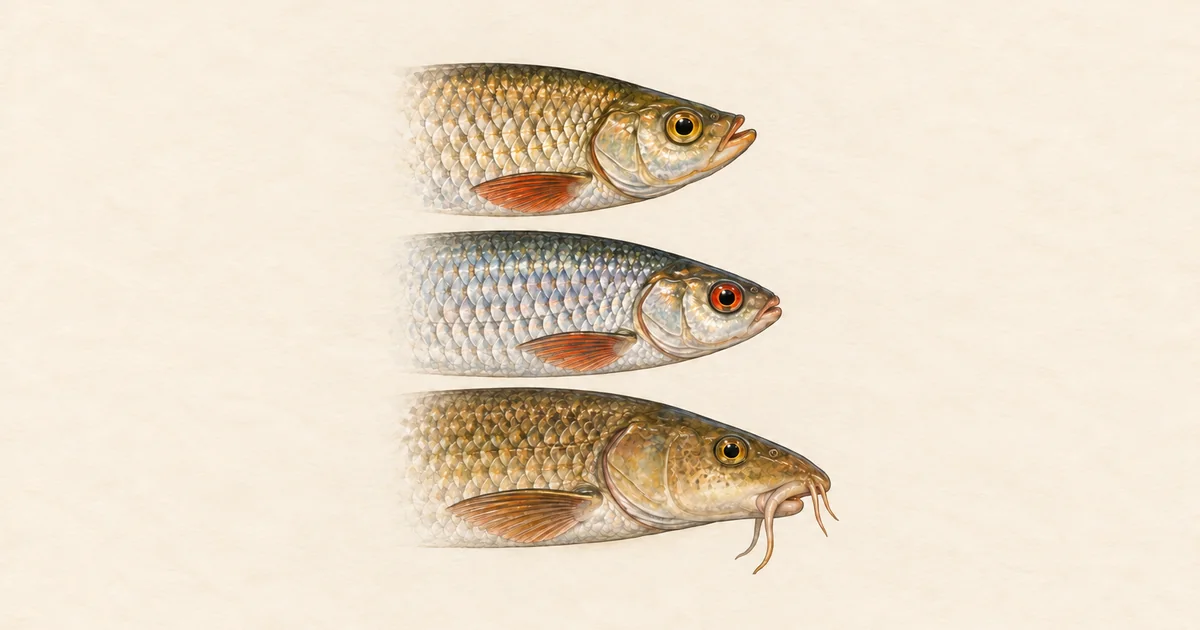
Look at the head from the side. What matters is which jaw protrudes, even a slight overhang counts.
- Superior: The lower jaw projects beyond the upper jaw, the mouth opening points obliquely upwards. This is the case in rudd and bleak, and among the predators in asp and pike.
- Terminal: Both jaws are equally long, the opening points straight ahead. Examples are roach, chub, tench and zander.
- Inferior: The lower jaw is shorter, the snout projects and the mouth opens downwards. This applies to barbel, common nase and gudgeon, and in a mild form to the bream.
The descriptions follow a worksheet of the German Anglers‘ Association and the exam questions of the state angling exam (Fischerprüfung) in Bavaria. Which species has which mouth is given there and in the fish encyclopaedia of the Landesfischereiverband Bayern (LFV Bayern).
There are transitions between the forms, and the sources do not always draw the line in the same place. The fish encyclopaedia calls the asp slightly superior, the exam questions call it superior. The bream is slightly inferior according to LFV Bayern, strongly inferior in the magazine Blinker. The mouth of the ide is terminal and points slightly upwards. In the Identify a fish tool, two answers are therefore accepted for such intermediate forms.
What the position tells you about feeding
A superior mouth is found in species that take prey at the surface (Wikipedia: Fischmaul). In summer the rudd stands just below the water surface and waits for insects falling into the water (information board of the Fischereiverband Mittelfranken). Such prey is called aerial food. According to LFV Bayern the bleak also lurks just below the surface for insects. The asp is regarded as a surface predator: after spawning it is usually found in the upper water layers (Blinker).
According to Wikipedia, the terminal mouth is common in fish of the middle water layer. The roach likes to stay in mid-water in still waters, writes Blinker.
Fish with an inferior mouth take their food mainly in the bottom zone, say the Bavarian exam questions. The barbel is a bottom fish and eats small bottom animals such as worms, insect larvae, snails and mussels. The common nase scrapes its food off the stones on the bottom with its sharp-edged mouth (LFV Bayern).
Protrusible mouth, barbels and pharyngeal teeth
The mouth of cyprinids is generally protrusible (Spektrum, Kompaktlexikon der Biologie). In bream and carp it becomes a tube, and the small mouth of the tench can also be protruded. The bream uses it to suck insect larvae, worms, snails and small mussels out of the soft bottom. It stands vertically on its head and leaves funnel-shaped feeding pits, according to the information board from Mittelfranken (Fig. 2).
Barbels are thread-like skin organs at the mouth with numerous taste buds and touch corpuscles (Spektrum, Lexikon der Biologie). The fish feels and tastes with them. They are found on the barbel and gudgeon, which live on the bottom, and also on carp, tench, wels catfish and burbot.
According to the same encyclopaedia, the mouth of cyprinids generally has no teeth. Instead, pharyngeal teeth sit on the pharyngeal bones, and the Bavarian exam questions also mention a chewing pad. Even the asp, which lives as a predator, has no teeth according to LFV Bayern.
Mouth gape and teeth of predatory fish
In predatory fish the wide mouth gape stands out. In the zander it reaches the rear edge of the eye and often beyond, in the asp to below the middle of the eye. The Spektrum encyclopaedia calls the snout of pike duck-billed and deeply cleft.
- Zander: Besides small brush teeth, both jaws carry large canine teeth. They hold the prey.
- Pike: The lower jaw carries strong, very sharp canine teeth. In addition there are many small, pointed, backward-facing villiform teeth that fill a large part of the mouth. The prey is swallowed whole.
- Wels catfish: The large mouth carries numerous small, brush-like teeth.
The information comes from the fish encyclopaedia, the Spektrum encyclopaedia and the exam questions of the Saxon state office. For the pike, the Bavarian exam questions name a hooklength made of bite-proof material, for example steel. They also state that handling fish with sharp teeth carries an increased risk of injury. Disgorgers and long forceps for such fish are covered on the page Landing a fish and unhooking it. This text does not replace medical advice.
Bait depth: a rule of thumb with exceptions
For fishing this gives a rule of thumb: present the bait in the water layer that suits the mouth of the target species.
- Superior: at the surface or slowly sinking. For the rudd, Blinker names baits that sink only slowly or float, such as bread. The bait is often taken as it sinks.
- Terminal: The layer is the least fixed here. Start in mid-water and change the depth in small steps, as described under float fishing.
- Inferior: on the bottom. For the barbel the bait should lie still or only roll slowly over the bottom, writes Blinker. Ledgering and feeder fishing suit this.
Rule of thumb, not a law. The mouth position shows a preference. Where a species is feeding at the moment also depends on water temperature and food supply, as the examples show.
These species deviate from the rule:
- Roach: terminal, but it looks for its food more on the bottom than the rudd. According to FishBase it switches between bottom animals and zooplankton depending on what is available.
- Chub: terminal, but from spring to autumn it also eats insects and then takes the dry fly. According to Blinker the rule for it is: the colder the water, the deeper.
- Dace: inferior, yet according to LFV Bayern a sociable surface fish that also eats aerial insects.
- Rudd: Large fish often stand in or below the shoal and, according to Blinker, are more likely to be caught when ledgering.
- Carp: mainly eats bottom animals, but according to FishBase also sucks in drifting insects at the surface.
Telling similar species apart by the mouth
For some look-alike pairs a glance at the mouth is enough. The information comes from the fish encyclopaedia, the Bavarian exam questions and the teaching material of the Saxon state office.
| Pair | First species | Second species |
|---|---|---|
| Roach and rudd | terminal | superior |
| Chub and dace | terminal, large | inferior |
| Chub and ide | terminal, large | terminal, small |
| Asp and chub | superior, cleft to below the middle of the eye | terminal |
| Bream and silver bream | tube protrudes far | protrudes less far |
| Common nase and vimba | lower lip horny and sharp-edged | horseshoe-shaped, lips not horny |
| Young barbel and gudgeon | four barbels | two barbels |
The identification only becomes certain with a second feature. In the roach the dorsal fin begins vertically above the pelvic fins, in the rudd behind them. The whole comparison is on the page about the roach. According to the Saxon exam questions you can reliably recognise the ide by its small scales and the inward-curved anal fin. According to LFV Bayern the roach can also hybridise with rudd, bream and bleak.
A second look is worthwhile for another reason too: different closed seasons and minimum sizes may apply to similar species. What applies is set by your federal state (Bundesland), more under Closed season and minimum size explained.
Frequently asked questions
What mouth position does the carp have?
The Spektrum Lexikon der Biologie describes the mouth of the carp as terminal, often thick-lipped and protrusible. According to FishBase the carp nevertheless looks for its food mainly on the bottom. So the position alone does not tell everything.
How many barbels do the native species have?
According to the Bavarian exam questions, carp and barbel have four barbels, tench and gudgeon two and the wels catfish six. The burbot has a single one on the lower jaw. Crucian carp and Prussian carp have none, which is how you tell them from the carp.
Does the pike feed at the surface because its mouth is superior?
No. Its mouth is duck-billed and superior, the lower jaw juts out. But the pike usually stands hidden among water plants and grabs prey swimming past with a quick lunge (LFV Bayern). For the water layer the position says little in its case.
Related
- Identify a fish: asks for the mouth position as one of several features.
- Species trainer: practise fish species from pictures.
- Bream: lift bite and bream runs.
- Float rig and running ledger rig: the set-up for bait in mid-water and on the bottom.
- The year at the water: how temperature and layering shift where fish stand.
- Food of fish: what is eaten in which water layer.
- Recognising fish families: telling families apart by a few features.
Sources
- Landesfischereiverband Bayern: Fischlexikon (Maul, Zähne und Nahrung der Arten)
- Bayerische Landesanstalt für Landwirtschaft, Institut für Fischerei: Staatliche Fischerprüfung in Bayern, Prüfungsfragen (Begriff unterständig, Bodenzone, Rapfen, Hecht, Karpfen, Barteln, Schlundzähne, Vorfach)
- Sächsisches Landesamt für Umwelt, Landwirtschaft und Geologie: Artenkunde „verwechselbare Fische“ (Maul von Döbel, Hasel, Aland, Nase und Zährte)
- Sächsisches Landesamt für Umwelt, Landwirtschaft und Geologie: Prüfungsfragen Spezielle Fischkunde (Zähne von Zander und Hecht, Aland und Döbel)
- Deutscher Angelfischerverband: Lösungsblatt 3 zum Unterrichtsbaustein „Wenn Fische Fische fressen“ (ober- und endständig, Rotauge und Rotfeder)
- Fischereiverband Mittelfranken: Infotafel Rotfeder, Roach, Brachse am Rothsee (Nahrungssuche der drei Arten)
- Spektrum, Lexikon der Biologie: Barteln (Aufbau und Aufgabe)
- Spektrum, Kompaktlexikon der Biologie: Cyprinidae (zahnloses Maul, Schlundzähne)
- Spektrum, Lexikon der Biologie: Karpfen (Maul des Karpfens)
- Spektrum, Lexikon der Biologie: Hechte (Schnauze, Unterkiefer, Beutefang)
- FishBase: Rutilus rutilus (Nahrung des Rotauges)
- FishBase: Cyprinus carpio (Nahrung des Karpfens)
- Blinker: Steckbrief Rotfeder (Köder an der Oberfläche)
- Blinker: Steckbrief Barbe (Köder am Grund)
- Blinker: Steckbrief Döbel (Trockenfliege, Tiefe)
- Blinker: Steckbrief Rapfen (Oberflächenräuber)
- Blinker: Steckbrief Rotauge (Mittelwasser)
- Blinker: Steckbrief Brassen (Maul der Brachse)
- Wikipedia: Fischmaul (Maulstellung und Wasserschicht, ergänzend)
Text AI-assisted, drawing AI-generated. Sources opened and checked in October 2026; no graphics taken from the sources.
All figures are guide values without guarantee. The mouth position is one feature among several: if in doubt, identify a fish by further features before you decide whether to keep or release it.