
Knowledge – Fish
Silver bream: Identification, habitat and fishing
The silver bream (Blicca bjoerkna), also called Blicke or Halbbrasse in German, is a silvery, deep-bodied cyprinid of still and slow-flowing waters. It lives in small shoals near the bottom and often stands together with bream. How to identify it reliably and what matters when catching it is covered here.
In short: The best time to catch silver bream is July to August, above all at night. Good spots in a lake: weed bed; in a river: calm bay. Proven baits: maggots, pinkies, casters, small dung worms and bloodworm. Step by step: Fishing for silver bream.
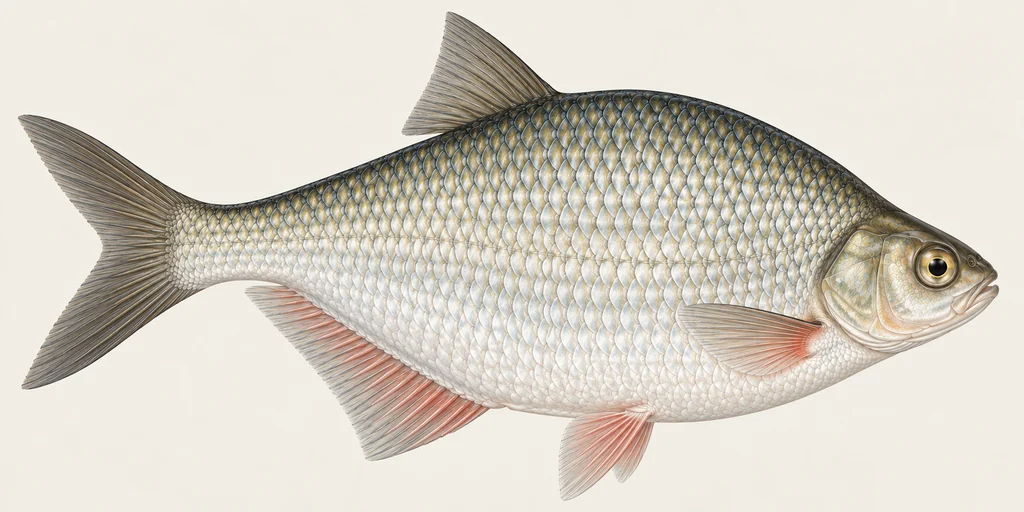
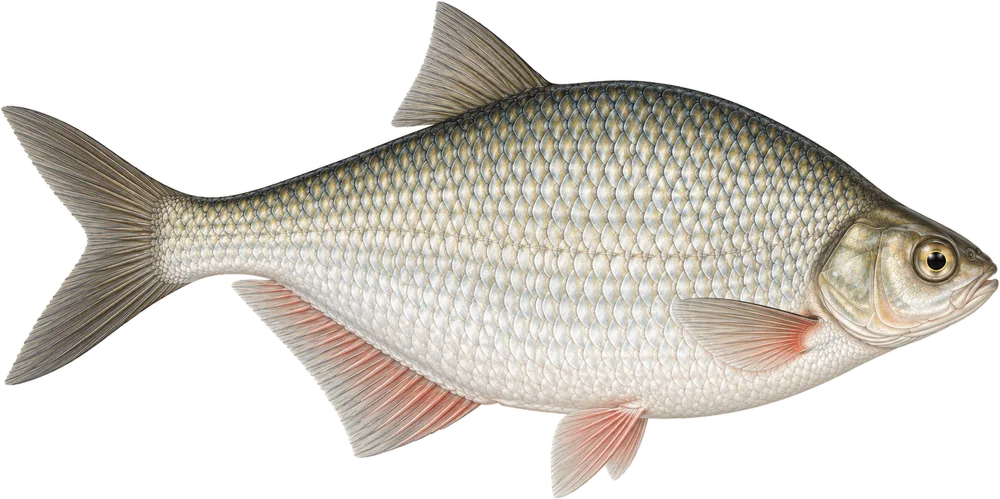
- Large eye: its diameter is at least as large as the length of the snout
- Pectoral and pelvic fins reddish at the base
- High-backed, strongly flattened body at the sides, shining silvery
Catch chances through the year
- Hardly any chance
- Possible
- Good
- Peak season
- Spawning (observe the closed season)
Editorial assessment for waters in Germany, not a measured value and no guarantee. Spawning time is not the same as the legal closed season.
Species profile and sources in the catch calendarAll species compared month by monthThe rules of your federal state
How to recognise it
The silver bream has a very deep body, strongly compressed from the side. The scales gleam silvery; the golden tone of older bream is missing. The bases of the pectoral and pelvic fins are reddish. The mouth is slightly sub-terminal and cannot be protruded as far as in the bream.
The large eye is striking: its diameter is greater than the length of the snout. The pectoral fins end before the pelvic fins and do not reach their base. FishBase counts 43 to 46 scales along the lateral line, Saxon sources give 45 to 50. The silver bream stays small: the Bayerischer Landesfischereiverband gives 10 to 25 centimetres, rarely up to 30. FishBase lists 45,5 centimetres as the maximum, with typical fish measuring 20 there. Rute & Rolle also gives up to 45 centimetres and an average weight of 200 to 400 grams, at most 1,5 kilograms.
A reliable feature is the anal fin. Its base lies roughly opposite the end of the dorsal fin, and the edge is nowhere near as strongly curved inwards as on the bream. Saxon sources give 19 to 23 soft rays, against 23 to 28 for the bream. FishBase counts 23 to 30 for the bream, and the caption gives that figure.
The silver bream is mistaken above all for the bream (Brachse). On the bream the bases of the paired fins are grey, the eye is small in relation to the head, and the fish grows distinctly longer. Blinker even gives length as a distinguishing feature. Another relative with a very long anal fin is the blue bream.
The two species often live in the same shoal, and hybrids occur. According to FishBase the silver bream also regularly hybridises with the vimba. The surest check is therefore the eye and the fin bases. The roach, described in the lexicon under Roach, has a red iris and a terminal mouth by comparison.
Side by side
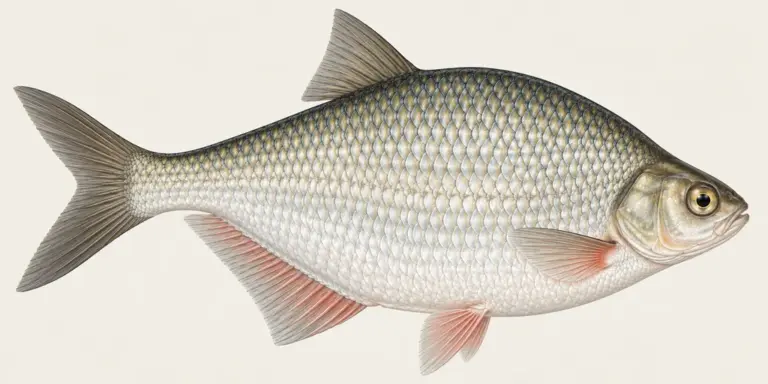
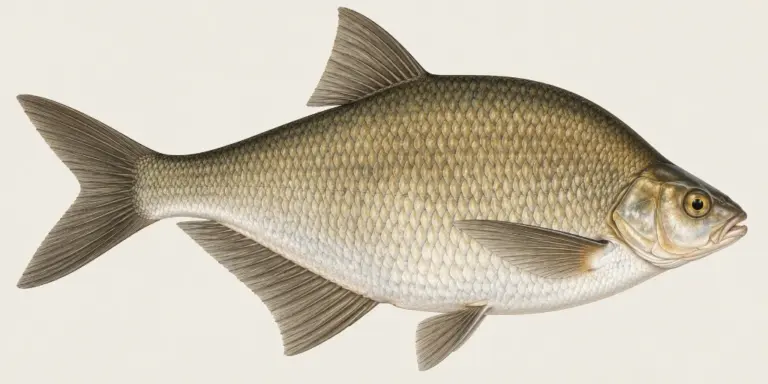
AI-generated illustrations.
Where it lives
The silver bream lives in lakes, oxbow lakes, impoundments, canals and slow-flowing rivers of the bream zone, and according to Saxon sources also in brackish water. According to FishBase it prefers shallow, warm lowland lakes and the calm lower reaches of large rivers. On the bed of large sandy rivers it can be very numerous. It makes no special demands on its habitat.
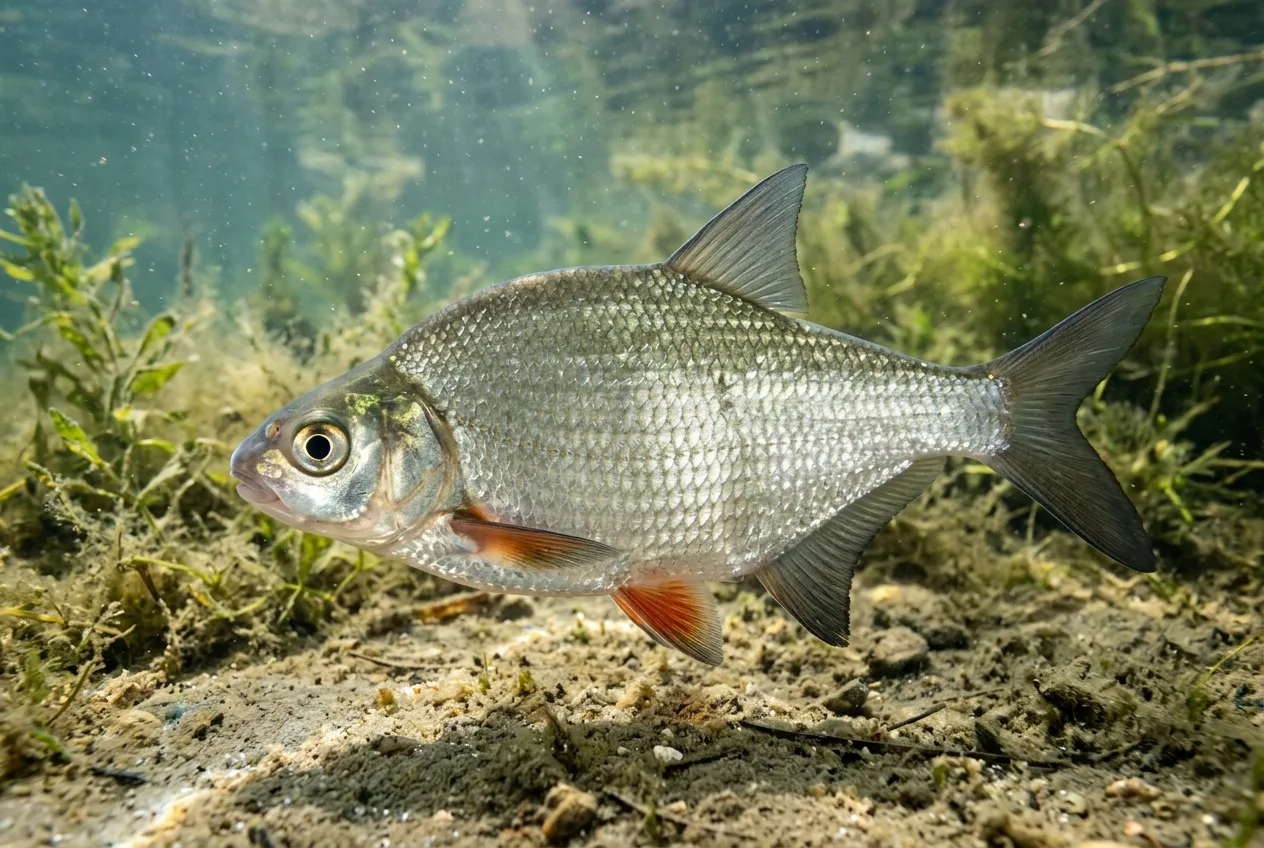
It lives in shoals and close to the bottom, often together with bream. For its winter rest it withdraws to deeper parts of the water.
Holding spots in the picture
Choose the season and time of day: the picture shows where the species stands then. Spots outlined in red apply only in the chosen season. Tap a fish or a spot in the list to bring it closer. The picture is schematic and AI-generated, every water is different.
Chance of a catch in springgood
Catch chance in summerPeak season
Catch chance in autumnpossible
Catch chance in winterhardly any
- J
- F
- M
- A
- M
- J
- J
- A
- S
- O
- N
- D
Spawning season
No main time FishBase describes the silver bream as mainly nocturnal.
No main time FishBase describes the silver bream as mainly nocturnal.
No main time FishBase describes the silver bream as mainly nocturnal.
Active time FishBase describes the silver bream as mainly nocturnal.
In the lake
Water lilies and weed bed
Silver bream are found here only in spring, summer and autumn.
Deep bottom
Silver bream are found here only in winter.
The silver bream lives in small shoals near the bottom and prefers weedy margins. It is common in shallow, warm lowland lakes.
Spring: according to the fishing calendar, catch chances are possible in March and good in April and May. Spawning starts in May, in shoals on shallow, weedy spots along the bank.
Summer: catch chance according to the catch calendar is good in June and peak season in July and August.
Autumn: catch chance according to the catch calendar good in September, possible in October, hardly any in November.
Winter: according to the fishing calendar, catch chances are slim. For their winter rest, silver bream retreat to deeper parts of the water.
In the river
Calm bay with aquatic plants
Silver bream are present here all year round.
In rivers, silver bream keep to calm, slow stretches, backwaters and canals, preferring weedy banks there. On the bed of large, sandy rivers they are often very numerous.
Spring: according to the fishing calendar, catch chances are possible in March and good in April and May. Spawning starts in May along the banks, on water plants and roots, and also over shallow gravel.
Summer: catch chance according to the catch calendar is good in June and peak season in July and August.
Autumn: catch chance according to the catch calendar good in September, possible in October, hardly any in November.
Winter: according to the fishing calendar, catch chances are slim. For their winter rest, silver bream retreat to deeper parts of the water.
Depth: The silver bream lives close to the bottom and mostly feeds there, but according to the Canal & River Trust it often feeds in mid-water too.
Size comparison: AI-generated drawing, schematic.
How it hunts and spawns
Silver bream search mainly on the bottom for insect larvae, worms, small mussels, snails and plankton. The British Canal & River Trust notes, however, that they often feed in mid-water rather than on the bottom. FishBase describes them as mostly nocturnal.
According to the Bayerischen Landesfischereiverband they spawn in May and June, according to FishBase into July. The shoals spawn with loud splashing on shallow, weedy banks. The sticky eggs attach to water plants, and according to FishBase also to roots or shallow gravel. The males then carry fine spawning tubercles. According to FishBase the males show trembling, splashing movements that trigger the release of eggs and milt over the plants. The larvae grow up in quiet parts of the water.
When it bites
The warm season is a good time to fish. Because silver bream shoal together with bream, you usually catch them on the bream swim, especially in calm bays and impoundments. During spawning the shoals move into the shallows along the banks.
In winter the fish withdraw to deeper spots.
Today’s catch index needs JavaScript. Season and spawning time are in the catch calendar.
You will find the monthly overview of all species and the water temperature check in the catch calendar.
From the blog: Freshwater fish in Germany: which species you catch where · Roach or rudd, bream or silver bream: how to tell these silver fish apart reliably
What to catch it with
Step by step: Fishing for silver bream: tips on bait, rig and tackle – season, swims, bait, tackle and rules on one page.
The silver bream is regarded as a poor target species, and FishBase calls it of little interest to sport anglers and consumers. You mostly catch it as a by-catch when fishing for bream. The methods Blinker names for bream suit it: the fine float rig at the edge of shoals or the feeder rig on the bottom. When float fishing, the lowest weight usually lies on the bottom so that the bait is presented on the bottom. If the bites stay away, you set the bait shallower, because silver bream often feed in mid-water too.
Good baits are maggots and casters, small worms and sweetcorn. For bream Blinker names the maggot or a bunch of maggots as the standard bait and stresses how important feeding is to keep a shoal in the swim. The same applies accordingly to the silver bream that shoals with it. Because it stays small, you choose small hooks and fine tackle. When legering, you place the rod firmly on two rod rests, following Blinker, and strike at every tug on the tip.
Watch for lift bites: If the silver bream lifts the bait off the bottom, the float rises out of the water or lies flat. According to Blinker bream show the same lift bite, and then you strike.
Identify it by the eye: If you are unsure whether it is a silver bream or a young bream, compare the eye and the fin bases. On the silver bream the eye is larger than the snout is long, and the pectoral and pelvic fins are reddish at the base.
Think carefully before keeping a fish: FishBase calls the silver bream of little interest to consumers. If you keep a fish anyway, the duty to stun and kill it applies, and the steps are under Stunning and killing fish.
Handle small fish gently: Wet hands protect the slime on the scales. How to land and unhook fish is on the page Landing and unhooking fish.
Suitable lures
Maggots, pinkies, casters, small dung worms and bloodworms (midge larvae).
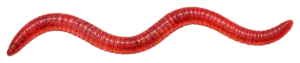
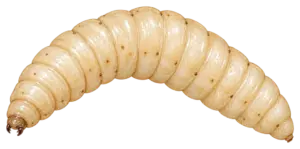
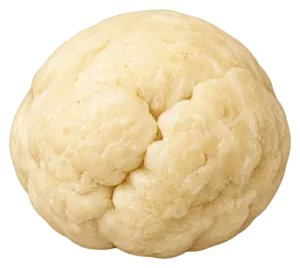
AI-generated illustrations. A click opens the lure’s page.
Rigs for these lures: float rig, running ledger rig.
How to prepare a silver bream for the kitchen
As a food fish the silver bream has little standing. In Norway it is regarded as hardly usable for the table, and commercial fishermen dislike it because it stays small and takes food from more sought-after species. If you keep one anyway, you can cook it whole, because small fish up to about 30 centimetres each make one portion for one person. Beforehand it is gutted.
Like every member of the carp family, the silver bream has forked bones that sit in the flesh without connection to the backbone. So that they do not get in the way, you cut the flanks at intervals of two to three millimetres almost down to the central bone. This chops the bones into many tiny pieces that are hardly noticeable when eating. If you want to freeze silver bream, make these cuts beforehand, because thawed flesh is softer and tears easily. Filleting fish shows how the cuts are placed.
What you need to observe
Closed seasons (Schonzeit), minimum sizes (Mindestmaß) and harvest windows are set by the federal states (Bundesland), and on many waters additionally by the club or leaseholder. They differ depending on the water and the time of year. We give figures only with a date and a source; always binding are the fisheries regulation of your federal state and your fishing permit (Erlaubnisschein). You will find a list of links to the official sources in the catch calendar.
A fish of legal size that you want to keep you stun and kill at once, in line with animal welfare rules. Protected, undersized fish or fish too large under a harvest slot you unhook, if possible still in the water and with wet hands, and release gently. What exactly applies is regulated by state law and your fishing permit (Erlaubnisschein).
The silver bream is rated as least concern in the German Red List of 2023, with a moderately common stock and a stable short-term trend. In Saxony it is so widespread, according to the Red List of 2015, that it no longer counts as endangered. FishBase occasionally mentions it as a baitfish. Many federal states (Bundesländer) expressly ban live baitfish, more under Baitfish.
What closed season, minimum size and harvest slot mean and where to find them is explained on the page Closed season and minimum size explained.
Frequently asked questions (FAQ)
How do I tell a silver bream from a bream?
The silver bream has a large eye, reddish bases to the pectoral and pelvic fins, and can hardly protrude its mouth. On the bream the fin bases are grey, the eye is small, and the fish grows distinctly longer.
How big does a silver bream get?
Mostly 10 to 25 centimetres. The Bayerischer Landesfischereiverband gives at most 30 centimetres, FishBase 45,5 centimetres as the maximum, Rute & Rolle up to 45 centimetres and 1,5 kilograms.
When and where is the best time to catch silver bream?
In the warm season on the bream swim on the bottom of lakes, impoundments and calm river stretches. Maggots, casters and sweetcorn on a fine float or feeder are enough.
Sources
The rating of catch chances is an editorial assessment. The facts come from these sources, and the text is worded in our own words. The illustration is an original design by Angel Momente in the style of a natural history plate (AI-generated, see the AI notice).
- Landesfischereiverband Bayern: Fischlexikon (Laichzeit, Lebensraum, Nahrung, Aktivität)
- FishBase: Blicca bjoerkna (Schuppenzahl, Auge, Lebensraum, Aktivität, Laichzeit)
- Rote-Liste-Zentrum: Güster (Rote Liste der Süßwasserfische Deutschlands 2023: ungefährdet)
- Wikipedia: Güster (Fisch) (Merkmale, Größe, Unterschied zur Brasse, Bedeutung)
- Sächsisches Landesamt für Umwelt, Landwirtschaft und Geologie: Artenkunde verwechselbare Fischarten (Blei, Güster, Zope)
- Sächsisches Landesamt für Umwelt, Landwirtschaft und Geologie: Gefährdungssituation der Fische und Rundmäuler in Sachsen 2015
- Blinker: Steckbrief Brassen (Merkmale, Köder, Anfüttern, Hebebiss, Hybriden mit Güster)
- FishBase: Abramis brama (Höchstalter, Lebensraum)
- Canal & River Trust: Silver bream (Güster: Fresstiefe im Mittelwasser, Lebensraum, feines Gerät)
- Rute & Rolle: Güster (Blicca bjoerkna), Fischkunde (Größe, Gewicht, Gewässer, Laichzeit)
- Store norske leksikon: flire
- Landesfischereiverband Bayern: Lernportal der Fischerjugend, Betäuben und Schlachten (Gräten)
- Landesfischereiverband Bayern: Lernportal der Fischerjugend, Fische aufbewahren, zerteilen und filetieren
Created with AI support from the sources listed. Figures only appear in the text if a source gives them. Last updated: 8 November 2026. Found a mistake? Write to us. Who is behind this site: About me.
More in the lexicon
- All fish species at a glance
- Catch calendar – month, water temperature and profile for 93 species
- Line calculator – breaking strain after the knot, drag guideline, backing
- Angling methods