
Knowledge – Fish
Blue bream: Features, difference from the white-eye bream, habitat
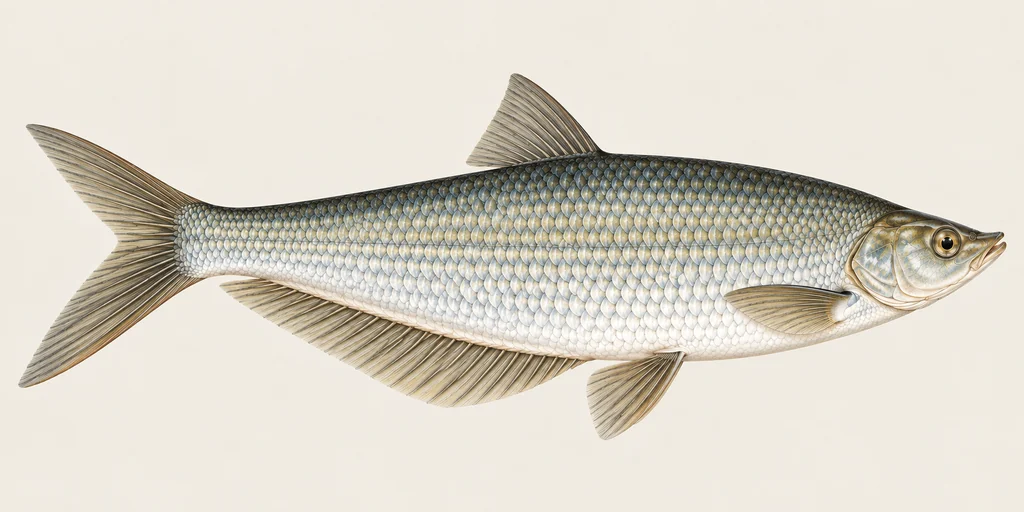
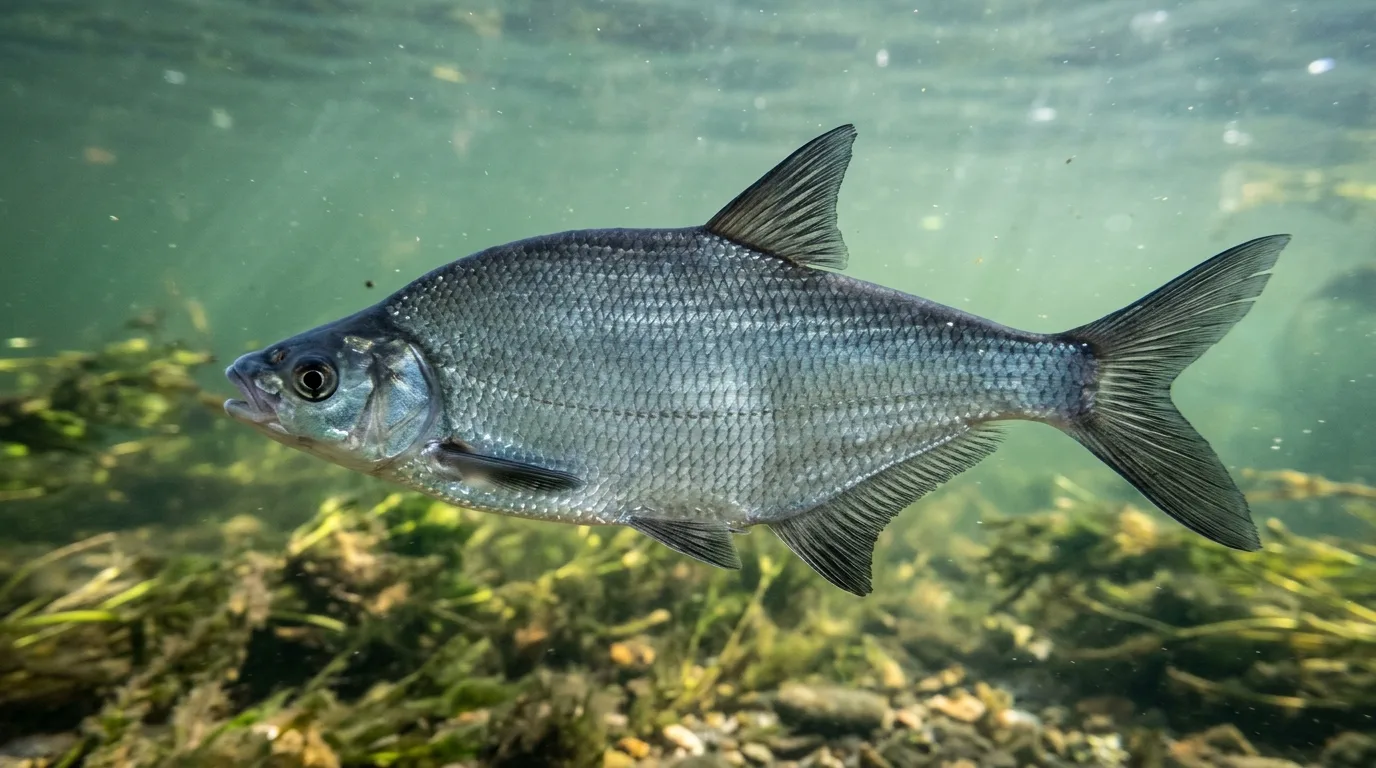
The blue bream (Ballerus ballerus) is a deep-bodied cyprinid of large lowland rivers with a very long anal fin and a pointed head. Unlike its relatives it feeds mainly on zooplankton in open water. In Germany it is very rare and is listed in the Red List as threatened.
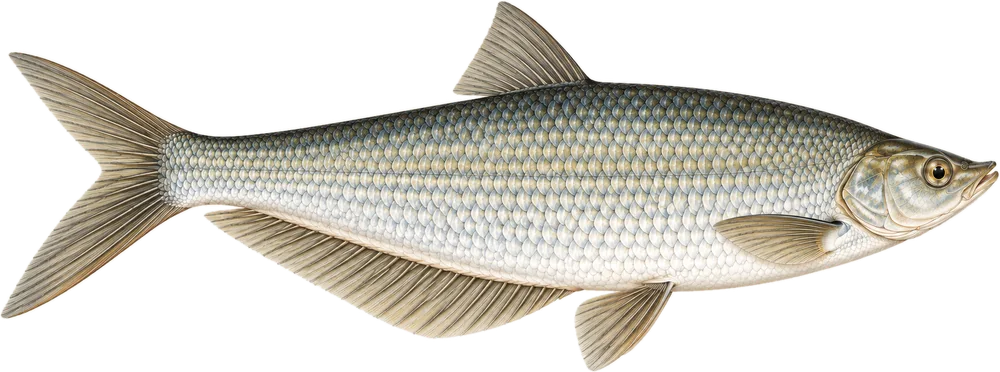
In short: The blue bream is listed as threatened in Germany’s Red List and is very rare. It is not a target fish; a bycatch is released gently. What to do with a bycatch: blue bream as bycatch.
- Small head tapering to a point, with a terminal mouth pointing obliquely upwards
- Very long anal fin under a small, high dorsal fin
- Lower lobe of the tail fin clearly longer than the upper
Catch chances through the year
- Hardly any chance
- Possible
- Good
- Peak season
- Spawning (observe the closed season)
Editorial assessment for waters in Germany, not a measured value and no guarantee. Spawning time is not the same as the legal closed season.
Species profile and sources in the catch calendarAll species compared month by monthThe rules of your federal state
How to recognise it
The blue bream has a deep body, strongly flattened from the sides. The head is small, elongated and tapers to a point. The mouth is terminal, the gape pointing obliquely upwards. The eyes sit far forward. The very long anal fin stands out, while the dorsal fin is small and high. In the tail fin the lower lobe is clearly longer than the upper.
The flanks gleam silvery with a brownish sheen, the back is darker, and the fins have dark edges. The NÖ Landesfischereiverband also describes a reddish throat. According to FishBase there are 62 to 77 small scales along the lateral line. Usual lengths are 20 to 30 centimetres; FishBase gives 49 centimetres as the maximum length.
Blue bream or white-eye bream?
| Feature | Blue bream | White-eye bream |
|---|---|---|
| Mouth | terminal, gape pointing obliquely upwards | small, slightly inferior |
| Snout | tapering to a point | blunt, domed above the eyes |
| Scales along the lateral line | 62 to 77 | 47 to 54 |
| Occurrence in Germany | mainly the Elbe, Havel and Oder, a small stock in the Danube | Danube; introduced in the Rhine |
The most similar is the white-eye bream. It has a slightly inferior mouth, a blunt, domed snout and, at 47 to 54, clearly fewer but larger scales along the lateral line. In Germany you find the white-eye bream only in the Danube and Rhine, whereas the blue bream is found mainly in the Elbe, Havel and Oder.
Bream and silver bream are deeper-bodied and have a clearly shorter anal fin. You can also recognise the silver bream by its yellow-orange fin bases.
Side by side
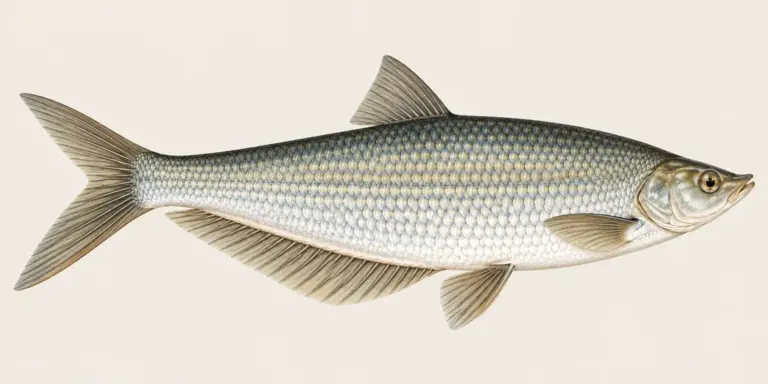
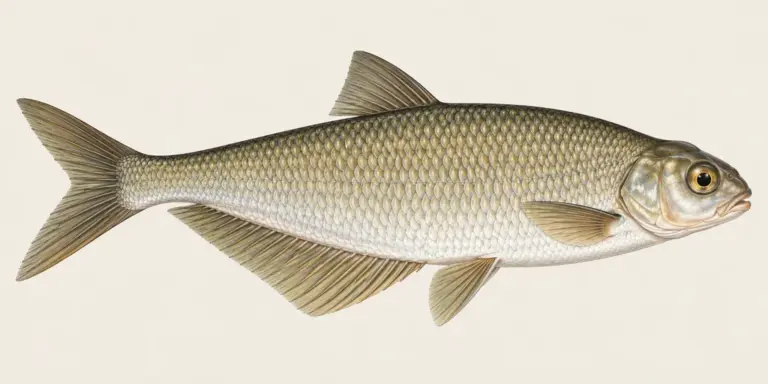
AI-generated illustrations.
Where it lives
The blue bream lives in the lower, flowing sections of large rivers, that is in the barbel and bream zones, and uses their oxbow lakes and floodplains. Large, open oxbows serve it for foraging and as winter quarters. Add to that nutrient-rich lowland lakes and some lakes in the catchments of the North Sea and Baltic Sea. To feed it also moves into freshened sea areas, on the southern Baltic mainly into the large river mouths.
In Germany the most important stocks lie, according to the Red List, in the lower Elbe and Havel and above all in the lower Oder. There is also a small stock in the Bavarian Danube. How badly the fish die-off in the Oder in August 2022 hit the blue bream had not yet been established when the Red List was published.
Holding spots in the picture
Choose a season and time of day: the picture shows where the species sits then. Tap a fish or a spot in the list to bring it closer. The picture is schematic and AI-generated, every water is different.
In the river
Calm bay with aquatic plants
The blue bream is found here all year round.
Free current in mid-river
The blue bream is found here all year round.
The blue bream lives in the lower reaches of large lowland rivers and in their oxbow lakes. There it travels through open water in small groups and feeds on plankton.
Spring: This is when spawning takes place, so observe the closed seasons. In spring, fish ready to spawn migrate upriver onto the flooded areas of the floodplain.
Winter: It spends the winter in large, open oxbow lakes.
In the lake
Open water
The blue bream is found here all year round.
Just below the surface
The blue bream is found here all year round.
In nutrient-rich lowland lakes it stays in open water. Besides plankton, it takes insects that fall onto the surface.
Spring: The spawning season falls in this period; observe the closed seasons (Schonzeiten).
On the coast
Open water, mid-water
The blue bream is found here all year round.
On the southern Baltic Sea it looks for food in water of reduced salinity, above all in the mouths of large rivers.
Spring: The spawning season falls in this period; observe the closed seasons (Schonzeiten).
Size comparison: AI-generated drawing, schematic.
How it feeds and spawns
The blue bream stays in small groups in open water. Unlike its close relatives it feeds, according to the LFV Bayern, mainly on zooplankton, plus algae and drift food, that is insects that fall onto the water surface.
Spawning takes place in spring, from April to June according to the LFV Bayern. For this the fish travel, sometimes far, upriver, usually onto the floodplains of the riverside woodland. The eggs stick to water plants, sometimes also to gravel in moderate current. According to HELCOM a female lays 5000 to 20.000 eggs, and the males often guard spawning territories at the bank. The juveniles grow up in backwaters and flooded bank zones.
According to HELCOM the blue bream becomes sexually mature at three to four years. FishBase states that it can live for more than ten years.
Is there a season?
There is no angling season in the usual sense for the blue bream. Because it is rare and threatened, we do not list it as a target fish. That is why all months are at zero in the catch calendar.
In spring, fish ready to spawn move into the floodplain woodlands and floodplains. In winter, blue bream stay in large, open oxbow lakes.
You will find the monthly overview of all species and the water temperature check in the catch calendar.
What to do with a bycatch
As bycatch: Fishing for blue bream? – why the species is not a target fish and what you do with a bycatch.
The blue bream is not fished for deliberately. As a bycatch it is most likely where it lives: in large lowland rivers and their oxbow lakes.
Unhook the fish in the water if possible, handle it only with wet hands and release it at once. Remember the anal fin and the position of the mouth. That way you will recognise the species next time and tell it apart from bream and silver bream.
Look at the anal fin and mouth: A very long anal fin, a pointed head and a mouth pointing obliquely upwards point to the blue bream. Bream and silver bream have a clearly shorter anal fin.
Keep a bycatch brief: Leave the fish in the water, skip long photo sessions on the bank and release it quickly.
Suitable lures
We deliberately show no baits for this species.
Threatened and very rare: do not target it, release a bycatch at once and gently, and observe state law.
What you need to observe
The blue bream is listed as threatened in Germany’s 2023 Red List, and its stock is regarded as very rare. In the previous list it was still on the early-warning list. In Lower Austria it is protected all year round according to the Landesfischereiverband there. Whether and how it is protected in your water is governed by state law.
Bavaria protects the blue bream all year round in the Danube basin, and so does Saxony. Brandenburg protects it from 1 March to 31 May with a minimum size of 20 cm, Mecklenburg-Western Pomerania from 1 April to 31 May. As of October 2026. What counts is the fisheries regulation of your federal state (Bundesland) and your fishing permit (Erlaubnisschein); you will find a list of links to the official sources in the catch calendar.
You release a blue bream you have caught gently with wet hands and, if possible, in the water (releasing fish).
What closed season, minimum size and harvest slot mean and where to find them is explained on the page Closed season and minimum size explained.
What state law says about the closed season (Schonzeit) and minimum size (Mindestmaß) for this species is in the “At a glance” box on the state pages for Bavaria, Brandenburg, Mecklenburg-Western Pomerania and Saxony. Our overview does not list this species for the other states; the state fisheries regulation applies there.
Frequently asked questions (FAQ)
How do I tell a blue bream from a white-eye bream?
The blue bream has a terminal mouth pointing obliquely upwards and small scales, 62 to 77 along the lateral line. The white-eye bream has a slightly inferior mouth, a blunt snout and clearly larger scales.
Where does the blue bream occur in Germany?
Mainly in the lower Elbe, the Havel and the lower Oder. There is also a small stock in the Bavarian Danube.
May I take a blue bream?
Bavaria protects it all year round in the Danube basin, and so does Saxony. Brandenburg protects it from 1 March to 31 May with a minimum size of 20 cm, Mecklenburg-Western Pomerania from 1 April to 31 May (as of October 2026). Because the species is threatened and very rare, we advise releasing a blue bream you have caught gently everywhere.
Sources
The rating of catch chances is an editorial assessment. The facts come from these sources, and the text is worded in our own words. The illustration is an original design by Angel Momente in the style of a natural history plate (AI-generated, see the AI notice).
- Landesfischereiverband Bayern: Fischlexikon (Zope, Zobel)
- FishBase: Ballerus ballerus (Merkmale, Lebensraum, Laichverhalten)
- NÖ Landesfischereiverband: Fischarten in Niederösterreich, Blue bream
- Rote-Liste-Zentrum: Zope (Rote Liste der Süßwasserfische Deutschlands 2023: gefährdet)
- HELCOM Red List: Species Information Sheet Ballerus ballerus (2013)
- FishBase: Ballerus sapa (Vergleichsmerkmale Zobel)
- Rote-Liste-Zentrum: Zobel (Rote Liste 2023, Vorkommen Donau und Rhein)
- Bayern.Recht: Verordnung zur Ausführung des Bayerischen Fischereigesetzes (AVBayFiG), Anlage Schonzeiten und Schonmaße
- Land Brandenburg: Fischereiordnung des Landes Brandenburg (BbgFischO), Anlage zu § 2
- Freistaat Sachsen: Sächsische Fischereiverordnung, Anlage Schonzeiten und Mindestmaße
- LALLF Mecklenburg-Vorpommern: Binnenfischereiverordnung (BiFVO M-V), §§ 3 bis 5
Created with AI support from the sources listed. Figures only appear in the text if a source gives them. Last updated: 27 October 2026. Found a mistake? Write to us. Who is behind this site: About me.
More in the lexicon
- All fish species at a glance
- Catch calendar – month, water temperature and profile for 93 species
- Line calculator – breaking strain after the knot, drag guideline, backing
- Angling methods