
Knowledge – Fish
White-eye bream: Features, difference from the blue bream, range
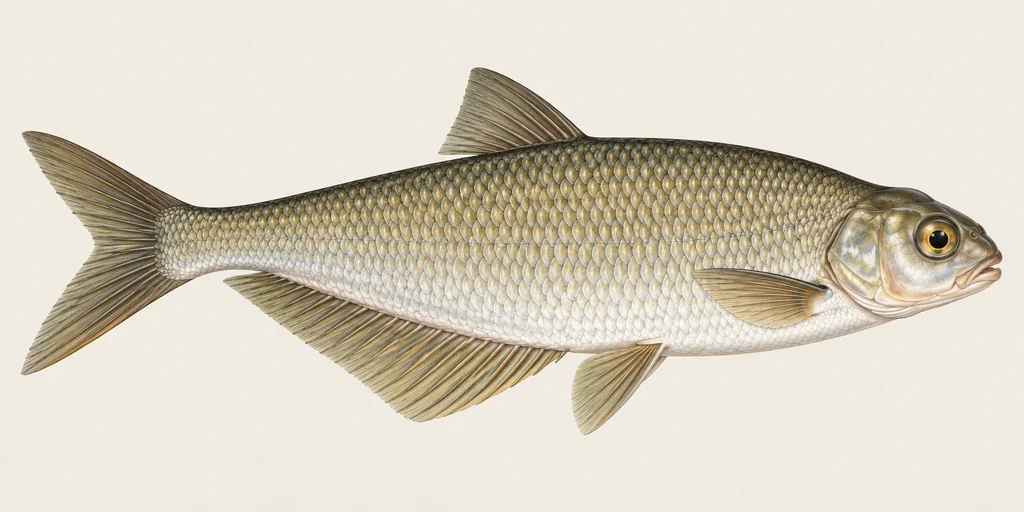
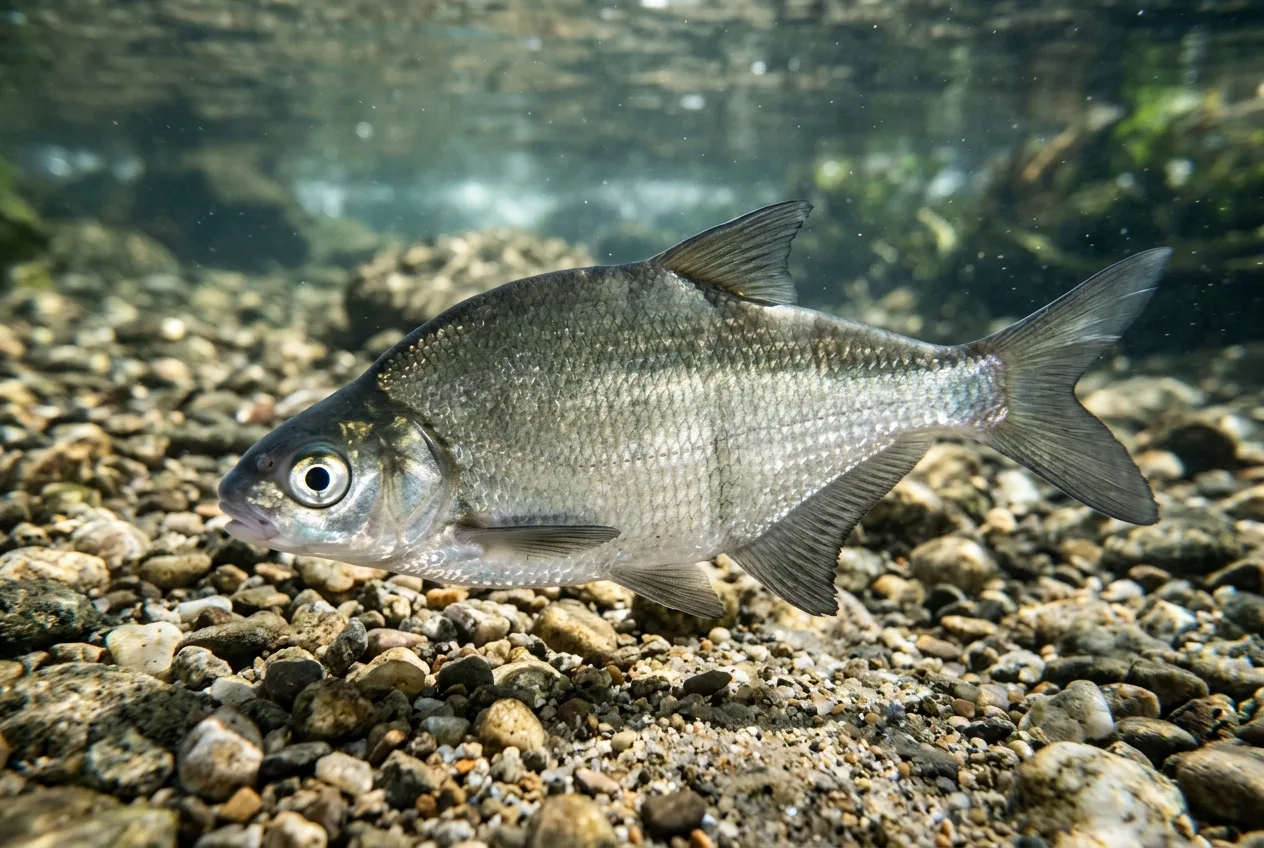
The white-eye bream (Ballerus sapa), also called Sape or Steinbrachsen in Austria, is a deep-bodied cyprinid of large rivers with a blunt, domed snout and a very long anal fin. In Germany it is native only in the Danube and is listed in the Red List as endangered. In the Rhine it lives as an introduced species.
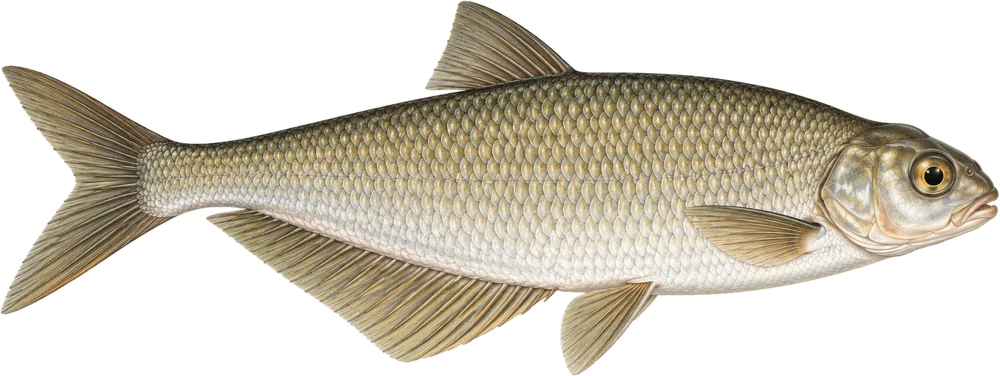
In short: The white-eye bream is listed as endangered in Germany’s Red List. It is native only in the Danube; in the Rhine it lives as an introduced species. What to do with a bycatch: white-eye bream as bycatch.
- Blunt snout strongly arched over the eyes, with a slightly inferior mouth
- Large eye set far forward
- Very long anal fin, lower tail lobe slightly longer than the upper
Catch chances through the year
- Hardly any chance
- Possible
- Good
- Peak season
- Spawning (observe the closed season)
Editorial assessment for waters in Germany, not a measured value and no guarantee. Spawning time is not the same as the legal closed season.
Species profile and sources in the catch calendarAll species compared month by monthThe rules of your federal state
How to recognise it
The body of the white-eye bream is deep and strongly flattened from the sides. The thick, blunt snout, strongly domed above the eyes, is typical. The mouth is small and slightly inferior. The large eyes sit far forward and bulge hemispherically; according to FishBase their diameter is roughly the length of the snout.
The anal fin is very long, and in the tail fin the lower lobe reaches somewhat further than the upper. The body is silvery pale to whitish grey, the back dark grey to faintly greenish grey. According to FishBase there are 47 to 54 scales along the lateral line. The LFV Bayern gives an average length of 15 to 30 centimetres, FishBase a maximum length of 35 centimetres.
White-eye bream or blue bream?
| Feature | White-eye bream | Blue bream |
|---|---|---|
| Mouth | small, slightly inferior | terminal, gape pointing obliquely upwards |
| Snout | blunt, domed above the eyes | tapering to a point |
| Scales along the lateral line | 47 to 54 | 62 to 77 |
| Eye | large, about as long as the snout | smaller, about two thirds of the snout length |
| Occurrence in Germany | Danube; introduced in the Rhine | mainly the Elbe, Havel and Oder, a small stock in the Danube |
The blue bream is the most similar. It has a pointed head, a terminal mouth pointing obliquely upwards and, at 62 to 77, much smaller scales along the lateral line. In Germany the blue bream lives mainly in the Elbe, Havel and Oder, and in the Danube only as a small stock.
Bream and silver bream are deeper-bodied and have a clearly shorter anal fin. In the silver bream the orange-reddish fin bases also stand out.
Side by side
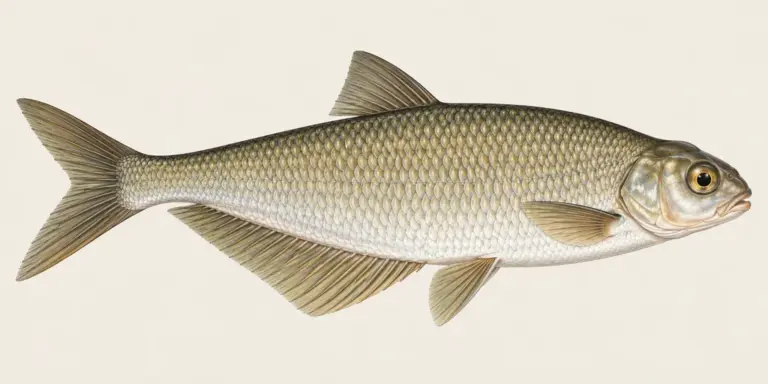
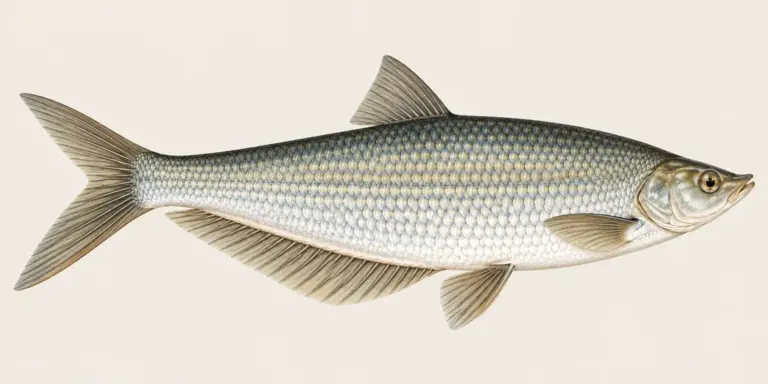
AI-generated illustrations.
Where it lives
The white-eye bream lives in the lower, flowing sections of large rivers in the barbel and bream zones and in their tributaries. According to the NÖ Landesfischereiverband it lives in shoals near the bottom and prefers strong current. It also occurs in slow-flowing and still stretches and in brackish water.
Its original range is the large rivers that drain into the Black, Azov and Caspian Seas and into the Aral Sea. It is native in the Danube. According to FishBase it reached the Rhine in 1995; in Poland it is spreading into the Vistula via a canal from the Dnieper basin. Germany’s Red List assesses only the Danube population; in the Rhine the white-eye bream is still very rare.
Holding spots in the picture
Choose the season and time of day: the picture shows where the species stands then. Spots outlined in red apply only in the chosen season. Tap a fish or a spot in the list to bring it closer. The picture is schematic and AI-generated, every water is different.
No main time FishBase describes the white-eye bream as a fish that is active mainly at night.
No main time FishBase describes the white-eye bream as a fish that is active mainly at night.
No main time FishBase describes the white-eye bream as a fish that is active mainly at night.
Active time FishBase describes the white-eye bream as a fish that is active mainly at night.
In the river
Gravelly shallow (riffle)
White-eye bream (sapa bream) is found here in spring only.
Current seam
White-eye bream (sapa bream) is found here all year round.
Free current in mid-river
White-eye bream (sapa bream) is found here all year round.
The white-eye bream lives in groups just above the bottom of large rivers and looks for small animals there. It likes strong current but also occurs in calmer stretches.
Spring: This is when spawning takes place, so observe the closed seasons (Schonzeiten). In April and May the fish gather to spawn over gravel where the water runs fast.
Size comparison: AI-generated drawing, schematic.
How it feeds and spawns
The white-eye bream looks for food on the bottom. It eats worms, insect larvae, small crustaceans, snails and small mussels, rarely plants as well. FishBase describes it as nocturnal.
Spawning takes place in spring, in April and May according to the LFV Bayern. For this the fish gather in large groups in fast-flowing water over gravel or at submerged plants. The sticky eggs adhere to stones or plants. At spawning time the males carry a fine spawning rash, that is small horny tubercles on the skin.
Semi-migratory stocks around the Black Sea feed in brackish river mouths and move to the lower reaches of the rivers to spawn.
Is there a season?
There is no angling season for the white-eye bream. Because it is endangered in Germany, we do not list it as a target fish, and all months are at zero in the catch calendar.
In spring, white-eye bream ready to spawn gather at gravelly spots with strong flow. It is best to avoid such spots at this time.
You will find the monthly overview of all species and the water temperature check in the catch calendar.
What to do with a bycatch
As bycatch: Fishing for white-eye bream? – why the species is not a target fish and what you do with a bycatch.
The white-eye bream is not fished for deliberately. As a bycatch it is most likely when fishing for coarse fish on the bottom of the Danube, because it looks for food on the bed there.
Unhook the fish in the water if possible, handle it only with wet hands and release it at once. A quick look at the snout, mouth and anal fin is enough to identify it with confidence.
Look at the snout and eye: A blunt snout domed above the eyes and large, bulging eyes point to the white-eye bream. The blue bream has a pointed head and an upturned mouth.
Keep a bycatch brief: Leave the fish in the water, skip long photo sessions on the bank and release it quickly.
Suitable lures
We deliberately show no baits for this species.
Endangered: do not target it, release a bycatch at once and gently, and observe state law.
What you need to observe
The white-eye bream is listed as endangered in Germany’s 2023 Red List, and its stock is regarded as very rare. In the previous list it was still considered not threatened. According to the Red List, the new rating rests on better knowledge, not on a real deterioration. How it is protected in your water is governed by state law.
In Bavaria, where the native stock lives, the white-eye bream is protected all year round in the Danube basin (as of October 2026). What counts is the fisheries regulation of your federal state (Bundesland) and your fishing permit (Erlaubnisschein); you will find a list of links to the official sources in the catch calendar.
You release a white-eye bream you have caught at once with wet hands and, if possible, in the water (releasing fish).
What closed season, minimum size and harvest slot mean and where to find them is explained on the page Closed season and minimum size explained.
What state law says about the closed season (Schonzeit) and minimum size (Mindestmaß) for this species is in the “At a glance” box on the state page for Bavaria. Our overview does not list this species for the other states; the state fisheries regulation applies there.
Frequently asked questions (FAQ)
Are the white-eye bream and the blue bream the same species?
No. Both belong to the genus Ballerus and look alike. The white-eye bream has a blunt snout, a slightly inferior mouth and larger scales; the blue bream has a pointed head and an upturned mouth.
Where does the white-eye bream live in Germany?
It is native only in the Danube. In the Rhine it occurs as an introduced species and is very rare there.
May I keep a white-eye bream?
In Bavaria, where its native stock lives, the white-eye bream is protected all year round in the Danube basin (as of October 2026). Elsewhere too we advise releasing a white-eye bream you have caught at once and gently, because the species is endangered in Germany.
Sources
The rating of catch chances is an editorial assessment. The facts come from these sources, and the text is worded in our own words. The illustration is an original design by Angel Momente in the style of a natural history plate (AI-generated, see the AI notice).
- Landesfischereiverband Bayern: Fischlexikon (Zobel)
- FishBase: Ballerus sapa (Merkmale, Verbreitung, Lebensweise)
- FishBase: Ballerus ballerus (Vergleichsmerkmale Zope)
- NÖ Landesfischereiverband: Fischarten in Niederösterreich, Zobel
- Rote-Liste-Zentrum: Zobel (Rote Liste der Süßwasserfische Deutschlands 2023: stark gefährdet)
- Rote-Liste-Zentrum: Zope (Vorkommen in Deutschland)
- Bayern.Recht: Verordnung zur Ausführung des Bayerischen Fischereigesetzes (AVBayFiG), Anlage Schonzeiten und Schonmaße
Created with AI support from the sources listed. Figures only appear in the text if a source gives them. Last updated: 27 October 2026. Found a mistake? Write to us. Who is behind this site: About me.
More in the lexicon
- All fish species at a glance
- Catch calendar – month, water temperature and profile for 93 species
- Line calculator – breaking strain after the knot, drag guideline, backing
- Angling methods