
Knowledge · Fish biology
Recognising fish families
Native fish families can be told apart by a few features: by the number and structure of the dorsal fins, by the adipose fin, by barbels and scales. With these you can place even a fish whose species you do not know into the right group. The page goes through cyprinids, perches and salmonids, then pike, wels catfish, eel and burbot, and finally three groups from the sea.
Three looks at the fish
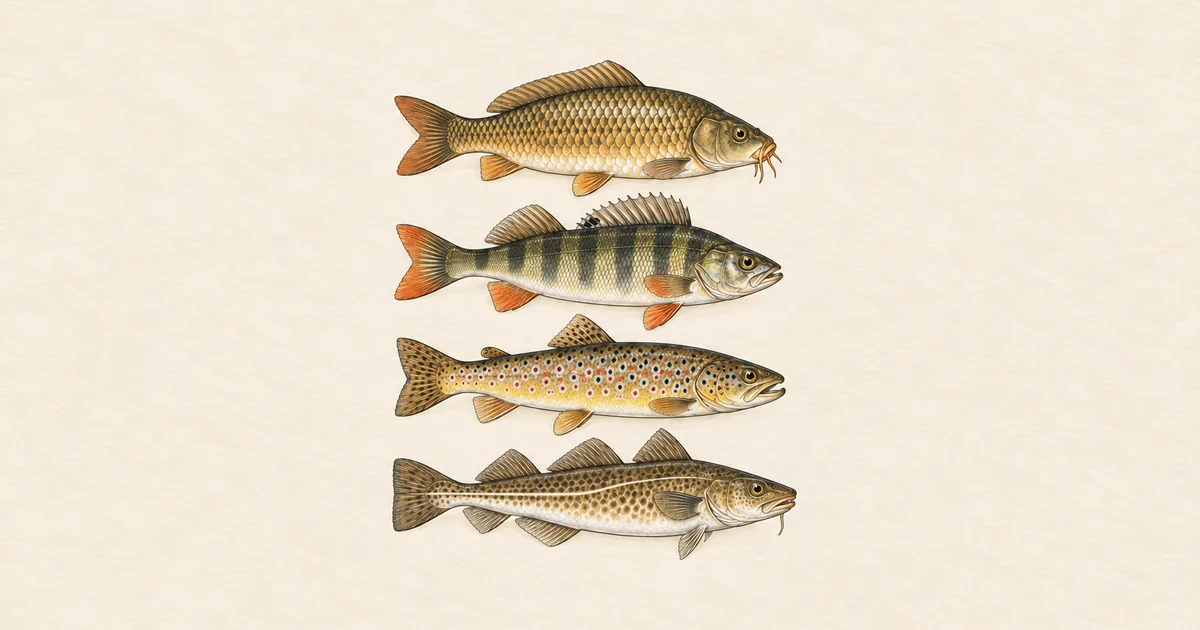
Three looks are enough for the family, ideally in this order.
- Back: Count the dorsal fins and check where they sit. A small, fleshy flap without rays between the dorsal fin and the tail is an adipose fin (Spektrum, Lexikon der Biologie).
- Fin rays: Spiny rays are hard and sharp, soft rays flexible. Look at the front part of the dorsal fin, that is where perch carry their spines.
- Mouth: Barbels are whisker-like filaments at the lips, corners of the mouth or chin, with which the fish tastes. Number and position differ from family to family.
Colouring hardly helps with the family. In the brown trout alone there are, according to the Landesfischereiverband Bayern, many colour variants depending on location. More on the body parts is under Body structure and fins and Mouth position.
Cyprinids: one dorsal fin, teeth only in the throat
Cyprinids have only one dorsal fin and no adipose fin. The fins are mostly spineless, the scales round and smooth-edged, many species carry barbels (Lexikon der Biologie: Weißfische). The Fragenkatalog zur Fischerprüfung in Sachsen-Anhalt calls them the most species-rich native fish family.
The jaws are toothless, the mouth can mostly be protruded. Food is only broken down in the throat, by strong pharyngeal teeth on sickle-shaped pharyngeal bones (Lexikon der Biologie: Karpfenfische). You cannot see them on a live fish. Experts identify the species by their number and arrangement (Fragenkatalog).
At the water, barbels help. According to the exam question catalogue, carp and barbel have four, tench and gudgeon two. Common nase and crucian carp have none. A single hard ray does not yet make a spiny fin: the barbel has one hard, serrated-edged ray in its dorsal fin (LFV Bayern) and still only that one.
Cyprinid does not mean peaceful feeder. Adult asp and chub live as predators.
In training material the whole group is called cyprinids or carp fishes. Newer taxonomy splits it up: the FishBase database still lists the carp under Cyprinidae, roach, bream and chub under Leuciscidae, and the tench in a family of its own, Tincidae. At the water this changes nothing, the features apply to all of them.
Perches: two dorsal fins, spines at the front
True perches have two dorsal fins. The front one is supported by sharp spiny rays, the rear one has soft rays. In the perch the two are clearly separate, in the zander there is a short gap between them (LFV Bayern). In other species of the family they are narrowly joined (FishBase).
The body carries comb-edged (ctenoid) scales. Their rear edge is set with tiny teeth (Lexikon der Biologie: Ctenoidschuppen). That is why a perch feels rough when you stroke along its flank from tail to head (FishBase-Glossar). Cyprinids, salmonids and herring-type fish, by contrast, have smooth-edged round scales (Kompaktlexikon der Biologie: Schuppen). There is also a spine at the end of the gill cover, strong in the perch, short in the zander.
Salmonids: the adipose fin
You recognise salmonids by the adipose fin. It sits between the dorsal and tail fins, is small and always without rays (Kompaktlexikon der Biologie: Salmoniformes, exam question catalogue of Saxony-Anhalt). The body is mostly spindle-shaped and the scales are small (Lexikon der Biologie: Lachsähnliche). Spiny rays are absent.
The family includes brown trout, lake trout and sea trout, rainbow trout, brook trout and Alpine char, salmon and huchen. Grayling and whitefish also have the adipose fin. The grayling also stands out for its tall, broad dorsal fin, the sail. Whitefish look like a herring, but their small adipose fin gives them away (LFV Bayern).
For grayling and whitefish the sources disagree. FishBase lists both as subfamilies of the Salmonidae. The LFV Bayern places the grayling with the trout-like fishes and puts the whitefish in a family of its own, Coregonidae, while the Kompaktlexikon separates both. At the water the adipose fin counts, and they all have one.
It is not enough on its own. The brown bullhead also has an adipose fin, but it has eight barbels as well (exam question catalogue of Saxony-Anhalt). And in coastal waters live the smelt, which carry one too.
Pike, wels catfish, eel and burbot
In the LFV Bayern fish encyclopaedia, each of these four species stands alone in its family. Their features:
- Pike: dorsal and anal fins sit far back, the mouth is flat like a duck’s bill. It has neither hard fin rays nor an adipose fin (Lexikon der Biologie: Hechtartige).
- Wels catfish: scaleless body, broad, flattened head and six barbels, two long ones on the upper jaw and four shorter ones on the lower jaw. The dorsal fin is very small, the anal fin reaches as far as the tail fin. It has no adipose fin, unlike the brown bullheads.
- Eel: snake-shaped body. Dorsal, tail and anal fins form one continuous fringe, there are no pelvic fins.
- Burbot: a single barbel on the chin, two separate dorsal fins and jugular pelvic fins, which means they sit at the front, at the throat. The LFV Bayern lists it as the only freshwater member of the cod family. FishBase places it with the ling and the tusk in the family Lotidae.
At sea: cod-like fishes, flatfish, herrings
- Cod-like fishes: an order with several families. What they share is soft fin rays, jugular pelvic fins and often a chin barbel (Lexikon der Biologie: Dorschfische). For the cod family, FishBase gives three dorsal fins and two anal fins. It includes cod, haddock, whiting, coley and pollack. In the cod the barbel is strong (Thünen-Institut). According to FishBase, the family of the ling and the tusk has one to three dorsal fins, one anal fin and always a chin barbel. The hake has two dorsal fins and no barbel (Thünen-Institut).
- Flatfish: also an order. Both eyes lie on one side of the body, and the fish rests on the bottom on the other, the blind side (Lexikon der Biologie: Plattfische). The larva of the plaice still swims upright. At a length of about 10 millimetres the left eye begins to migrate to the right side (Thünen-Institut). In the flounder both right-eyed and left-eyed individuals occur.
- Herrings: only one dorsal fin in the middle of the body, only soft fin rays and silvery round scales that fall off easily (Lexikon der Biologie: Heringsfische). The herring also lacks a lateral line.
All groups side by side
| Group | Distinguishing mark | Examples |
|---|---|---|
| Cyprinids | one dorsal fin, no adipose fin, mouth without teeth | carp, tench, roach, bream |
| Perch | two dorsal fins, spiny rays at the front, comb-edged scales | perch, zander |
| Salmonids | adipose fin behind the dorsal fin | trout, chars, salmon, grayling, whitefish |
| Pike | dorsal fin far back, flat mouth | Pike |
| Wels catfish | no scales, six barbels | Wels catfish |
| eels | fin fringe, no pelvic fins | Eel |
| Cod-like fishes | soft rays, pelvic fins at the throat, often a chin barbel | cod, coley, ling, burbot |
| Flatfish | both eyes on one side | plaice, flounder |
| Pegs | one dorsal fin, no lateral line | Herring |
From family to species leads fish identification: it asks about water, body shape, back, barbels, mouth and markings. With the species trainer you practise recognising fish from pictures.
Note: Whether you may keep a fish depends on the species, not the family. Closed seasons and minimum sizes are set by your federal state (Bundesland), and additional rules are in your fishing permit (Erlaubnisschein). The page Closed season and minimum size explained shows the way to the official sources.
Frequently asked questions
Is the zander a pike or a perch?
A perch. It has two dorsal fins, the front one with sharp spiny rays, and small comb-edged scales. The pike lacks hard fin rays, and its single dorsal fin sits far back.
Do redfish, coley and grey mullet belong to the perch, salmon and grayling families?
No, they do not belong to these families. „Seelachs“ (saithe) usually means the coley, which like the hake belongs to the cod-like fishes (Thünen-Institut). FishBase lists the redfish in the family Sebastidae, the grey mullet with the Mugilidae and the garfish with the Belonidae.
How do you recognise a cyprinid without barbels?
By the sum of the features: only one dorsal fin, no adipose fin, a mouth without teeth, smooth-edged round scales. Only part of the family has barbels. A second dorsal fin, an adipose fin or teeth in the jaws point to a different family.
What about species that fit none of these groups?
Mackerel, garfish, weever, monkfish and sturgeon belong to families that are missing here. Their features are in the profiles under Fish.
Related
- Identify a fish: from features to the species in six questions at most
- Species trainer: picture without a name, four species to choose from
- Fish: 125 profiles with identifying features and look-alike species
- Closed season and minimum size explained: where to find what applies to a species
- Catch calendar: spawning times and catch chances by species
- Body structure and fins: fins, rays and scales in detail
- Mouth position: superior, terminal or inferior and what it tells you
Sources
- Spektrum Akademischer Verlag, Lexikon der Biologie: Coarse fish, Karpfenfische, Fettflosse, Lachsähnliche, Hechtartige, Ctenoidschuppen, Dorschfische, Plattfische, Heringsfische (Kennzeichen der Gruppen)
- Spektrum Akademischer Verlag, Kompaktlexikon der Biologie: Salmoniformes, Schuppen (Fettflosse, Äschen, Renken, Stinte, Schuppentypen)
- Landesfischereiverband Bayern: Fischlexikon (Kennzeichen und Familien der Süßwasserarten)
- Ministerium für Wirtschaft, Tourismus, Landwirtschaft und Forsten des Landes Sachsen-Anhalt: Fragenkatalog zur Fischerprüfung (Fettflosse, Barteln, Schlundzähne, Seitenlinie)
- FishBase, Familien Cyprinidae, Leuciscidae, Tincidae, Percidae, Salmonidae, Gadidae und Lotidae, Arten Sebastes norvegicus, Chelon labrosus und Belone belone, Glossar: ctenoid scales (heutige Zuordnung der Arten, Flossenzahlen)
- Thünen-Institut für Ostseefischerei, Fischbestände Online: Kabeljau und Dorsch, Seelachs, Seehecht, Plaice (Bartfaden, Dorschartige, Augenwanderung)
Text AI-assisted, drawing AI-generated. Sources opened and checked in October 2026; no graphics taken from the sources.
All figures are guide values without guarantee. Individual fish, hybrids and farmed forms can deviate from the features described; which rules apply to a species is decided by the law of your federal state.