
Knowledge – Fish
Grey mullet: Features, habitat, best time and baits
By grey mullet on the North Sea and Baltic, people usually mean the thick-lipped grey mullet (Chelon labrosus). This shoal fish moves into harbours, bays and river mouths in summer and grazes algae and small animals there. It bites very cautiously.
In brief: You catch grey mullet best from July to September, in the morning, during the day and in the evening. Good spots on the coast: sandy bottom and stony mixed ground. Proven baits: bread flake and dough on a fine float, plus maggots or a piece of crab meat; small green flies. A summer visitor to the coast: in winter it moves into deeper layers and hardly feeds. In the western Baltic it has become rare in recent years, according to Blinker. Step by step: Fishing for grey mullet.
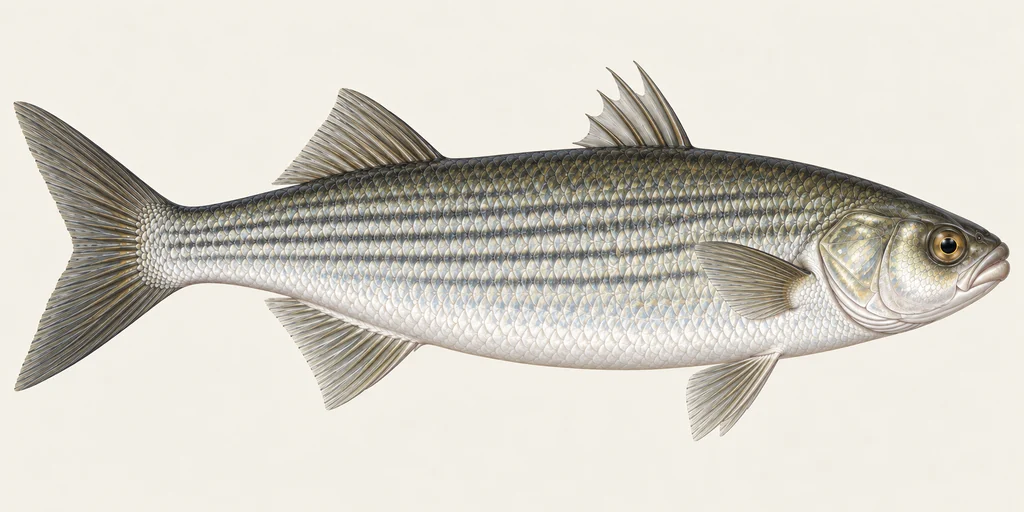
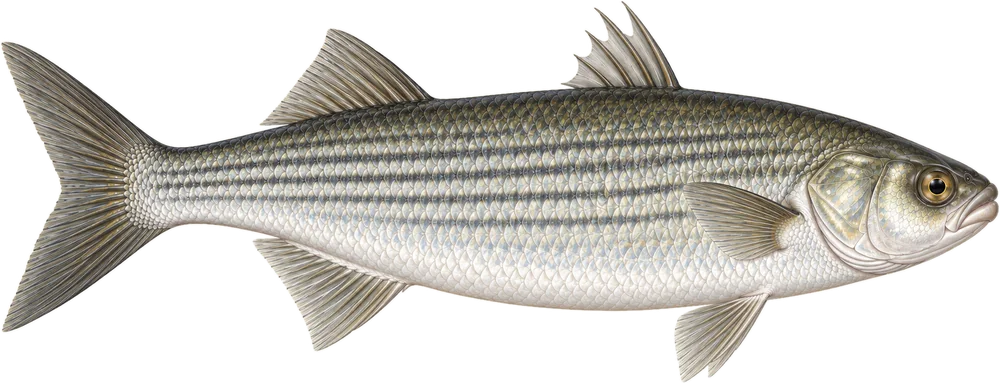
- Enlarged upper lip with fine projections (papillae)
- Two short, widely separated dorsal fins, the first with four spiny rays
- Silver-grey flanks with four to five dark longitudinal stripes
Catch chances through the year
- Hardly any chance
- Possible
- Good
- Peak season
- Spawning (observe the closed season)
Editorial assessment for waters in Germany, not a measured value and no guarantee. Spawning time is not the same as the legal closed season.
Species profile and sources in the catch calendarAll species compared month by monthThe rules of your federal state
How to recognise it
The thick-lipped grey mullet is a compact, roundish, elongated fish without a lateral line. The head is broad, the mouth small with a horizontal slit. The scales are large. The back is bluish or grey-green, the flanks are silver and the belly is white. Dark lengthwise stripes stand out on the sides.
The name comes from the upper lip. According to the Danish DTU Aqua it is as thick as the diameter of the pupil and bears horny, wart-like nodules in adults. With this lip the fish scrapes algae and small animals off stones and piles. Two dorsal fins stand far apart, and the front one has four spiny rays.
FishBase gives the usual length as about 32 centimetres and the maximum as 75 centimetres at 4.5 kilograms. For fish that are caught, the figures differ: an average of 40 centimetres is quoted, but on the German and Danish coast, according to Blinker, mainly large fish of 50 to 80 centimetres. Fisch & Fang gives an average weight of two to three kilograms for the Danish Baltic. Growth is slow: according to DTU Aqua, a fish of 25 centimetres is about five years old, one of 50 centimetres ten to fifteen years. FishBase and DTU Aqua give 25 years as the maximum age, some magazines only about nine.
Side by side: three grey mullets (lengths according to FishBase, each species measured with a different length measure)
| Thick-lipped | Thin-lipped | Golden grey | |
|---|---|---|---|
| Distinguishing feature | greatly enlarged upper lip | upper lip not enlarged | golden spot on the gill cover |
| Greatest length | 75 cm | 70 cm | 61 cm |
| Maximum age | 25 years | 10 years | no figure given |
| Spawning in the sea | winter, in the north spring | September to February | July to November |
You can confuse two other grey mullets. The thin-lipped grey mullet (Chelon ramada) occurs in the North Sea and Baltic. It has no enlarged upper lip, is somewhat smaller at 40 to 70 centimetres and otherwise resembles the thick-lipped one, with grey colouring and clearly visible side stripes. The golden grey mullet (Chelon auratus) occurs, according to FishBase, in the North Sea among other places and bears a golden spot on the gill cover.
The grey mullet is not related to the grayling of the rivers: it belongs to the order Mugiliformes (mullets).
Where it lives
The thick-lipped grey mullet lives in the eastern Atlantic from Iceland, the Faroe Islands and southern Norway to Cape Verde, and also in the Mediterranean. It is a warm-water species: with rising sea temperatures it has spread in Danish waters, according to DTU Aqua. Shoals only occasionally move into the Baltic, and in the western Baltic the species has become rare in recent years, according to Blinker.
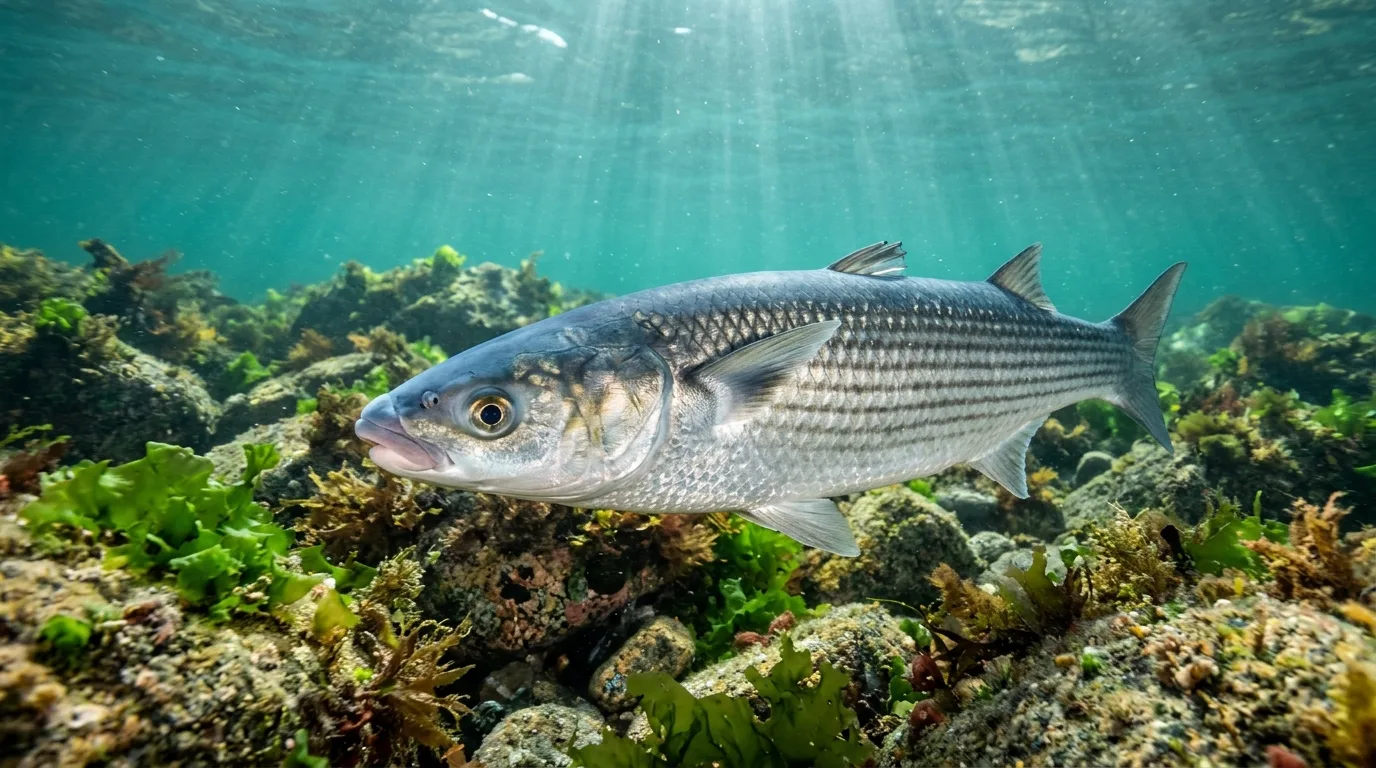
In summer the shoals stand close inshore in harbours, bays, lagoons and river mouths. You find them at quay walls, ropes, piles and boat hulls. Add to that shallow water over sand, silt and mixed ground. The fish enter brackish and fresh water; FishBase gives their depth range as 2 to 15 metres.
According to DTU Aqua, the grey mullet in the north are probably mostly immigrants from more southerly areas and move north in summer. Only at warm-water outlets of power stations, as observed in Sweden, do individual fish overwinter.
Holding spots in the picture
Choose the season and time of day: the picture shows where the species stands then. Spots outlined in red apply only in the chosen season. Tap a fish or a spot in the list to bring it closer. The picture is schematic and AI-generated, every water is different.
Catch chances in springhardly anyspawning season, observe the closed seasons (Schonzeit)
Catch chance in summerPeak season
Catch chance in autumnpossible
Catch chance in winterhardly any
- J
- F
- M
- A
- M
- J
- J
- A
- S
- O
- N
- D
Spawning season
Active time Blinker names the early morning hours in calm, fine weather as favourable. According to Fisch & Fang the fish feed well in the late morning, hardly in the afternoon, and bite best in the evening until dusk.
Active time Blinker names the early morning hours in calm, fine weather as favourable. According to Fisch & Fang the fish feed well in the late morning, hardly in the afternoon, and bite best in the evening until dusk.
Active time Blinker names the early morning hours in calm, fine weather as favourable. According to Fisch & Fang the fish feed well in the late morning, hardly in the afternoon, and bite best in the evening until dusk.
Not the main time Blinker names the early morning hours in calm, fine weather as favourable. According to Fisch & Fang the fish feed well in the late morning, hardly in the afternoon, and bite best in the evening until dusk.
On the coast
Sandy bottom
Mullet are found here only in spring, summer and autumn.
Stony mixed ground
Mullet are found here only in spring, summer and autumn.
Deep, colder water
Mullet are found here only in winter.
Just below the surface
Mullet are found here only in summer.
Mullet live as shoaling fish right at the coast, in shallow water over sandy, silty and mixed bottom. There they graze algal growth and small animals close to the bottom. They also enter lagoons, river mouths and fresh water.
Spring: according to the catch calendar, catch chances are hardly any in March and April, possible in May. The spawning season falls in this period, so observe the closed seasons (Schonzeit).
Summer: according to the catch calendar, chances are possible in June, main season in July and August. In summer the shoals move into coastal waters and stay near the surface. In harbours they hold at quay walls, sheet piling, piles and boat hulls.
Autumn: according to the catch calendar, main season in September, possible in October, hardly any chance in November. By October at the latest the fish leave the harbours.
Winter: according to the catch calendar, hardly any chance. In winter mullet retreat to deeper layers and hardly feed.
Depth: FishBase gives a depth range of 2 to 15 metres for the species.
Size comparison: AI-generated drawing, schematic.
How it feeds and spawns
Grey mullet are herbivores with a preference for algae. According to FishBase, adults eat diatoms, algae growing on surfaces, small animals and detritus, that is, dead material. For this they have a very muscular stomach like a bird’s gizzard and a long gut. In harbours they also take fish scraps and waste.
Spawning takes place in the sea: in spring in the north, in winter in the Mediterranean. Off France the spawning season lies between February and April, according to DTU Aqua; off England and Ireland it lasts into summer. The eggs float near the surface thanks to droplets of oil. Young fish about two centimetres long move into lagoons and river mouths from April to June.
Off Denmark they do not spawn, or only rarely, according to DTU Aqua; young fish have only been seen there occasionally.
When it bites
The fishing season falls in summer. For the North Sea, Blinker gives July to September as the best time, for the Baltic June to September. Fisch & Fang qualifies this for the Danish Baltic: before the end of June the fish can hardly be outwitted, and it only becomes worthwhile at water temperatures of around 20 degrees. The Danish catch reports also fall mainly in summer. The catch calendar therefore rates July to September as peak season, and June only as possible.
In winter the fish hardly feed and move into deeper layers. By October at the latest the shoals have left the harbours. The early morning hours and the forenoon are favourable; according to Fisch & Fang, though, the best hours are from evening until dusk, and in the afternoon the fish hardly bite. In stronger wind the chances fall, according to Blinker, whereas on slightly rippled water groups are easier to spot.
The related golden grey mullet tolerates large differences in temperature and salinity. Laboratory trials with young fish from the Black Sea showed survival between 8 and 36 degrees; the authors named 10 to 25 degrees at 10 to 30 parts per thousand of salt as the most favourable range.
Today’s catch index needs JavaScript. Season and spawning time are in the catch calendar.
You will find the monthly overview of all species and the water temperature check in the catch calendar.
What to catch it with
Step by step: Fishing for grey mullet: tips on bait, rig and tackle – season, spots, bait, tackle and rules on one page.
Grey mullet bite timidly and spit the bait out as soon as they feel resistance. So you fish finely: a float rod or Sbirolino rod, about three to four metres long according to Blinker 2007, a small fixed-spool reel and a line of no more than 0.25 millimetres, better 0.18. You will not get a two-kilo fish out of the water on line that thin; the landing net is a must, in a harbour one with a long handle.
Rig and float: A waggler rig or a clear water bubble (Sbirolino rig) is usual. The bait sinks slowly on the long hooklength, which, however, makes bite detection difficult. You will find more basics under float fishing. For hooks, the specialist press names sizes 8 to 16.
Baits are bread flake, dough, maggots, small pieces of pasta or bits of fish the size of a sweetcorn kernel. A larger piece of bread, fixed with a rubber band and fitted with several hooks, catches the fish as they scrape at it. If you feed the spot every day, you take the fear out of the fish.
Fly anglers use green flies and streamers or floating bread. For the fly rod, the magazine named a length of 2.70 to 3.00 metres in class 5/6 with a leader of 0.16 to 0.20 millimetres in 2007 (fly fishing). As with the chub in fresh water, the fish are wary: move quietly and keep your distance from the edge.
Stay inconspicuous: If you can see the fish, they can usually see you too. Keep your distance from the edge and move quietly.
Strike at once: As soon as a grey mullet takes the bait into its mouth, you must strike, otherwise it spits it out again.
Feed every day: Feed your chosen spot every day if possible, with dough or fish paste with bits of prawn. Offer the same bait on the hook, then the fish distrust it less.
Suitable lures
Bread flake and dough on a fine float, plus maggots or a piece of crab meat; small green flies.
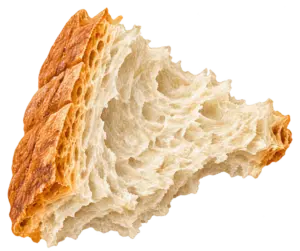
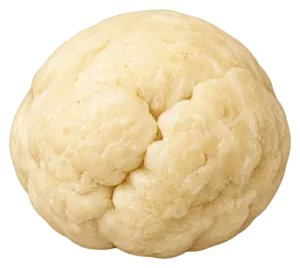
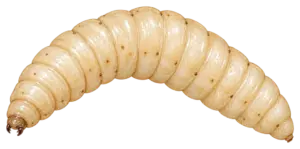
AI-generated illustrations. A click opens the lure’s page.
Rigs for these lures: surf rig.
Bites very cautiously: fish finely and feed.
What grey mullet tastes like and what you can do with it
The flesh is white and firm. DTU Aqua calls it very tasty, and in southern Europe the grey mullet is a sought-after food fish. It is oily and, depending on its diet, can taste slightly muddy. The roe is regarded as a delicacy in southern countries.
The scales are large, so scale the fish thoroughly before preparing it (scaling and skinning). How to gut it is described in gutting fish.
What you need to observe
Closed seasons, minimum sizes and harvest slots are set by the federal states (Bundesländer) and by the fisheries authorities of the neighbouring countries on the coast (Denmark, Norway, Poland). They vary by type of water, stretch of coast and time of year. We only give figures together with the date and source; the fisheries regulation of your federal state and your fishing permit (Erlaubnisschein) are always what is binding. You will find a list of links to the official sources in the catch calendar.
A fish of legal size that you want to keep you stun and kill at once, in line with animal welfare rules. Protected, undersized fish or fish too large under a harvest slot you unhook, if possible still in the water and with wet hands, and release gently. What exactly applies is regulated by state law and your fishing permit (Erlaubnisschein).
Harbours often have their own rules or fishing bans set by the operator. For coastal waters, the requirements change from year to year. Before fishing, check the coastal fisheries regulation (Küstenfischereiverordnung) of your federal state (Bundesland).
For comparison: in Denmark there has so far been, according to DTU Aqua, neither a minimum size (Mindestmaß) nor a catch limit nor a closed season (Schonzeit) for grey mullet. This cannot be applied to Germany, and the rules in Denmark can change too.
What closed season, minimum size and harvest slot mean and where to find them is explained on the page Closed season and minimum size explained.
Frequently asked questions (FAQ)
Which grey mullet do I catch on the German coast?
Mostly the thick-lipped grey mullet. Thin-lipped and golden grey mullet also occur. Neither has a thick upper lip; the golden grey mullet has a golden spot on the gill cover.
Why are grey mullet so hard to catch?
They do eat the feed you offer, but often do not touch the hook bait and spit it out when they feel resistance. Fine tackle, small baits and feeding help.
Do grey mullet stay in the Baltic in winter?
As a rule, no. They hardly feed in winter, move into deeper areas and leave the harbours by October at the latest. Only at warm outlets of power stations do individual fish overwinter.
Sources
The rating of catch chances is an editorial assessment. The facts come from these sources, and the text is worded in our own words. The illustration is an original design by Angel Momente in the style of a natural history plate (AI-generated, see the AI notice).
- FishBase: Chelon labrosus
- FishBase: Chelon ramada (Dünnlippige Meeräsche)
- FishBase: Chelon auratus (Gold-Meeräsche)
- DTU Aqua, Fiskepleje.dk: Multe (Chelon labrosus)
- DTU Aqua: Tyklæbet multe (Chelon labrosus) i Danmark, Biologi og fangster (Notat 2008)
- Blinker: Steckbrief Meeräsche
- Blinker extra: Die Fische der Ostsee und wie man sie beangelt (Stand 2007)
- Wikipedia: Dicklippige Meeräsche
- Nita & Nenciu 2020, Turk. J. Fish. Aquat. Sci.: Chelon auratus, Temperatur- und Salztoleranz
- Fisch & Fang: Grau, scheu und unglaublich stark (Meeräschen an der dänischen Ostsee: Saisonbeginn, Tageszeit, Gewicht)
- Blinker: Meeräsche fangen mit Algenfliegen (Größe an deutschen und dänischen Küsten, Rückgang in der westlichen Ostsee)
Created with AI support from the sources listed. Figures only appear in the text if a source gives them. Last updated: 27 October 2026. Found a mistake? Write to us. Who is behind this site: About me.
More in the lexicon
- All fish species at a glance
- Catch calendar – month, water temperature and profile for 93 species
- Line calculator – breaking strain after the knot, drag guideline, backing
- Angling methods