
Knowledge – Fish
Mullet fishing
Mullet fishing means: in summer find the shoals in harbours and bays, fish very finely and strike straight away at the first twitch. Here is the way to it in nine steps, each with a link to the detailed page.
 Choose another fish117 fish with guides
 EelOff-peak season
 EelpoutPossible
 IdePossible
 ArapaimaGood
 GraylingPeak season
 Atlantic salmonSpawning time, please spare
 Brown troutSpawning time, please spare
 Brook troutSpawning time, please spare
 BarbelOff-peak season
 BarramundiSpawning season
 Greater amberjackGood
 Topmouth gudgeonOnly as bycatch
 Blue marlinSpawning season
 BonefishSpawning season
 BonitoGood
 BreamOff-peak season
 Dusky grouperOnly as bycatch
 CobiaPossible
 Spiny dogfishOnly as bycatch
 CodPeak season
 ChubPeak season
 MinnowOnly as bycatch
 European sturgeonOnly as bycatch
 FlounderPeak season
 PerchPeak season
 Largemouth bassGood
 Ballan wrasseOnly as bycatch
 Yellowfin tunaSpawning season
 Giant trevallyGood
 Prussian carpPossible
 BrillPossible
 Gilthead breamSpawning time, please spare
 Golden doradoSpawning season
 Golden mahseerOnly as bycatch
 Dolphinfish (mahi-mahi)Good
 Grass carpPossible
 Great barracudaGood
 GudgeonPossible
 White breamPossible
 DaceOff-peak season
 PikePeak season
 HalibutOff-peak season
 HerringPossible
 GarfishOut of season
 Huchen (Danube salmon)Possible
 Crucian carpOnly as bycatch
 CarpOff-peak season
 RuffeOff-peak season
 VendaceOnly as bycatch
 DabPeak season
 GurnardPossible
 Coley (saithe)Peak season
 Chinook salmonHardly any chance
 King mackerelSpawning season
 LingPeak season
 TuskOff-peak season
 MackerelPossible
 Bighead carpOut of season
 WhitefishPossible
 Conger eelOff-peak season
 Sea troutSpawning time, please spare
- Grey mulletPossible
 Murray codSpawning season
 MuskellungeGood
 Common nasePossible
 Nile perchPossible
 PayaraPossible
 Peacock bassPeak season
 PermitGood
 WeeverOnly as bycatch
 PollackOff-peak season
 BurbotOff-peak season
 AspPossible
 Red snapperSpawning season
 Rainbow troutPeak season
 RoosterfishGood
 RoachPeak season
 RedfishOut of season
 Bluefin tunaOnly as bycatch
 RuddPossible
 Russian sturgeonOnly as bycatch
 HaddockOff-peak season
 SnakeheadPossible
 TenchOff-peak season
 SpirlinOnly as bycatch
 PlaiceOff-peak season
 Greenland halibutOnly as bycatch
 Round gobyOnly as bycatch
 SwordfishGood
 Lake troutSpawning time, please spare
 HakeSpawning time, please spare
 Alpine charSpawning time, please spare
 MonkfishPossible
 SoleOff-peak season
 SailfishGood
 Silver carpOut of season
 SnookPeak season
 PumpkinseedOnly as bycatch
 SpratOnly as bycatch
 Atlantic wolffishSpawning time, please spare
 TurbotPeak season
 SterletOnly as bycatch
 SmeltOnly as bycatch
 Horse mackerelPossible
 TaimenGood
 TarponGood
 TigerfishSpawning season
 BleakPossible
 WahooGood
 Wels catfishOff-peak season
 WhitingPeak season
 Sea bassOff-peak season
 ZanderPeak season
 White-eye breamOnly as bycatch
 Blue breamOnly as bycatch
 Brown bullheadPossible
 VimbaOnly as bycatch
Season in October according to the catch calendar, an estimate and not a guarantee of a catch. The fish pictures are reduced natural-history plates and AI-generated.
Best time
From July to September, in the morning, during the day and in the evening.
In January: Hardly any chanceIn February: Hardly any chanceIn March: Hardly any chance, spawningIn April: Hardly any chance, spawningIn May: Possible, spawningIn June: PossibleIn July: Main seasonIn August: Main seasonIn September: Main seasonIn October: PossibleIn November: Hardly any chanceIn December: Hardly any chance
Good spot
- Coast: sandy bottom and stony mixed groundsandy bottom, stony mixed ground and just below the surfacesandy bottom and stony mixed grounddeep water
Top baits
Starter tackle
- Rod: match or float rod of about 3,30–4,00 m
- Line: monofilament 0,18–0,25 mm
- Hook: size 6–8 for the bread flake, up to size 16 for maggots and small particles
- Rod: fly rod of class 6
- Line: floating fly line
- Hook: small algae and shrimp patterns
In short
In short: The best time for mullet is July to September, in the morning, during the day and in the evening. Good spots on the coast: sandy bottom and stony mixed ground. Proven baits: bread flake and dough under a fine float, plus maggots or a piece of crab meat; small green flies. A summer visitor on the coast: in winter it moves to deeper layers and hardly feeds. In the western Baltic Sea it has become rare in recent years, according to Blinker.
Quick to recognise
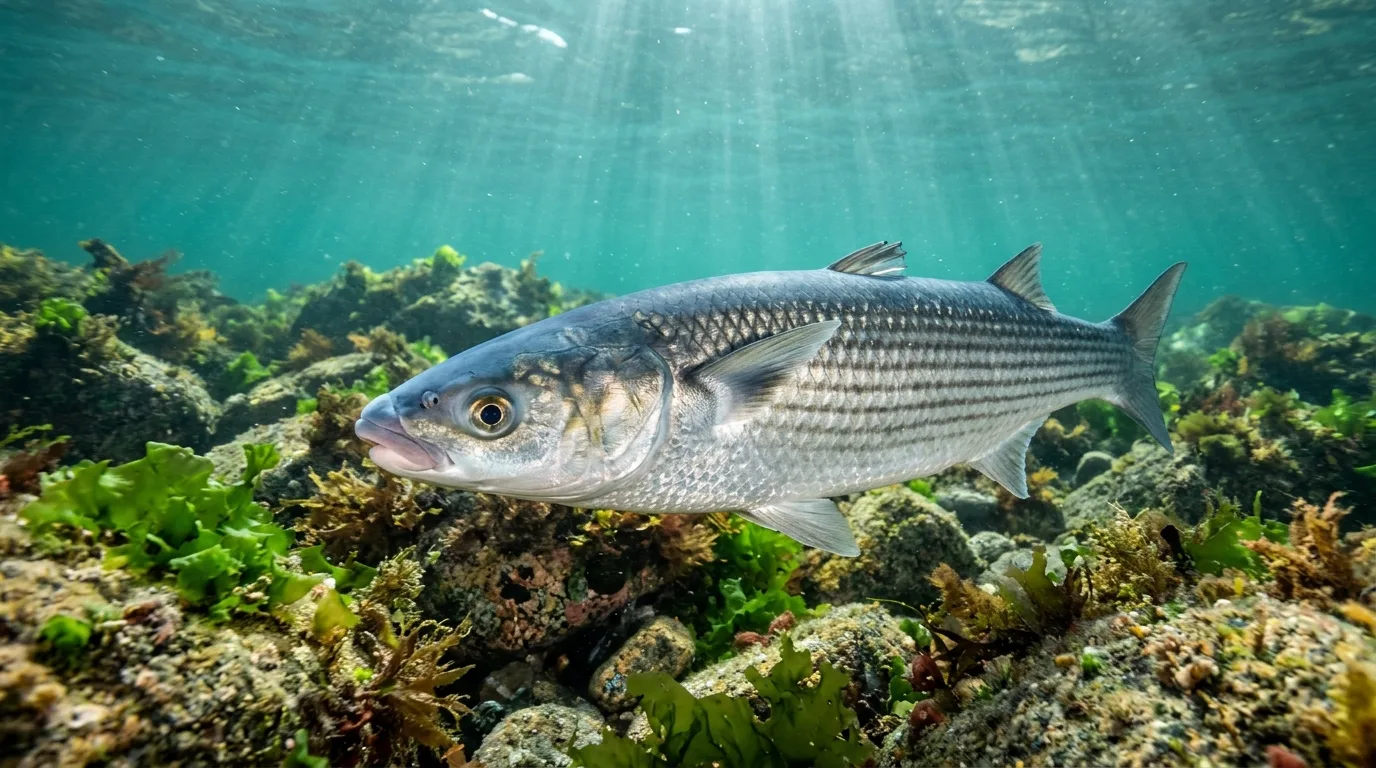
A shoaling fish with a thick upper lip full of horny nodules; on the North Sea and Baltic Sea the thicklip grey mullet is usually meant. On our coasts mostly large fish of 50 to 80 centimetres are caught, while worldwide around 32 is usual.
When
July to September is the main season, in May and June a catch is already possible, best in the late morning and in the hours before dusk, in calm weather. Spawning takes place out at sea, in the north in spring, off Denmark rarely or not at all. From October the shoals have left the harbours, and in winter they hardly feed.
- JanHardly any chance
- FebHardly any chance
- MarSlim chances, spawning
- AprHardly any chance, spawning season
- MayPossible, spawning season
- JunPossible
- JulPeak season
- AugPeak season
- SepPeak season
- OctPossible
- NovHardly any chance
- DecHardly any chance
Peak seasonGoodPossibleHardly any chanceSpawning season
Spring tactics
In spring little happens on the German coasts, and the fish only arrive with longer warm spells. Off Denmark they are considered hard to outwit until the end of June.
Summer tactics
It gets really good when the water warms to just under 20 degrees. Hot, windless days are then the best, in the harbour as on the beach.
Autumn tactics
In September they still bite well on warm days. When the water cools towards October, the shoals move into deeper water and the season is over.
Winter tactics
From the shore winter is not worthwhile. Even fish that overwinter at warm outflows feed only little in the cold.
Are they biting today?
In January: Out of seasonIn February: Out of seasonIn March: Spawning season, please spareIn April: Spawning season, please spareIn May: Spawning season, please spareIn June: PossibleIn July: Main seasonIn August: Main seasonIn September: Main seasonIn October: PossibleIn November: Out of seasonIn December: Out of season
Today’s catch index needs JavaScript. Season and spawning time are in the catch calendar.
Where it sits now
On the coast
In summer the shoals hold in harbours, bays and river mouths, often just below the surface at quay walls, piles and boat hulls. Shallow water over sand and silt is another option. Ask beforehand whether fishing is allowed in the harbour, since many operators have their own rules.
How to go about it: Harbour basins and breakwaters are easy to reach, but passers-by, gulls and ducks often get in the way there. On the open coast in a light wind you recognise travelling groups by the rippled water above their backs. Eelgrass beds with sandy patches, reefs and stream mouths are good feeding grounds; if the fish feed deeper in the current, a long chain of drifting pieces of bread can lure them up.
| Spring | Sandy ground, stony mixed ground |
|---|---|
| Summer | sandy bottom, stony mixed ground, just below the surface |
| Autumn | Sandy ground, stony mixed ground |
| Winter | deep water |
Biting time: in the morning, during the day and in the evening. What that looks like on the water is shown by the picture of the swims just below.
Holding spots in the picture
Choose the season and time of day: the picture shows where the species stands then. Spots outlined in red apply only in the chosen season. Tap a fish or a spot in the list to bring it closer. The picture is schematic and AI-generated, every water is different.
Catch chances in springhardly anyspawning season, observe the closed seasons (Schonzeit)
Catch chance in summerPeak season
Catch chance in autumnpossible
Catch chance in winterhardly any
- J
- F
- M
- A
- M
- J
- J
- A
- S
- O
- N
- D
Spawning season
Active time Blinker names the early morning hours in calm, fine weather as favourable. According to Fisch & Fang the fish feed well in the late morning, hardly in the afternoon, and bite best in the evening until dusk.
Active time Blinker names the early morning hours in calm, fine weather as favourable. According to Fisch & Fang the fish feed well in the late morning, hardly in the afternoon, and bite best in the evening until dusk.
Active time Blinker names the early morning hours in calm, fine weather as favourable. According to Fisch & Fang the fish feed well in the late morning, hardly in the afternoon, and bite best in the evening until dusk.
Not the main time Blinker names the early morning hours in calm, fine weather as favourable. According to Fisch & Fang the fish feed well in the late morning, hardly in the afternoon, and bite best in the evening until dusk.
On the coast
Sandy bottom
Mullet are found here only in spring, summer and autumn.
Stony mixed ground
Mullet are found here only in spring, summer and autumn.
Deep, colder water
Mullet are found here only in winter.
Just below the surface
Mullet are found here only in summer.
Mullet live as shoaling fish right at the coast, in shallow water over sandy, silty and mixed bottom. There they graze algal growth and small animals close to the bottom. They also enter lagoons, river mouths and fresh water.
Spring: according to the catch calendar, catch chances are hardly any in March and April, possible in May. The spawning season falls in this period, so observe the closed seasons (Schonzeit).
Summer: according to the catch calendar, chances are possible in June, main season in July and August. In summer the shoals move into coastal waters and stay near the surface. In harbours they hold at quay walls, sheet piling, piles and boat hulls.
Autumn: according to the catch calendar, main season in September, possible in October, hardly any chance in November. By October at the latest the fish leave the harbours.
Winter: according to the catch calendar, hardly any chance. In winter mullet retreat to deeper layers and hardly feed.
Depth: FishBase gives a depth range of 2 to 15 metres for the species.
Size comparison: AI-generated drawing, schematic.
How
Usually you fish finely with a float, for example on a waggler or water bubble rig, and let the bait sink slowly. Fly anglers offer green flies, small streamers or floating bread.
Easiest way
The easiest way is to try in high summer in a harbour where fishing is allowed, with a light float and a bread flake. First watch whether mullet are feeding at piles and sheet piling, then feed with small pieces of bread. A thin line of 0,18 to 0,25 mm and a landing net are absolutely essential.
Bread flake under a fine float
The usual way in the harbour and on shallow beaches, in which you lure the fish to the surface with drifting bread.
- Look first
With polarised glasses you spot feeding fish by flashing flanks, fins above the surface or stirred-up mud. Overgrown piles and sheet piling are the feeding places in the harbour.
- Lay a trail of bread
Throw in small pieces of bread and let them drift with a slight offshore wind. If gulls and ducks join in, bread dyed green with food colouring helps, as the birds pay less attention to it.
- Light and discreet
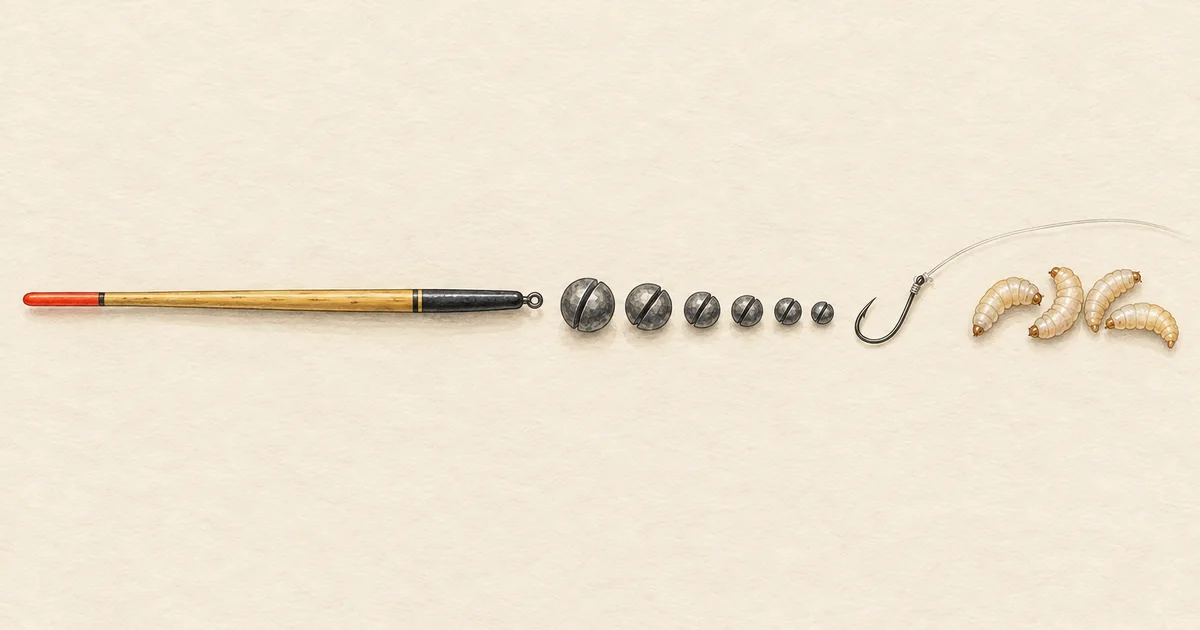
Take a waggler, a very lightly loaded float or a clear water bubble. Behind it comes a thin hooklength of about 0,18 to 0,20 mm, because thicker line scares the fish.
- Flake on the hook
Put a bread flake about the size of a thumbnail on the hook. A larger piece of crust with several small hooks, fixed with a rubber band, catches fish that scrape at the bread.
- Between the mouths
Place the bait where the fish are just slurping. Often they swim indifferently among the pieces for a long time and then suddenly all start feeding.
- Line-shy fish
If the fish only take bread without a line attached, a small shot ten to 30 cm above the hook helps, sinking the last centimetres of hooklength. If you grease the main line, you see bites better.
- Long runs
Mullet fight unusually hard, and landing a big fish can take a quarter of an hour. Set the drag softly and let it pull, the thin line cannot take brute force.
- Landing net ready beforehand
Have the landing net ready to hand before the first bait is in the water. You cannot lift a fish of two kilos out on such fine line.
Algae fly on sight
The method for fly anglers on shallow beaches and stones, where you cast deliberately at single fish or small groups.
- Search instead of casting
Expect to spend most of the time searching. Cast only when you are sure you see fish, for example a group grazing algae off a stone.
- A floating line is enough
A rod of class 6 with a floating line is enough. The reel should carry at least 100 m of backing, because the runs are long.
- Green algae fly
A simple green algae fly is the classic. Since the fish also eat small crustaceans and shrimp, take along some other patterns.
- Strip calmly
Place the fly in front of the fish and retrieve it steadily and slowly. If they do not react, change the presentation instead of giving up at once.
- Let it run into the pull
If a fish follows cautiously from behind, you do not strike but keep stripping calmly until it hooks itself on the resistance. In waves they often take the fly violently.
- Plan for backing
After the hook-up come very fast runs. Let the fish run into the backing and bring it in only when it tires.
What with
Bread flake, dough and maggots are the usual baits, plus small bits of fish the size of a grain of sweetcorn. Feed the spot every day if possible and offer the same bait on the hook. The hooks are small, roughly size 8 to 16.
- Breadall summer, as a flake or drifting chunk
Drifting bread brings the fish to the surface, and as a hookbait it matches the food they are eating at the moment.
- Bait pastein the harbour, when you feed at the same spot every day
Mixed with fish paste and pieces of crab it serves as feed and hookbait at the same time, which takes away the fish’s wariness.
- Maggots & larvaeon a fine float for cautious fish
They are small enough for hooks up to size 16 and fit the principle of offering mullet only tiny morsels.
Tackle
A float rod of three to four metres, a small fixed-spool reel and thin line, because mullet feel every resistance. Without a landing net you cannot get a bigger fish out, and in a harbour you need a drop net for sheet piling.
Bread flake under a fine float
- Rod
- Match or float rod of about 3,30–4,00 m
- Reel
- small fixed-spool reel with a finely adjustable drag
- Line
- Monofilament 0,18–0,25 mm
- Leader
- Monofilament around 0,18–0,20 mm
- Hooks
- size 6–8 for the bread flake, up to size 16 for maggots and small particles
- Weight, float, lead
- waggler, stip float of about 1,5 g carrying capacity or small clear water bubble
Algae fly on sight
- Rod
- Fly rod of class 6
- Reel
- Large-arbor reel with at least 100 m of backing
- Line
- floating fly line
- Leader
- tippet of around 0,20 mm in calm water and with small flies
- Hooks
- small algae and shrimp patterns
- Weight, float, lead
- unweighted or lightly weighted so that the fly sinks slowly
Common mistakes
- Line too thick: Mullet are line-shy and avoid heavy material. Fish with a main line of about 0,25 mm and a hooklength of about 0,18 to 0,20 mm.
- Fishing in the afternoon: In the afternoon the fish swim about quickly and restlessly and are almost impossible to outwit. Go in the late morning or in the hours before dusk.
- Gulls eat the feed: White bread attracts birds that scare the fish. Dye the bread green or find a quieter spot away from harbour activity.
- Too early in the year: Before the end of June and in cool water even experienced mullet anglers catch little. Wait for water temperatures close to 20 degrees.
- Hard strike on the fly: If the mullet follows the fly hesitantly, a quick strike scares it. Keep stripping and let it hook itself in the pull.
Rules
Our overview of the states has no figures on minimum size (Mindestmaß) or closed season (Schonzeit) for the mullet. That does not mean there are no rules: individual states and water regulations protect the species or set their own limits.
On the coast the rules of the coastal states apply, partly with their own catch restrictions: North Sea coast, Baltic coast of Schleswig-Holstein and Baltic coast of Mecklenburg-Western Pomerania.
The regulation and your fishing permit (Erlaubnisschein) are what count. Lake Constance, the Rhine and the coast, for example, have their own rules: Fishing waters in Germany.
After the catch
Playing and landing
On the float you strike straight away when the bait disappears, on the fly you let cautious fish run into the pull. With a soft drag and thin line the fight often takes long, give the fish room and net it only when it lies calmly on the surface. A fish you may not keep you unhook in the landing net in the water and let swim back.
A fish of legal size that you may take you stun and kill at once, protected or undersized ones you unhook with wet hands in the water. Scale the fish thoroughly, the scales are large. The flesh is white, firm and fatty, and sometimes tastes slightly musty from the food.
Frequently asked questions
Where in Germany can you fish for mullet?
On the North Sea the specialist press names Amrum, Föhr and Helgoland, among others, and sometimes the harbour basins in Büsum and Meldorf. In the western Baltic Sea there are clearly fewer of them today than before, according to Blinker.
What bait catches mullet?
Above all bread flake, dough, maggots or tiny bits of fish. What matters is that the hookbait matches the feed and stays very small.
Which line for mullet fishing?
At most 0,25 mm, better 0,18 mm. Since you cannot lift a heavy fish out of the water with it, you always need a landing net, in a harbour a drop net for sheet piling.
Why do mullet not bite?
They often eat the feed but leave the bait on the hook or spit it out at the slightest resistance. A finer hooklength, a small shot in front of the hook and the same bait as in the feed help.
Can you catch mullet on the fly?
Yes, with a green algae fly on a rod of class 6, usually by sight. It takes patience, because searching takes longer than casting.
When is the best time for mullet?
July to September, on hot and calm days. During the day the late morning and the hours before dusk are often better than the afternoon.
Similar species
If you fish for mullet, you can fish for these species with similar tackle too:
 Fishing for garfishOut of season
 Chub fishingPeak season
 Sea bass fishingShoulder season
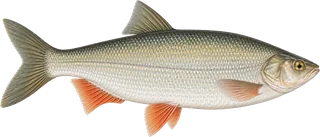 Ide fishingPossible
Sources
Status: October 2026. The practical knowledge comes from 5 sources, summarised in our own words.
View all 5 sources
- Steckbrief Meeräsche: Wissenswertes und Angeltipps · BLINKER (Redaktion)
- Grau, scheu und unglaublich stark · FISCH & FANG (Redaktion, mit Mats Andersson)
- Meeräsche fangen: Mit Algenfliegen zum Erfolg · BLINKER (Redaktion)
- Fein fängt Meeräsche · BLINKER (Redaktion)
- Erfolgreich Angeln an der Küste · BLINKER (Redaktion)
Text prepared with AI support, based on the sources listed and these pages: Mullet (profile), Float fishing, Fly fishing, Bread, Float rod.