
Knowledge – Fish
Blue marlin fishing
Blue marlin fishing means trolling baits behind the moving boat far out over deep blue water and, after the fight, usually releasing the fish in the water. Here is the way there in nine steps, each with a link to the detailed page.
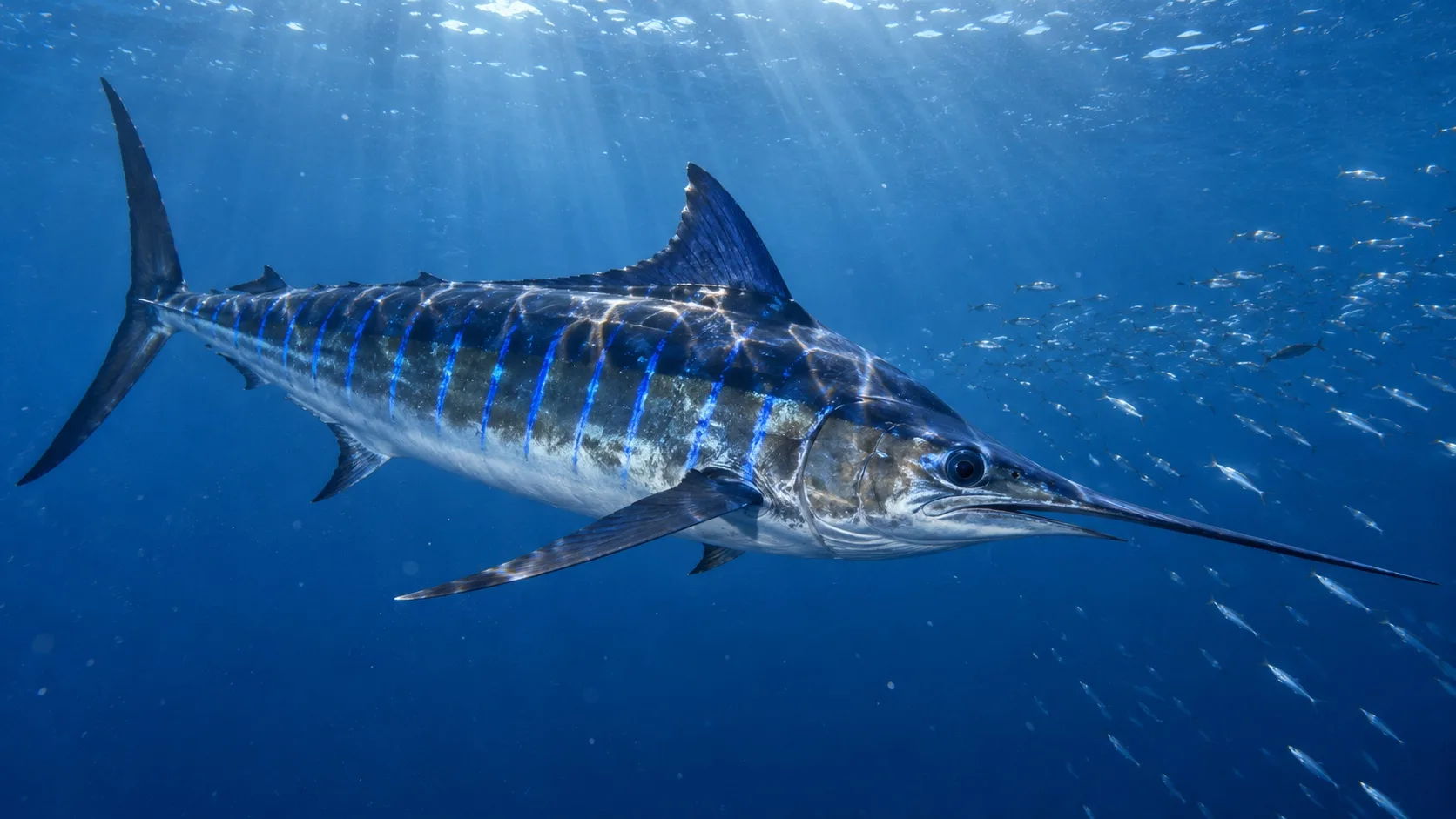
The International Union for Conservation of Nature (IUCN) classes the blue marlin as vulnerable, and since its 2024 assessment ICCAT regards the Atlantic stock as overfished. In US waters a marlin you are not keeping goes straight back, without being lifted out of the water. According to the FDA and EPA, marlin is among the fish most heavily contaminated with mercury; the authorities advise pregnant and breastfeeding women and small children against eating it.
 Choose another fish117 fish with guides
 EelOff-peak season
 EelpoutPossible
 IdePossible
 ArapaimaGood
 GraylingPeak season
 Atlantic salmonSpawning time, please spare
 Brown troutSpawning time, please spare
 Brook troutSpawning time, please spare
 BarbelOff-peak season
 BarramundiSpawning season
 Greater amberjackGood
 Topmouth gudgeonOnly as bycatch
- Blue marlinSpawning season
 BonefishSpawning season
 BonitoGood
 BreamOff-peak season
 Dusky grouperOnly as bycatch
 CobiaPossible
 Spiny dogfishOnly as bycatch
 CodPeak season
 ChubPeak season
 MinnowOnly as bycatch
 European sturgeonOnly as bycatch
 FlounderPeak season
 PerchPeak season
 Largemouth bassGood
 Ballan wrasseOnly as bycatch
 Yellowfin tunaSpawning season
 Giant trevallyGood
 Prussian carpPossible
 BrillPossible
 Gilthead breamSpawning time, please spare
 Golden doradoSpawning season
 Golden mahseerOnly as bycatch
 Dolphinfish (mahi-mahi)Good
 Grass carpPossible
 Great barracudaGood
 GudgeonPossible
 White breamPossible
 DaceOff-peak season
 PikePeak season
 HalibutOff-peak season
 HerringPossible
 GarfishOut of season
 Huchen (Danube salmon)Possible
 Crucian carpOnly as bycatch
 CarpOff-peak season
 RuffeOff-peak season
 VendaceOnly as bycatch
 DabPeak season
 GurnardPossible
 Coley (saithe)Peak season
 Chinook salmonHardly any chance
 King mackerelSpawning season
 LingPeak season
 TuskOff-peak season
 MackerelPossible
 Bighead carpOut of season
 WhitefishPossible
 Conger eelOff-peak season
 Sea troutSpawning time, please spare
 Grey mulletPossible
 Murray codSpawning season
 MuskellungeGood
 Common nasePossible
 Nile perchPossible
 PayaraPossible
 Peacock bassPeak season
 PermitGood
 WeeverOnly as bycatch
 PollackOff-peak season
 BurbotOff-peak season
 AspPossible
 Red snapperSpawning season
 Rainbow troutPeak season
 RoosterfishGood
 RoachPeak season
 RedfishOut of season
 Bluefin tunaOnly as bycatch
 RuddPossible
 Russian sturgeonOnly as bycatch
 HaddockOff-peak season
 SnakeheadPossible
 TenchOff-peak season
 SpirlinOnly as bycatch
 PlaiceOff-peak season
 Greenland halibutOnly as bycatch
 Round gobyOnly as bycatch
 SwordfishGood
 Lake troutSpawning time, please spare
 HakeSpawning time, please spare
 Alpine charSpawning time, please spare
 MonkfishPossible
 SoleOff-peak season
 SailfishGood
 Silver carpOut of season
 SnookPeak season
 PumpkinseedOnly as bycatch
 SpratOnly as bycatch
 Atlantic wolffishSpawning time, please spare
 TurbotPeak season
 SterletOnly as bycatch
 SmeltOnly as bycatch
 Horse mackerelPossible
 TaimenGood
 TarponGood
 TigerfishSpawning season
 BleakPossible
 WahooGood
 Wels catfishOff-peak season
 WhitingPeak season
 Sea bassOff-peak season
 ZanderPeak season
 White-eye breamOnly as bycatch
 Blue breamOnly as bycatch
 Brown bullheadPossible
 VimbaOnly as bycatch
Season in October according to the catch calendar, an estimate and not a guarantee of a catch. The fish pictures are reduced natural-history plates and AI-generated.
Best time
From May to October, mainly by day.
In January: PossibleIn February: PossibleIn March: PossibleIn April: PossibleIn May: Good, spawning seasonIn June: Good, spawning seasonIn July: Good, spawning seasonIn August: Good, spawning seasonIn September: Good, spawning seasonIn October: Good, spawning seasonIn November: PossibleIn December: Possible
Good spot
- Coast: open water and just below the surfaceopen water and just below the surfaceopen water and just below the surfaceopen water and just below the surface
Top baits
Starter tackle
- Rod: heavy offshore rod; 130 lb class tackle was usual off Bermuda
- Line: 130 lb (around 59 kg) as the usual class off Bermuda
- Hook: on natural bait a non-offset circle hook, not stainless steel; on artificial lures also J hooks, size 16/0 to 20/0 in the Bermuda study
In short
In short: According to the catch calendar the best time is May to October. Good spots on the coast: open water and just below the surface. Proven baits: trolled offshore artificial lures and trolled natural baitfish. The Atlantic stock is considered overfished by ICCAT, and the IUCN classes the species as vulnerable. In sport fishing the blue marlin is nowadays mostly released alive.
Quick to recognise
A huge offshore fish with a round bill, a steeply rising nape, a dark blue back and about 15 vertical rows of light blue dots on its silvery flanks. It usually measures around 290 centimetres. Only females reach up to 500 centimetres and 636 kilograms; males reach about 150 kilograms at most.
When
In the western Atlantic between the US east coast, the Bahamas and the Caribbean, May to October are good months because the fish gather in the warm water. In the rest of the year a catch is possible. It spawns in the North Atlantic from May to October, peaking in June and July, among other places in the Straits of Florida and around the Bahamas.
- JanPossible
- FebPossible
- MarPossible
- AprPossible
- MayGood, spawning
- JunGood, spawning
- JulGood, spawning
- AugGood, spawning
- SepGood, spawning season
- OctGood, spawning season
- NovPossible
- DecPossible
Peak seasonGoodPossibleHardly any chanceSpawning season
Season in the destination
In the western Atlantic the chances are best from May to October, when the surface water is warmest. Off North Carolina the blue marlin tournaments run from April to August; off south-eastern Florida boats fish mainly for tuna and marlin in spring and summer. Because the marlin follows the warm water, the good weeks shift with the water temperature. For the study off Bermuda the fish were caught in late July and early August.
Season and biting time
In January: PossibleIn February: PossibleIn March: PossibleIn April: PossibleIn May: Spawning seasonIn June: Spawning seasonIn July: Spawning seasonIn August: Spawning seasonIn September: Spawning seasonIn October: Spawning seasonIn November: PossibleIn December: Possible
Where it is now
On the coast
Look for it far from the coast in clear, deep blue ocean, where the surface water is 22 to 31 °C. It travels alone and hunts close below the surface by day for squid, flying fish, dolphinfish and small tuna. Important areas are the south-eastern coast of the USA, the Gulf of Mexico, the Caribbean and Brazil, and in the eastern Atlantic Madeira and Cape Verde.
How to go about it: The blue marlin lives in the open, deep blue ocean far from the coast. It comes closer to land only where deep water lies right off the coast, for example in the Gulf of Mexico off the mouth of the Mississippi. Off Bermuda the fish in a study were caught south-west of the island at the Challenger and Argus banks.
| All year round | open water, just below the surface |
|---|
Biting time: mainly during the day. How this looks in the water is shown by the picture of the holding spots just below.
Holding spots in the picture
Choose a season and time of day: the picture shows where the species sits then. Tap a fish or a spot in the list to bring it closer. The picture is schematic and AI-generated, every water is different.
Catch chances in springpossible
Chance of a catch in summergoodSpawning, observe the closed seasons
Chance of a catch in autumngoodSpawning season, observe the closed seasons
Catch chance in winterpossible
- J
- F
- M
- A
- M
- J
- J
- A
- S
- O
- N
- D
Spawning season
Not prime time Blue marlin feed by day; as far as is known, not at night.
Active time Blue marlin feed by day; as far as is known, not at night.
Not prime time Blue marlin feed by day; as far as is known, not at night.
Not prime time Blue marlin feed by day; as far as is known, not at night.
On the coast
Open water, mid-water
Blue marlin are present here all year round.
Just below the surface
Blue marlin are present here all year round.
The blue marlin lives far out in clear, deep blue ocean. It travels alone and looks for warm surface water. There it hunts flying fish, small tuna, dolphinfish and squid.
Spring: catch chances according to the catch calendar are possible in March and April, good in May.
Summer: chance of a catch good according to the catch calendar. This is when spawning falls, so observe the closed seasons.
Autumn: chance of a catch according to the catch calendar good in September and October, possible in November. The spawning season falls in this period, so observe the closed seasons.
Winter: catch chance according to the catch calendar possible.
Depth: It mostly stays in the upper 25 metres but often dives briefly to 100 to 200 metres, and individual fish deeper than 800 metres.
Size comparison: AI-generated drawing, schematic.
How
It is caught by trolling, so the baits run behind the moving boat. According to the North Carolina fisheries authority (Fischereibehörde), at 4 to 8 knots up to eight lines run at once, two of them close to the stern and the others further out on side outriggers. A hookless teaser in the wake brings the marlin up.
Easiest way
For blue marlin you fish from a moving boat that pulls baits behind it on several lines. Pick a bright day and warm, deep blue water far offshore for this. You take the rod only when a fish has bitten.
Trolling with skirted and natural baits
By day you pull artificial lures or skirted baitfish behind the boat; a hookless teaser brings the marlin to the surface.
- Look for warm blue water
The blue marlin stays above the thermocline and follows the warm water through the seasons. Off Bermuda tagged fish mostly stayed in water warmer than 26 °C, off Madeira mostly between 20 and 26 °C.
- Fan out the lines
Two shallow lines run close to the stern, the others away from the boat on the outriggers. In addition there is a hookless teaser in the wake that lures the fish up.
- Skirted lure or baitfish
For a study off Bermuda the boats trolled fast artificial lures and dead skirted baitfish. On a natural bait use a non-offset circle hook, which less often catches in the throat.
- Keep a steady speed
The North Carolina fisheries authority (Fischereibehörde) gives 4 to 8 knots for trolling for blue marlin. Keep the speed constant so that all baits run cleanly.
- At the surface by day
At night the blue marlin does not feed, as far as is known. Off Madeira tagged fish spent about 70 per cent of their time in the top five-odd metres, and made deep dives mainly in daylight.
- Hard and short
NOAA Fisheries advises heavy tackle, because a fish fought to exhaustion uses up its reserves. Off Bermuda the fights with fish of about 68 to 193 kg lasted between 15 and 35 minutes.
- Unhook beside the boat
Leave the marlin in the water to unhook it, even for a photo. Remove the hook with a hook remover, and do not put a gaff into the body. If the hook is stuck fast, cut the hooklength as short as possible.
- Revive slowly
Tow the fish slowly through the water with the boat in gear and its head under water until colour and strength return, often five minutes or longer. A recovered marlin changes from bronze to silver and swims off on its own.
What with
Artificial and natural baits are trolled. Among offshore trolling lures these are skirted heads and fast plugs, which run at roughly 4 to 12 knots depending on the model. If you take part in a registered tournament in US waters and fish with natural baits, circle hooks without side offset are compulsory.
- Offshore trolling luresby day when trolling in warm blue water, all year round, best from May to October
In the Bermuda study the marlin took fast-trolled artificial lures and skirted baitfish, and the North Carolina fisheries authority (Fischereibehörde) names both bait types for this species.
Tackle
A sturdy sea rod, because NOAA Fisheries advises strong tackle so that the fight does not last long. You match reel and line with the line calculator and the page on fishing line.
Trolling with skirted and natural baits
- Rod
- heavy offshore rod; 130 lb class tackle was usual off Bermuda
- Line
- 130 lb (around 59 kg) as the usual class off Bermuda
- Hooks
- on natural bait a non-offset circle hook, not stainless steel; on artificial lures also J hooks, size 16/0 to 20/0 in the Bermuda study
Common mistakes
- Lifting the fish out of the water for a photo: Out of the water, gravity puts great strain on the fish and lowers its chance of survival. Take the photo while it lies in the water beside the boat.
- Tackle that is too light: A long fight exhausts the marlin and raises lactic acid in its tissue. With heavy tackle the fight stays short.
- Forcing the hook out: If you cannot get the hook out safely, cut the hooklength as short as possible. A hook that is not stainless steel rusts away faster in the fish.
- Releasing the fish at once: A played-out marlin needs water flowing over its gills. Tow it with slow headway until it shows colour again and swims on its own.
- Trolling at night: The blue marlin is not known to feed at night. Put your trolling days in the bright hours.
Rules
For blue marlin the rules of the country where you fish apply, not the German fisheries acts (Fischereigesetze). Each country, often each water, sets its own licence, closed seasons (Schonzeiten), minimum sizes (Mindestmaße) and rules on keeping fish.
What the profile says: The Atlantic stock is considered overfished by ICCAT, and the IUCN classes the species as vulnerable. In sport fishing the blue marlin is nowadays mostly released alive.
The fisheries authority (Fischereibehörde) of the country you travel to is what counts. Ask about the current rules before the trip and read in the profile how threatened the species is.
After the catch
Playing and landing
Fight hard and short so that the marlin does not arrive at the boat completely exhausted. NOAA Fisheries recommends releasing billfish alive: the fish stays in the water, even for a photo, and you take the hook out with a hook remover or cut the hooklength close to the hook. Do not gaff it in the body. Then tow it slowly through the water with slow headway until it turns silver again and swims off on its own. The country where you fish decides the rules, licence and keeping of fish.
NOAA Fisheries recommends releasing billfish alive, and under US rules a marlin that is not kept also stays in the water for a photo. With a circle hook and a release tool you unhook it more easily beside the boat. If you want to keep a fish, identify the species with certainty first: on the blue marlin the dorsal and anal fins are pointed, on the white marlin they are rounded.
Frequently asked questions
How fast do you troll for blue marlin?
The North Carolina fisheries authority (Fischereibehörde) gives 4 to 8 knots. Up to eight lines run at once, and a hookless teaser draws the fish in.
What line strength do you need for blue marlin?
For a study off Bermuda the boats fished with the 130 lb class usual there, so around 59 kg. NOAA Fisheries generally advises heavy tackle so that the fight stays short.
How long does it take to fight a blue marlin?
Off Bermuda the anglers needed 15 to 35 minutes for fish between about 68 and 193 kg. The shorter the fight, the better the fish recovers.
Does a released blue marlin survive?
Usually yes. Of nine marlin released with satellite tags off Bermuda, at least eight were still alive after five days and swimming actively.
Does the blue marlin also bite at night?
Not as far as is known. It hunts in daylight and then also dives briefly into the depths, probably because it finds prey there in the light.
May you take a marlin out of the water for a photo?
Not in US waters. Billfish that you release go back there at once and stay in the water while doing so. NOAA Fisheries states explicitly that this also applies to a photo.
Similar species
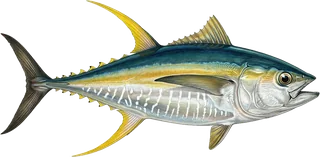
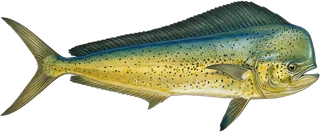
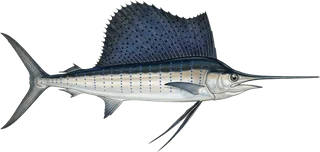
Anyone who catches blue marlin can also fish for these species with similar tackle:
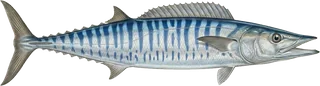
Sources
Correct as of October 2026. The practical knowledge comes from 7 sources, summarised in our own words.
View all 7 sources
- Careful Catch and Release – Atlantic Highly Migratory Species (Brochure, 2025) · NOAA Fisheries, Atlantic Highly Migratory Species Management Division
- Atlantic Highly Migratory Species Recreational Compliance Guide 2026 · NOAA Fisheries
- Blue Marlin (Species Profile) · North Carolina Division of Marine Fisheries
- Evaluation of pop-up satellite tags for estimating postrelease survival of blue marlin (Makaira nigricans) from a recreational fishery (Fishery Bulletin 100: 134–142, 2002) · NOAA Fisheries, Fishery Bulletin (Graves, Luckhurst und Prince; Virginia Institute of Marine Science)
- Where Can Anglers Find Blue Marlin? (Hook, Line and Science) · North Carolina Sea Grant, North Carolina State University
- Makaira nigricans – Atlantic Blue Marlin (Discover Fishes) · Florida Museum of Natural History, University of Florida
- Characteristics and trends in the nighttime and daytime United States Atlantic recreational swordfish fishery based on fishery-dependent data (Bulletin of Marine Science 93: 539–555, 2017) · NOAA Fisheries (Davis, Cudney und Blankinship), Bulletin of Marine Science, University of Miami
Text AI-assisted, based on the sources named and these pages: Blue marlin (profile), Sea fishing, Offshore trolling lures, Releasing fish.