
Knowledge – Fish
Fishing for greater amberjack
Fishing for greater amberjack means fishing over wrecks and reefs, getting the bait down deep and pulling the fish quickly away from the bottom after the bite. Here is the route to it in nine steps, each with a link to the detailed page.
FishBase records cases of ciguatera in amberjack in some areas, a poisoning caused by algal toxins from reef regions. You cannot tell by looking at, smelling or tasting a fish that it carries the toxin, and cooking or freezing does not remove it. If you have symptoms after a fish meal, seek medical help.
 Choose another fish117 fish with guides
 EelOff-peak season
 EelpoutPossible
 IdePossible
 ArapaimaGood
 GraylingPeak season
 Atlantic salmonSpawning time, please spare
 Brown troutSpawning time, please spare
 Brook troutSpawning time, please spare
 BarbelOff-peak season
 BarramundiSpawning season
- Greater amberjackGood
 Topmouth gudgeonOnly as bycatch
 Blue marlinSpawning season
 BonefishSpawning season
 BonitoGood
 BreamOff-peak season
 Dusky grouperOnly as bycatch
 CobiaPossible
 Spiny dogfishOnly as bycatch
 CodPeak season
 ChubPeak season
 MinnowOnly as bycatch
 European sturgeonOnly as bycatch
 FlounderPeak season
 PerchPeak season
 Largemouth bassGood
 Ballan wrasseOnly as bycatch
 Yellowfin tunaSpawning season
 Giant trevallyGood
 Prussian carpPossible
 BrillPossible
 Gilthead breamSpawning time, please spare
 Golden doradoSpawning season
 Golden mahseerOnly as bycatch
 Dolphinfish (mahi-mahi)Good
 Grass carpPossible
 Great barracudaGood
 GudgeonPossible
 White breamPossible
 DaceOff-peak season
 PikePeak season
 HalibutOff-peak season
 HerringPossible
 GarfishOut of season
 Huchen (Danube salmon)Possible
 Crucian carpOnly as bycatch
 CarpOff-peak season
 RuffeOff-peak season
 VendaceOnly as bycatch
 DabPeak season
 GurnardPossible
 Coley (saithe)Peak season
 Chinook salmonHardly any chance
 King mackerelSpawning season
 LingPeak season
 TuskOff-peak season
 MackerelPossible
 Bighead carpOut of season
 WhitefishPossible
 Conger eelOff-peak season
 Sea troutSpawning time, please spare
 Grey mulletPossible
 Murray codSpawning season
 MuskellungeGood
 Common nasePossible
 Nile perchPossible
 PayaraPossible
 Peacock bassPeak season
 PermitGood
 WeeverOnly as bycatch
 PollackOff-peak season
 BurbotOff-peak season
 AspPossible
 Red snapperSpawning season
 Rainbow troutPeak season
 RoosterfishGood
 RoachPeak season
 RedfishOut of season
 Bluefin tunaOnly as bycatch
 RuddPossible
 Russian sturgeonOnly as bycatch
 HaddockOff-peak season
 SnakeheadPossible
 TenchOff-peak season
 SpirlinOnly as bycatch
 PlaiceOff-peak season
 Greenland halibutOnly as bycatch
 Round gobyOnly as bycatch
 SwordfishGood
 Lake troutSpawning time, please spare
 HakeSpawning time, please spare
 Alpine charSpawning time, please spare
 MonkfishPossible
 SoleOff-peak season
 SailfishGood
 Silver carpOut of season
 SnookPeak season
 PumpkinseedOnly as bycatch
 SpratOnly as bycatch
 Atlantic wolffishSpawning time, please spare
 TurbotPeak season
 SterletOnly as bycatch
 SmeltOnly as bycatch
 Horse mackerelPossible
 TaimenGood
 TarponGood
 TigerfishSpawning season
 BleakPossible
 WahooGood
 Wels catfishOff-peak season
 WhitingPeak season
 Sea bassOff-peak season
 ZanderPeak season
 White-eye breamOnly as bycatch
 Blue breamOnly as bycatch
 Brown bullheadPossible
 VimbaOnly as bycatch
Season in October according to the catch calendar, an estimate and not a guarantee of a catch. The fish pictures are reduced natural-history plates and AI-generated.
Best time
All year round.
In January: GoodIn February: GoodIn March: Good, spawningIn April: Good, spawningIn May: Good, spawningIn June: Good, spawningIn July: GoodIn August: GoodIn September: GoodIn October: GoodIn November: GoodIn December: Good
Good spot
- Coast: Wreck, reef, rocky mixed bottom and open waterWreck, reef, rocky mixed bottom and open waterWreck, reef, rocky mixed bottom and open waterWreck, reef, rocky mixed bottom and open water
Top baits
Starter tackle
- Rod: strong boat rod for line of class 50–100 lb
- Line: class 50–100 lb (about 23–45 kg); in many situations lighter tackle will do too
- Hook: circle hook without offset, not stainless
In short
In short: According to the catch calendar, the best time is all year round. Good spots on the coast: wrecks, reefs, rocky mixed bottom and open water. Proven baits: live bait fish or pieces of fish when drifting over wrecks; when trolling, spoons and deep-running crankbaits. The ratings show the chance of a catch, not whether you may keep the fish: in the federal waters of the Gulf the 2026 recreational season was open only from 1 September to 13 October (next one from 1 September 2027), and in the South Atlantic April is closed for everyone (as of October 2026). FishBase records cases of ciguatera in some areas.
Quick to recognise
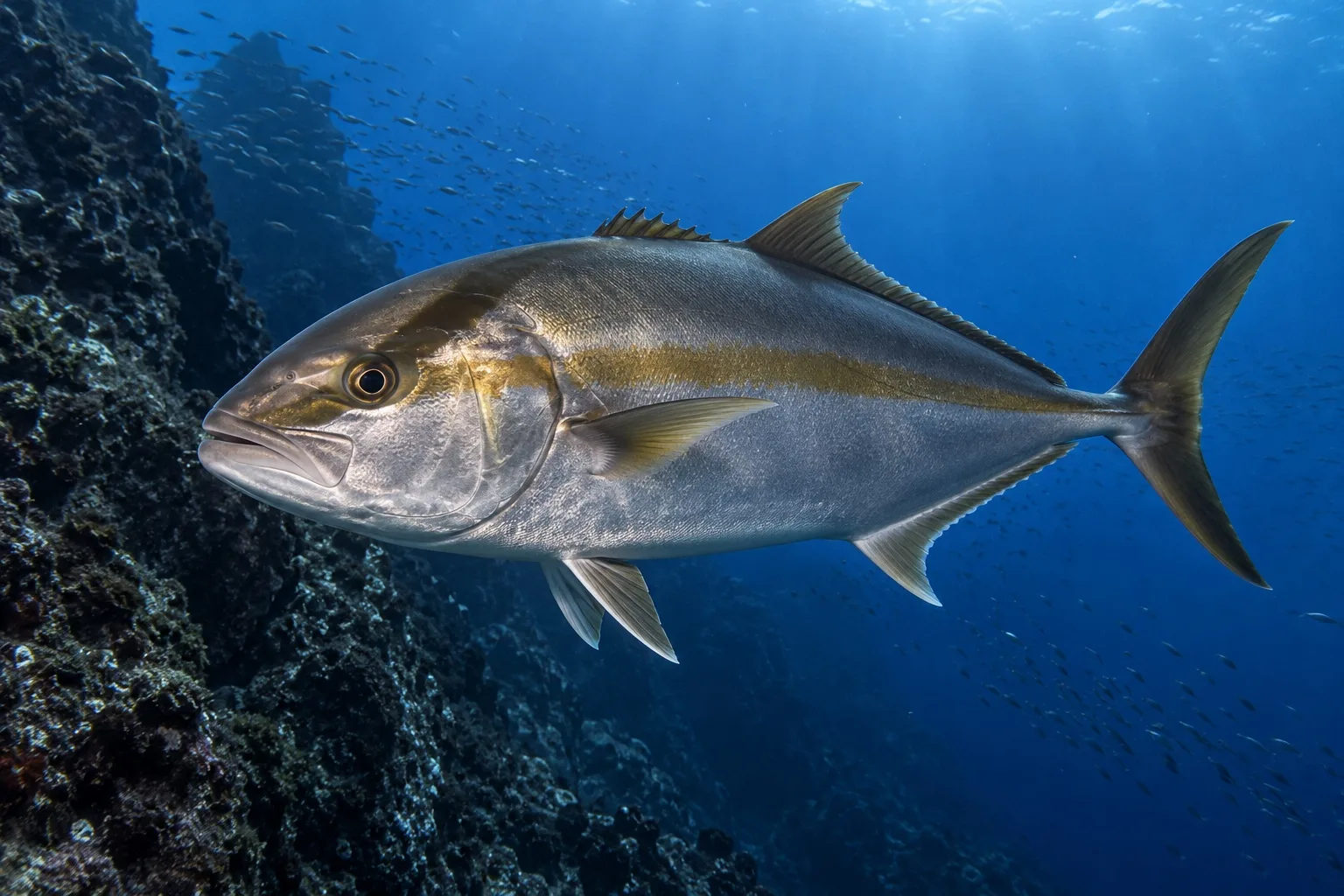
A large, spindle-shaped jack, usually called amberjack among anglers. You can recognise it by the dark stripe running from the snout over the eye to just before the first dorsal fin, and by the smooth tail stalk without bony scutes. Around one metre is usual, and most fish weigh about 18 kilograms.
When
At wrecks and reefs off the US south-east coast and in the Gulf of Mexico, amberjacks are present all year round, which is why the calendar rates every month as good. You may keep them only in short windows, though: in the federal waters of the Gulf the 2026 recreational season was open from 1 September to 13 October, and according to NOAA Fisheries the next one opens on 1 September 2027. In the South Atlantic a closure applies to everyone in April, recreational anglers included. As of October 2026. Spawning takes place in the western Atlantic from March to June at reefs and wrecks, according to information from North Carolina most strongly in May or June.
- JanGood
- FebGood
- MarGood, spawning
- AprGood, spawning
- MayGood, spawning
- JunGood, spawning
- JulGood
- AugGood
- SepGood
- OctGood
- NovGood
- DecGood
Peak seasonGoodPossibleHardly any chanceSpawning season
Season in the destination
Off the south-east USA and in the Gulf you catch amberjacks in every month at wrecks and reefs. Studies on which the fisheries authority of North Carolina relies show that many fish move south in spring from the waters off the Carolinas to off south-east Florida. In spring they spawn in larger groups at reef edges; which seasons then apply is determined by the country in which you fish.
Season and biting time
In January: GoodIn February: GoodIn March: SpawningIn April: SpawningIn May: SpawningIn June: SpawningIn July: GoodIn August: GoodIn September: GoodIn October: GoodIn November: GoodIn December: Good
Where it sits now
On the coast
Adult fish stay at wrecks, reefs and rocks and hunt there both on the bottom and in mid-water. They usually hold at depths between 18 and 72 metres. Juveniles, by contrast, are found in schools under drifting mats of algae out on the open sea.
How to go about it: Look for wrecks, rock reefs and artificial reefs, and in the Gulf also oil and gas platforms, usually at around 18 to 73 metres depth. The fish spend a lot of time in the upper water column near the structure and hunt there. In southern Florida they sometimes bite close to the shore too.
| All year round | Wreck, reef, rocky mixed bottom, open water |
|---|
Holding spots in the picture
Choose a season and time of day: the picture shows where the species sits then. Tap a fish or a spot in the list to bring it closer. The picture is schematic and AI-generated, every water is different.
Chance of a catch in springgoodSpawning, observe the closed seasons
Catch chance in summergood
Catch chance in autumngood
Catch chance in wintergood
- J
- F
- M
- A
- M
- J
- J
- A
- S
- O
- N
- D
Spawning season
On the coast
Stony mixed ground
Greater amberjack is found here all year round.
Wreck, reef
Greater amberjack is found here all year round.
Open water, mid-water
Greater amberjack is found here all year round.
Adult amberjacks hold at wrecks, reefs and rocks and hunt on the bottom as well as in mid-water. Young fish travel in schools under drifting mats of algae on the open sea.
Spring: chance of a catch good according to the catch calendar. This is when spawning falls, so observe the closed seasons.
Summer: catch chance according to the catch calendar good.
Autumn: chance of a catch good according to the catch calendar.
Winter: good chance of a catch according to the catch calendar.
Depth: It lives between 1 and 385 metres, but usually at 18 to 72 metres.
Size comparison: AI-generated drawing, schematic.
How
You fish mostly from a boat over the wrecks. In sea fishing you drift a bait fish or a piece of fish over the structure; when spinning and trolling, spoons and deep-running artificial lures do the work. Groundbait can keep schools at the boat.
Easiest way
The simplest way is drifting from a boat with a live bait fish over a wreck or reef. Use tackle of class 50 to 100 lb, a circle hook and only enough lead for the bait to swim in mid-water above the structure.
Live bait fish on the drift
The usual method over wrecks, reefs and platforms: a lively bait fish drifts with little lead over the structure.
- Head for structure
Head for wrecks, rock reefs, artificial reefs or, in the Gulf, oil and gas platforms. Amberjacks usually hunt in the upper water column around such structures.
- Draw in the school
Amberjacks feed in small groups over reefs and wrecks. Chum attracts such groups and keeps them near the boat.
- Circle hook, little lead
Hook a lively bait fish on a circle hook without offset that is not stainless. In front of it use only as much lead as you need for the bait to reach the depth of the fish.
- Into mid-water
Lower the bait, but not all the way to the bottom, because amberjacks roam above the reef. Keep it roughly halfway between the bottom and the surface.
- Plan for stamina
An amberjack pulls very hard and does not give up for a long time. A drag set beforehand protects your tackle; if the fish is to go back, do not fight it to complete exhaustion.
- Tools at the ready
Have the dehooker and a descending device ready before the fish is up. A fish that is to go back you support horizontally with wet hands or rubberised gloves.
What with
A live or dead bait fish and scraps of fish are the natural baits, together with spoons and crankbaits that run deep enough. You retrieve the spoon with a tumbling action, varying the pace and the pauses.
- Baitfishall year round, drifting over a wreck and reef
The amberjack is not fussy and takes almost any lively bait fish swimming at its depth.
- Cut baitat platforms and artificial reefs when live baits are not available
The fisheries authority in Texas names large hooks with pieces of fish as a way to catch them, especially with cutlassfish.
- Spoonwhen trolling and when fish hunt near the surface
In North Carolina people troll with spoons and deep-running artificial lures, and excited amberjacks rise right to the surface and attack spoons there too.
Tackle
A strong sea rod for drifting, a spinning rod for spoons and crankbaits. After the bite the amberjack heads for the bottom, so bring it up quickly; the tackle has to withstand that.
Live bait fish on the drift
- Rod
- strong boat rod for line of class 50–100 lb
- Reel
- strong sea reel, drag set before fishing to suit tackle and angler
- Line
- class 50–100 lb (about 23–45 kg); in many situations lighter tackle will do too
- Hooks
- circle hook without offset, not stainless
- Weight, float, lead
- lead just heavy enough for the bait to stay in mid-water above the bottom
Common mistakes
- Setting the drag only during the fight: Amberjacks pull hard and are very persistent. Set the drag before the first drop, to match rod, line and your strength, otherwise tackle breaks or the fish is lost.
- Bait lies on the bottom: Too much lead pulls the bait fish below the fish. Use just enough for it to swim in mid-water above the reef.
- Stainless hook with offset: A circle hook without offset is less likely to lodge in the eye, gills or stomach. If a hook does stay in the fish, a non-stainless one rusts out faster.
- Pumping the fish out to the very end: If the fish may have to go back, do not fight it to complete exhaustion. Keep the dehooker and a descending device within reach so that it gets back into the water quickly.
- Puncturing the bloated stomach: If the stomach hangs out of the mouth after bringing the fish up, never puncture it. Return the fish to depth with a weighted descending device; there the pressure equalises again.
Rules
For greater amberjack the rules of the country in which you fish apply, not German fisheries law. Licence, closed seasons, minimum sizes and keeping fish are set by each country, often by each water separately.
What the species profile says: The ratings show the chance of a catch, not whether you may keep the fish: in the federal waters of the Gulf the 2026 recreational season was open only from 1 September to 13 October (next one from 1 September 2027), and in the South Atlantic April is closed for everyone (as of October 2026). FishBase records cases of ciguatera in some areas.
The fisheries authority (Fischereibehörde) of the country you travel to is what counts. Ask about the current rules before the trip and read in the profile how threatened the species is.
After the catch
Playing and landing
Set the drag before fishing to suit tackle and strength, and expect a long, powerful fight. If the fish is to go back, do not fight it to complete exhaustion, hold it horizontally with wet hands or rubberised gloves and take photos quickly. If it shows barotrauma, such as a bloated belly or the stomach in its mouth, return it to depth with a weighted descending device and never puncture the stomach. Rules, licence and keeping fish are determined by the country in which you fish.
For landing, unhooking and releasing, the linked fish welfare pages will help. If you keep a fish, bear in mind the ciguatera notes above, because contaminated fish cannot be recognised.
Frequently asked questions
What line strength do you need for amberjack?
The fisheries authority in Florida names tackle of class 50 to 100 lb as usual. In many situations lighter tackle is possible too, but the drag then has to be set well.
Which bait fish do you use for amberjack?
Blue runners, pinfish, grunts, cigar minnows and sand perch are proven. The main thing is that the bait is lively.
Do you catch amberjack on artificial lures too?
Yes. From a boat, spoons and deep-running artificial lures are trolled, and when the fish rise excitedly towards the surface they also take surface lures, jigs and diving plugs.
At what depth does the amberjack hold?
Usually at wrecks, reefs and platforms at about 18 to 73 metres depth, deeper in the Gulf too. There it often stays in mid-water above the structure, not on the bottom.
Does amberjack taste good?
It is edible, but the fisheries authority in Texas does not usually count it among the preferred food fish.
How do you release an amberjack from great depth?
With a weighted descending device that brings the fish back to the depth where it was caught. The fisheries authorities in the South Atlantic prefer this to puncturing the swim bladder, because the belly stays undamaged.
Similar species
If you catch greater amberjack, you can fish for these species with similar tackle too:
 Chinook salmon fishingSlim chances
 Bonito fishingGood
 King mackerel fishingSpawning season
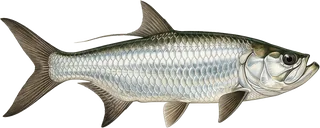 Tarpon fishingGood
Sources
Status: October 2026. The practical knowledge comes from 6 sources, summarised in our own words.
View all 6 sources
- Greater Amberjack (Saltwater Fish Profile, Fishing Tips) · Florida Fish and Wildlife Conservation Commission (FWC)
- Greater Amberjack (Species Profile) · North Carolina Division of Marine Fisheries (NC DEQ)
- Greater Amberjack (Seriola dumerili) · Texas Parks and Wildlife Department
- Greater Amberjack (Broschüre) · Louisiana Department of Wildlife and Fisheries
- Best Fishing Practices · South Atlantic Fishery Management Council
- Releasing Reef Fish 101: Techniques for reducing release mortality · Florida Sea Grant (University of Florida)
Text prepared with AI support, based on the sources named and these pages: Amberjack (profile), Sea fishing, Spinning, Bait fish, Spoon.