
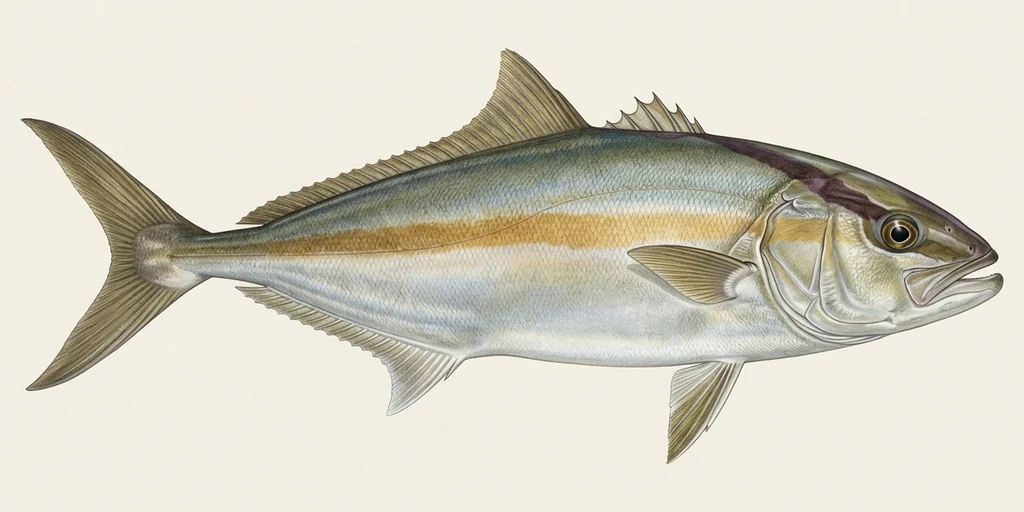
Knowledge – Fish
Greater amberjack: Features, waters and catching
The greater amberjack (Seriola dumerili), usually just called amberjack by anglers, is a large jack of the genus Seriola. It holds over wrecks, reefs and rocks in warm seas and is regarded in the USA as a trophy fish that puts both tackle and angler to a hard test.
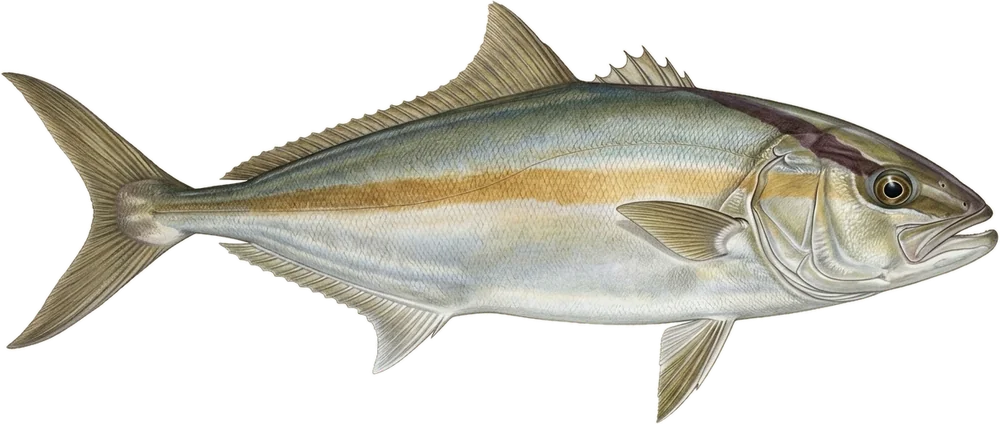
In short: According to the catch calendar the best time is the whole year. Good spots along the coast: wrecks, reefs, rocky mixed ground and open water. Proven baits: live baitfish or pieces of fish when drifting over wrecks, spoons and deep-diving crankbaits when trolling. The ratings show your chance of a bite, not what you may keep: in the federal waters of the Gulf the 2026 recreational season was open only from 1 September to 13 October (next one from 1 September 2027), and in the South Atlantic April is closed to everyone (as of October 2026). FishBase records cases of ciguatera in some areas. Step by step: How to fish for amberjack.
- Dark stripe from the snout through the eye to just in front of the first dorsal fin
- Amber lengthwise band along the middle of the flank
- Long second dorsal fin, clearly longer than the anal fin, no bony scutes on the caudal peduncle
Catch chances through the year
- Hardly any chance
- Possible
- Good
- Peak season
- Spawning (observe the closed season)
Editorial assessment for the home water (south-eastern coast of the USA and Gulf of Mexico), not a measured value and not a guarantee. The rules of the country you travel to are what count.
How to recognise it
The body is elongated and spindle-shaped, the head short and pointed, the eyes rather small. The back is brownish or blue-grey to olive-green, the belly silvery white. An amber band often runs along the middle of the flank, which gives the species its name.
A dark stripe is typical, running from the snout through the eye to just in front of the first dorsal fin. According to NOAA Fisheries it stands out more when the fish is feeding or excited. The second dorsal fin is much longer than the anal fin and the tail fin is deeply forked. Unlike many other jacks, Seriola species have no bony scutes along the lateral line. Juveniles are yellowish and carry five to six dark vertical bars.
FishBase gives a usual length of one metre, a maximum of 1,9 metres and 80,6 kilograms. According to the Florida Museum most fish weigh around 18 kilograms. Females grow larger and older than males. For maximum age FishBase gives 15 years, NOAA Fisheries 17 years.
The amberjack is mostly confused with close relatives: the lesser amberjack (Seriola fasciata), the almaco jack (Seriola rivoliana) and the banded rudderfish (Seriola zonata). According to the Florida Museum they can be told apart reliably by the number of gill rakers, the finger-like projections on the first gill arch, and by the length of the anal fin. The amberjack has 11 to 19 gill rakers, the lesser amberjack and the almaco jack have more than 20.
It differs from the giant trevally and other Caranx species by its smooth caudal peduncle without bony scutes. It also lacks the small finlets behind the dorsal and anal fins.
Side by side
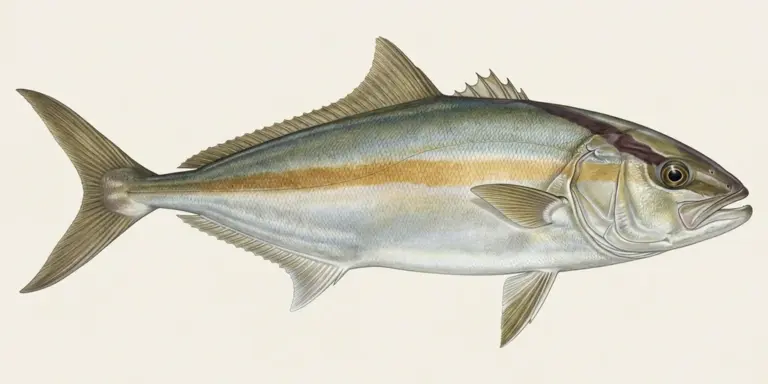
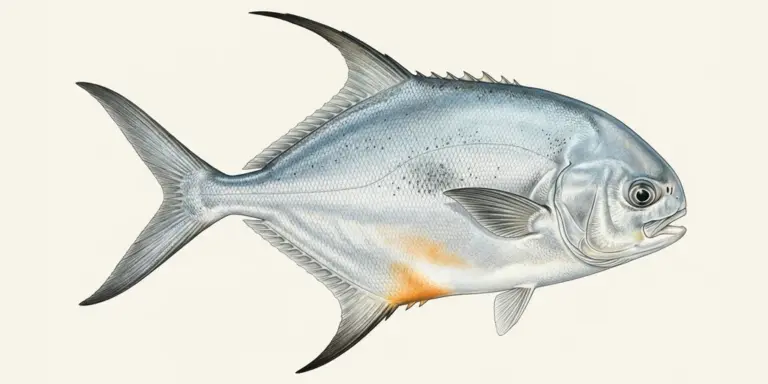
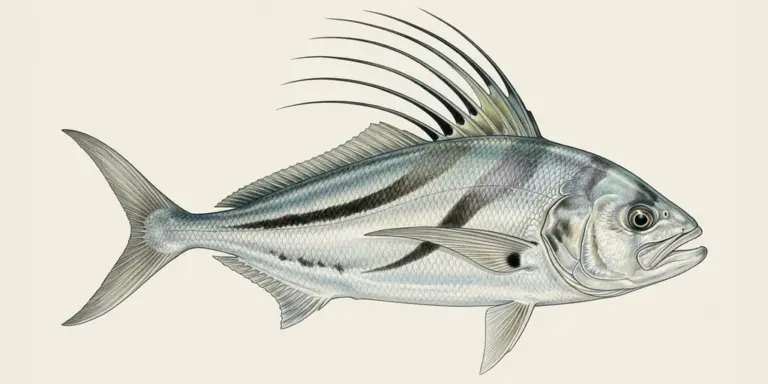
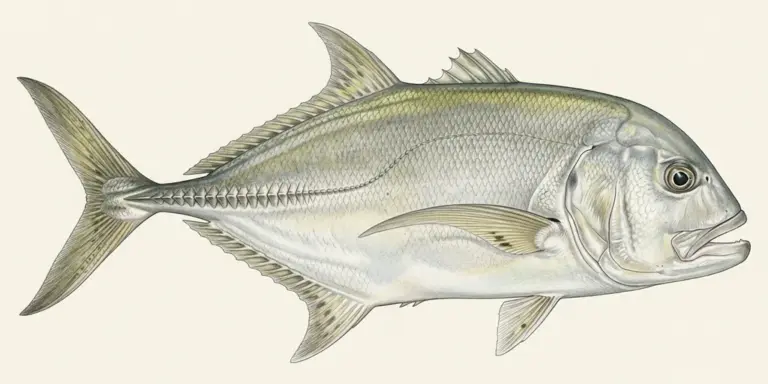
AI-generated illustrations.
Where it lives
The species occurs worldwide in tropical and warm-temperate seas. In the western Atlantic its range runs from Nova Scotia to Brazil, including the Gulf of Mexico and the Caribbean. In the eastern Atlantic it lives from Morocco to the Mediterranean; on the British coasts only stray individuals appear.
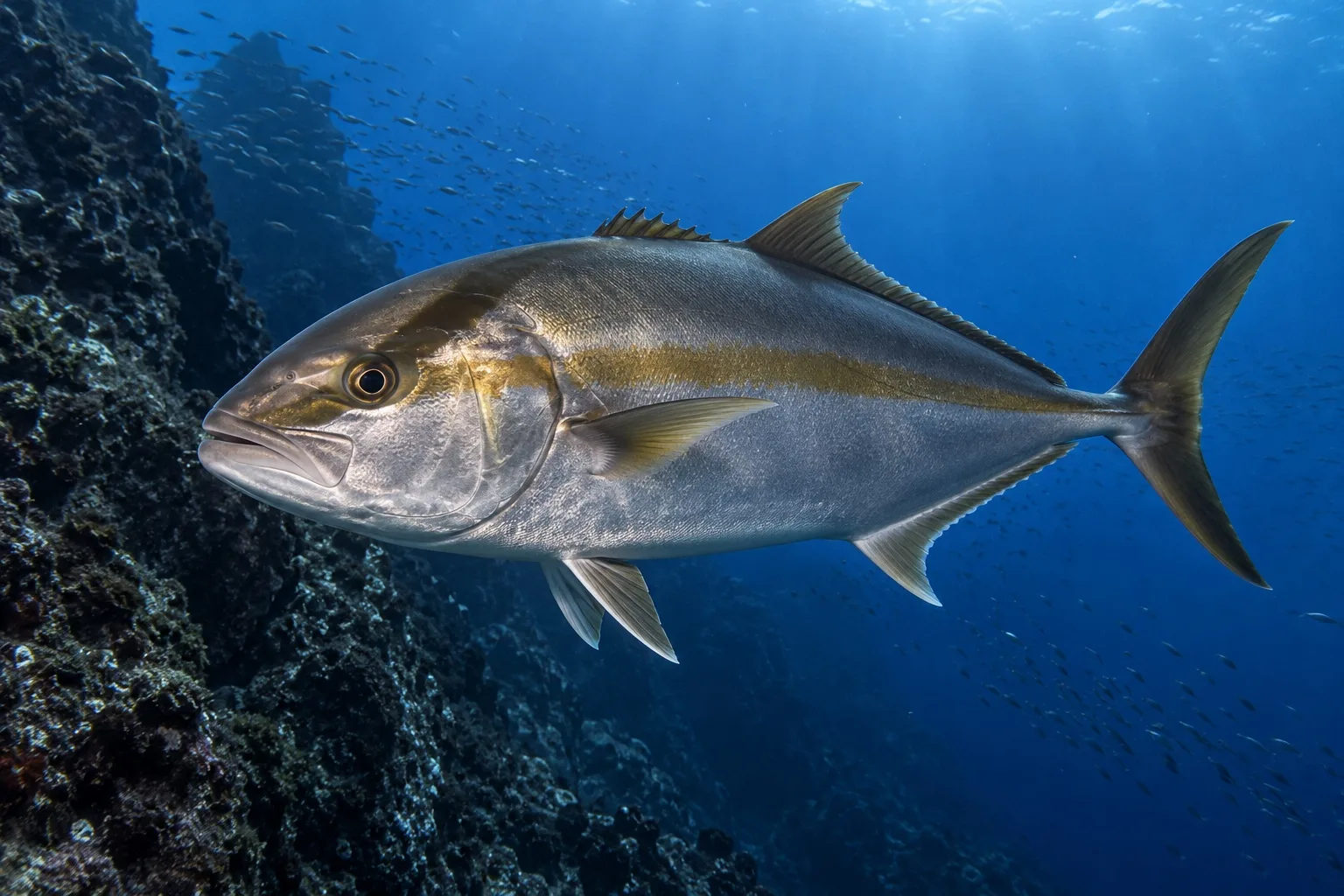
According to FishBase it lives at depths from 1 to 385 metres, mostly 18 to 72 metres. Older juveniles and adults gather at reefs, rocks and wrecks. Young fish travel in shoals under mats of sargassum (floating brown algae) in open water and move down to the bottom at five to six months. Some stocks stay local, others migrate.
Holding spots in the picture
Choose the time of day: the picture shows where the species holds. We do not show German seasons for travel fish; the bars give the chance of a catch for each month. Tap a fish or a spot in the list to bring it closer. The picture is schematic and AI-generated, and every water is different.
Chance of a catch per month according to the catch calendar
- J
- F
- M
- A
- M
- J
- J
- A
- S
- O
- N
- D
Spawning season
On the coast
Stony mixed ground
Greater amberjack is found here all year round.
Wreck, reef
Greater amberjack is found here all year round.
Open water, mid-water
Greater amberjack is found here all year round.
Adult amberjacks hold at wrecks, reefs and rocks and hunt on the bottom as well as in mid-water. Young fish travel in schools under drifting mats of algae on the open sea.
Depth: It lives between 1 and 385 metres, but usually at 18 to 72 metres.
Size comparison: AI-generated drawing, schematic.
How it feeds and spawns
The amberjack hunts fish near the bottom and in open water, as well as squid and crustaceans. Its prey includes bigeye scad and sardines. Juveniles feed on plankton. Young fish live in shoals, which fades with age, and the oldest animals are mostly solitary.
Spawning in the western Atlantic takes place off the coast from March to June, peaking in May or June according to NC DMF. Spawning grounds are reefs and wrecks. One female releases between 18 and 59 million eggs in a spawning season. The fish reach sexual maturity at three to five years.
When and where the season is
Amberjack can be found at wrecks and reefs all year round. According to the fisheries authority of North Carolina, studies show that fish move from the Carolinas to south-east Florida in spring. Off Florida some stocks live there permanently, while others only come into coastal waters from the South Atlantic for a time.
You may keep an amberjack only in short windows. In the federal waters of the Gulf of Mexico recreational fishing in 2026 was open only from 1 September to 13 October, and keeping fish there has been closed since. According to NOAA Fisheries the next season begins on 1 September 2027. In the South Atlantic April has been closed to everyone since October 2023, commercial and recreational anglers alike: nobody may keep an amberjack or have one on board then (Amendment 49), because the fish are packed together to spawn. In the coastal waters of the individual states their own periods may apply. As of October 2026.
How it is caught
Step by step: How to fish for amberjack: tips on bait, rigs and tackle – season, holding spots, bait, tackle and rules on one page.
Recreational anglers catch amberjack on hook and line, mostly from a boat over wrecks and reefs. The fisheries authority of North Carolina names drifting with live baitfish or pieces of fish, and trolling with spoons and other deep-running artificial lures. Chum helps to keep shoals at the boat. Amberjacks also often bite when anglers are fishing for king mackerel.
The fight is hard; the authority describes the amberjack as a powerful fighter that tests tackle. Because it holds over wrecks and heads for the bottom after the bite, anglers report that lifting it quickly off the bottom decides the outcome.
Check the eye stripe and the caudal peduncle: To identify the right species and so the right rule, look at the dark eye stripe and the smooth caudal peduncle without bony scutes. For similar Seriola species only counting the gill rakers helps.
Suitable lures
Live baitfish or pieces of fish when drifting over wrecks, spoons and deep-diving crankbaits when trolling.
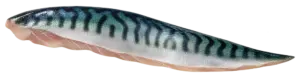
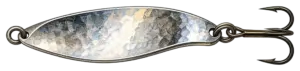
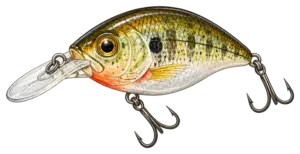
AI-generated illustrations. A click opens the lure’s page.
Check the US closed seasons (Schonzeit) and limits with the responsible authority
What applies locally
The amberjack is managed by NOAA Fisheries and the fishery management councils for the Gulf of Mexico and the South Atlantic. Minimum sizes (Mindestmaß), daily and per-trip limits and closed seasons apply. The stock in the Gulf has been regarded as overfished since 2001 and is managed under a rebuilding plan; the South Atlantic stock is not overfished. In the Gulf recreational anglers have a minimum size of 34 inches fork length, which is about 86 centimetres, and one fish per person per day (as of October 2026). The rules of the responsible authority on the spot are binding.
In the coastal waters of the states you need their fishing licence, in North Carolina for example the Coastal Recreational Fishing License. On the IUCN Red List the species is classed worldwide as not threatened (Least Concern, assessment of 2013).
Ciguatera is poisoning by algal toxins that can build up in fish from regions with coral reefs. FishBase records reports of ciguatera in amberjack in some areas. According to the Bundesinstitut für Risikobewertung, predatory fish living close to the coast such as mackerels, snappers and groupers are particularly affected. Whether a fish is contaminated cannot be told from its appearance, smell or taste, and cooking, frying or freezing does not break the toxin down. Anyone with symptoms after a fish meal should seek medical help. This information is no substitute for medical advice.
Frequently asked questions (FAQ)
How do I recognise an amberjack?
By the dark stripe from the snout through the eye to just in front of the dorsal fin, the amber lengthwise band and the smooth caudal peduncle without bony scutes.
Where does the amberjack hold?
At wrecks, reefs and rocks, mostly at depths of 18 to 72 metres. Juveniles live under floating sargassum in open water.
How big does an amberjack grow?
Usually around one metre. FishBase gives maximum values of 1,9 metres and 80,6 kilograms; most fish weigh around 18 kilograms.
Sources
The rating of catch chances is an editorial assessment. The facts come from these sources, and the text is worded in our own words. The illustration is an original design by Angel Momente in the style of a natural history plate (AI-generated, see the AI notice).
- FishBase: Seriola dumerili, Greater amberjack
- NOAA Fisheries: Greater Amberjack
- Florida Museum of Natural History: Seriola dumerili (Greater amberjack)
- North Carolina Division of Marine Fisheries: Greater Amberjack (Species Profile)
- Wikipedia: Große Bernsteinmakrele
- Bundesinstitut für Risikobewertung: Ciguatera – Fragen und Antworten (16. Mai 2022)
- NOAA Fisheries: Fishery Bulletin FB26-029, Recreational Fishing Season Length Announcement for Greater Amberjack in Federal Waters of the Gulf (1. Juni 2026)
- NOAA Fisheries: Final Rule to Implement Amendment 49, South Atlantic Greater Amberjack (April-Sperre für alle Sektoren, in Kraft seit 26. Oktober 2023)
Created with AI support from the sources listed. Figures only appear in the text if a source gives them. Last updated: 27 October 2026. Found a mistake? Write to us. Who is behind this site: About me.
More in the lexicon
- All fish species at a glance
- Catch calendar – month, water temperature and profile for 93 species
- Line calculator – breaking strain after the knot, drag guideline, backing
- Angling methods