
Knowledge – Fish
Roosterfish (Pez Gallo): Features, waters and methods
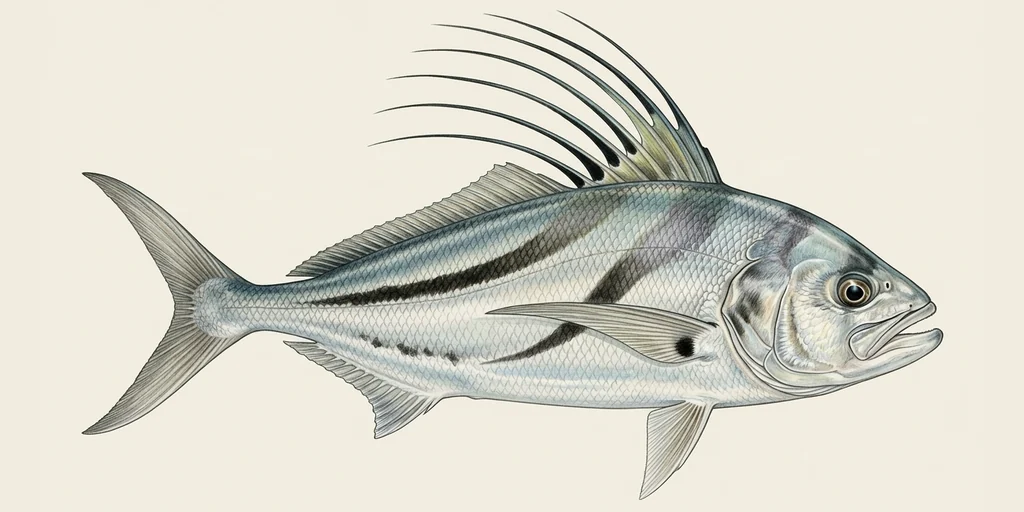
The roosterfish (Nematistius pectoralis), Spanish Pez Gallo, is a large predator of the Pacific coast between Baja California and Peru. It owes its name to its dorsal fin with seven long spines, which recalls a cock’s comb. In sport fishing in Central America and Mexico it is highly sought after.
In short: According to the catch calendar, the best time is all year round. Good spots on the coast: surf, sandy bottom and just below the surface. Proven baits: live baitfish such as thread herring and scad, trolled slowly. In Mexico, the Pez Gallo is reserved exclusively for sport fishing in a wide strip along the coast. Unmistakable thanks to its crest of seven long dorsal spines. Step by step: Fishing for roosterfish.
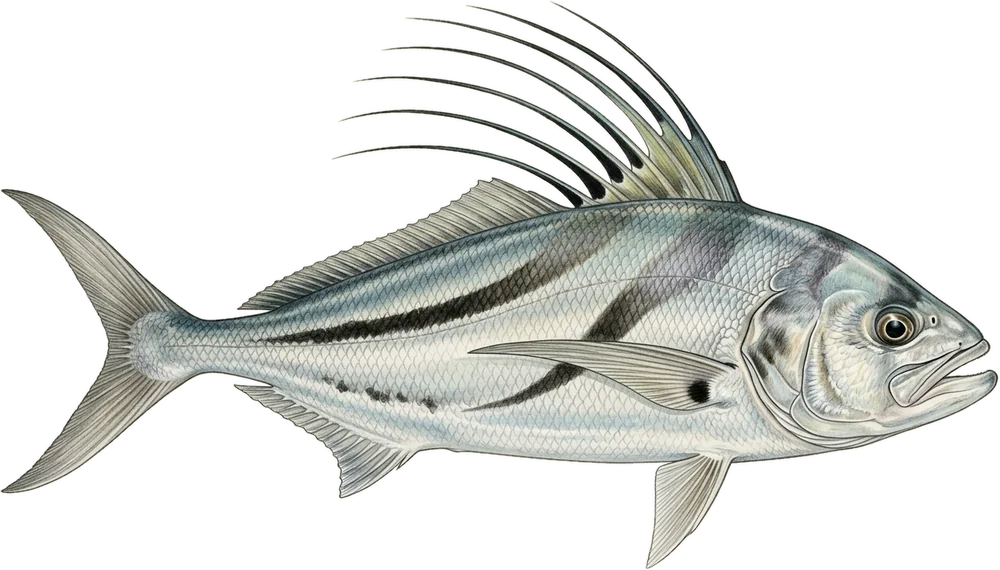
- Comb of seven very long, thread-like dorsal spines
- Two obliquely curved black bands on the flank
- Black spot at the base of the long, curved pectoral fin
Catch chances through the year
- Hardly any chance
- Possible
- Good
- Peak season
- Spawning (observe the closed season)
Editorial assessment for the home range (Pacific coast from Mexico to Panama), not a measurement and no guarantee. The rules of the country you visit are what count.
How to recognise it
The body is elongated and flattened from the sides, the head pointed. The first dorsal fin is unmistakable: six of its seven spines are greatly elongated and thread-like, and the long spines are black. When hunting, the fish can raise this crest.
Head and body are blue-grey with a silvery sheen. Four black markings stand out: a band between the eyes, one across the back of the head and two obliquely curved bands on the flank, the rear one running to the tail base. The pectoral fins are very long and curved and have a large black spot at the base underneath. The tail fin is deeply forked, the scales are small and smooth, and there are no bony plates.
FishBase gives a common length of 60 centimetres and a maximum of 163 centimetres fork length and 51,7 kilograms. The Smithsonian database for the eastern Pacific gives at least 191 centimetres. In juveniles the spiny dorsal fin is black with a white central band.
With its cock’s comb, the roosterfish is hard to confuse with anything else. It is the only species of its family and belongs to the wider kin of the jacks, which also include the giant trevally and the permit.
When the dorsal fin is lying flat, the two obliquely curved black bands on the flank and the black spot at the base of the pectoral fin help with identification.
Side by side
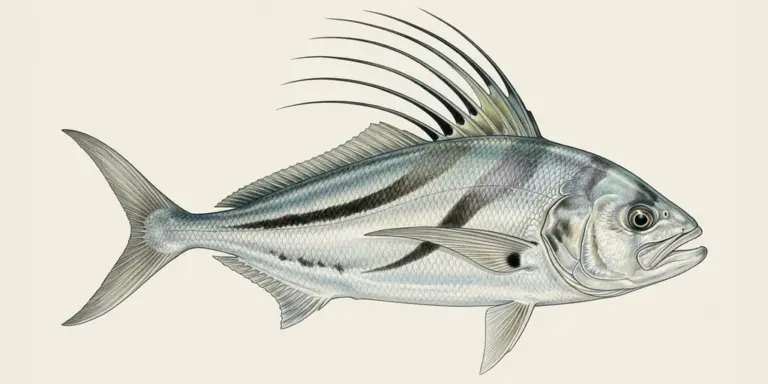
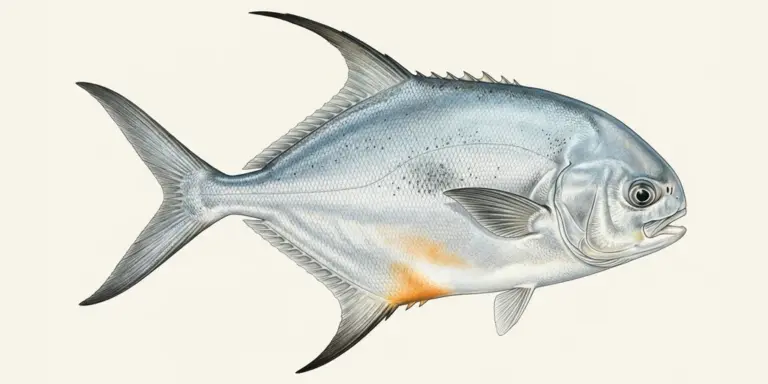
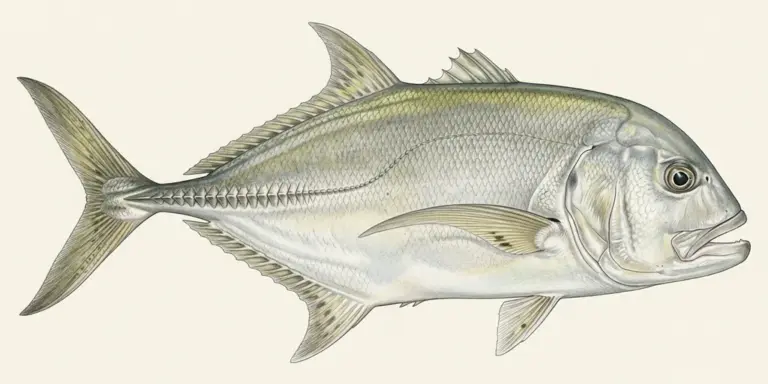
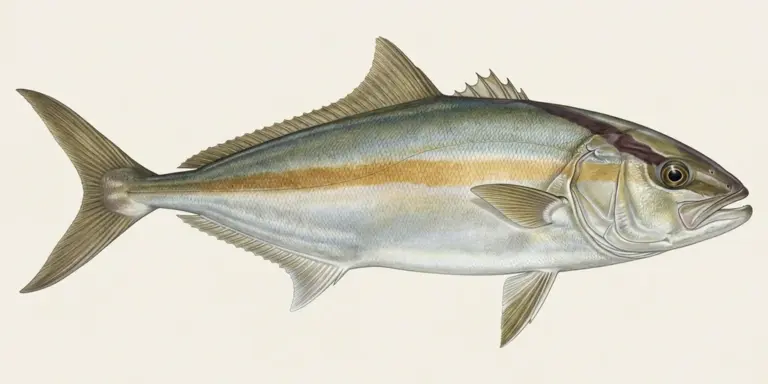
AI-generated illustrations.
Where it holds
The roosterfish lives in the eastern Pacific from Baja California and the Gulf of California to Peru, and also around the Galapagos Islands and Malpelo. North of Baja California it is rare.
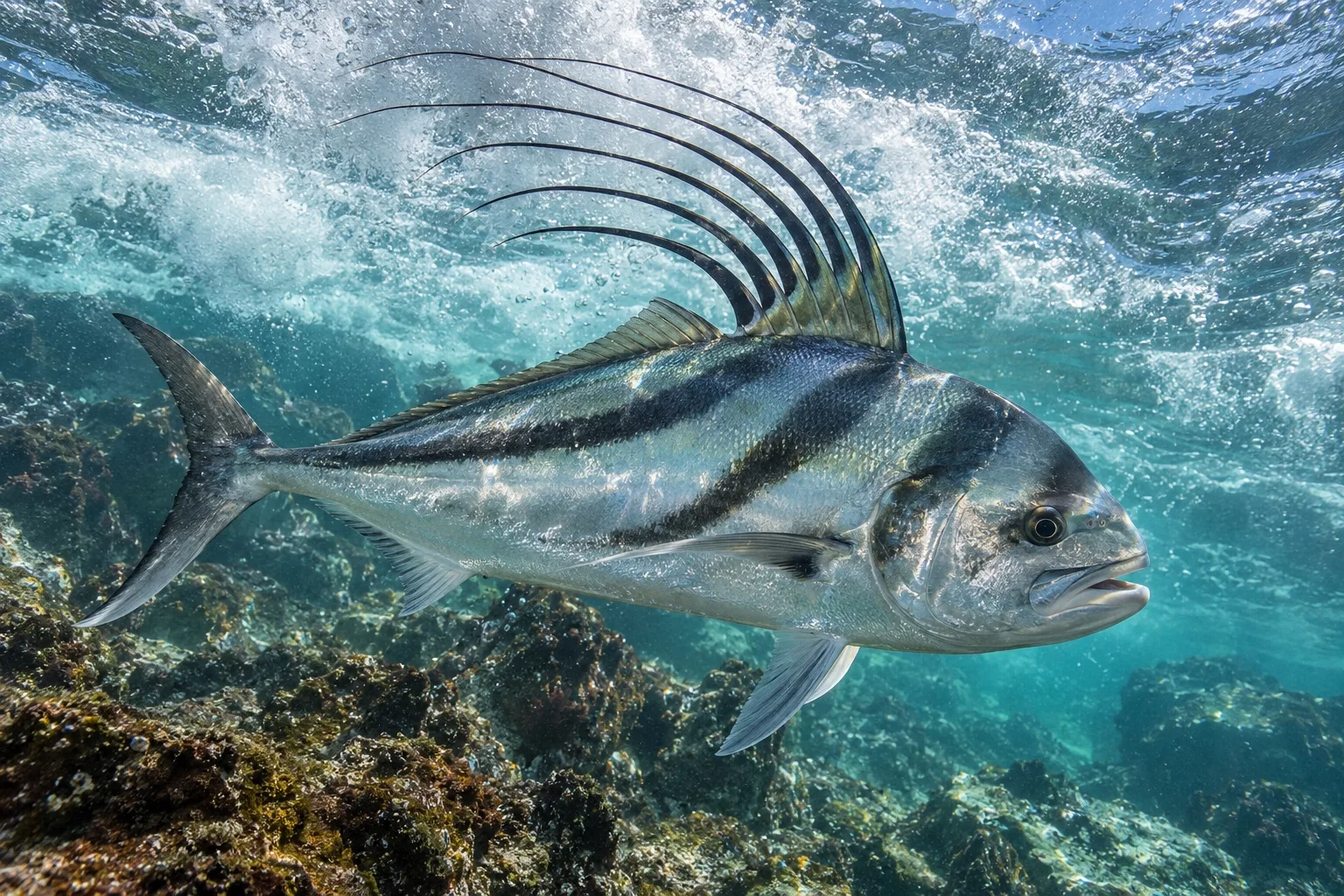
It stays in shallow coastal waters, mainly over sand off beaches, usually at depths of up to 20 metres. Juveniles are found in tide pools. In a telemetry study off Costa Rica, all the tracked fish stayed close to the coast in water under 100 metres deep and spent over 90 per cent of their time between the surface and 12 metres. In the temperate part of Baja California the species probably migrates with the water temperature.
Holding spots in the picture
Choose the time of day: the picture shows where the species holds. We do not show German seasons for travel fish; the bars give the chance of a catch for each month. Tap a fish or a spot in the list to bring it closer. The picture is schematic and AI-generated, and every water is different.
Chance of a catch per month according to the catch calendar
- J
- F
- M
- A
- M
- J
- J
- A
- S
- O
- N
- D
Active time From first light he is clearly more active; towards sunset he calms down.
Active time From first light he is clearly more active; towards sunset he calms down.
No main time From first light he is clearly more active; towards sunset he calms down.
No main time From first light he is clearly more active; towards sunset he calms down.
On the coast
Surf close to the shore
Roosterfish (pez gallo) is found here all year round.
Sandy bottom
Roosterfish (pez gallo) is found here all year round.
Open water, mid-water
Roosterfish (pez gallo) is found here all year round.
Just below the surface
Roosterfish (pez gallo) is found here all year round.
The roosterfish hunts in shallow coastal water off sandy beaches. There it drives shoals of small fish along the shoreline. It stays close to the coast, and juveniles are even found in tide pools.
Depth: It usually stays between the surface and about 12 metres, rarely deeper than 20 metres. At night it stays in the top 10 metres.
Size comparison: AI-generated drawing, schematic.
How it hunts and lives
The roosterfish is a fish hunter. In a study of 505 stomachs from Baja California Sur, jacks, anchovies and herring-like fish together made up almost half of the diet. As it grows larger it eats fewer sardine-like fish. Observations show that it regularly hunts shoaling fish along the beaches.
Satellite tags off Panama showed a clear daily rhythm: from dawn the fish dive and surface more often and are more active, and towards sunset activity drops. At night they mainly used the upper 10 metres, by day the upper 20 metres. Very little is yet known about spawning, growth and age.
When and where the season is
In the tropical waters from Mexico to Panama, the roosterfish can be found off the coast all year round. There is hardly any scientific data on stock size in individual months.
In the more northerly, cooler part of Baja California, observations point to seasonal migrations triggered by water temperature. There the catch depends more on the season than further south.
What it is caught on
Step by step: Fishing for roosterfish: tips on bait, rig and tackle – season, spots, bait, tackle and rules on one page.
The roosterfish is fished mainly from boats close to the beach, including trolling close to the shore. For a study off Costa Rica, live baitfish of 10 to 25 centimetres, thread herring and bigeye scad, were trolled slowly at depths of 5 to 30 metres along the coast, as the local sport fishery does. Circle hooks were used, that is, hooks with the point curved inwards.
In the study off Costa Rica the fights lasted 5 to 25 minutes. All the fish were hooked in the mouth with the circle hook and survived release, and two were caught again weeks later in good condition.
Circle hook and fish in the water: In the study off Costa Rica, all the fish stayed in the water for tagging, all were hooked in the mouth with the circle hook and all survived. The authors consider catch and release a suitable conservation strategy for the roosterfish.
Imitate the baitfish: Roosterfish hunt shoaling fish such as young jacks and herring-like fish. Live baitfish of this size, trolled slowly along the coast, are therefore the usual method.
Suitable lures
Live baitfish such as thread herring and scad, trolled slowly.
AI-generated illustrations. A click opens the lure’s page.
Reserved for sport fishing in Mexico; circle hooks and release in the water are kinder to the fish
What you need to know in the country you visit
In Mexico, under Article 68 of the fisheries law Ley General de Pesca y Acuacultura Sustentables, the Pez Gallo is reserved exclusively for sport and recreational fishing in a coastal strip of 50 nautical miles. Every person needs their own permit for sport fishing, foreigners included (Article 67, legal text).
In Costa Rica, Panama and the other countries of the region, separate licences and rules apply. The local fisheries authority (Fischereibehörde) is always the one that counts. Since 2024 the IUCN has listed the roosterfish as Least Concern.
Frequently asked questions (FAQ)
Where does the roosterfish get its name?
From the first dorsal fin. Six of its seven spines are long and thread-like and, when raised, recall a cock’s comb, which is why it is called Pez Gallo in Spanish.
Where can you catch roosterfish?
On the Pacific coast from Baja California to Peru, mainly in shallow water off sandy beaches and rocks. Well-known destinations are in Baja California Sur and on the Nicoya and Osa peninsulas in Costa Rica.
Can you catch roosterfish in Mexico?
Yes, but only as a sport and recreational angler with a permit. Close to the coast the species is reserved by law for sport fishing, and the local authority regulates the details.
Sources
The rating of catch chances is an editorial assessment. The facts come from these sources, and the text is worded in our own words. The illustration is an original design by Angel Momente in the style of a natural history plate (AI-generated, see the AI notice).
- FishBase: Nematistius pectoralis, Roosterfish
- Smithsonian Tropical Research Institute: Shorefishes of the Eastern Pacific – Nematistius pectoralis
- Europe PMC: Genome Survey Sequencing of the Roosterfish Nematistius pectoralis, Genes (2021), Volltext
- Europe PMC: Ortega-García et al. (2025), Trophic ecology of roosterfish in Baja California Sur, Journal of Fish Biology (Abstract)
- Europe PMC: The complete mitochondrial genome of the roosterfish, Gene (2022) (Abstract)
- Redalyc: Sepulveda et al. (2015), Post-release survival and movement patterns of roosterfish off the Central American coastline, Latin American Journal of Aquatic Research
- Nova Southeastern University: Vaudo et al. (2021), Diel vertical movements of a coastal predator, the roosterfish, Marine & Freshwater Research (Abstract)
- Cámara de Diputados (über CEC): Ley General de Pesca y Acuacultura Sustentables, Stand 2023
Created with AI support from the sources listed. Figures only appear in the text if a source gives them. Last updated: 27 October 2026. Found a mistake? Write to us. Who is behind this site: About me.
More in the lexicon
- All fish species at a glance
- Catch calendar – month, water temperature and profile for 93 species
- Line calculator – breaking strain after the knot, drag guideline, backing
- Angling methods