
Knowledge – Fish
Fishing for roosterfish
Fishing for roosterfish means heading along the Pacific coast of Central America to rocky reefs, sandbanks and river mouths and slowly trolling a live baitfish there. Here is the way there in nine steps, each with a link to the detailed page.
 Choose another fish117 fish with guides
 EelOff-peak season
 EelpoutPossible
 IdePossible
 ArapaimaGood
 GraylingPeak season
 Atlantic salmonSpawning time, please spare
 Brown troutSpawning time, please spare
 Brook troutSpawning time, please spare
 BarbelOff-peak season
 BarramundiSpawning season
 Greater amberjackGood
 Topmouth gudgeonOnly as bycatch
 Blue marlinSpawning season
 BonefishSpawning season
 BonitoGood
 BreamOff-peak season
 Dusky grouperOnly as bycatch
 CobiaPossible
 Spiny dogfishOnly as bycatch
 CodPeak season
 ChubPeak season
 MinnowOnly as bycatch
 European sturgeonOnly as bycatch
 FlounderPeak season
 PerchPeak season
 Largemouth bassGood
 Ballan wrasseOnly as bycatch
 Yellowfin tunaSpawning season
 Giant trevallyGood
 Prussian carpPossible
 BrillPossible
 Gilthead breamSpawning time, please spare
 Golden doradoSpawning season
 Golden mahseerOnly as bycatch
 Dolphinfish (mahi-mahi)Good
 Grass carpPossible
 Great barracudaGood
 GudgeonPossible
 White breamPossible
 DaceOff-peak season
 PikePeak season
 HalibutOff-peak season
 HerringPossible
 GarfishOut of season
 Huchen (Danube salmon)Possible
 Crucian carpOnly as bycatch
 CarpOff-peak season
 RuffeOff-peak season
 VendaceOnly as bycatch
 DabPeak season
 GurnardPossible
 Coley (saithe)Peak season
 Chinook salmonHardly any chance
 King mackerelSpawning season
 LingPeak season
 TuskOff-peak season
 MackerelPossible
 Bighead carpOut of season
 WhitefishPossible
 Conger eelOff-peak season
 Sea troutSpawning time, please spare
 Grey mulletPossible
 Murray codSpawning season
 MuskellungeGood
 Common nasePossible
 Nile perchPossible
 PayaraPossible
 Peacock bassPeak season
 PermitGood
 WeeverOnly as bycatch
 PollackOff-peak season
 BurbotOff-peak season
 AspPossible
 Red snapperSpawning season
 Rainbow troutPeak season
- RoosterfishGood
 RoachPeak season
 RedfishOut of season
 Bluefin tunaOnly as bycatch
 RuddPossible
 Russian sturgeonOnly as bycatch
 HaddockOff-peak season
 SnakeheadPossible
 TenchOff-peak season
 SpirlinOnly as bycatch
 PlaiceOff-peak season
 Greenland halibutOnly as bycatch
 Round gobyOnly as bycatch
 SwordfishGood
 Lake troutSpawning time, please spare
 HakeSpawning time, please spare
 Alpine charSpawning time, please spare
 MonkfishPossible
 SoleOff-peak season
 SailfishGood
 Silver carpOut of season
 SnookPeak season
 PumpkinseedOnly as bycatch
 SpratOnly as bycatch
 Atlantic wolffishSpawning time, please spare
 TurbotPeak season
 SterletOnly as bycatch
 SmeltOnly as bycatch
 Horse mackerelPossible
 TaimenGood
 TarponGood
 TigerfishSpawning season
 BleakPossible
 WahooGood
 Wels catfishOff-peak season
 WhitingPeak season
 Sea bassOff-peak season
 ZanderPeak season
 White-eye breamOnly as bycatch
 Blue breamOnly as bycatch
 Brown bullheadPossible
 VimbaOnly as bycatch
Season in October according to the catch calendar, an estimate and not a guarantee of a catch. The fish pictures are reduced natural-history plates and AI-generated.
Best time
All year round, mainly in the morning and during the day.
In January: GoodIn February: GoodIn March: GoodIn April: GoodIn May: GoodIn June: GoodIn July: GoodIn August: GoodIn September: GoodIn October: GoodIn November: GoodIn December: Good
Good spot
- Coast: surf, sandy bottom and just below the surfacesurf, sandy bottom and just below the surfacesurf, sandy bottom and just below the surfacesurf, sandy bottom and just below the surface
Top baits
Starter tackle
- Rod: strong boat rod, matched to 15 kg line
- Line: monofilament, 15 kg breaking strain
- Hook: circle hook 8/0 with no offset
In short
In short: According to the catch calendar the best time is all year round. Good spots on the coast: surf, sandy bottom and just below the surface. Proven baits: live baitfish such as thread herring and scad, trolled slowly. In Mexico the pez gallo is reserved exclusively for sport fishing in a broad coastal strip. Unmistakable thanks to the crest of seven long dorsal fin spines.
Quick to recognise
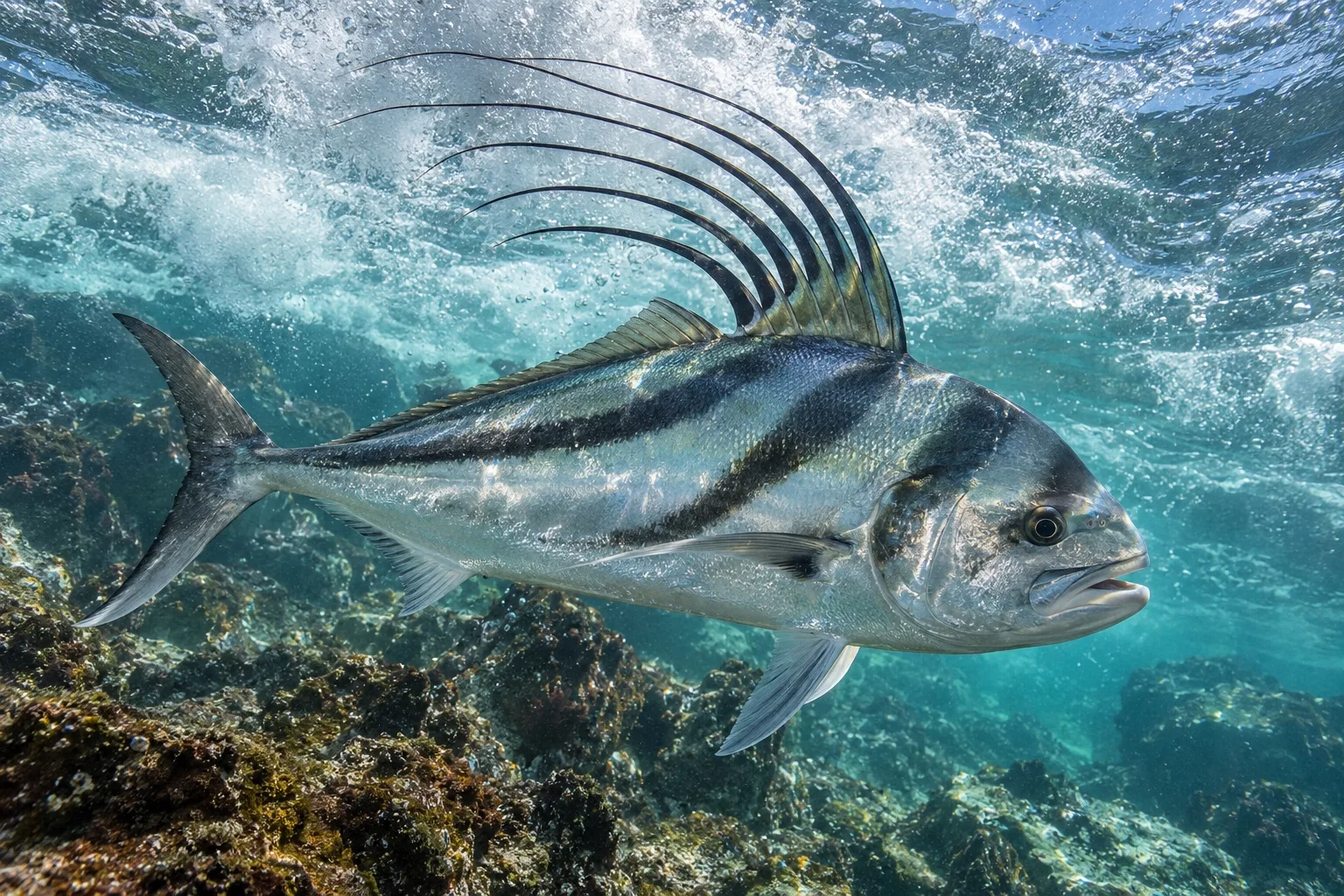
An elongated predator whose first dorsal fin consists of seven spines, six of them long and thread-like like a cock’s comb. In addition there are two slanting black bands on the flank. Around 60 centimetres is usual; as maximum weight FishBase gives almost 52 kilograms.
When
Between Mexico and Panama you find him in the tropical grounds off the coast all year round; precise monthly data are scarce. In the cooler north of Baja California he probably migrates with the water temperature, so the season counts for more there. Little is known so far about his spawning season.
- JanGood
- FebGood
- MarGood
- AprGood
- MayGood
- JunGood
- JulGood
- AugGood
- SepGood
- OctGood
- NovGood
- DecGood
Peak seasonGoodPossibleHardly any chanceSpawning season
Season in the destination
Sport fishing for roosterfish in Baja California Sur and Central America is seasonal, but the studies give no fixed monthly data. Off Costa Rica the water was 23 to 31 degrees during a telemetry study. In the milder waters off Baja California his migrations, according to older studies, probably depend on the water temperature. Tropical squalls with heavy rain and high surf forced the researchers off Costa Rica to break off work on the water several times.
Season and biting time
In January: GoodIn February: GoodIn March: GoodIn April: GoodIn May: GoodIn June: GoodIn July: GoodIn August: GoodIn September: GoodIn October: GoodIn November: GoodIn December: Good
Where it is now
On the coast
He hunts in shallow water off sandy beaches, close to the surf, and drives shoaling fish along the shoreline. Off Costa Rica tagged fish mostly stayed between the surface and a depth of 12 metres.
How to go about it: Off Costa Rica tagged roosterfish stayed close to the coast over less than 100 metres of depth and moved back and forth between rocky reefs, sandbanks and river mouths. Off Panama they stayed mostly in the top 20 metres by day and the top 10 at night. Young fish are often found right at the shoreline, larger ones more in the surf zone, at reefs and on sandbanks.
| All year round | surf, sandy bottom, just below the surface, open water |
|---|
Feeding time: mainly in the morning and during the day. How this looks on the water is shown by the picture of the holding spots right below.
Holding spots in the picture
Choose a season and time of day: the picture shows where the species sits then. Tap a fish or a spot in the list to bring it closer. The picture is schematic and AI-generated, every water is different.
Chance of a catch in springgood
Catch chance in summergood
Catch chance in autumngood
Catch chance in wintergood
- J
- F
- M
- A
- M
- J
- J
- A
- S
- O
- N
- D
Active time From first light he is clearly more active; towards sunset he calms down.
Active time From first light he is clearly more active; towards sunset he calms down.
No main time From first light he is clearly more active; towards sunset he calms down.
No main time From first light he is clearly more active; towards sunset he calms down.
On the coast
Surf close to the shore
Roosterfish (pez gallo) is found here all year round.
Sandy bottom
Roosterfish (pez gallo) is found here all year round.
Open water, mid-water
Roosterfish (pez gallo) is found here all year round.
Just below the surface
Roosterfish (pez gallo) is found here all year round.
The roosterfish hunts in shallow coastal water off sandy beaches. There it drives shoals of small fish along the shoreline. It stays close to the coast, and juveniles are even found in tide pools.
Spring: catch chances according to the catch calendar are good.
Summer: catch chance according to the catch calendar good.
Autumn: chance of a catch good according to the catch calendar.
Winter: good chance of a catch according to the catch calendar.
Depth: It usually stays between the surface and about 12 metres, rarely deeper than 20 metres. At night it stays in the top 10 metres.
Size comparison: AI-generated drawing, schematic.
How
Local sport fishing trolls live baitfish slowly along the coast from boats, over rocky reefs, sandbanks and off river mouths. From first light he is more active, and this tails off towards sunset.
Easiest way
The easiest way is to troll a live baitfish slowly from a small boat along the coast, as sport fishing does in Costa Rica. A circle hook 8/0 and a fluorocarbon leader of about 20 kilos breaking strain on a monofilament main line are enough as the end rig.
Live baitfish, trolled slowly
The usual method of the sport boats in Central America: a live baitfish is pulled along the coast close in at low speed.
- Head for structures
Head for rocky reefs, sandbanks and river mouths near the shore. Off Costa Rica tagged roosterfish were most active there, especially when the echo sounder showed many small fish.
- Get hold of baitfish
Take live thread herring or bigeye scad 10 to 25 centimetres long, as used by the sport boats off Costa Rica.
- Circle hook and leader
Tie a fluorocarbon leader of 20 kilos breaking strain to a monofilament main line of 15 kilos. The bait sits on a circle hook 8/0 whose point is not offset to the side.
- Troll slowly
Pull the baitfish at low speed parallel to the coast over 5 to 30 metres of water depth. Around sunrise and sunset the fish off Costa Rica covered the greatest distances.
- Moderate drag
Set the drag to 3 to 4 kilos, which is how the researchers fought their fish. Expect long runs, because the roosterfish is known for strength and stamina.
- Alongside the boat in the water
Bring the fish alongside the boat and leave it in the water. In the study measuring and releasing took less than a minute.
What with
A live baitfish, as used by the sport boats off Costa Rica: thread herring or bigeye scad of 10 to 25 centimetres on a circle hook. Jacks, anchovies and herring-type fish make up almost half of his food.
- Baitfishwhen trolling slowly along the coast
Jacks, anchovies and herring-type fish together make up almost half of his food, and a live thread herring or scad fits exactly this prey pattern.
Tackle
A strong boat rod and a reel with a finely adjustable drag; the researchers off Costa Rica fished with 15 kilos of monofilament. Expect fights of 5 to 25 minutes.
Live baitfish, trolled slowly
- Rod
- strong boat rod, matched to 15 kg line
- Reel
- Reel with a finely adjustable drag, 3–4 kg of drag in the fight
- Line
- Monofilament, 15 kg breaking strain
- Leader
- Fluorocarbon, 20 kg breaking strain
- Hooks
- Circle hook 8/0 with no offset
- Weight, float, lead
- live baitfish 10–25 cm, without weight
Common mistakes
- Ordinary hook on natural bait: With circle hooks in the study off Costa Rica the hook sat in the mouth of every fish, and there was no damage to gills or throat. So use a circle hook with no offset.
- Lifting the fish out of the water for a photo: The researchers left every roosterfish in the water and were done in less than a minute. Take photos and measurements alongside the boat or in shallow water.
- Searching too far out: Tagged fish stayed close to the coast and hardly left the upper layers of water. Troll close to reefs, sandbanks and river mouths instead of over deep water.
- Starting only late in the morning: Off Panama activity rose sharply at first light, and off Costa Rica the fish were most on the move around sunrise and sunset. Be on the water early.
Rules
For roosterfish the rules of the country where you fish apply, not the German fisheries laws. Each country, and often each water, sets its own licence, closed seasons, minimum sizes and rules on keeping fish.
What the profile says: In Mexico the pez gallo is reserved exclusively for sport fishing in a broad coastal strip. Unmistakable thanks to the crest of seven long dorsal fin spines.
The fisheries authority (Fischereibehörde) of the country you travel to is what counts. Ask about the current rules before the trip and read in the profile how threatened the species is.
After the catch
Playing and landing
Fight it with a moderate drag and bring the fish in promptly. At the boat it stays in the water, and measuring and unhooking should take less than a minute. After release, tagged fish went to the bottom for two to three hours and were calmer, then hunted again. In sport fishing the roosterfish is usually released; the country where you fish sets the rules, the licence and what you may keep.
Unhook him while he stays in the water. Off Costa Rica in a study every fish had the circle hook in the mouth and all survived release. The researchers consider catch and release a suitable form of protection for roosterfish.
Frequently asked questions
What hook size for roosterfish?
With live baitfish the researchers off Costa Rica fished circle hooks of size 8/0 with the point not offset to the side.
How strong should the drag be for roosterfish?
In the study off Costa Rica the researchers fought fish with 3 to 4 kilos of drag on 15 kilo monofilament and a 20 kilo fluorocarbon leader.
When does the roosterfish bite best?
Tagged fish showed the most movement around sunrise and sunset. Off Panama diving activity began at first light and lasted until dusk.
How deep does the roosterfish sit?
Mostly shallow: off Panama by day he used mainly the top 20 metres, at night the top 10. The deepest point a fish reached off Costa Rica was 62 metres.
Similar species
If you catch roosterfish, you can fish for these species with similar tackle:
 Amberjack fishingGood
 Cobia fishingPossible
 Fishing for great barracudaGood
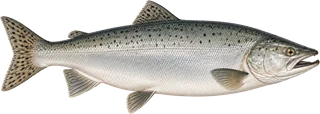 Chinook salmon fishingSlim chances
Sources
As of October 2026. The practical knowledge comes from 4 sources, summarised in our own words.
See all 4 sources
- Post-release survival and movements patterns of roosterfish (Nematistius pectoralis) off the Central American coastline (Lat. Am. J. Aquat. Res. 43, 2015) · Latin American Journal of Aquatic Research (Sepulveda, Aalbers, Bernal; Pfleger Institute of Environmental Research, University of Massachusetts)
- Diel vertical movements of a coastal predator, the roosterfish (Nematistius pectoralis) (Marine and Freshwater Research 73, 2021) · Nova Southeastern University, NSUWorks (Vaudo, Logan, Wetherbee, Harvey, Shivji; Abstract)
- Trophic ecology of roosterfish (Nematistius pectoralis) inferred from stomach content and stable isotope analyses in the southern part of Baja California peninsula (Journal of Fish Biology, 2025) · Journal of Fish Biology (Ortega-García u. a., CICIMAR-IPN; Abstract)
- Age, growth, and length–weight relationship of roosterfish (Nematistius pectoralis) in the eastern Pacific Ocean (Fishery Bulletin 115, 2017) · NOAA Fisheries, Fishery Bulletin (Ortega-Garcia, Sepulveda, Aalbers u. a.)
Text AI-assisted, based on the sources named and these pages: Roosterfish (profile), Sea fishing, Baitfish, Releasing fish.