
Knowledge – Fish
Rudd fishing
Fishing for rudd means stalking quietly up to reeds and water lilies and offering the bait slowly from above. Here is the way to get there in nine steps, each with a link to the detailed page.
 Choose another fish117 fish with guides
 EelOff-peak season
 EelpoutPossible
 IdePossible
 ArapaimaGood
 GraylingPeak season
 Atlantic salmonSpawning time, please spare
 Brown troutSpawning time, please spare
 Brook troutSpawning time, please spare
 BarbelOff-peak season
 BarramundiSpawning season
 Greater amberjackGood
 Topmouth gudgeonOnly as bycatch
 Blue marlinSpawning season
 BonefishSpawning season
 BonitoGood
 BreamOff-peak season
 Dusky grouperOnly as bycatch
 CobiaPossible
 Spiny dogfishOnly as bycatch
 CodPeak season
 ChubPeak season
 MinnowOnly as bycatch
 European sturgeonOnly as bycatch
 FlounderPeak season
 PerchPeak season
 Largemouth bassGood
 Ballan wrasseOnly as bycatch
 Yellowfin tunaSpawning season
 Giant trevallyGood
 Prussian carpPossible
 BrillPossible
 Gilthead breamSpawning time, please spare
 Golden doradoSpawning season
 Golden mahseerOnly as bycatch
 Dolphinfish (mahi-mahi)Good
 Grass carpPossible
 Great barracudaGood
 GudgeonPossible
 White breamPossible
 DaceOff-peak season
 PikePeak season
 HalibutOff-peak season
 HerringPossible
 GarfishOut of season
 Huchen (Danube salmon)Possible
 Crucian carpOnly as bycatch
 CarpOff-peak season
 RuffeOff-peak season
 VendaceOnly as bycatch
 DabPeak season
 GurnardPossible
 Coley (saithe)Peak season
 Chinook salmonHardly any chance
 King mackerelSpawning season
 LingPeak season
 TuskOff-peak season
 MackerelPossible
 Bighead carpOut of season
 WhitefishPossible
 Conger eelOff-peak season
 Sea troutSpawning time, please spare
 Grey mulletPossible
 Murray codSpawning season
 MuskellungeGood
 Common nasePossible
 Nile perchPossible
 PayaraPossible
 Peacock bassPeak season
 PermitGood
 WeeverOnly as bycatch
 PollackOff-peak season
 BurbotOff-peak season
 AspPossible
 Red snapperSpawning season
 Rainbow troutPeak season
 RoosterfishGood
 RoachPeak season
 RedfishOut of season
 Bluefin tunaOnly as bycatch
- RuddPossible
 Russian sturgeonOnly as bycatch
 HaddockOff-peak season
 SnakeheadPossible
 TenchOff-peak season
 SpirlinOnly as bycatch
 PlaiceOff-peak season
 Greenland halibutOnly as bycatch
 Round gobyOnly as bycatch
 SwordfishGood
 Lake troutSpawning time, please spare
 HakeSpawning time, please spare
 Alpine charSpawning time, please spare
 MonkfishPossible
 SoleOff-peak season
 SailfishGood
 Silver carpOut of season
 SnookPeak season
 PumpkinseedOnly as bycatch
 SpratOnly as bycatch
 Atlantic wolffishSpawning time, please spare
 TurbotPeak season
 SterletOnly as bycatch
 SmeltOnly as bycatch
 Horse mackerelPossible
 TaimenGood
 TarponGood
 TigerfishSpawning season
 BleakPossible
 WahooGood
 Wels catfishOff-peak season
 WhitingPeak season
 Sea bassOff-peak season
 ZanderPeak season
 White-eye breamOnly as bycatch
 Blue breamOnly as bycatch
 Brown bullheadPossible
 VimbaOnly as bycatch
Season in October according to the catch calendar, an estimate and not a guarantee of a catch. The fish pictures are reduced natural-history plates and AI-generated.
Best time
From June to August, especially in the morning and in the evening.
In January: Hardly any chanceIn February: Hardly any chanceIn March: PossibleIn April: Good, spawning seasonIn May: Good, spawning seasonIn June: Main seasonIn July: Main seasonIn August: Main seasonIn September: GoodIn October: PossibleIn November: Hardly any chanceIn December: Hardly any chance
Good spot
- Lake: weed bed and reed edgeweed bed, reed edge and surfaceweed bed and reed edgedeep bottom
- River: quiet bayquiet bayquiet bayquiet bay
Starter tackle
- Rod: light match rod 3–4 m
- Line: monofilament up to 0,20 mm
- Hook: size 14 or smaller, depending on the bait
- Rod: pole 6–8 m to start with
- Line: monofilament 0,18–0,20 mm
- Hook: size 14–16
- Rod: light fly rod class 4–5
- Line: floating fly line
- Hook: dry fly size 16 if no natural insect to copy can be seen
In short
In short: The best time to catch rudd is from June to August, especially in the morning and in the evening. Good spots on a lake: weed bed and reed edge; on a river: quiet bay. Proven baits: a flake of bread or a grasshopper at the surface; sweetcorn, maggots, paste or small dry flies.
Quick to recognise
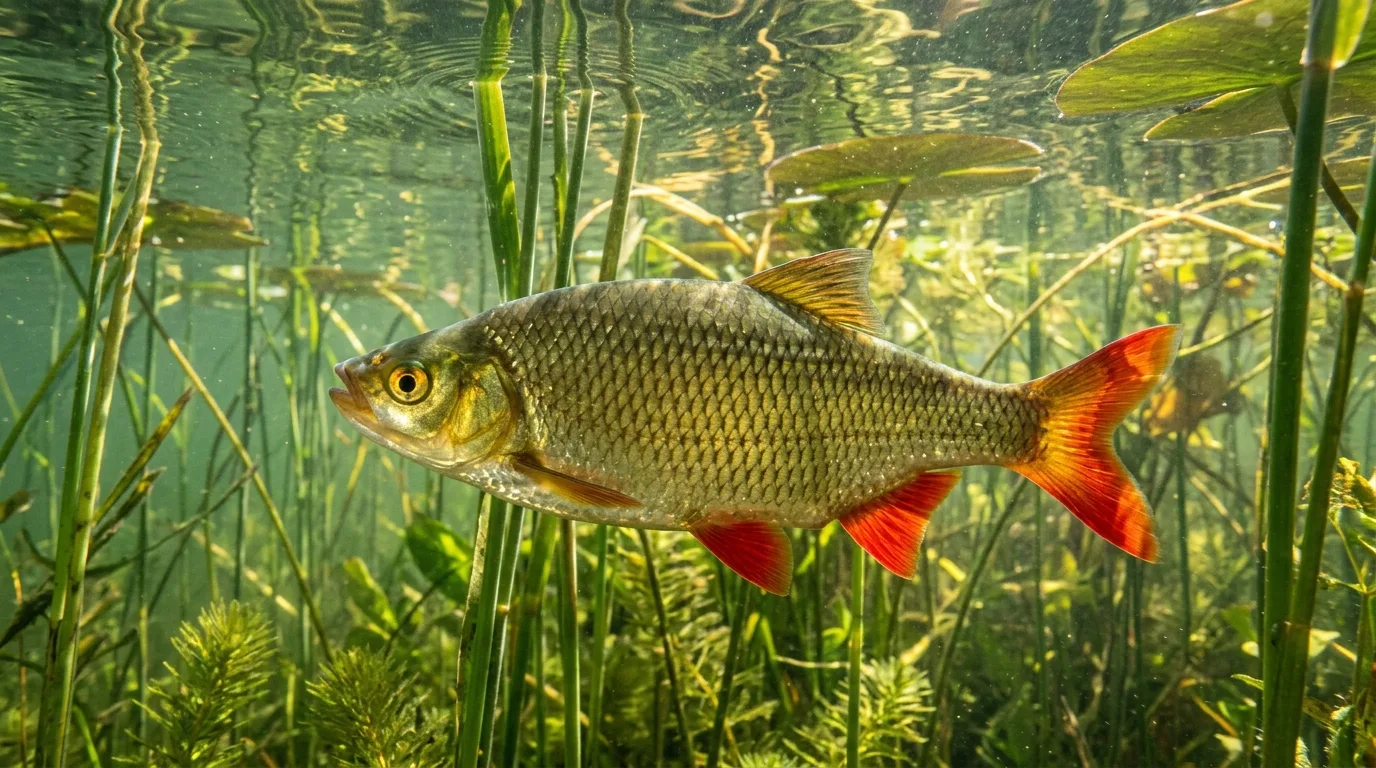
A shoaling fish of weedy waters with an upturned mouth, which likes to take food from the surface and is often mistaken for the roach. 20 to 30 centimetres is typical.
When
Rudd are summer fish: the main season is June to August, and April, May and September are also good. In April and May they spawn in densely overgrown shallows, and you leave them in peace there. They bite best early in the morning and at dusk in the evening.
- JanHardly any chance
- FebHardly any chance
- MarPossible
- AprGood, spawning
- MayGood, spawning
- JunPeak season
- JulPeak season
- AugPeak season
- SepGood
- OctPossible
- NovHardly any chance
- DecHardly any chance
Peak seasonGoodPossibleHardly any chanceSpawning season
Spring tactics
Before and during the spawning season in April and May, targeted catches are rare. Shallow, small waters warm up first, and that is where the first rudd show at the surface in late spring. Whether a closed season (Schonzeit) applies then is set by your federal state (Bundesland).
Summer tactics
Now the best time begins. When the sun is blazing you fish early in the morning or at dusk; on mild, overcast days the fish come up during the day as well. Over the course of the day they often move from the surface layer into mid-water, and then you set the float a little deeper.
Autumn tactics
In late summer and early autumn a morning session with drifting bread or maggots is worthwhile. Towards October fewer fish come up, and you are more likely to catch big rudd close to the bottom on a worm.
Winter tactics
In winter the rudd is hardly a target fish. If you try, you offer a small bait in the deeper spots close to the bottom and expect few bites.
Are they biting today?
In January: Off seasonIn February: Off seasonIn March: PossibleIn April: Spawning season, please spare the fishIn May: Spawning season, please spare the fishIn June: Main seasonIn July: Main seasonIn August: Main seasonIn September: Shoulder seasonIn October: PossibleIn November: Off seasonIn December: Off season
Today’s catch index needs JavaScript. Season and spawning time are in the catch calendar.
From the blog: Freshwater fish in Germany: which species you catch where · Roach or rudd, bream or silver bream: how to tell these silver fish apart reliably
Where it sits now
In the lake
The shoals sit close to the bank at reed edges, at the edge of water lily beds and in heavily weeded shallows. On warm days they feed at the surface, and in winter they move into deeper water.
How to go about it: In shallow lakes with murky water and a dense belt of reeds and water lilies, big rudd stay very faithfully in the plants. Fish these spots from a distance, from the opposite bank or from an anchored boat. From the boat you can see the fish feeding at the surface early in the morning.
| Spring | weed bed, reed edge |
|---|---|
| Summer | weed bed, reed edge, surface |
| Autumn | weed bed, reed edge |
| Winter | deep bottom |
In the river
On a river you find rudd in slow-flowing, weedy stretches and in oxbow lakes with a soft bottom.
How to go about it: On a river you look for bays, oxbow lakes and weedy ditches with little current. Where it flows gently, it carries drifting bread along the bank edge more predictably than the wind on a lake; simply let the rig drift along.
| All year round | calm bay |
|---|
At the pond
How to go about it: In small ponds and stormwater retention basins, rudd are often among the commonest fish. A pole and a few maggots near the bank are usually enough there.
Biting time: mainly in the morning and in the evening. What that looks like at the water is shown by the picture of the holding spots just below.
Holding spots in the picture
Choose the season and time of day: the picture shows where the species stands then. Spots outlined in red apply only in the chosen season. Tap a fish or a spot in the list to bring it closer. The picture is schematic and AI-generated, every water is different.
Chance of a catch in springgoodSpawning, observe the closed seasons
Catch chance in summerPeak season
Catch chance in autumnpossible
Catch chance in winterhardly any
- J
- F
- M
- A
- M
- J
- J
- A
- S
- O
- N
- D
Spawning season
Active time The best biting time for rudd is early in the morning and at dusk in the evening.
No peak time The best biting time for rudd is early in the morning and at dusk in the evening.
Active time The best biting time for rudd is early in the morning and at dusk in the evening.
No peak time The best biting time for rudd is early in the morning and at dusk in the evening.
In the lake
reed edge
Rudd are found here only in spring, summer and autumn.
Water lilies and weed bed
Rudd are found here only in spring, summer and autumn.
Deep bottom
Rudd are found here only in winter.
Just below the surface
Rudd are found here only in summer.
The rudd lives in shoals in shallow, soft-bottomed areas rich in plants, preferably near the bank. The shoals sit at reed edges, among water lilies and in heavily weeded stretches.
Spring: catch chance according to the catch calendar: possible in March, good in April and May. The spawning season falls in this period, so observe closed seasons (Schonzeit). To spawn, the shoals seek out shallow, densely overgrown bank areas. The eggs stick to aquatic plants.
Summer: catch chance according to the catch calendar: main season. On warm days from May to September the shoals take insects that have landed on the water from the surface. After spawning until autumn is when rudd are caught most of all.
Autumn: catch chance according to the catch calendar good in September, possible in October, hardly any in November.
Winter: catch chance according to the catch calendar: hardly any. In the winter months rudd seek out the deeper zones of the water.
In the river
Calm bay with aquatic plants
Rudd are found here all year round.
On a river the rudd lives in slow-flowing stretches rich in plants and in oxbow lakes with a soft bottom.
Spring: catch chance according to the catch calendar possible in March, good in April and May. This is the spawning period, so observe the closed seasons (Schonzeit).
Summer: catch chance according to the catch calendar: main season.
Autumn: catch chance according to the catch calendar good in September, possible in October, hardly any in November.
Winter: catch chance according to the catch calendar: hardly any. In the winter months rudd seek out the deeper zones of the water.
Depth: The rudd likes to stay near the bank and the surface. Big ones sit in the middle of the shoal or beneath it.
Size comparison: AI-generated drawing, schematic.
How
Mostly you fish with a float or long pole just below the surface, because many bites come while the bait is still sinking. The float therefore has to cock quickly. If the fish are rising to insects, you can also use the fly rod and a dry fly.
Easiest way
To start with, a pole of 6 to 8 m with 0,18 monofilament, a hook of size 14 or 16 and a light float of 1 to 4 g is enough. Sit down at an overgrown pond or a lake shore with reeds and offer a maggot in mid-water. A few maggots thrown in front of the float every few minutes keep the shoal with you.
Shallow float at the reed edge
The most common way in summer, when the shoals feed in the upper water at reeds and water lilies.
- Finding the shoal
Let a few pieces of bread drift in front of reeds or water lilies. Where they are attacked straight away, a shoal is present. In natural lakes, rudd in summer feed at the surface mainly shortly after it gets light.
- Little and often
Fire a few maggots round the float with the catapult at short intervals. If you top up without a break, you increase the competition for food and keep the fish in place even after a fight.
- Set it shallow
You do not need to plumb the depth here. Set the bait in mid-water or just below the surface, with a very short hooklength under a pre-weighted waggler or a small bubble float.
- Baiting so it stays on
In summer rudd grab boldly and quickly pick soft baits off the hook. Two or three maggots or a grain of sweetcorn stay on better, and for big fish it can be more.
- Right at the edge
Place the rig a few centimetres in front of the reeds or right at the edge of the water lilies. If there is wind, cast a little to the side and let it drift into the area instead of throwing it on the fish’s heads.
- Already on the drop
Keep the line under control straight after the cast, because many fish take the bait before it reaches its depth. If the float dives or does not cock as usual, strike.
- Away from the shoal
Draw the hooked fish briskly to the side. A fish thrashing at the surface in the middle of the shoal scares off the rest.
- Landing net ready
Net larger rudd instead of lifting them out on the fine line. Handle them only with wet hands.
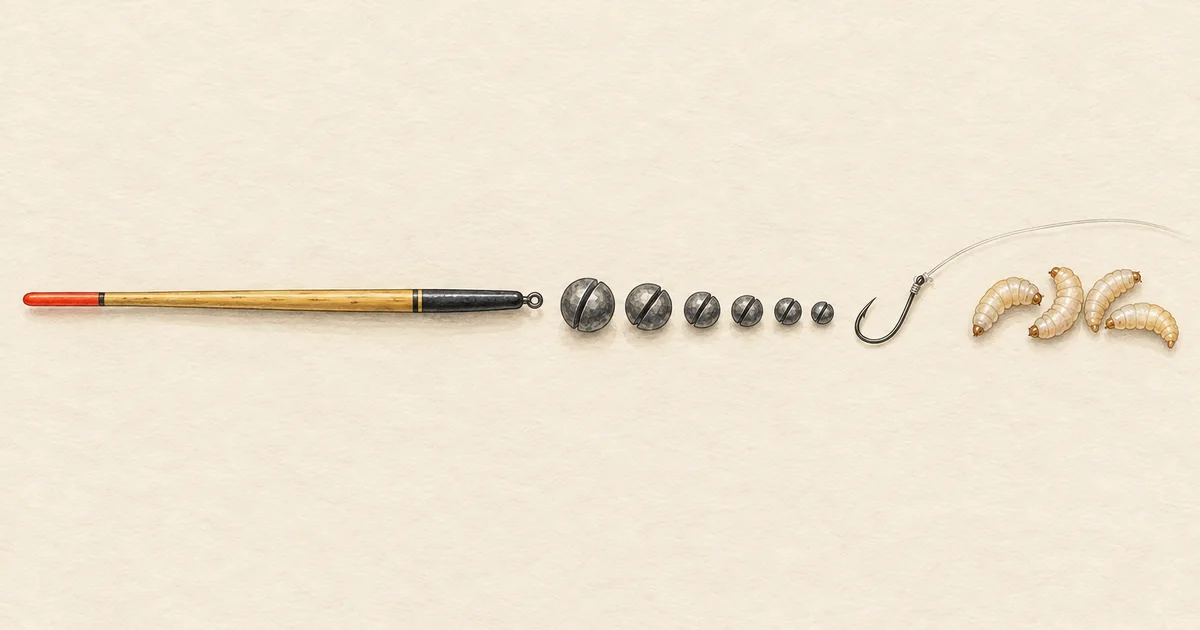
Long pole at the bank
For rudd within rod reach, in a pond, at the lake shore and when stalking quietly in shallow water.
- Bank with plants
Find a spot with weed or reeds within reach of the rod. In ponds and retention basins, rudd often sit right by the bank.
- Line shorter than the rod
The line is a little shorter than the pole, so you can comfortably reach hook and fish. Spread small shot evenly, and then the bait sinks slowly through mid-water, where rudd feed.
- Topping up the maggots
Throw a small portion of maggots round the float every few minutes. Floating maggots keep the fish in the upper water.
- Stalking with a grasshopper
In shallow waters you can approach by wading and let a grasshopper flutter on the surface from the long pole. At the bank, rudd usually react more shyly than to an angler standing quietly in the water.
- Strike short
When the float pulls away or the bait disappears at the surface, you lift the rod with a short jerk.
- Push the rod back
After the fight push the pole back section by section until you can guide the fish into the landing net. A disgorger makes unhooking quicker.
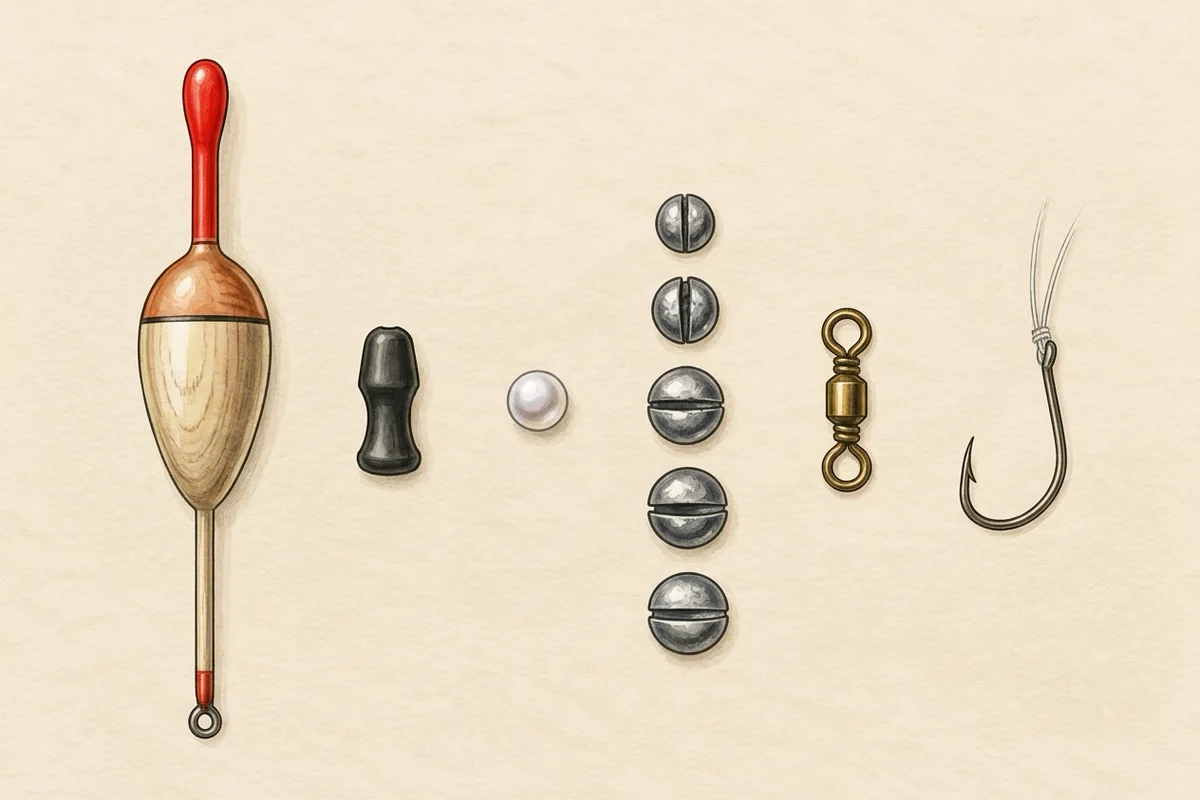
Dry fly to spotted fish
For warm summer days, when rings on the water show that rudd are rising to insects.
- Look for rings
Scan shallow ditches, oxbow lakes or lake shores with plants, wearing polarised glasses. If you see one rudd, the rest of the group is usually not far away.
- Dressing the fly
Tie a bushy dry fly to the long leader and grease it well so that it stays up for a long time.
- To the centimetre
Place the fly right in the fish’s field of view, often close in front of a reed stem. A cast that is too short goes unnoticed, and one that is too long hangs in the vegetation.
- Nymph at midday
During the day hardly any fish often rise. Then a small, conspicuously red nymph catches, as its landing on the water makes the rudd curious.
- Waiting for the fish to turn away
Strike only when the fly has disappeared into the mouth and the fish turns away. If you strike as soon as the mouth opens, you usually pull the fly out again.
- Disgorger at hand
Big rudd have a wide mouth, and a nymph sometimes sits deep. A disgorger with a big eye frees it quickly, and then you put the fish straight back.
What with
Maggots and casters, bread and insects floating on the water such as grasshoppers. Baits that sink slowly or float on top are good. Big rudd are more likely to take a lobworm on the bottom.
- Maggots & larvaethe whole season, in summer also near the surface
Maggots stay on well and also serve as feed for the catapult; in a tub with a little water they pump themselves full of air in about half an hour and then float on top.
- Insectswarm summer days and evenings, when fish rise
A grasshopper on the pole or a dry fly imitates the insects landing on the water that rudd take from the surface with their upturned mouths.
- Sweetcorn & particlessummer to autumn, especially for larger fish
Sweetcorn stays on the hook even with greedy bites; the many small rudd leave a plastic grain alone, but the big ones take it.
Tackle
A long pole without a reel or a light match rod three to four metres long. Add line up to 0,20 millimetre and hooks in size 14 or smaller.
Shallow float at the reed edge
- Rod
- light match rod 3–4 m
- Reel
- small fixed-spool reel
- Line
- Monofilament up to 0,20 mm
- Leader
- clearly shorter than the usual 40–60 cm, or no hooklength at all, straight on the main line
- Hooks
- size 14 or smaller, depending on the bait
- Weight, float, lead
- pre-weighted waggler, small clear bubble float or pre-weighted trout float; for bread at distance a controller of about 5 g with a 1–1,5 m hooklength
Long pole at the bank
- Rod
- Pole 6–8 m to start with
- Line
- Monofilament 0,18–0,20 mm
- Leader
- always thinner than the main line
- Hooks
- size 14–16
- Weight, float, lead
- fixed float carrying 1–4 g, evenly spaced shot
More on tackle
- Float rod: match, Bolognese and pole
- Fly rod: choose line class, length and action
- Pole: no reel, fine and direct
- Line calculator
- Fishing line: monofilament, braid or fluorocarbon?
- Spooling a reel properly – without line twist
- Wading net: the small landing net for wading
- Disgorger: unhooking quickly and gently
Common mistakes
- Rig sits too deep: With a long hooklength and a deep-diving float you do not get close enough to the surface. Shorten the hooklength a lot or use a float with almost no draught.
- Cast at the first rush: The first fight scatters a freshly attracted shoal. Keep feeding for a while first, until the fish are greedy, and then keep the feeding going.
- Floating feed in quantity: Lots of maggots, casters or slices of bread drift away with the wind and surface current and take the fish with them. Better to give small portions often.
- Dry fly at midday: In the middle of the day hardly any rudd rise. Fish the dry fly in the early evening dusk or switch to a nymph during the day.
- Looking for big fish only at the top: The really big specimens like to stay beneath the shoal or close to the bottom. A single redworm on a small feeder close to the plants catches more reliably there.
Rules
Each federal state (Bundesland) sets its own closed season (Schonzeit) and minimum size (Mindestmaß). Choose your state; the values come from our state pages.
Baden-Württemberg
Our overview for Baden-Württemberg does not list the rudd. What applies there is on the page Fishing in Baden-Württemberg, with the places in that state.
Bavaria
Our overview for Bavaria does not list the rudd. What applies there is on the page Fishing in Bavaria, with the places in that state.
Berlin
Our overview for Berlin does not list the rudd. What applies there is on the page Fishing in Berlin, with the places in that state.
Brandenburg
Our overview for Brandenburg does not list the rudd. What applies there is on the page Fishing in Brandenburg, with the places in that state.
Bremen
Our overview for Bremen does not list the rudd. What applies there is on the page Fishing in Bremen, with the places in that state.
Hamburg
Our overview for Hamburg does not list the rudd. What applies there is on the page Fishing in Hamburg, with the places in that state.
Hesse
- Minimum size
- 20 cm
- Closed season
- 15.3.–31.5.
- Note
- harvest slot (Entnahmefenster) 20–30 cm
As of October 2026. All rules, exceptions and sources: Fishing in Hesse.
Mecklenburg-Western Pomerania
Our overview for Mecklenburg-Western Pomerania does not list the rudd. What applies there is on the page Fishing in Mecklenburg-Western Pomerania, with the places in that state.
Lower Saxony
Our overview for Lower Saxony does not list the rudd. What applies there is on the page Fishing in Lower Saxony, with the places in that state.
North Rhine-Westphalia
Our overview for North Rhine-Westphalia does not list the rudd. What applies there is on the page Fishing in North Rhine-Westphalia, with the places in that state.
Rhineland-Palatinate
- Minimum size
- 15 cm
- Closed season
- none
- Note
- observe the general closed seasons (Schonzeit)
As of October 2026. All rules, exceptions and sources: Fishing in Rhineland-Palatinate.
Saarland
Our overview for Saarland does not list the rudd. What applies there is on the page Fishing in Saarland, with the places in that state.
Saxony
Our overview for Saxony does not list the rudd. What applies there is on the page Fishing in Saxony, with the places in that state.
Saxony-Anhalt
Our overview for Saxony-Anhalt does not list the rudd. What applies there is on the page Fishing in Saxony-Anhalt, with the places in that state.
Schleswig-Holstein
Our overview for Schleswig-Holstein does not list the rudd. What applies there is on the page Fishing in Schleswig-Holstein, with the places in that state.
Thuringia
Our overview for Thuringia does not list the rudd. What applies there is on the page Fishing in Thuringia, with the places in that state.
The regulation and your fishing permit (Erlaubnisschein) are what count. Lake Constance, the Rhine and the coast, for example, have their own rules: Fishing waters in Germany.
After the catch
Playing and landing
Rudd fight spiritedly on fine tackle. Keep the rod high, steer the fish quickly out of the shoal and net it with a knotless, fine-mesh net. Handle it only with wet hands and with no feed residue on your fingers, unhook it in the water if possible, and put back at once every fish you may not or do not want to keep.
Fish of legal size that you may keep you stun and kill straight away. Protected or undersized rudd you unhook with wet hands, in the water if possible, and return gently.
Frequently asked questions
Which hook size for rudd?
On float and pole, sizes 14 to 16 are usual, and smaller for single maggots. Rudd shy little from coarse hooks, and on the feeder a size 14 hook on a 0,14 hooklength is enough.
When do rudd bite best?
From June to August, on hot days above all in the first hours after it gets light. On some waters the evening hours also go well, and with the dry fly early dusk is the best time.
How do you fish for rudd with bread?
Take tough toast bread with the crust and pull the hook through a thumb-sized piece twice. For more distance, a floating controller or a bubble float goes about 1,5 m in front of the hook. Strike only when the fish dives with the bread.
How do you catch big rudd?
Big specimens are scarce and wary in many waters. Artificial sweetcorn under a shallow float works well, as does a red worm on a small feeder close to the bottom; many bites come just as the feeder settles.
How do you tell a rudd from a roach?
On a rudd the mouth points clearly upwards at an angle, and the dorsal fin starts well behind the base of the pelvic fins. It also has a keel of large scales between the pelvic and anal fins.
What groundbait for rudd?
A light groundbait that breaks up as soon as it hits the water and forms a cloud, plus floating ingredients such as coconut flakes or soaked bread. Mix in plenty of maggots and casters.
Similar species
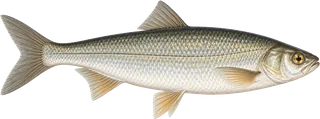
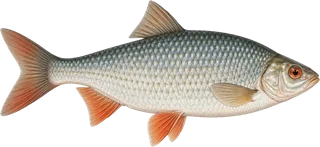
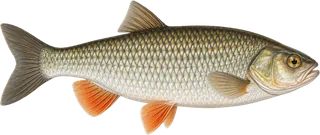
If you catch rudd, you can fish for these species with similar tackle:
Sources
As of October 2026. The practical knowledge comes from 15 sources, summarised in our own words.
View all 15 sources
- Steckbrief Rotfeder · BLINKER (Redaktion)
- Die Sommer-Taktik auf Rotfeder heißt flach angeln · BLINKER (Frank Schlichting)
- Die Top 5 Tipps für Rotfedern · BLINKER (Andre Pawlitzki)
- Rotfedern: Spätsommer-Gold · BLINKER (Andre Pawlitzki)
- Angeln auf Rotfedern: Die besten Futter-Tipps · BLINKER (Redaktion)
- Rotfeder mit der Fliege: Sommer-Highlight · BLINKER (Florian Pippardt)
- Fliegenfischen auf Rotfedern: Kapitale Friedfische auf Sicht · BLINKER (Robert de Wilt)
- Mit dem Feeder auf Rotfedern? · FISCH & FANG (Martin Weisbrodt)
- Beißzeiten: So ticken die Friedfische · FISCH & FANG (Specimen Hunting Group Dortmund)
- Oberflächenangeln: spannend und erfolgreich · RUTE & ROLLE (Redaktion)
- Spannung pur: Friedfischangeln mit Oberflächenködern · RUTE & ROLLE (Tobias Norff)
- Grundkurs Stippfischen: So fängt jeder · RUTE & ROLLE (Georg Baumann)
- Angeln im Teich: Perfekt für Einsteiger und Naturfreunde · BLINKER (Michael Werner)
- Fische landen: Wie nutze ich Kescher, Lip-Grip und Co.? · BLINKER (Nick Bremer)
- Fischlexikon: Fische bayerischer Gewässer (Rotfeder) · Landesfischereiverband Bayern
Text produced with AI support, based on the sources listed and these pages: Rudd (profile), Pole fishing, Insects, Maggots & larvae.