
Knowledge – Fish
Fishing for tigerfish
To fish for tigerfish means: from a boat, work a diving crankbait in the open water of the main current and, after a short fight, release the fish gently. Here is the way there in nine steps, each with a link to the detailed page.
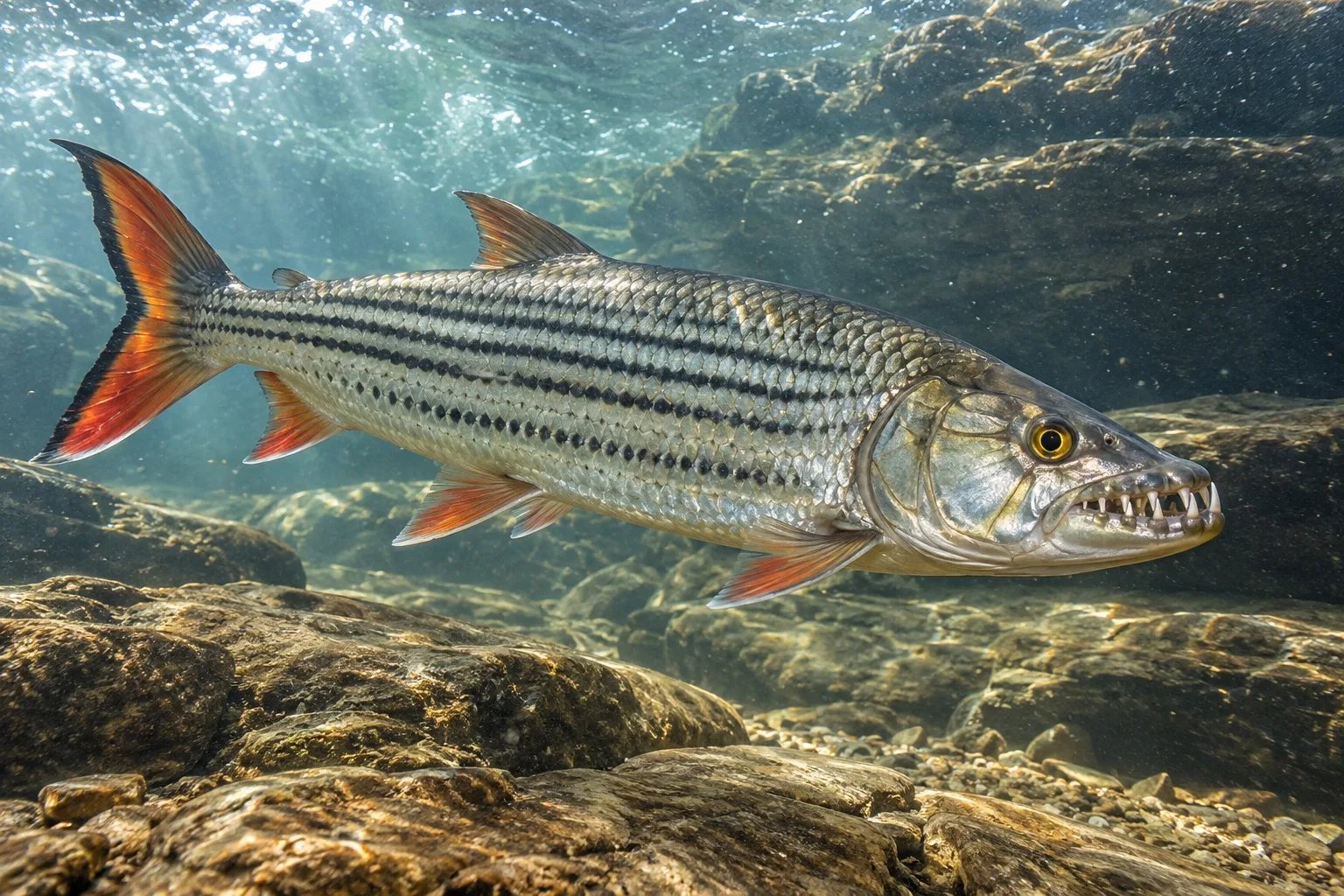
In South Africa the tigerfish is on the list of protected species under the biodiversity act NEMBA; what anglers may do there is set by the nature conservation authority of the province (as of October 2026). It has long, sharp fangs: keep your hands out of its mouth and use long pliers when unhooking.
 Choose another fish117 fish with guides
 EelOff-peak season
 EelpoutPossible
 IdePossible
 ArapaimaGood
 GraylingPeak season
 Atlantic salmonSpawning time, please spare
 Brown troutSpawning time, please spare
 Brook troutSpawning time, please spare
 BarbelOff-peak season
 BarramundiSpawning season
 Greater amberjackGood
 Topmouth gudgeonOnly as bycatch
 Blue marlinSpawning season
 BonefishSpawning season
 BonitoGood
 BreamOff-peak season
 Dusky grouperOnly as bycatch
 CobiaPossible
 Spiny dogfishOnly as bycatch
 CodPeak season
 ChubPeak season
 MinnowOnly as bycatch
 European sturgeonOnly as bycatch
 FlounderPeak season
 PerchPeak season
 Largemouth bassGood
 Ballan wrasseOnly as bycatch
 Yellowfin tunaSpawning season
 Giant trevallyGood
 Prussian carpPossible
 BrillPossible
 Gilthead breamSpawning time, please spare
 Golden doradoSpawning season
 Golden mahseerOnly as bycatch
 Dolphinfish (mahi-mahi)Good
 Grass carpPossible
 Great barracudaGood
 GudgeonPossible
 White breamPossible
 DaceOff-peak season
 PikePeak season
 HalibutOff-peak season
 HerringPossible
 GarfishOut of season
 Huchen (Danube salmon)Possible
 Crucian carpOnly as bycatch
 CarpOff-peak season
 RuffeOff-peak season
 VendaceOnly as bycatch
 DabPeak season
 GurnardPossible
 Coley (saithe)Peak season
 Chinook salmonHardly any chance
 King mackerelSpawning season
 LingPeak season
 TuskOff-peak season
 MackerelPossible
 Bighead carpOut of season
 WhitefishPossible
 Conger eelOff-peak season
 Sea troutSpawning time, please spare
 Grey mulletPossible
 Murray codSpawning season
 MuskellungeGood
 Common nasePossible
 Nile perchPossible
 PayaraPossible
 Peacock bassPeak season
 PermitGood
 WeeverOnly as bycatch
 PollackOff-peak season
 BurbotOff-peak season
 AspPossible
 Red snapperSpawning season
 Rainbow troutPeak season
 RoosterfishGood
 RoachPeak season
 RedfishOut of season
 Bluefin tunaOnly as bycatch
 RuddPossible
 Russian sturgeonOnly as bycatch
 HaddockOff-peak season
 SnakeheadPossible
 TenchOff-peak season
 SpirlinOnly as bycatch
 PlaiceOff-peak season
 Greenland halibutOnly as bycatch
 Round gobyOnly as bycatch
 SwordfishGood
 Lake troutSpawning time, please spare
 HakeSpawning time, please spare
 Alpine charSpawning time, please spare
 MonkfishPossible
 SoleOff-peak season
 SailfishGood
 Silver carpOut of season
 SnookPeak season
 PumpkinseedOnly as bycatch
 SpratOnly as bycatch
 Atlantic wolffishSpawning time, please spare
 TurbotPeak season
 SterletOnly as bycatch
 SmeltOnly as bycatch
 Horse mackerelPossible
 TaimenGood
 TarponGood
- TigerfishSpawning season
 BleakPossible
 WahooGood
 Wels catfishOff-peak season
 WhitingPeak season
 Sea bassOff-peak season
 ZanderPeak season
 White-eye breamOnly as bycatch
 Blue breamOnly as bycatch
 Brown bullheadPossible
 VimbaOnly as bycatch
Season in October according to the catch calendar, an estimate and not a guarantee of a catch. The fish pictures are reduced natural-history plates and AI-generated.
Best time
From March to April.
In January: Good, spawning seasonIn February: Good, spawning seasonIn March: Peak seasonIn April: Peak seasonIn May: GoodIn June: PossibleIn July: PossibleIn August: PossibleIn September: GoodIn October: Good, spawning seasonIn November: Good, spawning seasonIn December: Good, spawning season
Good spot
- River: current edge and main currentcurrent edge and main currentcurrent edge and main currentcurrent edge and main current
- Lake: open wateropen wateropen wateropen water
Starter tackle
- Rod: spinning rod of about 7 feet, so roughly 2,10 m
- Line: braided, about 4 kg breaking strain
- Hook: lures with a single hook, size 2/0–4/0
In short
In short: According to the catch calendar the best time is from March to April. Good spots on the river: current edge and main current; on the lake: open water. Proven baits: slim diving crankbaits with a single hook that imitate a small fish. On the Incomati it is barely active below 24 °C in winter, but on the Kavango and in the Okavango Delta tigerfish were also caught from June to October. In South Africa it is on the list of protected species (NEMBA).
Quick to recognise
An elongated African predatory characin with dark longitudinal stripes, whose fangs stay visible even when the mouth is closed. FishBase gives up to 105 centimetres fork length and 28 kilograms; it reaches maturity at around 40 centimetres.
When
In southern Africa it is a fish of the southern summer: March and April after the spawning season are best, and the chances are also good in May and from September to February. From June to August, when the water is cooler, it bites less often on the Incomati; on the Kavango in Namibia researchers still caught many fish during that time, and in the Okavango Delta in September at 21 to 23,5 degrees. On the Incomati in South Africa the spawning season falls in the flood season from October to February.
- JanGood, spawning
- FebGood, spawning
- MarPeak season
- AprPeak season
- MayGood
- JunPossible
- JulPossible
- AugPossible
- SepGood
- OctGood, spawning season
- NovGood, spawning
- DecGood, spawning
Peak seasonGoodPossibleHardly any chanceSpawning season
Season in the destination
How much the tigerfish moves around depends heavily on water temperature and discharge: in rivers of the Kruger National Park it moved more in warmer water and less in strong flow. In the Okavango Panhandle researchers measured just under 21 to 23,5 degrees in September, which is the lower end; over the southern summer it gets much warmer there. On the Zambezi in Namibia the river rises sharply in January, and from February to June the floodplains are under water. On the Kavango researchers caught 49 tigerfish on a spinning rod between June and October.
Season and biting time
In January: Spawning seasonIn February: Spawning seasonIn March: Peak seasonIn April: Peak seasonIn May: GoodIn June: PossibleIn July: PossibleIn August: PossibleIn September: GoodIn October: Spawning seasonIn November: Spawning seasonIn December: Spawning season
Where it is now
In the river
It needs warm, well-oxygenated water in larger rivers. Search the current edges and the main current, where groups of fish of about the same size roam and hunt small characins and barbs. Radio-tagged fish mostly stayed in a small territory.
How to go about it: Look for the main current with open water; on the Zambezi, tagged tigerfish were found there almost every time, never under plants. On the Kavango, shallow rapids less than a metre deep alternate with deep pools of more than twelve metres. The tagged fish visited oxbow lakes and flooded floodplains much less often.
| All year round | current seam, main current |
|---|
In the lake
In large lakes such as Lake Kariba it hunts in open water, among other things small fish of the genus Limnothrissa.
How to go about it: In Lake Kariba its main prey is the small sardine Limnothrissa, called kapenta there, and near the shore it also often eats young cichlids. Where fishermen gather shoals of sardines with lights at night, tigerfish hunt particularly hard.
| All year round | Open water |
|---|
Holding spots in the picture
Choose a season and time of day: the picture shows where the species sits then. Tap a fish or a spot in the list to bring it closer. The picture is schematic and AI-generated, every water is different.
Catch chance in springPeak season
Catch chances in summerpossible
Chance of a catch in autumngoodSpawning season, observe the closed seasons
Chance of a catch in wintergoodSpawning, observe the closed seasons
- J
- F
- M
- A
- M
- J
- J
- A
- S
- O
- N
- D
Spawning season
In the river
Current seam
Tigerfish are found here all year.
Free current in mid-river
Tigerfish are found here all year.
The tigerfish needs warm, well-oxygenated water and lives mainly in larger rivers. Except for the largest ones, tigerfish roam in groups of fish of the same size, hunting small characins and barbs. On the Incomati, tagged fish mostly stayed in a territory of just under 5 hectares.
Spring: catch chance according to the catch calendar is peak season in March and April, good in May.
Summer: catch chances according to the catch calendar are possible.
Autumn: good chance of a catch according to the catch calendar. This is also the spawning period, so observe the closed seasons.
Winter: chance of a catch good according to the catch calendar. This is when spawning falls, so observe the closed seasons.
In the lake
Open water
Tigerfish are found here all year.
It also occurs in large lakes such as Lake Kariba. There the groups hunt fish of the genus Limnothrissa, among others.
Spring: catch chance according to the catch calendar is peak season in March and April, good in May.
Summer: catch chances according to the catch calendar are possible.
Autumn: good chance of a catch according to the catch calendar. This is also the spawning period, so observe the closed seasons.
Winter: chance of a catch good according to the catch calendar. This is when spawning falls, so observe the closed seasons.
Size comparison: AI-generated drawing, schematic.
How
Fishing is done with a spinning rod from a boat. Researchers on the Kavango and in the Okavango Delta caught their tigerfish with diving crankbaits in the open water of the main current; slim models that look like a small fish suit its prey.
Easiest way
The easiest way in is from a boat in the main current of a large river. A spinning rod of about 2,10 metres with a fixed-spool reel and braided line of about 4 kilos breaking strain is enough. On it hangs a diving crankbait that you pull through open water.
Crankbait from a boat in the main current
This is how researchers in the Okavango Delta and on the Kavango caught their tigerfish: with diving crankbaits, from a boat, in the open water of the main current.
- Head for the main current
Take the boat out into the main current. On the Zambezi in Namibia, tagged tigerfish were located there almost every time, and they used oxbow lakes, swamps and floodplains much less often.
- Watch the birds
In the Okavango Panhandle researchers fished in September during the catfish runs. Birds over the water show where these shoals are currently moving.
- Crankbait with single hooks
Take a diving crankbait. On the Kavango the researchers‘ lures had single hooks in sizes 2/0 to 4/0.
- Work the open water
Pull the lure through open water rather than close along plants. Under vegetation on the Zambezi not a single tagged fish was found.
- Keep it short
Bring the fish in quickly. On the Kavango the fight with tigerfish of around 55 centimetres lasted less than two minutes on average.
- Landing net, then current
Land it with the landing net and remove the hook while it lies in the net. Before it swims off, let it recover in the flowing river water.
What with
A diving crankbait with single hooks in sizes 2/0 to 4/0, like the ones researchers used on the Kavango. Choose slim lures, because its prey of small characins, barbs and sardines is usually only a few centimetres long.
- Crankbaitall year in the open water of the main current, from a boat
Researchers on the Kavango and in the Okavango Delta caught their tigerfish with diving crankbaits on single hooks; slim models suit its small prey.
- Baitfishall year, on Lake Kariba in the size of kapenta sardines
In tournament catches on Lake Kariba, kapenta was found in about two thirds of the stomachs, and the prey there usually measured around 4 centimetres, rarely more than two fifths of the predator’s length.
Tackle
A spinning rod of about 2,10 metres with a fixed-spool reel and braided line, plus a landing net and long pliers for unhooking. The line calculator and the page on fishing line help with choosing line and reel.
Crankbait from a boat in the main current
- Rod
- Spinning rod of about 7 feet, so roughly 2,10 m
- Reel
- Fixed-spool reel
- Line
- braided, about 4 kg breaking strain
- Hooks
- lures with a single hook, size 2/0–4/0
- Weight, float, lead
- diving crankbait
Common mistakes
- Playing the fish to exhaustion: After only about a minute of fighting, the lactic acid in the blood of tigerfish in the Okavango Delta rose markedly. Set the drag so that you land the fish quickly.
- Dawdling after landing: The longer unhooking took, the stronger the stress response, even after a short fight. Have pliers and landing net ready and let the fish recover afterwards in flowing water.
- Fishing only at first and last light: Tagged tigerfish in the Kruger National Park were more active during the day, especially when the water was warmer. So plan for the warm hours of the day as well.
- Searching among plants and reeds: On the Zambezi, tagged fish stayed in the open water of the main current and never under vegetation. Fish the free current.
- Lures that are too big: In Lake Kariba prey fish were usually around 4 centimetres long and rarely longer than two fifths of the tigerfish. Choose slim lures that match a small fish.
Rules
For the tigerfish, the rules of the country where you fish apply, not the German fisheries laws. Licence, closed seasons, minimum sizes and the taking of fish are set by each country, often by each water separately.
What the profile says: On the Incomati it is barely active below 24 °C in winter, but on the Kavango and in the Okavango Delta tigerfish were also caught from June to October. In South Africa it is on the list of protected species (NEMBA). In southern Africa tigerfish mostly stay in a small territory, and catching and releasing can disturb them there.
The fisheries authority (Fischereibehörde) of the country you travel to is what counts. Ask about the current rules before the trip and read in the profile how threatened the species is.
After the catch
Playing and landing
Play the tigerfish quickly, because from about a minute onwards the strain shows clearly in the blood. Take it in the landing net, unhook it while it is still in the net and then hold it in flowing river water until it swims off by itself. Freshly released fish fell prey to crocodiles in studies, so every minute less stress helps. In South Africa the tigerfish is on the list of protected species; rules, licence and the taking of fish are determined by the country where you fish.
To unhook it, use the long pliers and keep your fingers out. If you release it, do so gently: in a study on the Incomati most of the marked fish returned to the spot where they were caught, but some never did; researchers therefore see catching and releasing as a possibly strong disturbance.
Frequently asked questions
Which line for tigerfishing?
In a study in the Okavango Delta the anglers fished with braided line of about 4 kilos breaking strain on fixed-spool reels and rods of around 2,10 metres.
Which hook size for tigerfish?
On the Kavango researchers caught 49 tigerfish on lures fitted with single hooks in size 2/0 to 4/0. The fish averaged around 55 centimetres.
How long does it take to play a tigerfish?
On the Kavango, on average just under two minutes (about 1,75) for fish averaging 2,9 kilos. Larger fish need longer, as a study in the Okavango Delta also showed.
Does the tigerfish bite during the day?
Yes. In rivers of the Kruger National Park, tagged tigerfish were mainly active during the day, and the more so the warmer the water was.
Does a tigerfish survive release?
Capture stresses it measurably, but researchers still consider release a useful means of protecting stocks. On the Kavango a freshly marked fish fell prey to a crocodile two days later, so a quick procedure protects it.
Can a tigerfish without teeth bite?
Yes. It replaces its teeth, and fish that are changing teeth still attack lures that look like prey.
Similar species
If you catch tigerfish, you can fish for these species with similar tackle too:
 Fishing for largemouth bassGood
 Nile perch fishingPossible
 Fishing for peacock bassPeak season
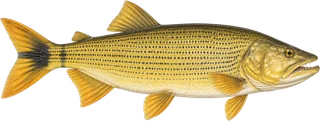 Fishing for golden doradoSpawning season
Sources
Correct as of October 2026. The practical knowledge comes from 7 sources, summarised in our own words.
View all 7 sources
- The conservation ecology of the African tigerfish Hydrocynus vittatus in the Kavango River, Namibia (Dissertation) · University of KwaZulu-Natal (F. J. Jacobs, 2017; im Auftrag des Fischereiministeriums Namibia)
- Physiological response of tigerfish and smallmouth yellowfish to catch-and-release angling (Masterarbeit) · University of Johannesburg (R. Gerber, 2011)
- Physiological response to angling of Africa's premier freshwater angling species, the tigerfish Hydrocynus vittatus (African Zoology 52, 2017) · North-West University, Repositorium (Gerber, Howatson, Smit, Greenfield, Wagenaar)
- Temporal movement of free-swimming fishes and their response to environmental variables in some of the rivers of Kruger National Park (Environmental Biology of Fishes 105, 2022) · Springer Nature, Environmental Biology of Fishes (Burnett, O'Brien, Sonamzi u. a.; Abstract)
- Assessing the effect of tagging and the vulnerability to predation in tigerfish in a water-stressed system using telemetry methods (Koedoe 62, 2020) · University of Mpumalanga / Koedoe (Sonamzi, Burnett, Petersen, O'Brien, Downs)
- Some observations on the predatory feeding habits of Hydrocynus vittatus in Lake Kariba · FAO (M. Takano und S. P. Subramaniam, Fischereiforschung Sambia)
- Using the Kariba Invitation Tiger Fishing Tournament for monitoring an invasive crayfish in Lake Kariba (African Journal of Aquatic Science, Abstract) · NISC, African Journal of Aquatic Science (Marufu, Phiri, Barson, Nhiwatiwa)
Text written with AI assistance, based on the sources named and these pages: Tigerfish (profile), Spin fishing, Baitfish, Crankbait, Releasing fish.