
Knowledge – Fish
Russian sturgeon fishing
You should not go fishing for Russian sturgeon: this migratory fish of the Black, Azov and Caspian Seas is critically endangered. Here you can read how to recognise it, where it lives and what to do if it bites anyway.
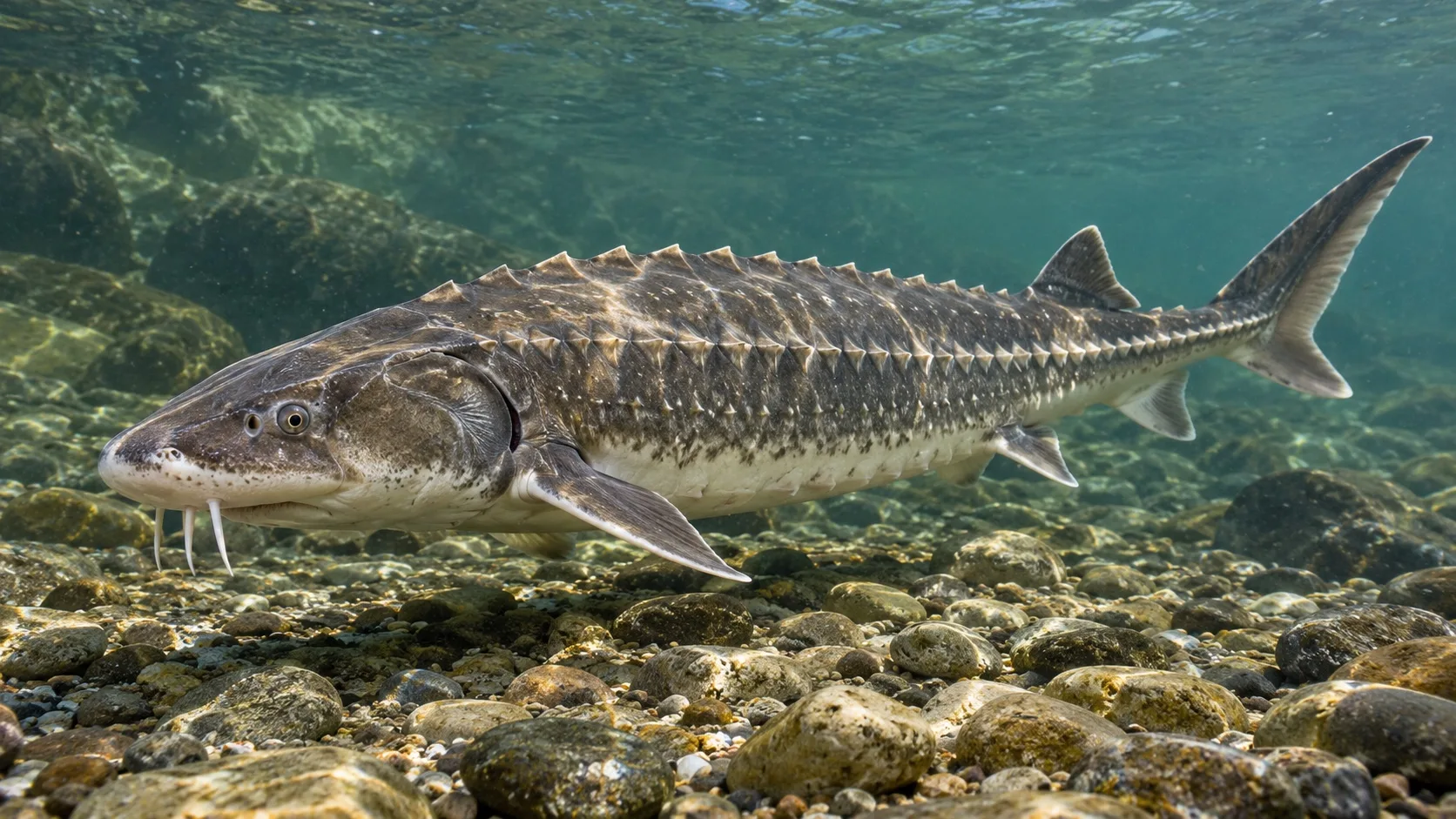
Since 2019 the IUCN has classed the Russian sturgeon as critically endangered, and it is also listed in Appendix II of the Washington Convention on endangered species (CITES). It is not fished for deliberately.
Quick to recognise
A sturgeon without scales, with five lengthways rows of bony scutes, an underslung mouth, an olive-grey back, paler flanks and a white belly. Around 145 centimetres is usual; FishBase gives up to 236 centimetres.
Why it is not a target fish
In 2022 the IUCN classed all sturgeon species as threatened, mainly because of dams and poaching, and according to the German Federal Agency for Nature Conservation (Bundesamt für Naturschutz) no group of fish in the world is so threatened. Natural reproduction is no longer enough, and the stocks depend mainly on artificial breeding. Caviar is subject to labelling and permit requirements, and without a permit it does not belong in holiday luggage.
Where it lives
On the coast
At sea it stays in shallow water off coasts and river mouths, mostly 10 to 25 metres deep, over sandy or muddy bottom.
| All year round | Sandy bottom |
|---|
In the river
In rivers it uses deep stretches of large rivers where the water flows moderately to strongly. To spawn it mostly moves upstream from April to June to stony and gravelly bottom.
| All year round | Pools, main current |
|---|
Holding spots in the picture
Choose a season and time of day: the picture shows where the species sits then. Tap a fish or a spot in the list to bring it closer. The picture is schematic and AI-generated, every water is different.
On the coast
Sandy bottom
Russian sturgeon are present here all year round.
In the Black, Azov and Caspian Seas the Russian sturgeon lives in shallow coastal areas and off river mouths, mostly close to the shore over sand and mud. There it searches the bottom for mussels, snails, crayfish and small fish.
Spring: The spawning season falls in this period; observe the closed seasons (Schonzeiten).
In the river
Pools, deep spot
Russian sturgeon are present here all year round.
Free current in mid-river
Russian sturgeon are present here all year round.
In large rivers it inhabits the deep areas with moderate to strong current. To spawn it mostly swims upstream from April to June and lays its eggs on stony or gravelly bottom in deep, fast-flowing water.
Spring: The spawning season falls in this period; observe the closed seasons (Schonzeiten).
Depth: At sea it mostly lives at 10 to 25 metres.
Size comparison: AI-generated drawing, schematic.
Do not confuse
In Central Europe you are more likely to meet the sterlet: its snout is narrow and pointed, the four barbels are long and fringed, and 56 to 71 scutes sit on each flank. The European sturgeon has diamond-shaped instead of star-shaped plates between the rows of scutes. Because farms also keep other species and hybrids, treat every sturgeon as a strictly protected species.
If it bites anyway
Fight it quickly, leave the sturgeon in the water and take the hook out there; do not lift it out by the gills or tail. Point its head into the current and wait until it swims off under its own power. If the hook will not come out, cut the line close to the mouth. Report the catch with place, date, approximate length and, if present, the tag to the responsible fisheries authority (Fischereibehörde).
Rules
For Russian sturgeon the rules of the country where you fish apply, not the German fisheries acts (Fischereigesetze). Each country, often each water, sets its own licence, closed seasons (Schonzeiten), minimum sizes (Mindestmaße) and rules on keeping fish.
What the profile says: Critically endangered (IUCN) and protected under CITES Appendix II, not a target fish. Release any bycatch at once and gently in the water.
The fisheries authority (Fischereibehörde) of the country you travel to is what counts. Ask about the current rules before the trip and read in the profile how threatened the species is.
Text AI-assisted, summarised from these pages: Russian sturgeon (profile), Releasing fish.