
Knowledge – Fish
Russian sturgeon: Features, protection and bycatch
The Russian sturgeon (Acipenser gueldenstaedtii), also called the Danube sturgeon, is a migratory fish from the Black Sea, the Sea of Azov and the Caspian Sea. The IUCN lists it as critically endangered. It is not a target fish, but it is farmed in many countries as a source of caviar.
In short: Critically endangered (IUCN) and protected under CITES Appendix II, not a target fish. Release bycatch immediately and gently in the water. What to do with a bycatch: Russian sturgeon as bycatch.
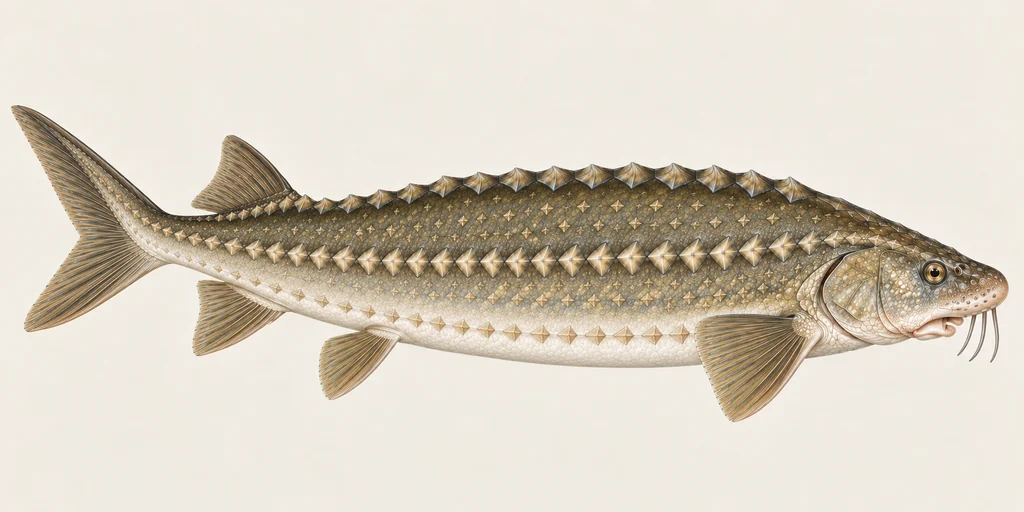
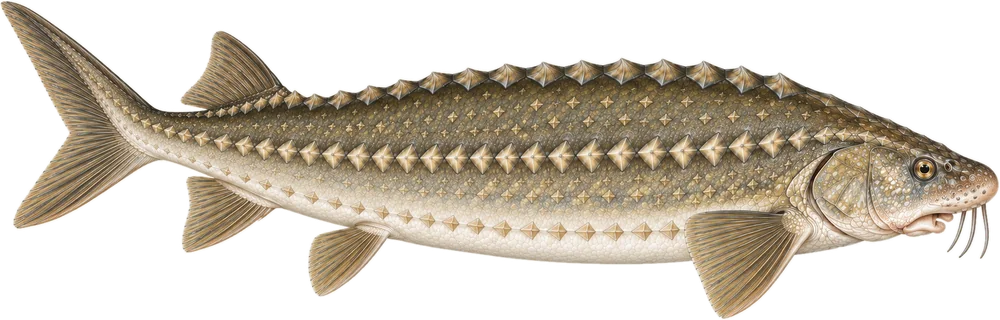
- Five rows of bony scutes, 24 to 44 scutes per side on the flanks
- Small star-shaped bony plates between the rows of scutes
- Lower lip interrupted in the middle, mouth underslung
Catch chances through the year
- Hardly any chance
- Possible
- Good
- Peak season
- Spawning (observe the closed season)
Editorial assessment for the home waters (Black Sea, Sea of Azov and Caspian Sea with tributaries), not a measured value and no guarantee. The rules of the country you travel to are binding.
How to recognise it
Like all sturgeons, the Russian sturgeon has no scales but five longitudinal rows of bony scutes: 7 to 19 on the back, 24 to 44 on each flank and 6 to 13 on each side of the belly. Between them lie rows of small, star-shaped bony plates. The mouth is on the underside, and the lower lip is interrupted in the middle.
The back is olive-grey, the flanks are paler and the belly is white. Lengths of around 145 centimetres are usual. FishBase gives maximum values of 236 centimetres, 115 kilograms and 46 years.
In central Europe anglers mostly come across the sterlet. It has a narrow, pointed snout with four long, fringed barbels and 56 to 71 bony scutes on each flank, clearly more than the Russian sturgeon. The native European sturgeon has 24 to 39 scutes on its flanks and diamond-shaped instead of star-shaped plates between the rows.
European fish farms keep several sturgeon species and also hybrids. Treat every sturgeon as if it were strictly protected.
Side by side
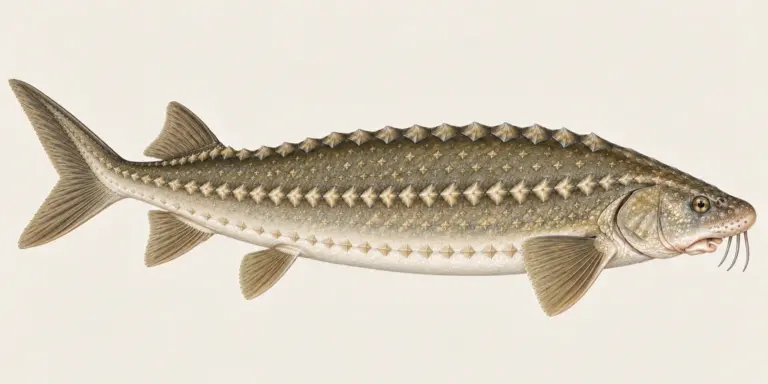
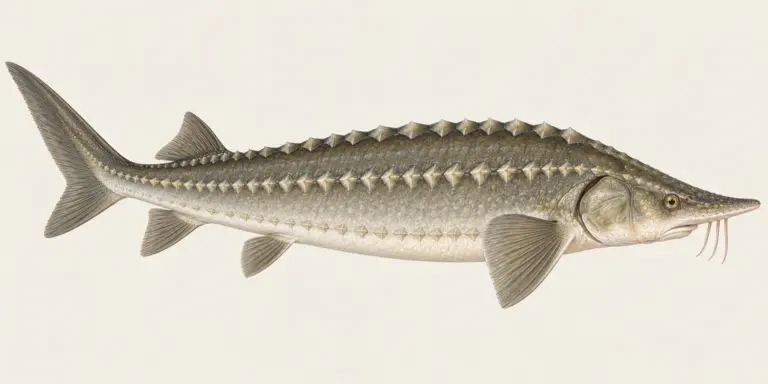
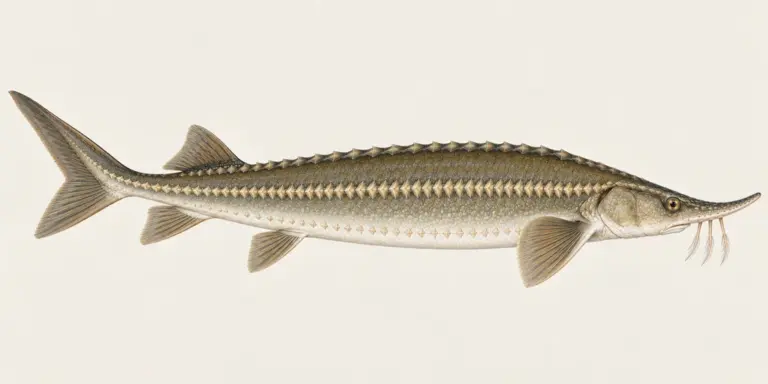
AI-generated illustrations.
Where it lives
The Russian sturgeon’s home is the Black Sea, the Sea of Azov and the Caspian Sea with their tributaries. For Austria the species is listed in the fish fauna of the Danube. There are migratory forms that live in the sea and enter rivers to spawn, and stocks that stay entirely in fresh water.
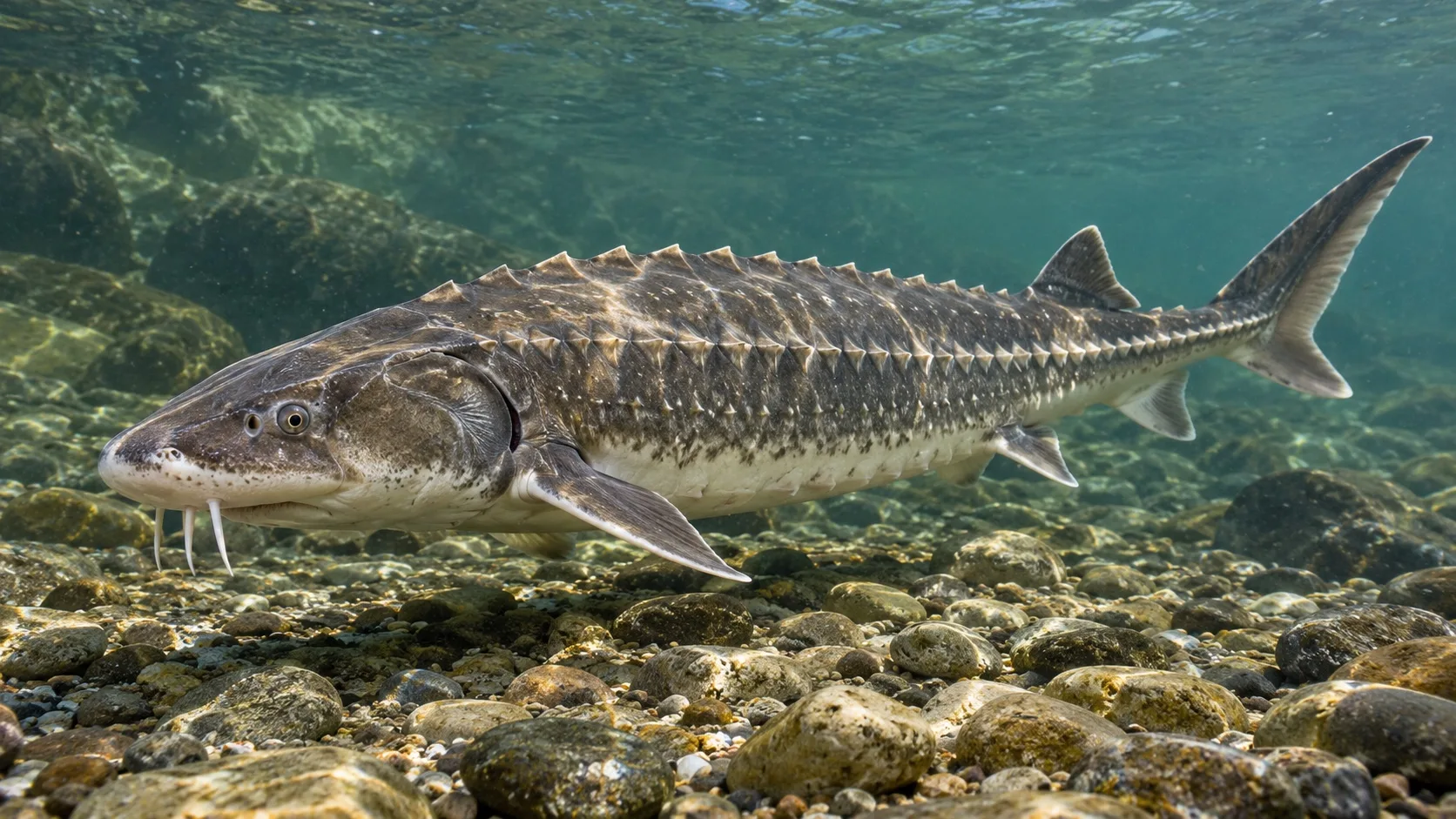
At sea it stays in shallow coastal and estuary zones, usually at 10 to 25 metres depth, mostly close to the shore over sand and mud. In rivers it inhabits the deep stretches of large rivers with moderate to strong current.
Holding spots in the picture
Choose the time of day: the picture shows where the species holds. We do not show German seasons for travel fish; the bars give the chance of a catch for each month. Tap a fish or a spot in the list to bring it closer. The picture is schematic and AI-generated, and every water is different.
On the coast
Sandy bottom
Russian sturgeon are present here all year round.
In the Black, Azov and Caspian Seas the Russian sturgeon lives in shallow coastal areas and off river mouths, mostly close to the shore over sand and mud. There it searches the bottom for mussels, snails, crayfish and small fish.
In the river
Pools, deep spot
Russian sturgeon are present here all year round.
Free current in mid-river
Russian sturgeon are present here all year round.
In large rivers it inhabits the deep areas with moderate to strong current. To spawn it mostly swims upstream from April to June and lays its eggs on stony or gravelly bottom in deep, fast-flowing water.
Depth: At sea it mostly lives at 10 to 25 metres.
Size comparison: AI-generated drawing, schematic.
How it lives and spawns
The Russian sturgeon feeds on the bottom: on mussels and snails, crayfish and small fish. It mostly lives as a loner. It gathers in larger groups to overwinter and on the spawning migration.
From April to June the fish ascend into the rivers, a few in autumn. Spawning takes place on stone or gravel bottom in large, deep rivers with a strong current of 1 to 1.5 metres per second. Natural reproduction is no longer enough today; the stocks are supported mainly by artificial propagation.
Is there a season?
There is no fishing season for the Russian sturgeon. The species is critically endangered and is not fished for deliberately.
As bycatch a sturgeon can end up on the hook in spring and early summer during the spawning migration in the rivers. Sturgeons are farmed on a large scale in Europe: in 2013 Italy produced around 25 tonnes of caviar, about a fifth of it from the Russian sturgeon.
What to do with a bycatch
As bycatch: Fishing for Russian sturgeon? – why the species is not a target fish and what to do with a bycatch.
The Russian sturgeon is not fished for deliberately.
If a sturgeon is hooked as bycatch, play it quickly, keep it in the water and unhook it there. Do not lift it out of the water by the gills or the tail. Hold it head into the current until it swims off by itself. If the hook cannot be removed, cut the line close to the mouth.
Note the date, place, estimated length and any visible tag, and report the catch to the responsible fisheries authority (Fischereibehörde). Sturgeons from reintroduction programmes are tagged, and every report helps to monitor the stocks.
Count the scutes: A photo of the flank is often enough to count the bony scutes later. That way a sterlet can be told apart from a Russian or European sturgeon without holding the fish for long.
No caviar in your luggage: Anyone travelling around the Black Sea or Caspian region should buy and import caviar only with the necessary permits.
Suitable lures
We deliberately show no baits for this species.
Critically endangered (IUCN) and protected under CITES: do not target it, and release bycatch immediately and gently in the water.
Protection, trade and caviar
Since its 2019 assessment the IUCN has listed the Russian sturgeon as critically endangered. After the reassessment of 2022 all surviving sturgeon species are threatened, mainly by dams and poaching. According to the Federal Agency for Nature Conservation (Bundesamt für Naturschutz), no other group of fish in the world is as threatened as the sturgeons.
All sturgeon-like fishes have been listed since 1998 in the appendices of the Washington Convention on the protection of species (CITES), the Russian sturgeon in Appendix II. Labelling and permit requirements apply to caviar, and the EU has taken them into its own law. The Bundesamt für Naturschutz expressly warns: no caviar from holiday without a permit.
Native sturgeons are strictly protected in Germany, regulated in the Federal Nature Conservation Act and in the fisheries acts of the federal states (Bundesland). What applies to a Russian sturgeon you have caught is set by the fisheries regulation of your federal state and your fishing permit (Erlaubnisschein). You will find a list of links to the official sources in the catch calendar. In the countries of origin, the local fisheries and nature conservation authority is what counts.
Frequently asked questions (FAQ)
May I fish for Russian sturgeon?
You should not target wild Russian sturgeons: the species is critically endangered and internationally protected. What applies to stocked fish in fishing ponds is set by state law, the water rules and the operator. A bycatch is released immediately and gently in the water.
How do I tell it from the sterlet?
The sterlet has fringed barbels, a narrow, pointed snout and 56 to 71 scutes on each flank. The Russian sturgeon has only 24 to 44.
May I bring caviar back from holiday?
Only with the necessary permits. Since 1998 all sturgeon-like fishes have been covered by the Washington Convention on the protection of species, and caviar must be labelled.
Sources
The rating of catch chances is an editorial assessment. The facts come from these sources, and the text is worded in our own words. The illustration is an original design by Angel Momente in the style of a natural history plate (AI-generated, see the AI notice).
- FishBase: Acipenser gueldenstaedtii, Danube sturgeon
- FishBase: Acipenser ruthenus, Sterlet
- FishBase: Acipenser sturio, Sturgeon
- Bundesamt für Naturschutz: CITES, Kaviar
- Bundesamt für Naturschutz: Schutz der Störe
- IUCN: Pressemitteilung zur Neubewertung der Störe (Juli 2022)
- PLoS One 2022 (Zangl et al.): A comprehensive DNA barcode inventory of Austria’s fish species (Volltext, Europe PMC)
- Viruses 2024 (Bondavalli et al.): Detection of Acipenser European Iridovirus in Sturgeon Farms in Northern Italy (Volltext, Europe PMC)
Created with AI support from the sources listed. Figures only appear in the text if a source gives them. Last updated: 27 October 2026. Found a mistake? Write to us. Who is behind this site: About me.
More in the lexicon
- All fish species at a glance
- Catch calendar – month, water temperature and profile for 93 species
- Line calculator – breaking strain after the knot, drag guideline, backing
- Angling methods