
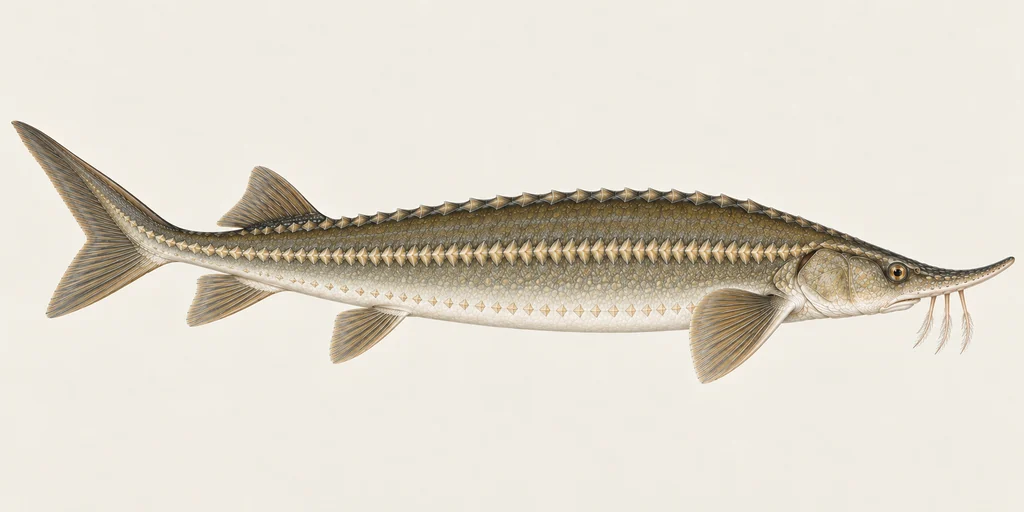
Knowledge – Fish
Sterlet: Features, range, stocking and protection
The sterlet (Acipenser ruthenus) is a small sturgeon that spends its whole life in fresh water. In Germany only a small remnant population lives in the lower Bavarian Danube, and the species is classed as critically endangered. Sterlets in gravel-pit lakes and ponds come from stocking.
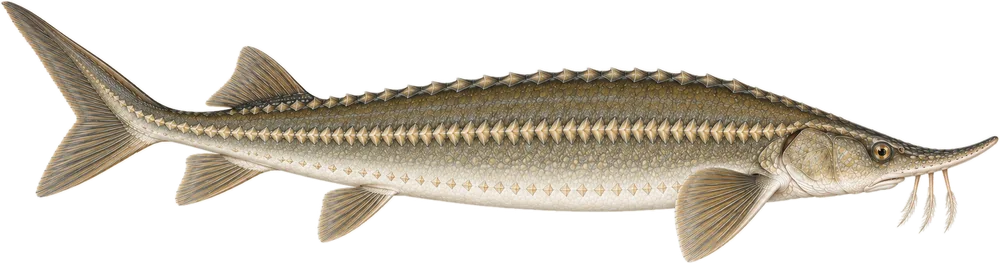
In short: The sterlet is classed as critically endangered on Germany’s Red List. Only a small stock in the lower Bavarian Danube is native; sterlets in other waters stem from stocking. What to do with an accidental catch: Sterlet as bycatch.
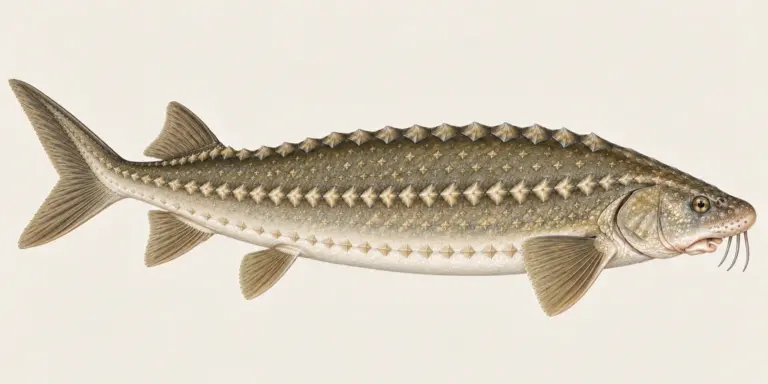
- Narrow, pointed snout with four long, fringed barbels
- Lateral row with 56 to 71 closely set, pale bony scutes
- Elongated, shark-like body with a tapering tail fin
Catch chances through the year
- Hardly any chance
- Possible
- Good
- Peak season
- Spawning (observe the closed season)
Editorial assessment for waters in Germany, not a measured value and no guarantee. Spawning time is not the same as the legal closed season.
Species profile and sources in the catch calendarAll species compared month by monthThe rules of your federal state
How to recognise it
The sterlet has an elongated body reminiscent of a small shark and a tapering tail fin. Instead of scales it bears five lengthwise rows of bony scutes on the back, flanks and belly. The side rows are very densely set with 56 to 71 scutes. FishBase names this high number as the feature that distinguishes it from other European sturgeons. The back and flanks are beige, the scutes on the flanks and belly very pale, almost white.
The snout is narrow and pointed. Four long, clearly fringed barbels hang in front of the mouth, and the lower lip is split in the middle. FishBase gives about 40 centimetres as usual. As a maximum, the NÖ Landesfischereiverband gives 1,20 metres, FishBase 1,25 metres at 16 kilograms.
The sterlet is most easily confused with the European sturgeon and the Russian sturgeon as long as the fish are small. The surest check is the side row: FishBase gives 56 to 71 lateral scutes for the sterlet, 24 to 39 for the European sturgeon and 24 to 44 for the Russian sturgeon. In addition, the sterlet has fringed barbels.
According to FishBase, the Siberian sturgeon has 32 to 59 lateral scutes. The NÖ Landesfischereiverband warns that stocking with foreign sturgeon species or strains alien to the site endangers the native sterlet, because sturgeons tend to interbreed. Not every small sturgeon in a pond is therefore a pure sterlet.
Side by side
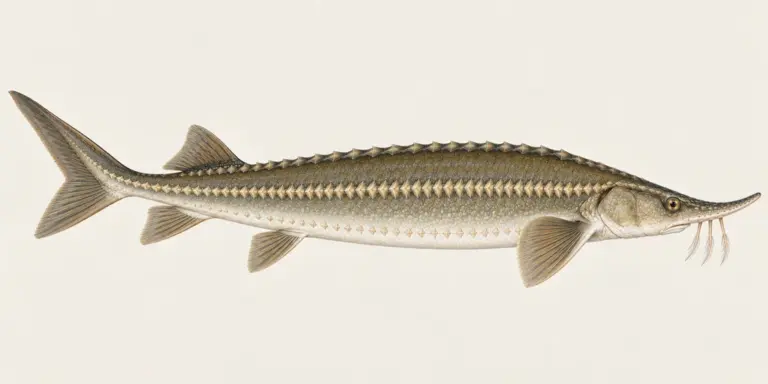
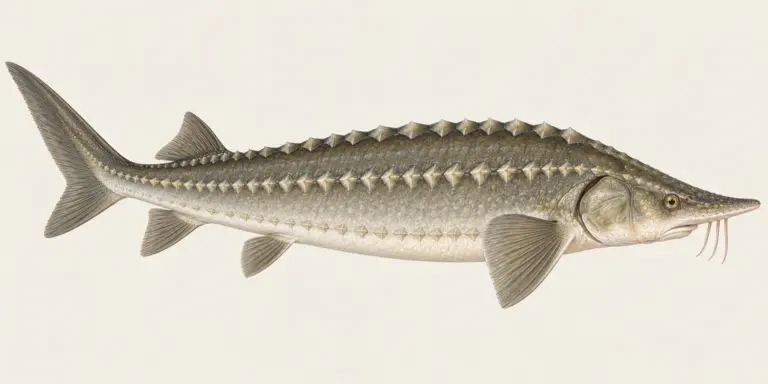
AI-generated illustrations.
Where it lives
Unlike most sturgeons, the sterlet lives entirely in fresh water and reaches brackish water only exceptionally. It lives in large rivers, mostly in the current and in deep water, and moves into flooded areas to feed. Originally it inhabited the tributaries of the Black, Azov and Caspian Seas as well as Siberian rivers from the Ob to the Yenisei.
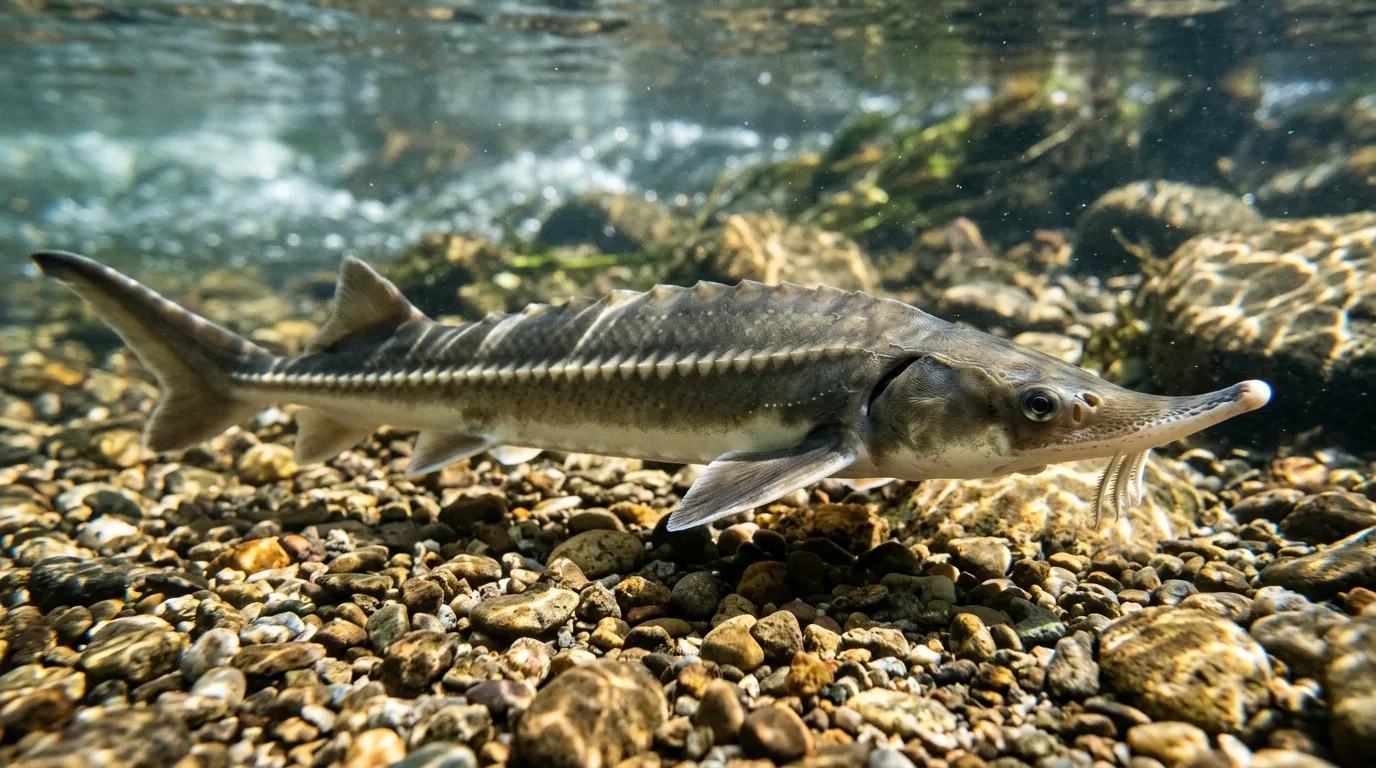
Formerly it was found in Germany along the whole length of the Danube and in the lower reaches of larger tributaries. According to the Red List, today only a small population remains in the lowest German stretch of the Danube, which probably sustains itself without stocking. On the Austrian side the NÖ Landesfischereiverband describes a self-sustaining stock below the Jochenstein power station.
Outside its range the sterlet has been introduced all over Europe, according to FishBase, without permanent stocks forming. According to the magazine Blinker, it is a popular stocking fish for gravel-pit lakes in central Europe.
Holding spots in the picture
Choose the season and time of day: the picture shows where the species stands then. Spots outlined in red apply only in the chosen season. Tap a fish or a spot in the list to bring it closer. The picture is schematic and AI-generated, every water is different.
In the river
Gravelly shallow (riffle)
Sterlet is found here in spring only.
Pools, deep spot
Sterlet is found here all year round.
Current seam
Sterlet is found here all year round.
Free current in mid-river
Sterlet is found here all year round.
The sterlet lives entirely in the fresh water of large rivers, mostly in the current over deep bottom. It also moves into flooded areas to feed.
Spring: This is when spawning takes place, so observe the closed seasons (Schonzeiten). When the ice breaks in spring it migrates upstream and usually spawns over gravel in a strong current.
Winter: In winter the fish gather in deep holes and are hardly active.
Depth: The sterlet stays in deep water near the bottom. In winter it lies almost motionless in deep holes.
Size comparison: AI-generated drawing, schematic.
How it lives and spawns
The sterlet feeds mainly on invertebrates living on the bottom such as worms, snails, insect larvae and mussels. In winter it gathers in deep pits on the bottom and is hardly active. When the ice breaks in spring it leaves the pits and travels upstream to the spawning grounds.
According to the NÖ Landesfischereiverband, spawning takes place from April to June, mostly over gravel in strong current, more rarely over gravel and sand or on flooded areas. The young fish stay in the river during their first summer. Adult sterlets do not become ready to spawn every year, which further limits the number of spawners. FishBase gives a maximum age of 36 years.
Is there a season?
There is no angling season for the sterlet. It is critically endangered in Germany, so all months in the catch calendar are set to zero.
A species recovery programme using Danube-descended fish is under way in the Bavarian Danube. In October 2025, 993 young sterlets were stocked near Vilshofen, and at least 1500 are planned for 2024 to 2027. All the fish carry a chip and an orange tag on the underside of the snout.
You will find the monthly overview of all species and the water temperature check in the catch calendar.
What to do with a bycatch
As bycatch: Fishing for sterlet? – why the species is not a target fish and what to do with an accidental catch.
Nobody fishes for sterlet on purpose. As bycatch it can take the hook when bottom fishing on the Danube or in a stocked water.
Remove the hook in the water and do not lift the fish by the gills or the tail. Look for an orange mark under the snout and photograph it before you release the fish. Tagged fish come from the species recovery programme on the Danube, which is funded by the Bezirk Niederbayern and the Bavarian fishing levy (Fischereiabgabe).
Count the lateral scutes: Very many closely set scutes in the side row and fringed barbels point to the sterlet. A photo of the flank is enough to count them later in peace.
Unhook it in the water: Leave the fish in the water and skip photos on land. A picture taken in the water with the snout visible is enough for identification later.
Suitable lures
We deliberately show no baits for this species.
Critically endangered: do not target it, release an accidental catch gently at once and observe state law.
What you need to observe
The sterlet is listed as critically endangered in Germany’s 2023 Red List. All sturgeon species that are not in Annex IV, and so the sterlet too, are listed in Annex V of the Habitats Directive (FFH). According to the Bundesamt für Naturschutz, Annex V species may only be used if that is compatible with a favourable conservation status. In international trade it is listed, according to FishBase, in Appendix II of the Convention on International Trade in Endangered Species (CITES).
Whether you may take a sterlet from a stocked water is governed by state law, the water’s rules and your fishing permit (Erlaubnisschein). A sterlet from the Danube always goes straight back.
Bavaria protects the sterlet all year round in the Danube basin, and Brandenburg protects all sturgeon species (as of October 2026). What counts is the fisheries regulation of your federal state (Bundesland), the water’s rules and your fishing permit. You will find a list of links to the official sources in the catch calendar.
You release a sterlet at once with wet hands and, if possible, in the water (releasing fish).
What closed season, minimum size and harvest slot mean and where to find them is explained on the page Closed season and minimum size explained.
What state law says about the closed season (Schonzeit) and minimum size (Mindestmaß) for this species is in the “At a glance” box on the state pages for Bavaria and Brandenburg. Our overview does not list this species for the other states; the state fisheries regulation applies there.
Frequently asked questions (FAQ)
Is the sterlet a native fish?
Yes, but only in the Danube. A small remnant population lives in the lowest German stretch. Sterlets in other waters come from stocking.
How do I tell a sterlet from other sturgeons?
Most reliably by the number of lateral scutes: 56 to 71 on a sterlet, clearly fewer on the European, Russian and Siberian sturgeon. Then there are the fringed barbels.
May I take a sterlet from a gravel pit lake?
State law, the water’s rules and your fishing permit govern that. In the Bavarian Danube basin the sterlet is protected all year round, and in Brandenburg that applies to all sturgeon species (as of October 2026). Because the species is critically endangered in Germany, we advise releasing it gently even in a gravel pit lake.
Sources
The rating of catch chances is an editorial assessment. The facts come from these sources, and the text is worded in our own words. The illustration is an original design by Angel Momente in the style of a natural history plate (AI-generated, see the AI notice).
- FishBase: Acipenser ruthenus (Merkmale, Größe, Alter, Lebensweise, CITES)
- Rote-Liste-Zentrum: Sterlet (Rote Liste der Süßwasserfische Deutschlands 2023: vom Aussterben bedroht)
- NÖ Landesfischereiverband: Fischarten in Niederösterreich, Sterlet
- Bezirk Niederbayern / LIFE-Boat4Sturgeon: Tätigkeitsbericht Artenhilfsprogramm Sterlet 2025
- Blinker: Steckbrief Stör (Störarten, Sterlet, Besatz)
- EUR-Lex: Richtlinie 92/43/EWG (FFH-Richtlinie), konsolidierte Fassung, Anhang V
- Bundesamt für Naturschutz: Artenschutz der FFH-Richtlinie (Entnahme von Anhang-V-Arten)
- FishBase: Acipenser sturio (Seitenschilde)
- FishBase: Acipenser gueldenstaedtii (Seitenschilde)
- FishBase: Acipenser baerii (Seitenschilde)
- Bayern.Recht: Verordnung zur Ausführung des Bayerischen Fischereigesetzes (AVBayFiG), Anlage Schonzeiten und Schonmaße
- Land Brandenburg: Fischereiordnung des Landes Brandenburg (BbgFischO), Anlage zu § 2
Created with AI support from the sources listed. Figures only appear in the text if a source gives them. Last updated: 27 October 2026. Found a mistake? Write to us. Who is behind this site: About me.
More in the lexicon
- All fish species at a glance
- Catch calendar – month, water temperature and profile for 93 species
- Line calculator – breaking strain after the knot, drag guideline, backing
- Angling methods