
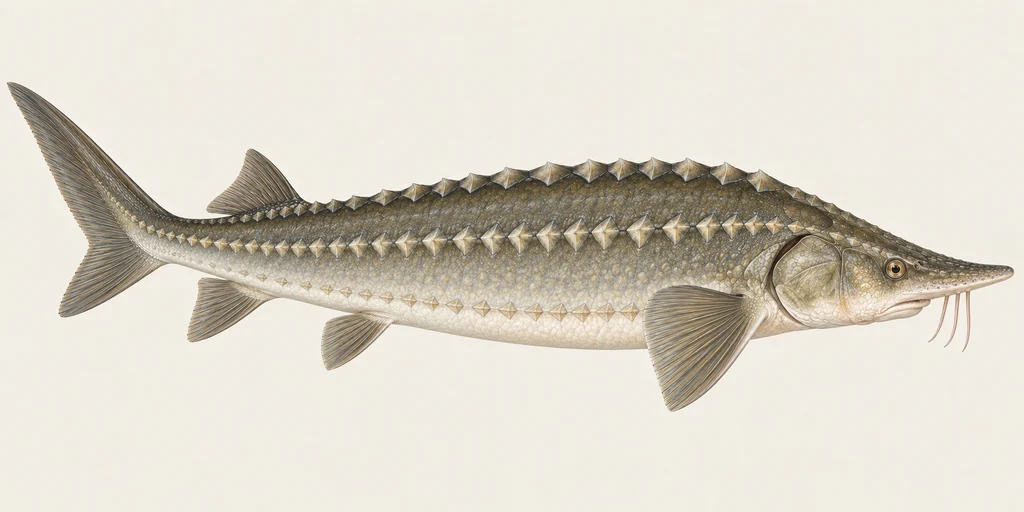
Knowledge – Fish
European sturgeon: Features, protection, reintroduction
The European sturgeon (Acipenser sturio) lives in the sea and enters large rivers only to spawn. In Germany it is regarded as extinct or missing, but has been reintroduced to the Elbe since 2008. It is strictly protected and not a target species. This profile shows how to recognise it and what matters if you catch one by accident.
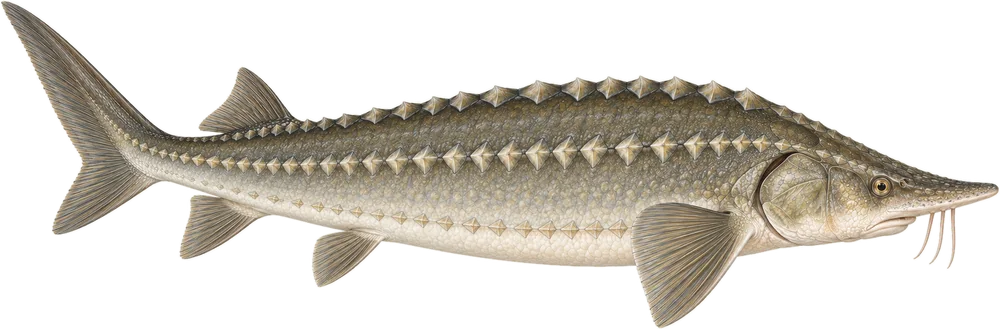
In brief: The European sturgeon is strictly protected and not a target species. In Germany it is regarded as extinct or missing. What to do with a by-catch: European sturgeon as by-catch.
- Five longitudinal rows of large bony scutes along the body
- Four barbels in a transverse row in front of the inferior, protrusible mouth
- Asymmetrical (heterocercal) tail fin with an elongated upper lobe
Catch chances through the year
- Hardly any chance
- Possible
- Good
- Peak season
- Spawning (observe the closed season)
Editorial assessment for waters in Germany, not a measured value and no guarantee. Spawning time is not the same as the legal closed season.
Species profile and sources in the catch calendarAll species compared month by monthThe rules of your federal state
How to recognise it
The European sturgeon has an elongated body without scales. Instead it carries five longitudinal rows of bony scutes: one row on the back, one on each flank and one on each side of the belly. The snout is pointed and drawn out, the mouth lies on the underside and can be protruded. In front of it are four barbels in a transverse row, according to FishBase about halfway between the tip of the snout and the mouth.
The tail fin is asymmetrically forked. The back is greenish-brown to blackish with a golden sheen, the flanks are lighter with a silvery gloss, the belly is white. FishBase counts 9 to 16 scutes on the back, 24 to 39 scutes in the row on each flank and 9 to 14 on the belly.
The size figures in the sources differ. The Bundesamt für Naturschutz gives over 3 metres in the species profile and up to 5,5 metres and more than 600 kilograms in the text on reintroduction. FishBase gives 6 metres and 400 kilograms as maximum values and 1,25 metres as the usual length. Today males usually reach only 100 to 150 centimetres, females 130 to 215 centimetres.
The Atlantic sturgeon (Acipenser oxyrinchus), which was once native to the Baltic Sea and is being reintroduced to the Oder, looks very similar to the European sturgeon. The two are hard to tell apart. On the Atlantic sturgeon the snout is relatively long and broad, the barbels usually sit closer to the mouth than to the tip of the snout, and between the pelvic and anal fins there are bony plates in two or more rows.
The sterlet, which is often stocked in gravel pits in central Europe, stays clearly smaller at no more than about 1,20 metres and has strongly fringed barbels. According to Blinker, sturgeon are often stocked along with trout in trout ponds, and non-native species get into the waters from aquaculture facilities. A sturgeon in an angling pond or gravel pit therefore comes from stocking with other species, see also Russian sturgeon.
Side by side
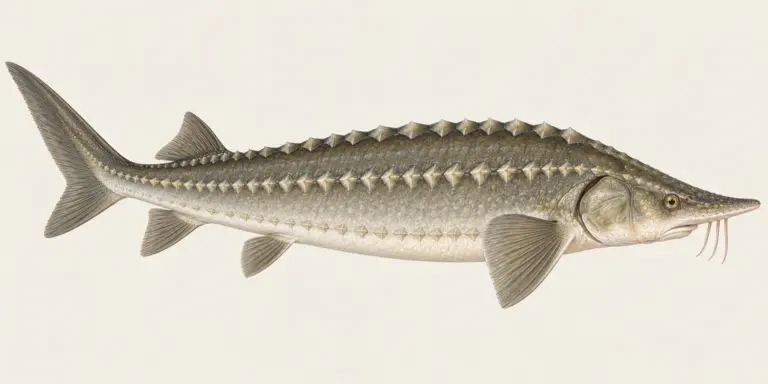
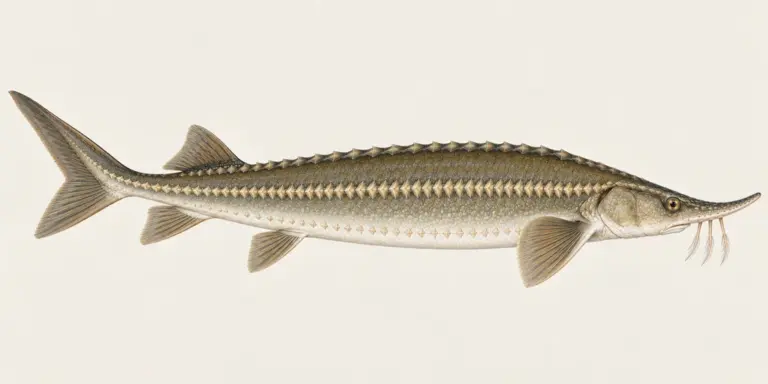
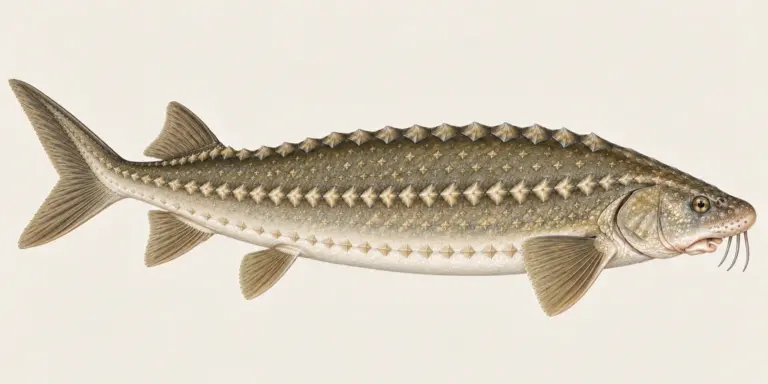
AI-generated illustrations.
Where it lives
The sturgeon spends most of its life in the sea, near the coast and in river mouths. According to FishBase it usually stays at depths of 5 to 60 metres, over bottoms from sand to rock. The Bundesamt für Naturschutz names food-rich, sandy-muddy bottoms at medium depths. To spawn it enters large, deep rivers with a strong current and a stony-gravelly bed.
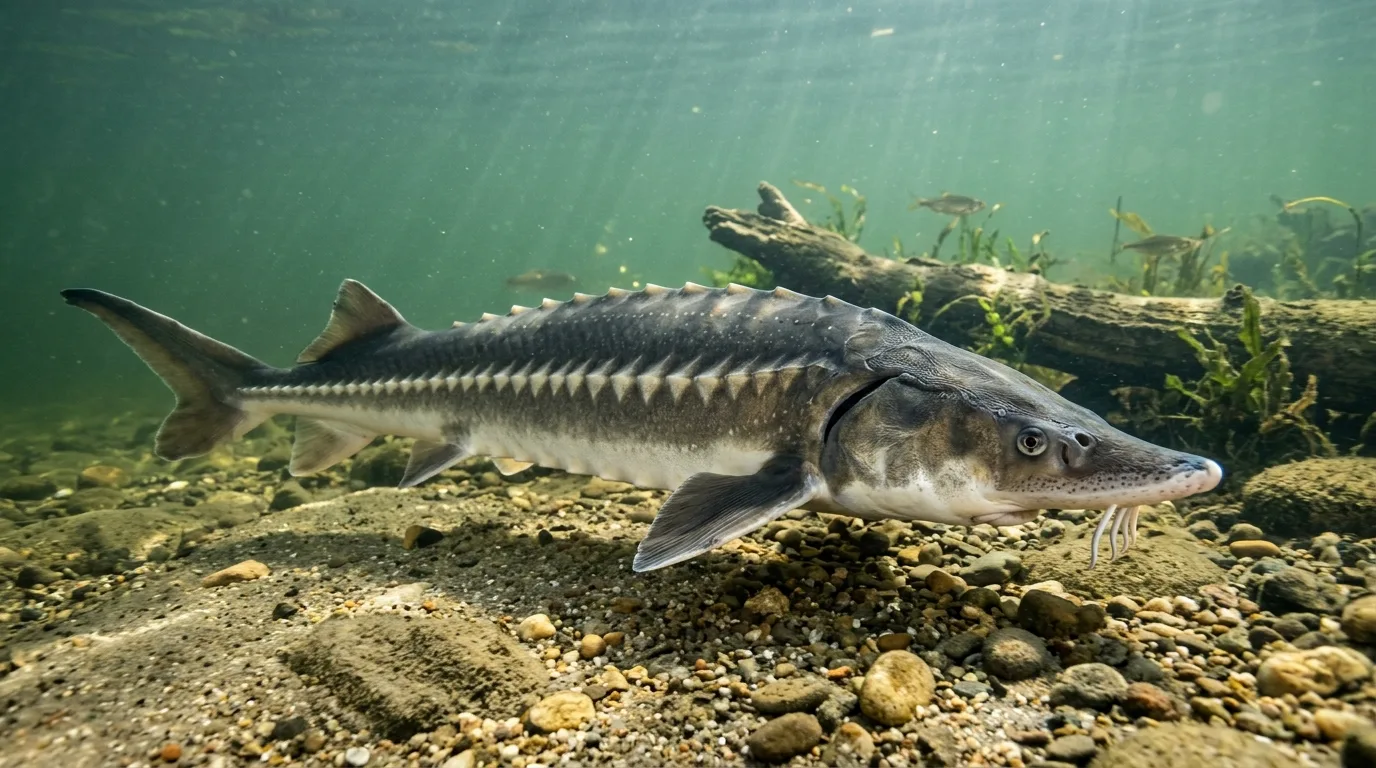
The sturgeon used to occur in all the larger rivers that flow into the North Sea. The last reported specimen in Germany was caught in the North Sea in 1993. The last remaining stock in the EU lives in the Gironde in France. As a breeding species it has been regarded as extinct since 1964 according to the Red List of 2023, when the last young sturgeon were recorded in the Elbe.
Since 2008, young sturgeon from French breeding have been released into the Elbe every year. In 2021, returning fish were recorded for the first time in the lower Elbe, as far up as Hamburg. Reproduction has not been recorded to this day. According to the Red List, the development of the Elbe and weirs on tributaries such as the Havel, Spree, Saale and Mulde pose a risk to the reintroduction.
Holding spots in the picture
Choose the season and time of day: the picture shows where the species stands then. Spots outlined in red apply only in the chosen season. Tap a fish or a spot in the list to bring it closer. The picture is schematic and AI-generated, every water is different.
Time of day Young sturgeon fitted with tags in the Gironde showed no difference between day and night; their movements followed the tidal current.
On the coast
Sandy bottom
European sturgeon is present here all year round.
The European sturgeon spends most of its life in the sea, usually near the coast and in river mouths. It stays on the bottom over sandy and muddy ground and feeds there. The species is strictly protected.
Spring: From April, spawning-ready sturgeon leave the sea and move up the large rivers.
Summer: The spawning season falls in this period; observe the closed seasons (Schonzeiten).
In the river
Pools, deep spot
European sturgeon is present here all year round.
Free current in mid-river
European sturgeon is present here only in summer.
In the river the sturgeon uses deep holes as resting zones and lies. Young sturgeon stay two to four years in the river and around the mouth before migrating out to sea.
Spring: From April the sturgeon begin their spawning migration.
Summer: This is the spawning period, so observe the closed seasons (Schonzeit). From May to July sturgeon spawn in large, deep rivers over stony, gravelly bottoms, in the main current or in channels with a strong flow. Afterwards the adults return to the sea.
Winter: Fish migrating downstream use deep holes as winter quarters.
Depth: FishBase gives 4 to 93 metres, usually 5 to 60 metres. The WWF gives usually 40 to 100 metres for the sea.
Size comparison: AI-generated drawing, schematic.
How it lives and spawns
The sturgeon looks for its food on the bottom: worms, crustaceans, snails, mussels, small fish. The Bundesamt für Naturschutz describes how it roots tiny organisms out of fine sandy or gravelly ground. FishBase calls it mostly solitary.
Males mature at 9 to 13 years, females at 11 to 18 years. Males can breed every year, females take breaks. From April the fish ready to spawn move upstream, and spawning runs from May to July. A female can lay up to 2,5 million eggs. According to FishBase the eggs develop in about a week at 17 °C.
The young sturgeon stay 2 to 4 years in the lower reaches and the estuary and then migrate to the sea. According to the Leibniz-Institut IGB, mortality in the first two years of life in the Gironde is just under 90 percent.
Is there a season?
There is no angling season for the European sturgeon. The species is protected all year, and in the catch calendar it stands at the lowest level in all twelve months.
The first returning fish were sighted in summer 2021, and in spring and summer sturgeon also move upstream on their spawning migration. A sturgeon in the Elbe, the Oder or on the coast is a very rare event, but it is not ruled out.
You will find the monthly overview of all species and the water temperature check in the catch calendar.
From the blog: Freshwater fish in Germany: which species you catch where
What to do with a bycatch
As a by-catch: Fishing for European sturgeon? – why the species is not a target and what you do if you catch one by accident.
The European sturgeon is not fished for deliberately. That is why there is no rig and no bait here. What matters is the right handling of a by-catch, in case a sturgeon does end up on your hook.
Play it quickly and leave it in the water. Fish should not stay in the air longer than necessary, because they suffer needless stress there and in the worst case suffocate. Remove the hook in the water with the disgorger or the forceps. How to do this with a fish is on the pages Landing and unhooking fish and Releasing fish. Hold the fish in the current until it swims away by itself.
A sturgeon is large and carries sharp-edged bony plates. That is another reason to leave it in the water.
Unhook it in the water: Remove the hook in the water and do without photos on land. Even catching, injuring or killing a strictly protected species is prohibited.
Pass on the catch: Stocked sturgeon are tagged so that the place and date of release can be traced. If it can be done without losing time, you note the date, place, estimated length and a visible tag, and pass the details to the responsible fisheries authority (Fischereibehörde).
Suitable lures
We deliberately show no baits for this species.
Strictly protected: deliberate fishing is prohibited throughout Europe. Release a sturgeon hooked by accident at once and gently.
What you need to observe
The European sturgeon is listed as extinct or missing in the German Red List of 2023 and appears in Annex II and Annex IV of the Habitats Directive (FFH). Annex IV species count as specially and strictly protected under the Federal Nature Conservation Act (Bundesnaturschutzgesetz). Under § 44 it is prohibited to pursue, catch, injure or kill such animals. So it may neither be fished for deliberately nor kept.
Closed seasons (Schonzeit), minimum sizes (Mindestmaß) and harvest windows are set by the federal states (Bundesland), and on many waters additionally by the club or leaseholder. They differ depending on the water and the time of year. We give figures only with a date and a source; always binding are the fisheries regulation of your federal state and your fishing permit (Erlaubnisschein). You will find a list of links to the official sources in the catch calendar.
What closed season, minimum size and harvest slot mean and where to find them is explained on the page Closed season and minimum size explained.
Frequently asked questions (FAQ)
May I fish for the European sturgeon?
No. The species is strictly protected, and even catching, injuring or killing it is prohibited. A sturgeon hooked by accident is unhooked in the water and released at once.
What do I do if a sturgeon is on the hook?
Play it quickly, leave the fish in the water, remove the hook in the water and hold it in the current until it swims away. If it can be done without losing time, you note the place, date, estimated length and a visible tag for the fisheries authority (Fischereibehörde).
Are there sturgeon in Germany again?
European sturgeon have been released into the Elbe since 2008, and the first returning fish arrived in 2021. Atlantic sturgeon are being reintroduced in the Oder. Reproduction has not yet been recorded.
Sources
The rating of catch chances is an editorial assessment. The facts come from these sources, and the text is worded in our own words. The illustration is an original design by Angel Momente in the style of a natural history plate (AI-generated, see the AI notice).
- Bundesamt für Naturschutz: Artenporträt Acipenser sturio (Schutzstatus, Lebenszyklus, Besatz in der Elbe)
- FishBase: Acipenser sturio (Tiefe, Barteln, Knochenschilde, Höchstalter)
- Bundesamt für Naturschutz: Rote Liste und Gesamtartenliste der Süßwasserfische und Neunaugen Deutschlands 2023 (Naturschutz und Biologische Vielfalt 170/6)
- Rote-Liste-Zentrum: Europäischer Stör (Rote Liste der Süßwasserfische Deutschlands 2023: ausgestorben oder verschollen)
- Leibniz-IGB: Der Stör kehrt zurück in Elbe und Oder (Interview zum Wiederansiedlungsprogramm, 2021)
- Bundesamt für Naturschutz: Wiederansiedlung Baltischer Störe (Besatz in der Oder, Markierung, Monitoring)
- Bundesamt für Naturschutz: Wiederansiedlung Europäischer Störe (Elterntiere, Laichgebiete, Aktionsplan)
- Müritzeum Waren: Tierartenlexikon Atlantischer Stör (Merkmale, Abgrenzung)
- Müritzeum Waren: Tierartenlexikon Sterlet (Barteln, Größe)
- Niederösterreichischer Landesfischereiverband: Fischarten in Niederösterreich, Sterlet
- Blinker: Steckbrief Stör (Störarten, Sterlet, Lebensweise)
- Bundesministerium der Justiz: Bundesnaturschutzgesetz, § 44 (Zugriffsverbote)
- Bundesministerium der Justiz: Bundesnaturschutzgesetz, § 7 (Begriffsbestimmungen, streng geschützte Arten)
- Hessisches Landwirtschaftsministerium: Bundeseinheitlicher Fragenkatalog der Fischerprüfung (Fassung Hessen 2025)
- Wikipedia: Europäischer Stör (Merkmale, Größe, Gefährdung, Wiederansiedlung, FFH-Anhänge)
- WWF-Artenlexikon: Europäischer Stör (Lebensraum im Meer, Laichplätze)
- Hessen-Forst FENA / HLNUG: Artensteckbrief Stör (Acipenser sturio), Stand 2006
- Taverny et al. 2002, Journal of Applied Ichthyology (INRAE/HAL): Habitat selection by juvenile European sturgeon Acipenser sturio in the Gironde estuary (Telemetrie, Tag-Nacht-Vergleich)
- Acolas et al. 2012, Journal of Experimental Marine Biology and Ecology (INRAE/HAL): Downstream migration patterns of one-year-old hatchery-reared European sturgeon (Telemetrie)
Created with AI support from the sources listed. Figures only appear in the text if a source gives them. Last updated: 7 November 2026. Found a mistake? Write to us. Who is behind this site: About me.
More in the lexicon
- All fish species at a glance
- Catch calendar – month, water temperature and profile for 93 species
- Line calculator – breaking strain after the knot, drag guideline, backing
- Angling methods