
Knowledge – Fish
Fishing for European sturgeon
Fishing for the European sturgeon is not allowed: it is strictly protected and is being painstakingly reintroduced in the Elbe. This page explains how to recognise it, where it lives and what to do if it takes your bait anyway.
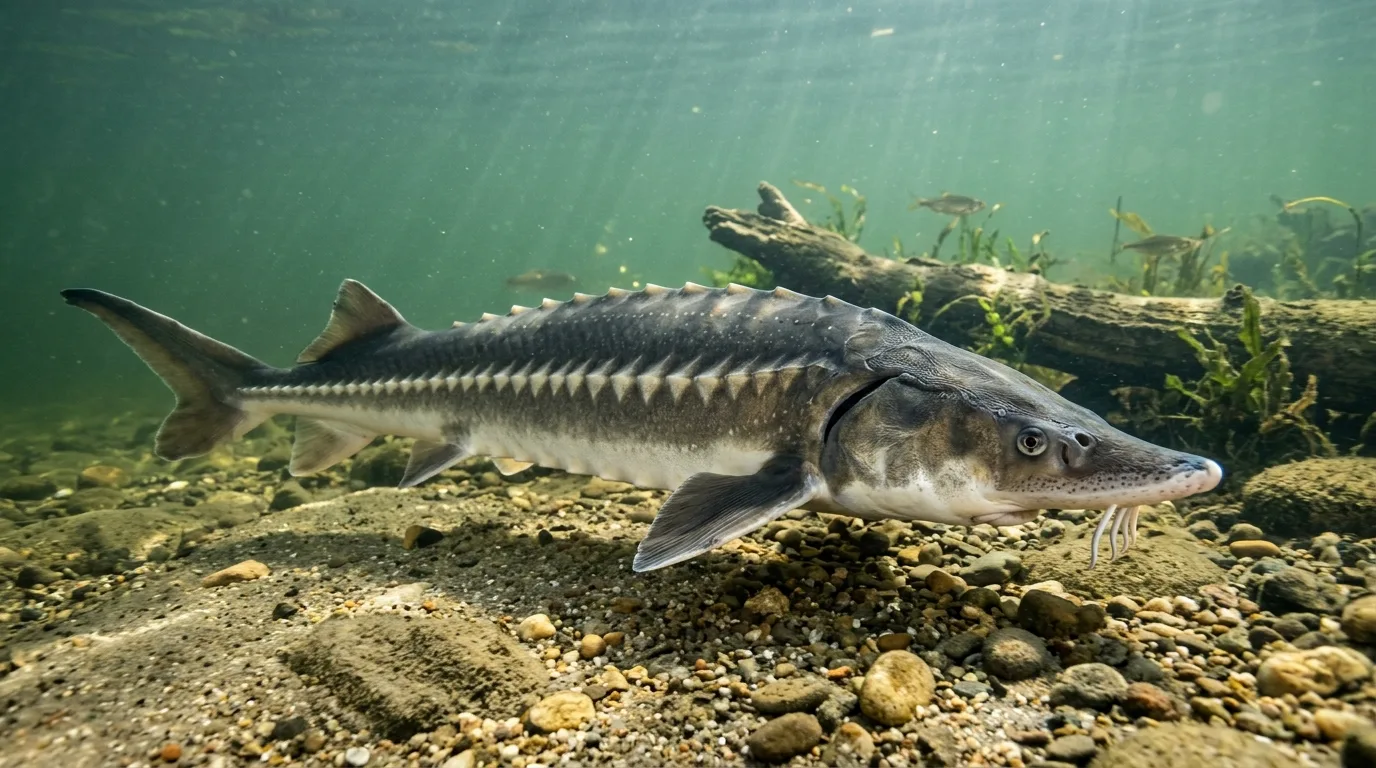
The European sturgeon is strictly protected, all year round. Catching, injuring or killing it is prohibited.
Quick to recognise
A long fish without scales, with five rows of bony scutes, a pointed snout, four barbels in front of the underslung mouth and an unevenly forked tail fin. According to the Bundesamt für Naturschutz it grows longer than 3 metres; today males usually stay at 100 to 150 and females at 130 to 215 centimetres.
Why it is not a target fish
The 2023 Red List lists the European sturgeon in Germany as extinct or missing; as a reproducing species it has been absent since 1964. It is in Annexes II and IV of the FFH Directive and is therefore strictly protected under the Bundesnaturschutzgesetz. Young sturgeon have been released into the Elbe since 2008; reproduction has not been proven so far.
Where it lives
On the coast
The sturgeon spends most of its life in the sea, near the coast and in river mouths. There it searches for food on the bottom over sandy to muddy ground.
| All year round | Sandy bottom |
|---|
In the river
From April, spawning-ready sturgeon move into large, deep rivers with a strong current and spawn from May to July over gravel and stones. Deep holes serve as resting places; young sturgeon stay two to four years in the lower reaches and at the river mouth.
| All year round | Pools |
|---|---|
| Summer extra | Main current |
Holding spots in the picture
Choose the season and time of day: the picture shows where the species stands then. Spots outlined in red apply only in the chosen season. Tap a fish or a spot in the list to bring it closer. The picture is schematic and AI-generated, every water is different.
Time of day Young sturgeon fitted with tags in the Gironde showed no difference between day and night; their movements followed the tidal current.
On the coast
Sandy bottom
European sturgeon is present here all year round.
The European sturgeon spends most of its life in the sea, usually near the coast and in river mouths. It stays on the bottom over sandy and muddy ground and feeds there. The species is strictly protected.
Spring: From April, spawning-ready sturgeon leave the sea and move up the large rivers.
Summer: The spawning season falls in this period; observe the closed seasons (Schonzeiten).
In the river
Pools, deep spot
European sturgeon is present here all year round.
Free current in mid-river
European sturgeon is present here only in summer.
In the river the sturgeon uses deep holes as resting zones and lies. Young sturgeon stay two to four years in the river and around the mouth before migrating out to sea.
Spring: From April the sturgeon begin their spawning migration.
Summer: This is the spawning period, so observe the closed seasons (Schonzeit). From May to July sturgeon spawn in large, deep rivers over stony, gravelly bottoms, in the main current or in channels with a strong flow. Afterwards the adults return to the sea.
Winter: Fish migrating downstream use deep holes as winter quarters.
Depth: FishBase gives 4 to 93 metres, usually 5 to 60 metres. The WWF gives usually 40 to 100 metres for the sea.
Size comparison: AI-generated drawing, schematic.
Do not confuse
The Atlantic sturgeon looks very similar: its snout is rather long and broad, the barbels usually sit closer to the mouth, and between the pelvic and anal fins there are bony plates in at least two rows. The sterlet stays much smaller at about 1.20 metres at most and has strongly fringed barbels. A sturgeon from a gravel-pit lake or an angling pond comes from stocking.
If it bites anyway
Play the fish quickly, leave it in the water and remove the hook there with a disgorger or pliers, with no photos on the bank. The sharp-edged bony plates are another reason not to lift it out. Hold it in the current until it swims off by itself. If it can be done without losing time, note the day of the catch, the spot, the approximate length and any recognisable marking, and report it to the responsible fisheries authority (Fischereibehörde).
Rules
In our overview of the states there are no figures for the European sturgeon on minimum size (Mindestmaß) or closed season (Schonzeit). That does not mean you may catch or keep it: protection is governed by state fisheries law and nature conservation law.
What applies in your country is on the country pages under Fishing waters in Germany.
The regulation and your fishing permit (Erlaubnisschein) are what count. Lake Constance, the Rhine and the coast, for example, have their own rules: Fishing waters in Germany.
Text AI-assisted, summarised from these pages: European sturgeon (profile), Landing a fish and unhooking it, Releasing a fish.