
Knowledge – Fish
Whiting fishing
Fishing for whiting means: from the boat, find a shoal in deep water and offer fresh natural baits just above the bottom. Here is the route there in nine steps, each with a link to the detailed page.
 Choose another fish117 fish with guides
 EelOff-peak season
 EelpoutPossible
 IdePossible
 ArapaimaGood
 GraylingPeak season
 Atlantic salmonSpawning time, please spare
 Brown troutSpawning time, please spare
 Brook troutSpawning time, please spare
 BarbelOff-peak season
 BarramundiSpawning season
 Greater amberjackGood
 Topmouth gudgeonOnly as bycatch
 Blue marlinSpawning season
 BonefishSpawning season
 BonitoGood
 BreamOff-peak season
 Dusky grouperOnly as bycatch
 CobiaPossible
 Spiny dogfishOnly as bycatch
 CodPeak season
 ChubPeak season
 MinnowOnly as bycatch
 European sturgeonOnly as bycatch
 FlounderPeak season
 PerchPeak season
 Largemouth bassGood
 Ballan wrasseOnly as bycatch
 Yellowfin tunaSpawning season
 Giant trevallyGood
 Prussian carpPossible
 BrillPossible
 Gilthead breamSpawning time, please spare
 Golden doradoSpawning season
 Golden mahseerOnly as bycatch
 Dolphinfish (mahi-mahi)Good
 Grass carpPossible
 Great barracudaGood
 GudgeonPossible
 White breamPossible
 DaceOff-peak season
 PikePeak season
 HalibutOff-peak season
 HerringPossible
 GarfishOut of season
 Huchen (Danube salmon)Possible
 Crucian carpOnly as bycatch
 CarpOff-peak season
 RuffeOff-peak season
 VendaceOnly as bycatch
 DabPeak season
 GurnardPossible
 Coley (saithe)Peak season
 Chinook salmonHardly any chance
 King mackerelSpawning season
 LingPeak season
 TuskOff-peak season
 MackerelPossible
 Bighead carpOut of season
 WhitefishPossible
 Conger eelOff-peak season
 Sea troutSpawning time, please spare
 Grey mulletPossible
 Murray codSpawning season
 MuskellungeGood
 Common nasePossible
 Nile perchPossible
 PayaraPossible
 Peacock bassPeak season
 PermitGood
 WeeverOnly as bycatch
 PollackOff-peak season
 BurbotOff-peak season
 AspPossible
 Red snapperSpawning season
 Rainbow troutPeak season
 RoosterfishGood
 RoachPeak season
 RedfishOut of season
 Bluefin tunaOnly as bycatch
 RuddPossible
 Russian sturgeonOnly as bycatch
 HaddockOff-peak season
 SnakeheadPossible
 TenchOff-peak season
 SpirlinOnly as bycatch
 PlaiceOff-peak season
 Greenland halibutOnly as bycatch
 Round gobyOnly as bycatch
 SwordfishGood
 Lake troutSpawning time, please spare
 HakeSpawning time, please spare
 Alpine charSpawning time, please spare
 MonkfishPossible
 SoleOff-peak season
 SailfishGood
 Silver carpOut of season
 SnookPeak season
 PumpkinseedOnly as bycatch
 SpratOnly as bycatch
 Atlantic wolffishSpawning time, please spare
 TurbotPeak season
 SterletOnly as bycatch
 SmeltOnly as bycatch
 Horse mackerelPossible
 TaimenGood
 TarponGood
 TigerfishSpawning season
 BleakPossible
 WahooGood
 Wels catfishOff-peak season
- WhitingPeak season
 Sea bassOff-peak season
 ZanderPeak season
 White-eye breamOnly as bycatch
 Blue breamOnly as bycatch
 Brown bullheadPossible
 VimbaOnly as bycatch
Season in October according to the catch calendar, an estimate and not a guarantee of a catch. The fish pictures are reduced natural-history plates and AI-generated.
Best time
From September to November, mainly by day and by night.
In January: Good, spawningIn February: Possible, spawningIn March: Possible, spawningIn April: Possible, spawningIn May: Possible, spawningIn June: Possible, spawningIn July: Possible, spawningIn August: GoodIn September: Peak seasonIn October: Peak seasonIn November: Peak seasonIn December: Good
Good spot
- Coast: deep water, sandy bottom and wreck, reefdeep water, sandy bottom and wreck, reefdeep water, sandy bottom and wreck, reefdeep water, sandy bottom and wreck, reef
Starter tackle
- Rod: light boat rod of the 12–20 lbs class; with great depth and strong current one step heavier
- Line: thin braid up to about 0,15 mm
- Hook: 1/0–2/0, size 2 for smaller baits; long-shanked by preference because of the teeth
- Rod: pilk rod up to about 200 g casting weight
- Line: braid of around 0,18 mm
- Hook: small soft-plastic twisters or flies on hooks around 1/0–2/0
In short
In short: The best time for whiting is September to November, mainly by day and at night. Good spots on the coast: deep water, sandy bottom and wrecks, reefs. Proven baits: lugworm, pieces of prawn and small strips of herring on a paternoster; small twisters or cod flies as droppers. A shoaling fish: where one bites, more are usually nearby. The best season depends on the region: late summer to autumn in the Baltic Sea, November to January around the British Isles.
Quick to recognise
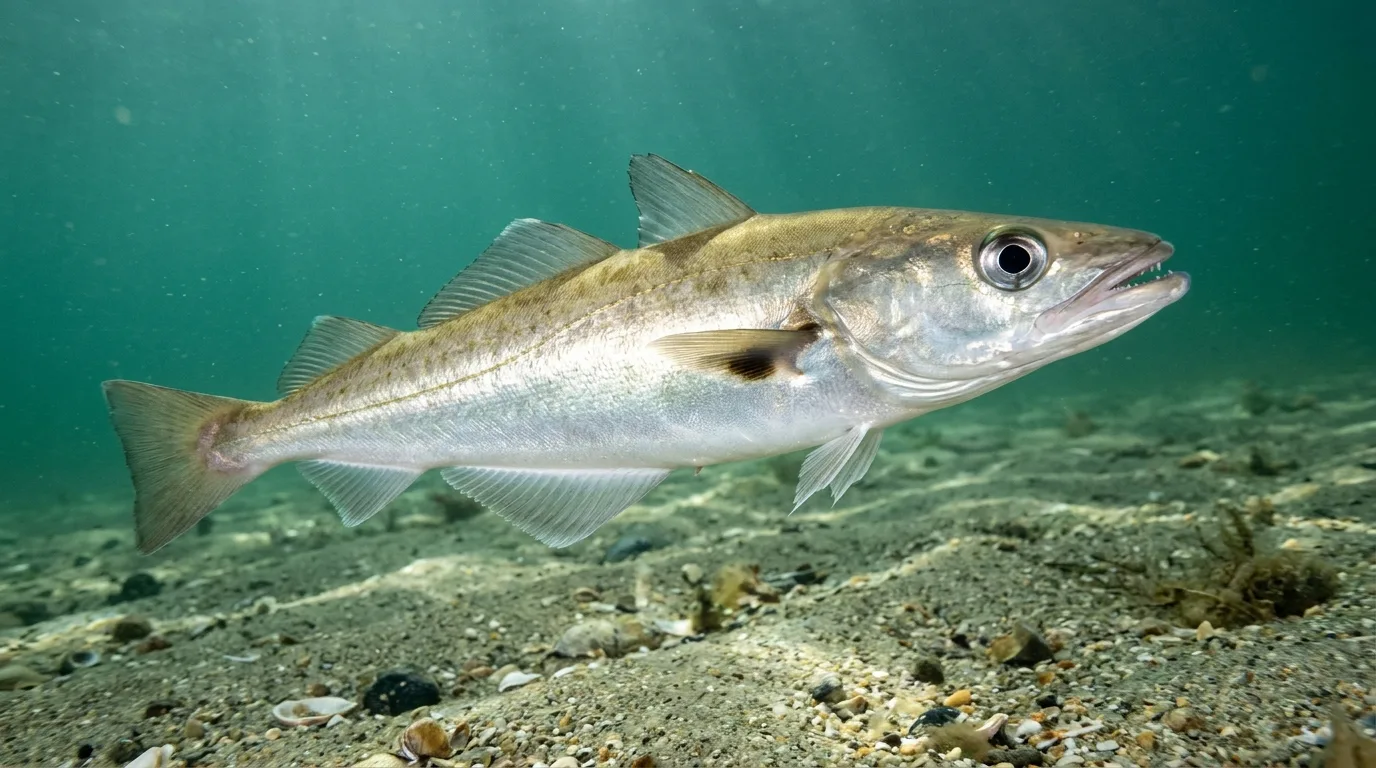
A small relative of the cod with a dark spot at the base of the pectoral fin, also called merlan. It usually measures 30 to 40 centimetres, 70 at most.
When
September to November are the best months, and August and December also bring good catches. On the Baltic Sea the late summer and autumn are especially worthwhile. In the North Sea its spawning season runs from January to July, starting earlier in the south.
- JanGood, spawning
- FebPossible, spawning season
- MarPossible, spawning season
- AprPossible, spawning season
- MayPossible, spawning season
- JunPossible, spawning season
- JulPossible, spawning season
- AugGood
- SepPeak season
- OctPeak season
- NovMain season
- DecGood
Peak seasonGoodPossibleHardly any chanceSpawning season
Spring tactics
During the long spawning season the shoals are scattered and targeted trips bring less. Still, pack a dropper rig, because single whiting often join the catch when you fish for cod from a charter boat.
Summer tactics
In late summer things get noticeably better in the Baltic Sea. In Norway whiting bite in summer in shallow sandy bays when you fish lightly with natural bait, often alongside flatfish and gurnards.
Autumn tactics
The strongest time. The shoals gather, and in Norwegian fjords many bites come not right on the bottom but a few metres above it. Try the bait at several depths until you find the layer where the fish are.
Winter tactics
Around the British Isles November to January is the main season, and good conditions there are a spring tide after a cold frost spell. At night the fish near the shore often bite more readily than by day.
Is it biting today?
In January: Spawning season, please spareIn February: Spawning season, please spareIn March: Spawning season, please spareIn April: Spawning season, please spareIn May: Spawning season, please spareIn June: Spawning season, please spareIn July: Spawning season, please spareIn August: Off-peak seasonIn September: Main seasonIn October: Main seasonIn November: Main seasonIn December: Off-peak season
Today’s catch index needs JavaScript. Season and spawning time are in the catch calendar.
From the blog: Fishing in November: which fish bite now and where I look for them
Where it is now
On the coast
Whiting move in shoals close to the bottom through deep water, preferably over mud and sand. Occasionally they also hold at deep breakwaters, reefs and wrecks. They avoid shallow water, and in a rough sea the shoals go deeper still.
How to go about it: From a boat, search soft bottom of silt and sand in bays from about 20 m deep. The bigger fish tend to hold further out at wrecks and reefs, while good shoals are often found over featureless ground. Fish at anchor or in a slow drift and keep the baits close to the bottom.
| All year round | deep water, sandy bottom, wreck, reef |
|---|
Biting time: mainly by day and at night. What that looks like in the water is shown by the picture of the holding spots just below.
Holding spots in the picture
Choose a season and time of day: the picture shows where the species sits then. Tap a fish or a spot in the list to bring it closer. The picture is schematic and AI-generated, every water is different.
Catch chance in springpossibleSpawning season, observe closed seasons
Chance of a catch in summerpossibleSpawning, observe closed seasons
Catch chance in autumnPeak season
Chance of a catch in wintergoodSpawning, observe the closed seasons
- J
- F
- M
- A
- M
- J
- J
- A
- S
- O
- N
- D
Spawning season
Not the main time The whiting feeds on bottom-dwelling prey mainly at night and on free-swimming prey rather by day.
Active time The whiting feeds on bottom-dwelling prey mainly at night and on free-swimming prey rather by day.
Not the main time The whiting feeds on bottom-dwelling prey mainly at night and on free-swimming prey rather by day.
Active time The whiting feeds on bottom-dwelling prey mainly at night and on free-swimming prey rather by day.
On the coast
Sandy bottom
Whiting are found here all year round.
Wreck, reef
Whiting are found here all year round.
Deep, colder water
Whiting are found here all year round.
Whiting usually hold close to the bottom in deep water, preferably over mud and sand, sometimes also at deep breakwaters, reefs and wrecks. They also leave the bottom and follow prey fish up almost to the surface. Young fish stay near the coast in their first year, and in a rough sea the shoals retreat to deeper water.
Spring: catch chance according to the catch calendar possible. This is when the spawning season falls, observe closed seasons.
Summer: according to the catch calendar, chances are possible in June and July, good in August. The spawning season falls in this period, so observe the closed seasons.
Autumn: according to the catch calendar, chances are in the main season. On the Baltic Sea the late summer and autumn are given as the main season.
Winter: according to the catch calendar, chances are good in December and January, possible in February. The spawning season falls in this period, so observe the closed seasons. In the southern North Sea spawning already begins in January and goes on for months.
Depth: The whiting lives at depths of 10 to 200 metres, mostly 30 to 100 metres. Anglers look for it from a water depth of about 20 metres.
Size comparison: AI-generated drawing, schematic.
How
From a boat or charter boat you fish natural baits on a paternoster close to the bottom. If you hit a shoal while jigging with a pilk, a trace with small twisters above the pilk brings extra fish.
Easiest way
To start with, a trip on a charter boat or a boat in autumn is enough. Attach a thin paternoster with three side arms and small hooks to a light boat rod, bait them with narrow strips of mackerel or lugworm and lower everything to the bottom. Hold the rod in your hand, then you will feel the rattling of the bites straight away.
Paternoster with natural bait
The standard method from a charter boat or boat, at anchor or in a slow drift, as soon as you have found a shoal over soft ground.
- Find the shoal
Work deep bays and open areas of silt or sand where prawns and sand eels live. The echo sounder often shows the shoals as a dense cloud just above the bottom.
- Thin and short
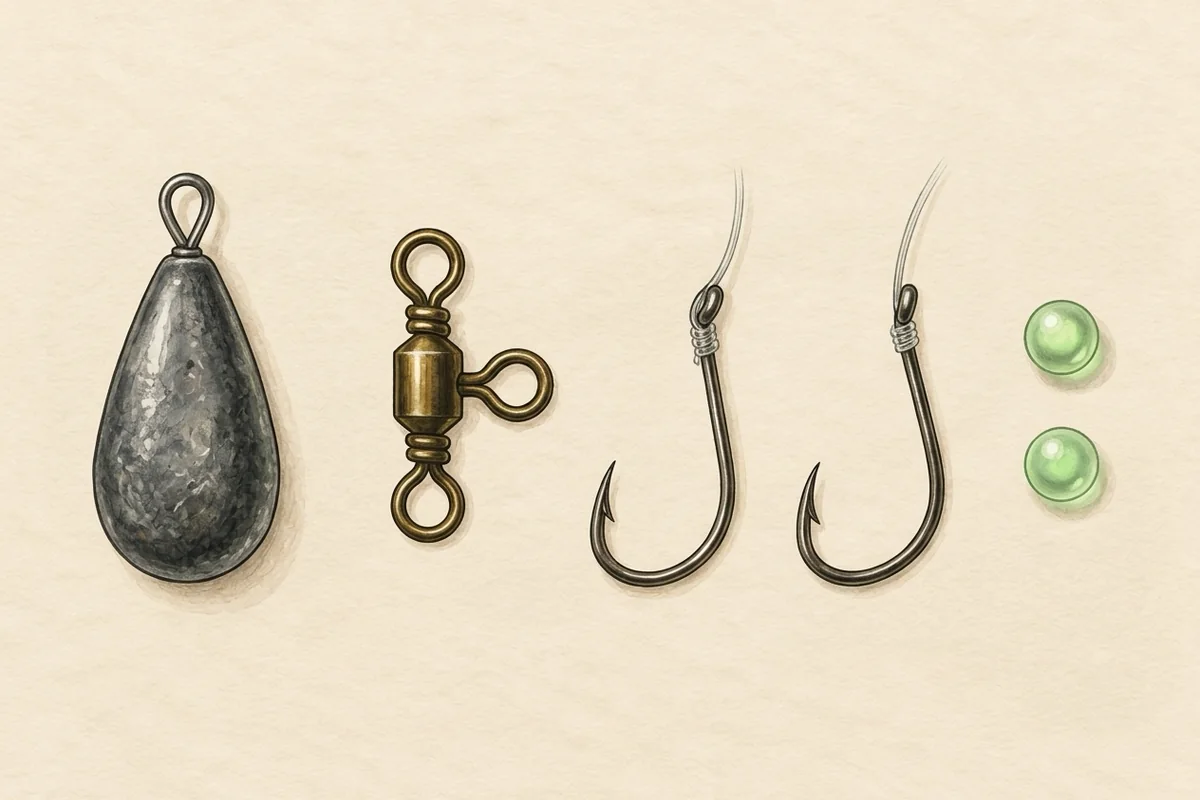
Tie a hooklength of about one metre from 0,20 to 0,25 mm monofilament with three side arms and attach the weight at the bottom in a link swivel. A lure bead or a small spinner blade in front of the hook can add attraction.
- Narrow strips
Cut long, thin strips of mackerel or herring, combine lugworm with a thumbnail-sized piece of fish or thread on a prawn. Do not put too much on one hook, or the point stays hidden.
- Lower to the bottom
Lower the rig vertically until the weight touches down. The English way is then to wind up about a metre, so that the baits hang in the feeding zone above the bottom.
- Lift gently
Lift the rod tip in small, calm movements and lower it again. This way the side arms work without the baits losing contact with the bottom zone.
- Wait for the rattle
A whiting bite usually comes as a quick rattle in the tip. Do not strike at the first tremble, but lift the rod only when the tugging becomes clearer or the line briefly goes slack.
- Often two at once
The fight is short, and it is not unusual for two or three fish to hang on the paternoster at once. Wind steadily so that a lightly hooked fish does not drop off.
- Mind the teeth
Small whiting you swing over the rail. They have sharp teeth, so remove the hook with pliers or use long-shank models from the start, which are easier to grip.
Dropper bait above the pirk
When you are really jigging for cod from a charter boat and suddenly run into a shoal of whiting.
- Use the cod spots
On many charter trips whiting turn up exactly when the cod stay away. Stay on the spot then instead of moving at once.
- Little seducers
Fit a dropper trace above the pilk, with small twisters or flies on its short arms. A halved mackerel rig serves the same purpose.
- Down to the bottom
Let the pilk sink until it hits the bottom and take up the slack line straight away. The droppers then sit just above the bottom.
- Only a light twitch
Lift the pilk only a hand-width and let it drop back briefly. Whiting take the dancing droppers, while big jumps with the iron tend to scare the shoal.
- Multiple bites
If you feel a pluck, leave the rig still for a moment. Often further fish then hook themselves on the free hooks.
- Pump steadily
Bring the fish up without haste. Several whiting pull in different directions, and jerky winding easily tears them free.
What with
Lugworm, pieces of prawn and narrow strips of herring or mackerel, all as fresh as possible. You work the twisters on the droppers with gentle jerks just above the bottom.
- Cut baitall year round, from a charter boat and from a boat
Long, thin strips of fresh mackerel or herring flutter in the current and give off plenty of scent, while whiting hardly react to old pieces of fish.
- Lugwormmainly in autumn and winter, gladly combined with a small piece of fish
Worms and fish are the most important attractants, and together on one hook they combine both scent trails.
- Crustaceans & musselsover silt and sand, where prawns are part of the diet anyway
Prawns are a classic sea bait for whiting; threaded with a baiting needle and secured with thin wire to the hook, they stay on well.
Tackle
Light tackle is enough. The page on the sea rod shows which boat rod or pilk rod is meant for what.
Paternoster with natural bait
- Rod
- light boat rod of 12–20 lbs class; one step stronger in deep water and strong current
- Reel
- Fixed-spool reel or small multiplier
- Line
- thin braid up to about 0,15 mm
- Leader
- paternoster of monofilament 0,20–0,25 mm, about 1 m long, with two to three short side arms
- Hooks
- 1/0–2/0, size 2 for smaller baits; long-shank preferred because of the teeth
- Weight, float, lead
- Weight 100–500 g depending on current, drift and depth; about 300 g at around 25 m with a current
Dropper bait above the pirk
- Rod
- Pilk rod up to about 200 g casting weight
- Reel
- medium-sized fixed-spool reel
- Line
- Braid of around 0,18 mm
- Leader
- dropper trace with two to three short arms above the pilk
- Hooks
- small twisters or flies on hooks around 1/0–2/0
Common mistakes
- Cod tackle that is too heavy: Thick hooklengths and big hooks bring few bites with whiting. A fine paternoster with hooks around 1/0 to 2/0 catches clearly more.
- Searching in the shallows: The whiting usually holds in deeper water. Rather position yourself over deep bays with a soft bottom than over shallow sandbanks.
- Hook overloaded with bait: A thick lump of several worms hides the point. Use little bait, then the hook sets when you lift.
- Rod put down: Whiting strip the bait clean in a short time. Hold the rod in your hand, then you react to the rattling in time.
- Time lost rebaiting: When a shoal is under the boat, bait the next trace while the first one is fishing. That way you are back down quickly before the fish move on.
Rules
Our overview of the states has no figures on minimum size (Mindestmaß) or closed season (Schonzeit) for the whiting. That does not mean there are no rules: individual states and water regulations protect the species or set their own limits.
On the coast the rules of the coastal states apply, partly with their own catch restrictions: North Sea coast, Baltic coast of Schleswig-Holstein and Baltic coast of Mecklenburg-Western Pomerania.
The regulation and your fishing permit (Erlaubnisschein) are what count. Lake Constance, the Rhine and the coast, for example, have their own rules: Fishing waters in Germany.
After the catch
Playing and landing
After the first rattle wait a moment and then lift the rod calmly, a hard strike is not necessary. The fight lasts only a short time, and if several fish are hooked, keep winding steadily. A fish you may keep you stun and kill straight away; undersized ones you unhook with pliers and return at once.
Natural baits near the bottom often also bring flounder and dab, so identify every fish before you keep it. What you take you stun and kill at once. Undersized or protected fish you unhook with wet hands in the water and return.
Frequently asked questions
Which hook size for whiting?
Hooks of size 1/0 to 2/0 on thin side arms are usual. English anglers like long-shank hooks of size 2, which are easy to remove from the toothy mouth.
When is the best time for whiting fishing?
On the Baltic Sea late summer and autumn are worthwhile, around the British Isles rather November to January. Near the shore the shoals often bite better in the dark than by day.
How deep do whiting hold?
Usually from about 20 m and close to the bottom, in English waters down to about 100 m. When they follow prey fish they hold clearly higher; in Norwegian fjords in autumn many bites came a few metres above the bottom.
Do whiting have teeth?
Yes, the mouth has sharp teeth. Do not put your fingers in, but remove the hook with pliers; long-shank hooks make this easier.
Which bait is best for whiting?
Fresh, narrow strips of fish, lugworm and prawns. English match anglers also soak their fish baits in fish oil to strengthen the scent trail.
Similar species
If you fish for whiting, you can fish for these species with similar tackle too:
Sources
As of: October 2026. The practical knowledge comes from 9 sources, summarised in our own words.
View all 9 sources
- Steckbrief Wittling: Der kleine Verwandte des Dorschs · BLINKER (Redaktion)
- Know Your Fish: Whiting · Sea Angler (Redaktion)
- Night Time Is the Right Time to Catch Whiting · Sea Angler (Redaktion)
- Fischfetzen in Norwegen: Artenvielfalt fangen · BLINKER (Florian Pippardt)
- Angeln in Südnorwegen: So nah, so gut · BLINKER (Johannes Radtke)
- Norwegen: Angeln im Fjord – Technik, Taktik und Traumreviere · BLINKER (Joshua Zettelmeier u. a.)
- Angeln vor den Lofoten: Kapitale Aussichten im hohen Norden · BLINKER (Steve Kaufmann)
- Die 7 besten Naturköder zum Meeresangeln · BLINKER (Redaktion)
- Mit Garnelen angeln: Der perfekte Naturköder · BLINKER (Justus Müller)
Text prepared with AI support, based on the sources listed and these pages: Whiting (profile), Pilk fishing, Strips of fish, Sea rod.