
Knowledge – Fish
Fishing for king salmon
Fishing for king salmon means: follow the run, troll deep at sea and search the eddies in the river. Here is the way there in nine steps, each with a link to the detailed page.
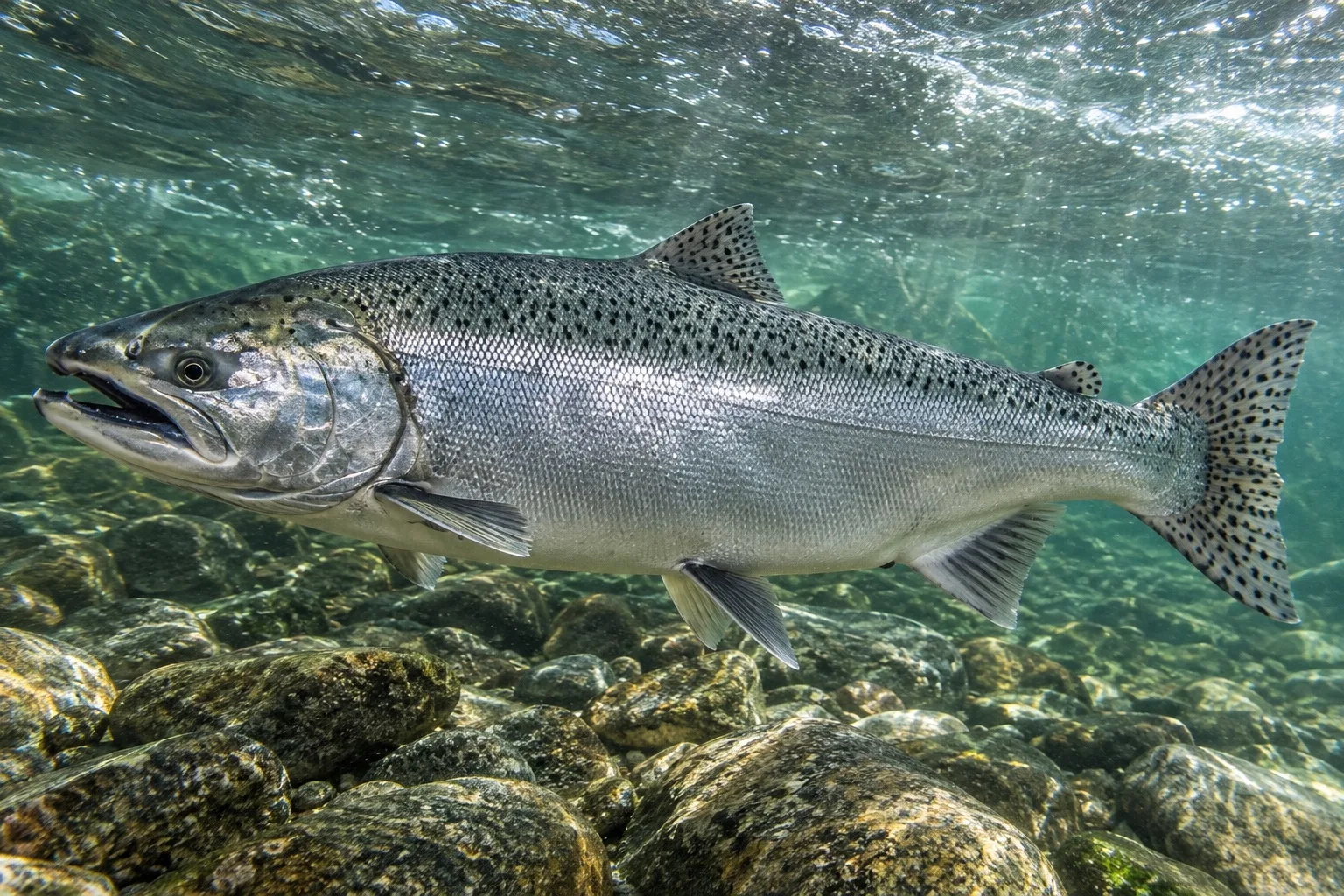
NOAA Fisheries lists several stocks on the US West Coast as threatened or endangered under the Endangered Species Act; for Alaska this applies to no stock. In Alaska the authority can close fisheries at short notice during the season; a closed water is then also off limits for catch and release. In 2026 this affected, for example, the Kenai River from the mouth to Skilak Lake and the upper Cook Inlet north of Bluff Point, both from 1 May to 15 August; on the Kasilof only hatchery king salmon could be kept (as of October 2026).
 Choose another fish117 fish with guides
 EelOff-peak season
 EelpoutPossible
 IdePossible
 ArapaimaGood
 GraylingPeak season
 Atlantic salmonSpawning time, please spare
 Brown troutSpawning time, please spare
 Brook troutSpawning time, please spare
 BarbelOff-peak season
 BarramundiSpawning season
 Greater amberjackGood
 Topmouth gudgeonOnly as bycatch
 Blue marlinSpawning season
 BonefishSpawning season
 BonitoGood
 BreamOff-peak season
 Dusky grouperOnly as bycatch
 CobiaPossible
 Spiny dogfishOnly as bycatch
 CodPeak season
 ChubPeak season
 MinnowOnly as bycatch
 European sturgeonOnly as bycatch
 FlounderPeak season
 PerchPeak season
 Largemouth bassGood
 Ballan wrasseOnly as bycatch
 Yellowfin tunaSpawning season
 Giant trevallyGood
 Prussian carpPossible
 BrillPossible
 Gilthead breamSpawning time, please spare
 Golden doradoSpawning season
 Golden mahseerOnly as bycatch
 Dolphinfish (mahi-mahi)Good
 Grass carpPossible
 Great barracudaGood
 GudgeonPossible
 White breamPossible
 DaceOff-peak season
 PikePeak season
 HalibutOff-peak season
 HerringPossible
 GarfishOut of season
 Huchen (Danube salmon)Possible
 Crucian carpOnly as bycatch
 CarpOff-peak season
 RuffeOff-peak season
 VendaceOnly as bycatch
 DabPeak season
 GurnardPossible
 Coley (saithe)Peak season
- Chinook salmonHardly any chance
 King mackerelSpawning season
 LingPeak season
 TuskOff-peak season
 MackerelPossible
 Bighead carpOut of season
 WhitefishPossible
 Conger eelOff-peak season
 Sea troutSpawning time, please spare
 Grey mulletPossible
 Murray codSpawning season
 MuskellungeGood
 Common nasePossible
 Nile perchPossible
 PayaraPossible
 Peacock bassPeak season
 PermitGood
 WeeverOnly as bycatch
 PollackOff-peak season
 BurbotOff-peak season
 AspPossible
 Red snapperSpawning season
 Rainbow troutPeak season
 RoosterfishGood
 RoachPeak season
 RedfishOut of season
 Bluefin tunaOnly as bycatch
 RuddPossible
 Russian sturgeonOnly as bycatch
 HaddockOff-peak season
 SnakeheadPossible
 TenchOff-peak season
 SpirlinOnly as bycatch
 PlaiceOff-peak season
 Greenland halibutOnly as bycatch
 Round gobyOnly as bycatch
 SwordfishGood
 Lake troutSpawning time, please spare
 HakeSpawning time, please spare
 Alpine charSpawning time, please spare
 MonkfishPossible
 SoleOff-peak season
 SailfishGood
 Silver carpOut of season
 SnookPeak season
 PumpkinseedOnly as bycatch
 SpratOnly as bycatch
 Atlantic wolffishSpawning time, please spare
 TurbotPeak season
 SterletOnly as bycatch
 SmeltOnly as bycatch
 Horse mackerelPossible
 TaimenGood
 TarponGood
 TigerfishSpawning season
 BleakPossible
 WahooGood
 Wels catfishOff-peak season
 WhitingPeak season
 Sea bassOff-peak season
 ZanderPeak season
 White-eye breamOnly as bycatch
 Blue breamOnly as bycatch
 Brown bullheadPossible
 VimbaOnly as bycatch
Season in October according to the catch calendar, an estimate and not a guarantee of a catch. The fish pictures are reduced natural-history plates and AI-generated.
Best time
In June.
In January: Hardly any chanceIn February: Hardly any chanceIn March: Hardly any chanceIn April: Hardly any chanceIn May: GoodIn June: Peak seasonIn July: Good, spawningIn August: Good, spawningIn September: Possible, spawningIn October: Hardly any chanceIn November: Hardly any chanceIn December: Hardly any chance
Good spot
- Coast: Open and deep waterOpen and deep waterOpen and deep waterOpen and deep water
- River: current edge and main currentcurrent edge and main currentcurrent edge and main currentcurrent edge and main current
Starter tackle
- Rod: 2,6–2,7 m for 20–30 lb line and 2–6 oz weight; in the north of Southeast Alaska also 2,1–2,7 m for up to 8 oz; with a flasher and no downrigger long enough to leave room for 1,5–1,8 m of flasher leader plus the bait section
- Line: monofilament, 15–40 lb (about 7–18 kg); with a flasher or dodger at least 30 lb (about 14 kg)
- Hook: two hooks tied in tandem, 2/0–5/0, matched to the length of the herring
- Rod: 2,1–2,6 m, power medium heavy to extra heavy, action medium to fast, for 15–30 lb line
- Line: 15–30 lb (about 7–14 kg), monofilament, braided or fluorocarbon; for big chinooks in Washington 20–25 lb (about 9–11 kg)
- Hook: single hooks or pinched-down barbs if you want to release
- Rod: 2,6–2,7 m, extra heavy
- Line: 40–60 lb (about 18–27 kg), monofilament or braided
In short
In short: According to the catch calendar the best time is June. Good spots on the coast: open and deep water; in the river: current edge and main current. Proven baits: trolled herring, octopus imitations, crankbaits, spoons and spinners, in the river also salmon eggs and flies. The largest Pacific salmon, with black gums and spots on both lobes of the tail. In Alaska a King Salmon Stamp is required in addition to the fishing licence.
Quick to recognise
The largest Pacific salmon, called chinook or king salmon in North America. You can identify it reliably by the black gums and the spots on both tail lobes. Fish ready to spawn usually measure around 90 centimetres at roughly 14 kilograms.
When
In Alaska the peak season is June; May, July and August are also good. The fish mostly run up there from May to July, and for trolling in the eddies inland the authority recommends July. Spawning runs from summer into early autumn, after which all king salmon die.
- JanHardly any chance
- FebHardly any chance
- MarHardly any chance
- AprHardly any chance
- MayGood
- JunPeak season
- JulGood, spawning
- AugGood, spawning
- SepPossible, spawning
- OctHardly any chance
- NovHardly any chance
- DecHardly any chance
Peak seasonGoodPossibleHardly any chanceSpawning season
Season in the destination
In Southeast Alaska, large king salmon ready to spawn travel along the coast from late April to June, and the best time there is from late May to late June; near Ketchikan the peak is in June. In July and August fishing at sea stays good, even if catch rates fall, and around Sitka immature feeders still pass through in August and September. In the rivers of the Kenai Peninsula the early run lasts from late May into June, and a late one follows in July. Because of weak stocks, many stretches there were recently closed completely; in 2026 this applied, for example, to the Kenai River from 1 May to 15 August, even for catch and release (as of October 2026). High, muddy water clearly lowers the prospects in the river.
Season and biting time
In January: Hardly any chanceIn February: Hardly any chanceIn March: Hardly any chanceIn April: Hardly any chanceIn May: GoodIn June: Peak seasonIn July: SpawningIn August: SpawningIn September: SpawningIn October: Hardly any chanceIn November: Hardly any chanceIn December: Hardly any chance
Where it is now
On the coast
At sea it lives in open water, some fish close to the coast, others far out. Most anglers fish there from a boat; Southeast Alaska and Cook Inlet are heavily fished.
How to go about it: At sea, look for spots where baitfish gather: points jutting into the tidal current with eddies and current edges, plus kelp beds, underwater rocks and bay mouths. On the Kenai Peninsula the fish come close to the shore at high tide, and most are caught there within about 400 metres of the beach.
| All year round | open water, deep water |
|---|
In the river
In the river it no longer feeds during the run. In inland Alaska people troll from a boat in eddies or cast from the bank. The spawning redds lie in rather deep, fast-flowing water.
How to go about it: In the river, running salmon hold at spots with cover and calmer water: in big rivers on inside bends and current edges, in small ones at the tail of a pool above the riffle. From the boat you troll big crankbaits backwards through the eddies; from the bank you cast spoons and spinners.
| All year round | current seam, main current |
|---|
Holding spots in the picture
Choose a season and time of day: the picture shows where the species sits then. Tap a fish or a spot in the list to bring it closer. The picture is schematic and AI-generated, every water is different.
Chance of a catch in springslim
Chance of a catch in summergoodSpawning, observe the closed seasons
Catch chance in autumnhardly any
Catch chance in winterhardly any
- J
- F
- M
- A
- M
- J
- J
- A
- S
- O
- N
- D
Spawning season
On the coast
Deep, colder water
The king salmon (chinook) is found here all year round.
Open water, mid-water
The king salmon (chinook) is found here all year round.
At sea the king salmon lives in open water and eats herring, sand lance, squid and crustaceans. Some fish stay near the coast, others travel far out. Fishing is done mainly from a boat, for example in Southeast Alaska and in Cook Inlet.
Spring: catch chance according to the catch calendar hardly any in March and April, good in May.
Summer: catch chance according to the catch calendar peak season in June, good in July and August. Spawning falls in this period, observe closed seasons.
Autumn: catch chance according to the catch calendar possible in September, hardly any in October and November.
Winter: catch chance according to the catch calendar hardly any.
In the river
Current seam
The king salmon (chinook) is found here all year round.
Free current in mid-river
The king salmon (chinook) is found here all year round.
To spawn it runs up into its home river, in Alaska mostly from May to July, and no longer feeds there. In inland Alaska people troll in eddies or cast from the bank. The spawning redds lie in rather deep, fast-flowing water.
Spring: catch chance according to the catch calendar hardly any in March and April, good in May.
Summer: catch chance according to the catch calendar peak season in June, good in July and August. Spawning falls in this period, observe closed seasons.
Autumn: catch chance according to the catch calendar possible in September, hardly any in October and November.
Winter: catch chance according to the catch calendar hardly any.
Depth: At sea, baits for king salmon are fished deeper and more slowly than for coho. With mooching you can search several depths in turn.
Size comparison: AI-generated drawing, schematic.
How
At sea you troll a prepared herring slowly and deep, or let the current move it while mooching as the boat drifts or lies at anchor. In inland Alaska you cast spoons, spinners and crankbaits from the bank in the river, or troll big crankbaits backwards through the eddies from a boat.
Easiest way
Without your own boat, a river is the easiest way in. Take a sturdy spinning rod of 2,1 to 2,6 metres with 15 to 30 pound line and cast a spoon or a spinner of size 5 to 6 from the bank. On busy Alaskan rivers the early morning hours are best. Check the emergency orders beforehand to see whether your river is open for king salmon at all.
Trolling with herring
The usual method at sea off Alaska and Washington: a spinning herring, often behind a flasher, is trolled slowly and deep from a moving boat.
- Find the baitfish
Use the echo sounder to look for shoals of herring or sand lance, and the king salmon are usually close by. Diving seabirds and circling gulls give such shoals away from a long way off.
- Prepare the herring
Cut the head off at an angle, angled in two directions, or cut a narrow strip from the flank. The bait has to spin in the water; how fast is secondary.
- Flasher and leader
Between the flasher and the herring there is usually 70 to 80 centimetres of leader for king salmon. With a downrigger and a quick-release clip there is no heavy weight on the rod, which makes the fight easier.
- Slow and deep
Troll more slowly than for coho, below about 3 km/h, and keep the bait close to the bottom, ideally by kelp beds and underwater rocks. You set the depth with the weight and the amount of line let out.
- Remember the depth
If you count the line out in pulls of equal length, you can bring every bait back to exactly that depth after a bite. A diver flips over at the bite and then hardly pulls at all.
- Make room
Once a fish is hooked, the other rods come in and the boat keeps its distance from the neighbours. Play the salmon with steady pressure, without wearing it out completely.
- Unhook in the water
If the fish is to go back, it stays in the water. Hold it around the body and remove the hook with long needle-nose pliers, keeping your fingers away from the gills.
Spoons and spinners in the river
From the bank for running king salmon, as long as the river is not high and muddy.
- Read the resting spots
Running salmon take the easiest route with cover: deep channels, logs, big rocks, foaming water. In small rivers they rest at the end of a pool just before the next riffle.
- Swivel and bait
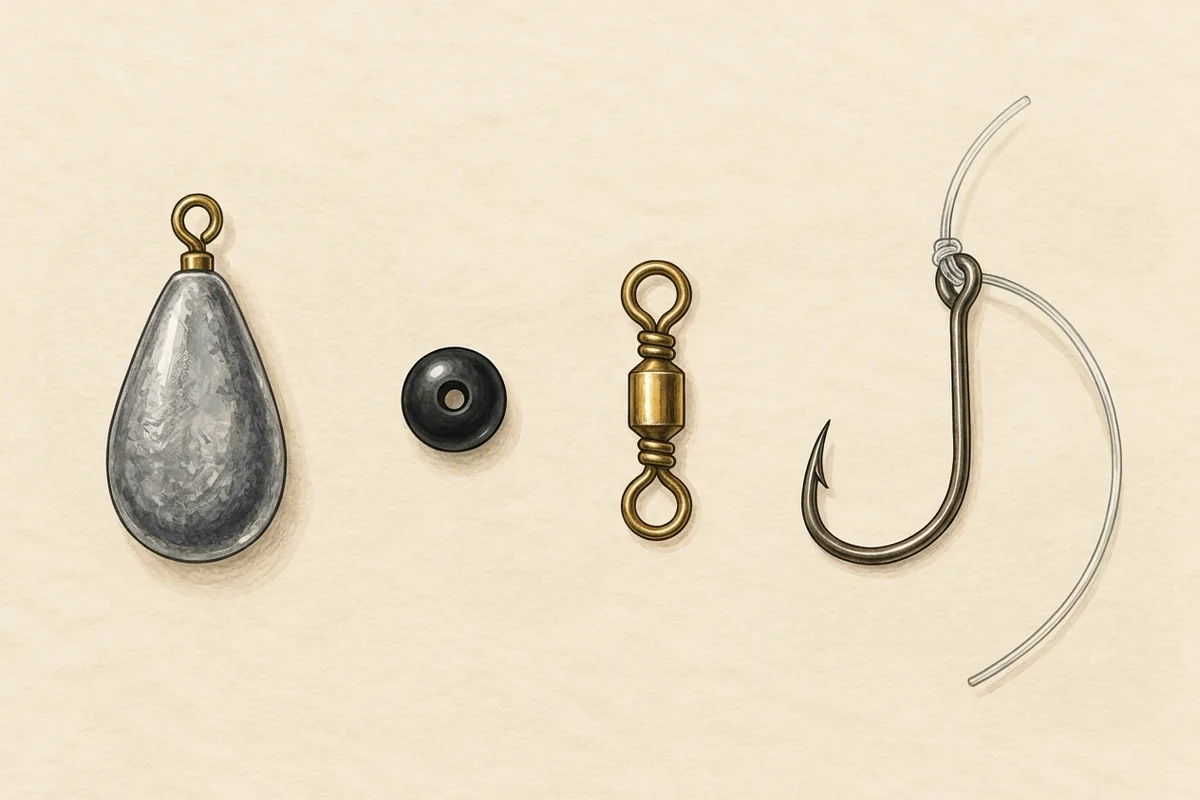
Tie a snap swivel to the main line and clip on a spoon of about 14 to 25 grams or a spinner of size 5 to 6. Slip weights take the bait deeper when needed.
- Angled upstream
Cast at an angle of 30 to 45 degrees upstream. Work the pool from your bank to the far bank and from the top end to the bottom end.
- Drift with the current
Let the bait tap along the bottom, roughly as fast as the current, and retrieve only slowly until the line points downstream at the same angle. Then the next cast begins.
- Bite or rock
At first a bite is hard to tell from a snag. With practice you feel when to strike and when to ease the bait gently off a rock.
- Keep it short
Bring the fish in as quickly as possible. A salmon played to exhaustion has too little strength left for spawning afterwards.
- Head upstream
Remove the hook in the water with long pliers. Then hold the salmon loosely in your hand, head into the current, until it swims off on its own.
Plunking with a crankbait
Sitting in wait on the migration route of big rivers such as the Columbia: a weight holds the rig in place and the current makes a plug work.
- Choose the migration route
On big rivers, sit at an inside bend that the fish have to swing round. When the water is high, fish the margins where the current is not too strong.
- Sliding swivel and side arm
Thread on a sliding swivel and four to six beads, followed by a swivel with 1,2 to 1,8 metres of leader to the plug. The weight hangs on a thinner side arm of 45 to 75 centimetres.
- Set up the plug
Test the plug by pulling it against the current. If it veers to the left, turn the eyelet clockwise; if it veers to the right, the other way round. On the Columbia it is often wrapped with a small piece of fish fillet.
- Let it down with the current
Let the rig drift downstream until the weight lies firmly on the bottom and the plug still wobbles from side to side. The rod goes into a rod rest.
- Let the rod work
Do not strike at the first tug. Only when the fish has pulled the rod tip down to the surface at least three times do you pick up the rod and wind.
- Bring it in quickly
Bring the salmon in quickly with strong tackle rather than holding it in the current for long.
- Unhooking gently
If you want to release the fish, leave it in the water and never reach under the gill covers. If the hook is too deep, cut the line close to the hook.
What with
At sea, prepared herring is the most important bait, and it is trolled more slowly and deeper than for coho. In rivers, plugs, spoons and spinners are cast or trolled.
- Baitfishat sea, all season
According to the fisheries authority in Sitka (Fischereibehörde), herring is the best bait for king salmon, so many anglers leave artificial lures alone altogether.
- Spoonin rivers on the run upstream, at sea also behind the flasher
According to the authority in Alaska, a conspicuously shiny spoon will also make running king salmon bite.
- Spinnerin rivers from the bank, in estuaries when trolling
The authority’s tackle guide in Alaska lists spinners in sizes 5 to 6 for king salmon in rivers; in Washington they are also trolled in tidal waters.
Tackle
A boat rod for trolling and mooching at sea, a spinning rod for casting in rivers. For line, the authority in Alaska gives a breaking strain of 15 to 40 pounds.
Trolling with herring
- Rod
- 2,6–2,7 m for 20–30 lb line and 2–6 oz of weight; in the north of Southeast Alaska also 2,1–2,7 m for up to 8 oz; with a flasher and no downrigger, long enough to have room for 1,5–1,8 m of flasher leader plus the bait section
- Reel
- Multiplier reel with level wind; a heavy fixed-spool reel at a pinch
- Line
- monofilament, 15–40 lb (about 7–18 kg); with a flasher or dodger at least 30 lb (about 14 kg)
- Leader
- behind the flasher, depending on its size, 26–72 inches (about 65–185 cm), in Sitka usually 28–32 inches (about 70–80 cm)
- Hooks
- two hooks tied in tandem, 2/0–5/0, matched to the length of the herring
- Weight, float, lead
- trolling weight 2–8 oz (about 55–230 g); with a flasher and no downrigger 12–32 oz (about 340–900 g)
Spoons and spinners in the river
- Rod
- 2,1–2,6 m, power medium heavy to extra heavy, action medium to fast, for 15–30 lb line
- Reel
- matched to the rod and rated for the same line strength
- Line
- 15–30 lb (about 7–14 kg), monofilament, braid or fluorocarbon; for big Chinook in Washington 20–25 lb (about 9–11 kg)
- Hooks
- single hooks or crimped barbs if you want to release the fish
- Weight, float, lead
- Spoon ½–⅞ oz (about 14–25 g), spinner size 5–6; slip weight to suit the current
Plunking with a crankbait
- Rod
- 2,6–2,7 m, extra heavy
- Line
- 40–60 lb (about 18–27 kg), monofilament or braid
- Leader
- 1,2–1,8 m of monofilament at 40–60 lb; weight side arm 45–75 cm at about 15 lb (around 7 kg)
- Weight, float, lead
- weight 1–8 oz (about 28–230 g), depending on the current
Common mistakes
- Trolling too fast and too shallow: What suits coho is often too fast for king salmon. Go slower than about 3 km/h and bring the bait close to the bottom.
- The herring does not spin: Every herring bait is designed to spin. Cut the head off at an angle in two directions or use a mitre box so that the angle is right.
- The line is vertical when mooching: Then the leader wraps around the main line. Keep a line angle of about 45 degrees, with a heavier or lighter weight or a little help from the motor.
- Striking too early when plunking: The authority in Washington advises leaving the rod in the rest until the fish has pulled the tip down to the water at least three times. Only then do you wind.
- Lifting the fish out for a photo: In some Alaskan fisheries a king salmon lifted out of the water already counts as kept. Take pictures while it is in the water.
Rules
For king salmon, the rules of the country where you fish apply, not the German fisheries laws. Each country, and often each water, sets its own licence, closed seasons (Schonzeit), minimum sizes (Mindestmaß) and rules on keeping fish.
What the profile says: The largest Pacific salmon, with black gums and spots on both lobes of the tail fin. In Alaska you need a King Salmon Stamp in addition to the angling licence. The authority closes waters at short notice too; in 2026, for example, the Kenai River and upper Cook Inlet from May to mid-August, including for catch and release.
The fisheries authority (Fischereibehörde) of the country you travel to is what counts. Ask about the current rules before the trip and read in the profile how threatened the species is.
After the catch
Playing and landing
Play the king salmon briskly, because a completely exhausted fish has no strength left for the run upstream and spawning. If it is to go back, fish with single hooks or crimped barbs, leave it in the water and never reach under the gill covers, because damaged gill arches almost always end in death. Hold it gently around the body, remove the hook with long needle-nose pliers or, if it is deep, cut the line, and hold the fish head upstream until it swims away. The country where you fish sets the rules, licence and what you may keep.
For release you use single hooks or crimp the barbs, play the fish briskly and leave it in the water without reaching under the gill covers. If the hook is lodged firmly, you cut the line close to it and hold the salmon with its mouth facing upstream until it swims off under its own power.
Frequently asked questions
Which line for king salmon?
For trolling at sea, the fisheries authority of Alaska gives a breaking strain of 15 to 40 pounds, at least 30 pounds with a flasher. In rivers 15 to 30 pounds is enough; for big fish Washington recommends 20 to 25 pounds.
How deep do you troll for king salmon?
Deeper than for coho, often close to the bottom. If the echo sounder shows fish or shoals of baitfish, you set the baits to their depth; otherwise the bottom is always a good choice for king salmon.
What is mooching in salmon fishing?
You fish with lighter tackle from an anchored, drifting or very slowly moving boat, and a banana-shaped weight pulls the herring down. Because you cover so many depths, it is regarded in Sitka as particularly effective for big king salmon in high summer.
When is the best time for king salmon in Alaska?
In the southeast from late May to late June, on the rivers of the Kenai Peninsula from late May if they are open; in 2026 the Kenai River stayed closed for king salmon. At sea off the Kenai Peninsula you do better at high tide, on the rivers usually early in the morning.
Which bait for king salmon in rivers?
Spoons, spinners and plugs trolled backwards are usual, along with floating drift lures. Whether natural baits such as salmon eggs are allowed is set by the country where you fish.
How long is the leader behind the flasher for king salmon?
In Sitka usually 28 to 32 inches, so about 70 to 80 centimetres. Washington gives 26 to 72 inches depending on flasher size and bait; with a bigger flasher the leader gets longer.
Similar species
If you catch king salmon, you can fish for these species with similar tackle:
Sources
As of October 2026. The practical knowledge comes from 11 sources, summarised in our own words.
See all 11 sources
- Marine salmon fishing (Sitka area) · Alaska Department of Fish and Game, Division of Sport Fish
- Fishing in northern Southeast Alaska: Salmon · Alaska Department of Fish and Game, Division of Sport Fish
- Fishing in the Ketchikan area: Salmon · Alaska Department of Fish and Game, Division of Sport Fish
- Kachemak Bay (Kenai Peninsula Recreational Fishing Series) · Alaska Department of Fish and Game, Division of Sport Fish
- The Central Kenai Peninsula saltwater and freshwater fisheries (Recreational Fishing Series) · Alaska Department of Fish and Game, Division of Sport Fish
- King Salmon: River Spin Fishing Setup · Alaska Department of Fish and Game, Division of Sport Fish
- Roadside Salmon Fishing in the Tanana River Drainage · Alaska Department of Fish and Game, Division of Sport Fish
- Salmon fishing in marine areas · Washington Department of Fish and Wildlife
- Freshwater salmon fishing · Washington Department of Fish and Wildlife
- Salmon fishing in estuaries and tidewater · Washington Department of Fish and Wildlife
- Emergency Orders 2026: Kenai River king salmon closed (EO 2-KS-1-7-26, 2-KS-1-8-26) und Cook Inlet saltwater (EO 2-KS-7-5-26) · Alaska Department of Fish and Game, Division of Sport Fish (09,02,2026)
Text produced with AI assistance, based on the sources named and these pages: King salmon (profile), Sea fishing, Spinning, Spoons, Releasing a fish.