
Knowledge – Fish
Snook fishing
Fishing for snook means fishing right up against mangrove roots, bridge pilings and current edges and pulling the fish out of cover before it gets back to it. Here is the way there in nine steps, each with a link to the detailed page.
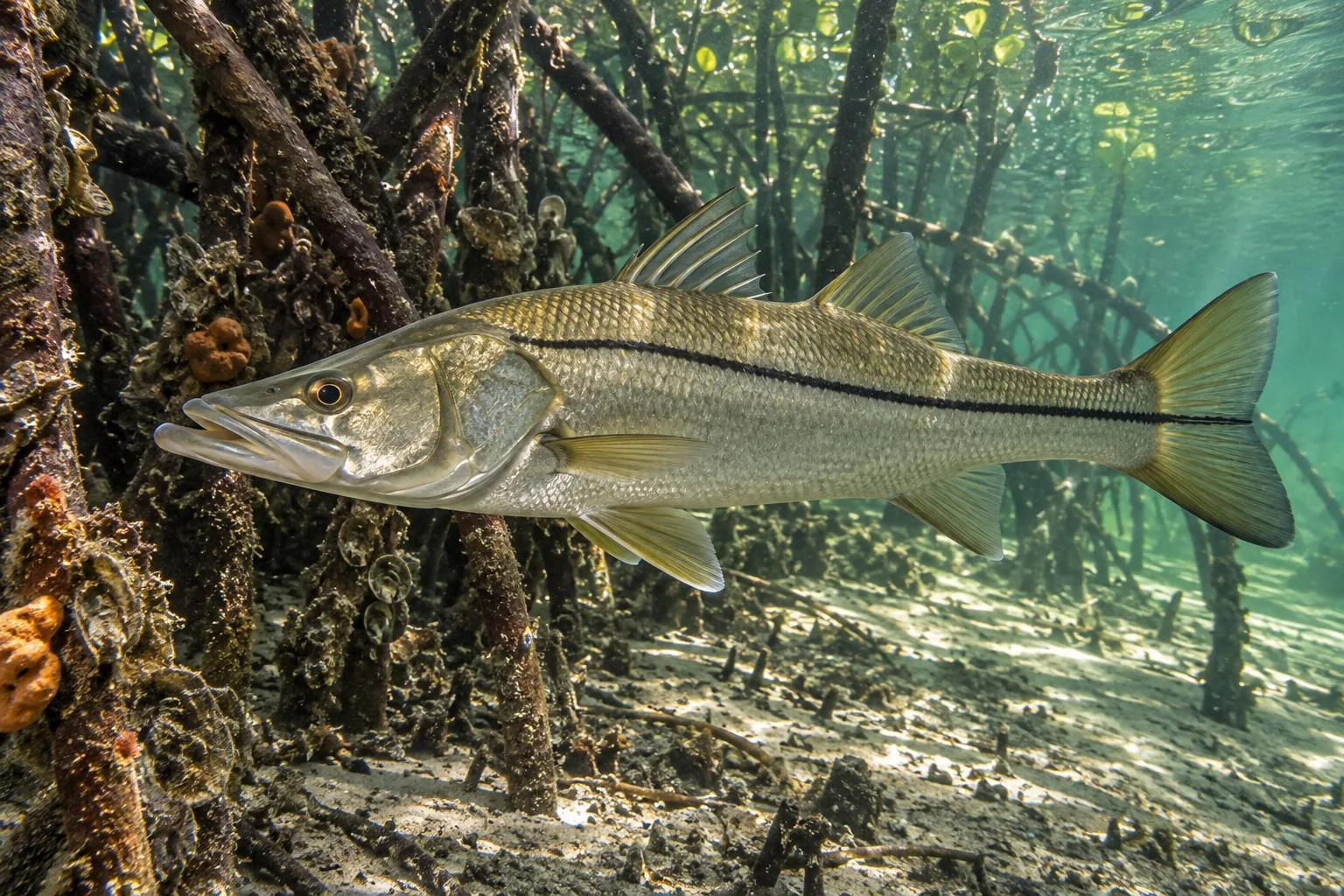
Florida lists the snook as a protected species, and buying and selling it is prohibited. Harvest is regulated by region (as of October 2026): on the Atlantic coast it is closed from 1 June to 31 August and from 15 December to 31 January, on the Gulf coast from 1 May to 31 August and from 1 December to the end of February; in the Charlotte Harbor and Southwest regions it is open only in March, April, October and November. With a Snook Permit you may keep one fish per day within the harvest slot, on the Atlantic coast 28 to 32 inches in length (71 to 81 cm), on the Gulf coast 28 to 33 inches in length (71 to 84 cm).
 Choose another fish117 fish with guides
 EelOff-peak season
 EelpoutPossible
 IdePossible
 ArapaimaGood
 GraylingPeak season
 Atlantic salmonSpawning time, please spare
 Brown troutSpawning time, please spare
 Brook troutSpawning time, please spare
 BarbelOff-peak season
 BarramundiSpawning season
 Greater amberjackGood
 Topmouth gudgeonOnly as bycatch
 Blue marlinSpawning season
 BonefishSpawning season
 BonitoGood
 BreamOff-peak season
 Dusky grouperOnly as bycatch
 CobiaPossible
 Spiny dogfishOnly as bycatch
 CodPeak season
 ChubPeak season
 MinnowOnly as bycatch
 European sturgeonOnly as bycatch
 FlounderPeak season
 PerchPeak season
 Largemouth bassGood
 Ballan wrasseOnly as bycatch
 Yellowfin tunaSpawning season
 Giant trevallyGood
 Prussian carpPossible
 BrillPossible
 Gilthead breamSpawning time, please spare
 Golden doradoSpawning season
 Golden mahseerOnly as bycatch
 Dolphinfish (mahi-mahi)Good
 Grass carpPossible
 Great barracudaGood
 GudgeonPossible
 White breamPossible
 DaceOff-peak season
 PikePeak season
 HalibutOff-peak season
 HerringPossible
 GarfishOut of season
 Huchen (Danube salmon)Possible
 Crucian carpOnly as bycatch
 CarpOff-peak season
 RuffeOff-peak season
 VendaceOnly as bycatch
 DabPeak season
 GurnardPossible
 Coley (saithe)Peak season
 Chinook salmonHardly any chance
 King mackerelSpawning season
 LingPeak season
 TuskOff-peak season
 MackerelPossible
 Bighead carpOut of season
 WhitefishPossible
 Conger eelOff-peak season
 Sea troutSpawning time, please spare
 Grey mulletPossible
 Murray codSpawning season
 MuskellungeGood
 Common nasePossible
 Nile perchPossible
 PayaraPossible
 Peacock bassPeak season
 PermitGood
 WeeverOnly as bycatch
 PollackOff-peak season
 BurbotOff-peak season
 AspPossible
 Red snapperSpawning season
 Rainbow troutPeak season
 RoosterfishGood
 RoachPeak season
 RedfishOut of season
 Bluefin tunaOnly as bycatch
 RuddPossible
 Russian sturgeonOnly as bycatch
 HaddockOff-peak season
 SnakeheadPossible
 TenchOff-peak season
 SpirlinOnly as bycatch
 PlaiceOff-peak season
 Greenland halibutOnly as bycatch
 Round gobyOnly as bycatch
 SwordfishGood
 Lake troutSpawning time, please spare
 HakeSpawning time, please spare
 Alpine charSpawning time, please spare
 MonkfishPossible
 SoleOff-peak season
 SailfishGood
 Silver carpOut of season
- SnookPeak season
 PumpkinseedOnly as bycatch
 SpratOnly as bycatch
 Atlantic wolffishSpawning time, please spare
 TurbotPeak season
 SterletOnly as bycatch
 SmeltOnly as bycatch
 Horse mackerelPossible
 TaimenGood
 TarponGood
 TigerfishSpawning season
 BleakPossible
 WahooGood
 Wels catfishOff-peak season
 WhitingPeak season
 Sea bassOff-peak season
 ZanderPeak season
 White-eye breamOnly as bycatch
 Blue breamOnly as bycatch
 Brown bullheadPossible
 VimbaOnly as bycatch
Season in October according to the catch calendar, an estimate and not a guarantee of a catch. The fish pictures are reduced natural-history plates and AI-generated.
Best time
In April and in October.
In January: PossibleIn February: PossibleIn March: GoodIn April: Peak seasonIn May: Good, spawning seasonIn June: Good, spawning seasonIn July: Good, spawning seasonIn August: Good, spawning seasonIn September: Good, spawning seasonIn October: Peak seasonIn November: GoodIn December: Possible
Good spot
- Coast: surf, seagrass and wreck, reefsurf, seagrass and wreck, reefsurf, seagrass and wreck, reefsurf, seagrass and wreck, reef
- River: undercut bank, riprap and current edgeundercut bank, riprap and current edgeundercut bank, riprap and current edgeundercut bank, riprap and current edge
Starter tackle
- Rod: long, strong rod with which you can present the bait right up against pilings
- Line: strong enough to land the fish quickly away from the structure
- Hook: circle hook with no offset, not stainless steel, barb pinched down
In short
In short: According to the catch calendar the best time is April and October. Good spots on the coast: surf, seagrass and wreck, reef; in the river: undercut bank, riprap and current edge. Proven baits: baitfish, prawns and crabs, and lures that imitate them. Sensitive to cold: cold snaps can kill many snook in Florida. For keeping fish, Florida has regional closed seasons and harvest slots, and a snook permit is also required.
Quick to recognise
A slender predator with a sloping forehead, a protruding lower jaw and a deep black lateral line that stands out sharply against the pale flank. Around 50 centimetres is usual; FishBase gives up to 140 centimetres.
When
In Florida he is caught all year round, with the best chances in April and October and clearly worse ones in midwinter. On the Gulf coast most used to be caught in spring and early summer, and on the Atlantic coast many of the fish that were kept came from autumn. From about May to September he spawns at passes and river mouths, as soon as the water reaches around 25 °C.
- JanPossible
- FebPossible
- MarGood
- AprPeak season
- MayGood, spawning
- JunGood, spawning
- JulGood, spawning
- AugGood, spawning
- SepGood, spawning season
- OctPeak season
- NovGood
- DecPossible
Peak seasonGoodPossibleHardly any chanceSpawning season
Season in the destination
In southern Florida you catch snook all year round, best in spring and autumn. Warmth decides: below a water temperature of about 10 degrees it becomes critical for him, and in the cold he seeks out warm spring-fed bays and spring rivers, such as Kings Bay near Crystal River. In Texas he is a tropical visitor that turns up only when the water is warm enough, and he spawns there in June or July at the passes.
Season and biting time
In January: PossibleIn February: PossibleIn March: GoodIn April: Peak seasonIn May: Spawning seasonIn June: Spawning seasonIn July: Spawning seasonIn August: Spawning seasonIn September: Spawning seasonIn October: Peak seasonIn November: GoodIn December: Possible
Where it is now
On the coast
On the coast he sits at beaches, on seagrass beds and at reefs close to the shore. He likes to lie in wait at edges and channels through which the current runs. In summer he gathers at the mouths of the passes.
How to go about it: On the coast adult snook sit at passes, beaches, reefs close to the shore, seagrass beds and mangroves. You find particularly many of them at pilings, jetties and other fixed structures under the water.
| All year round | surf, seagrass, wreck, reef, gully in front of the sandbank |
|---|
In the river
He is most common at mangroves and in river mouths, and from there he moves up into fresh water. Cast right up against roots and bankside wood, bridge pilings, riprap and current edges.
How to go about it: Snook travel far up the rivers and sometimes into lakes, but never stay far from salt water. In winter many seek out the warm outflows from springs.
| All year round | undercut bank, riprap, current edge |
|---|
Holding spots in the picture
Choose a season and time of day: the picture shows where the species sits then. Tap a fish or a spot in the list to bring it closer. The picture is schematic and AI-generated, every water is different.
Chance of a catch in springgood
Chance of a catch in summergoodSpawning, observe the closed seasons
Catch chance in autumngood
Catch chance in winterpossible
- J
- F
- M
- A
- M
- J
- J
- A
- S
- O
- N
- D
Spawning season
On the coast
Surf close to the shore
Snook (robalo) is found here all year round.
gully in front of the sandbank
Snook (robalo) is found here all year round.
Seagrass, gravel and stones in the shallows
Snook (robalo) is found here all year round.
Wreck, reef
Snook (robalo) is found here all year round.
Snook sit at beaches, on seagrass beds and at reefs close to the shore. In the spawning season they gather at the mouth of passes. They like to lie in wait at edges where the current runs.
Spring: according to the catch calendar, the chance of a catch is good in March, peak season in April, good in May.
Summer: chance of a catch good according to the catch calendar. This is when spawning falls, so observe the closed seasons.
Autumn: according to the catch calendar, the chance of a catch is good in September, peak season in October, good in November.
Winter: catch chance according to the catch calendar possible.
In the river
Undercut bank, overhanging branches, timber
Snook (robalo) is found here all year round.
riprap, sheet piling, harbour
Snook (robalo) is found here all year round.
Current seam
Snook (robalo) is found here all year round.
The most important habitat is mangroves, and in river mouths snook also move into fresh water. They lie in wait right up against roots, bridge pilings and current edges. Juveniles grow up in shallow, sheltered areas under overhanging bankside vegetation.
Spring: according to the catch calendar, the chance of a catch is good in March, peak season in April, good in May.
Summer: chance of a catch good according to the catch calendar. This is when spawning falls, so observe the closed seasons.
Autumn: according to the catch calendar, the chance of a catch is good in September, peak season in October, good in November.
Winter: catch chance according to the catch calendar possible.
Size comparison: AI-generated drawing, schematic.
How
Offer a live prawn or a small live baitfish right up against pilings, bridge pillars and edges where snook lie in wait for prey. With a long rod you let the bait hang there in clear water.
Easiest way
To start with, a long, strong rod and a live prawn on a circle hook are enough. Let it hang in clear water right up against pilings, bridge pillars or jetties, where snook lie in wait for prey.
Live prawn at pilings
The proven way at structures: a live natural bait presented right up against pilings, pillars and edges where snook wait for prey.
- Look for structure
Adult snook gather at passes and around pilings and other structures under the water. In Texas most are caught in the lower Laguna Madre at exactly such places.
- Circle hook without offset
For natural bait use a circle hook with no offset and not made of stainless steel, and pinch the barb down. It usually catches in the corner of the mouth and is easy to remove.
- Live shrimp
Hook a live prawn. Snook eat fish, prawns and crabs, so a small live baitfish works just as well.
- Let it hang at the piling
With the long rod you let the bait hang in clear water directly along the pilings. That way it stays exactly where the fish lies in wait for prey.
- Hold firm
Snook fight hard. Take tackle strong enough to land the fish quickly away from the pilings; an exhausted fish is more easily taken by predators after release.
- Wet and horizontal
Handle the fish only with wet hands, never with a towel, and support it horizontally if you have to lift it. Turn the hook out the way it went in.
What with
He feeds mainly on small shoaling fish, plus prawns and crabs, so a live prawn, a crab or a small baitfish is a good fit. For natural baits the Florida fisheries authority recommends circle hooks with no offset, and treble hooks on natural baits have been banned there since 1987.
- Crustaceans & musselsall year, at pilings and jetties
Live prawns presented right up against pilings are, according to the Texas fisheries authority, a proven way to catch snook.
- Baitfishat passes and current edges
From a length of about four and a half centimetres snook eat mainly fish, so a small live shoaling fish fits exactly his prey pattern.
- Rubber crabif you want to work pilings and edges with lures
It imitates prawns and crabs, which, alongside fish, make up most of his food.
Tackle
A long, strong rod, because a hooked snook flees straight into cover and has to be got out of it quickly. For line and reel the line calculator and the page on fishing line will help.
Live prawn at pilings
- Rod
- long, strong rod with which you can present the bait right up against pilings
- Line
- strong enough to land the fish quickly away from the structure
- Hooks
- Circle hook with no offset, not stainless steel, barb pinched down
Common mistakes
- Stainless or offset hook: A stainless steel hook does not dissolve in the fish, and an offset one more often ends up in the throat. For natural baits Florida recommends circle hooks with no offset and not made of stainless steel.
- Tackle too light at pilings: A long fight exhausts the fish and makes it easy prey after release. Choose tackle with which you can land it quickly.
- Handling with a towel or dry hands: Both rub off the protective layer of slime. Handle the snook only with wet hands and as little as possible.
- Pulling out a deeply lodged hook: If the hook sits deep in the throat or stomach, cut the line as close to the hook as you can. A hook that is not stainless dissolves over time.
- Simply releasing an exhausted fish: Move it slowly forward with its mouth slightly open so that water flows over the gills. If it does not swim off, bring it back and try again.
Rules
For snook, the rules of the country where you fish apply, not German fisheries law. Each country, and often each water, sets its own licence, closed seasons, minimum sizes and rules on keeping fish.
What the profile says: Sensitive to cold: cold snaps in Florida can kill many snook. Florida has regional closed seasons and slot limits for keeping fish, and you also need a snook permit.
The fisheries authority (Fischereibehörde) of the country you travel to is what counts. Ask about the current rules before the trip and read in the profile how threatened the species is.
After the catch
Playing and landing
Fight the snook quickly with strong tackle and away from cover so that it is not completely exhausted. Unhook it in the water if you can, handle it only with wet hands and support it horizontally, never with a towel. If the hook is deep, cut the line close to the hook. If it is limp, move it forward until it swims off by itself, and release it head first. The country where you fish sets the rules, licence and rules on keeping fish.
The vast majority of snook in Florida go back into the water, and around two per cent of them do not survive. Keep it in the water and unhook it quickly. After severe cold snaps the fish are weakened, so it is better to leave stressed snook alone.
Frequently asked questions
Which bait for snook?
Live shrimp are a proven bait, presented close to pilings. Small live fish and crabs also work, because that is what it feeds on.
Which hooks for snook with natural bait?
Circle hooks without an offset and not made of stainless steel, ideally with the barb pressed down. They usually hook in the jaw and come out quickly.
Where are snook in winter?
In the cold they look for warmer water, for example the outflows of springs on Florida’s Nature Coast. Below about 10 degrees it becomes dangerous for them, and cold snaps can kill many fish.
Are there snook in Texas?
Yes, mainly on the lower Gulf coast. They are most often caught in the lower Laguna Madre at pilings and other structure, but only when the water is warm enough.
How do you hold a snook properly?
With wet hands and supported horizontally, if you have to take it out of the water at all. Put it back into the water head first.
Similar species
If you catch snook, you can also fish for these species with similar tackle:
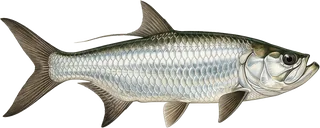 Tarpon fishingGood
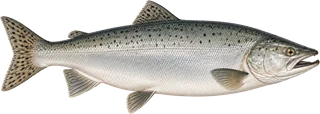 Chinook salmon fishingSlim chances
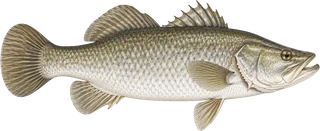 Fishing for barramundiSpawning season
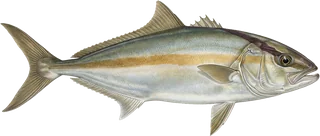 Amberjack fishingGood
Sources
Status: October 2026. The practical knowledge comes from 6 sources, summarised in our own words.
View all 6 sources
- Common Snook (Centropomus undecimalis) · Texas Parks and Wildlife Department
- Fishing – Catch and Release Information (Boating and Angling Guide to the Florida Keys) · Florida Fish and Wildlife Conservation Commission, Fish and Wildlife Research Institute (mit Mote Marine Laboratory)
- Centropomus undecimalis – Common Snook (Discover Fishes) · Florida Museum of Natural History, University of Florida
- Common Snook: New Predators in the Nature Coast · UF/IFAS Nature Coast Biological Station, University of Florida
- SWFWMD, FWC, UF launch shocking snook study in King's Bay · UF/IFAS Nature Coast Biological Station, University of Florida
- Catch and Release · Bonefish & Tarpon Trust
Text AI-assisted, based on the sources named and these pages: Snook (profile), Sea fishing, Releasing fish.