
Knowledge – Fish
Dolphinfish fishing
Catching dolphinfish means this: on the open sea, look for drifting mats of weed and flotsam, troll along their edge and use a hooked fish as a decoy for the school. Here is the way there in nine steps, each with a link to the detailed page.
 Choose another fish117 fish with guides
 EelOff-peak season
 EelpoutPossible
 IdePossible
 ArapaimaGood
 GraylingPeak season
 Atlantic salmonSpawning time, please spare
 Brown troutSpawning time, please spare
 Brook troutSpawning time, please spare
 BarbelOff-peak season
 BarramundiSpawning season
 Greater amberjackGood
 Topmouth gudgeonOnly as bycatch
 Blue marlinSpawning season
 BonefishSpawning season
 BonitoGood
 BreamOff-peak season
 Dusky grouperOnly as bycatch
 CobiaPossible
 Spiny dogfishOnly as bycatch
 CodPeak season
 ChubPeak season
 MinnowOnly as bycatch
 European sturgeonOnly as bycatch
 FlounderPeak season
 PerchPeak season
 Largemouth bassGood
 Ballan wrasseOnly as bycatch
 Yellowfin tunaSpawning season
 Giant trevallyGood
 Prussian carpPossible
 BrillPossible
 Gilthead breamSpawning time, please spare
 Golden doradoSpawning season
 Golden mahseerOnly as bycatch
- Dolphinfish (mahi-mahi)Good
 Grass carpPossible
 Great barracudaGood
 GudgeonPossible
 White breamPossible
 DaceOff-peak season
 PikePeak season
 HalibutOff-peak season
 HerringPossible
 GarfishOut of season
 Huchen (Danube salmon)Possible
 Crucian carpOnly as bycatch
 CarpOff-peak season
 RuffeOff-peak season
 VendaceOnly as bycatch
 DabPeak season
 GurnardPossible
 Coley (saithe)Peak season
 Chinook salmonHardly any chance
 King mackerelSpawning season
 LingPeak season
 TuskOff-peak season
 MackerelPossible
 Bighead carpOut of season
 WhitefishPossible
 Conger eelOff-peak season
 Sea troutSpawning time, please spare
 Grey mulletPossible
 Murray codSpawning season
 MuskellungeGood
 Common nasePossible
 Nile perchPossible
 PayaraPossible
 Peacock bassPeak season
 PermitGood
 WeeverOnly as bycatch
 PollackOff-peak season
 BurbotOff-peak season
 AspPossible
 Red snapperSpawning season
 Rainbow troutPeak season
 RoosterfishGood
 RoachPeak season
 RedfishOut of season
 Bluefin tunaOnly as bycatch
 RuddPossible
 Russian sturgeonOnly as bycatch
 HaddockOff-peak season
 SnakeheadPossible
 TenchOff-peak season
 SpirlinOnly as bycatch
 PlaiceOff-peak season
 Greenland halibutOnly as bycatch
 Round gobyOnly as bycatch
 SwordfishGood
 Lake troutSpawning time, please spare
 HakeSpawning time, please spare
 Alpine charSpawning time, please spare
 MonkfishPossible
 SoleOff-peak season
 SailfishGood
 Silver carpOut of season
 SnookPeak season
 PumpkinseedOnly as bycatch
 SpratOnly as bycatch
 Atlantic wolffishSpawning time, please spare
 TurbotPeak season
 SterletOnly as bycatch
 SmeltOnly as bycatch
 Horse mackerelPossible
 TaimenGood
 TarponGood
 TigerfishSpawning season
 BleakPossible
 WahooGood
 Wels catfishOff-peak season
 WhitingPeak season
 Sea bassOff-peak season
 ZanderPeak season
 White-eye breamOnly as bycatch
 Blue breamOnly as bycatch
 Brown bullheadPossible
 VimbaOnly as bycatch
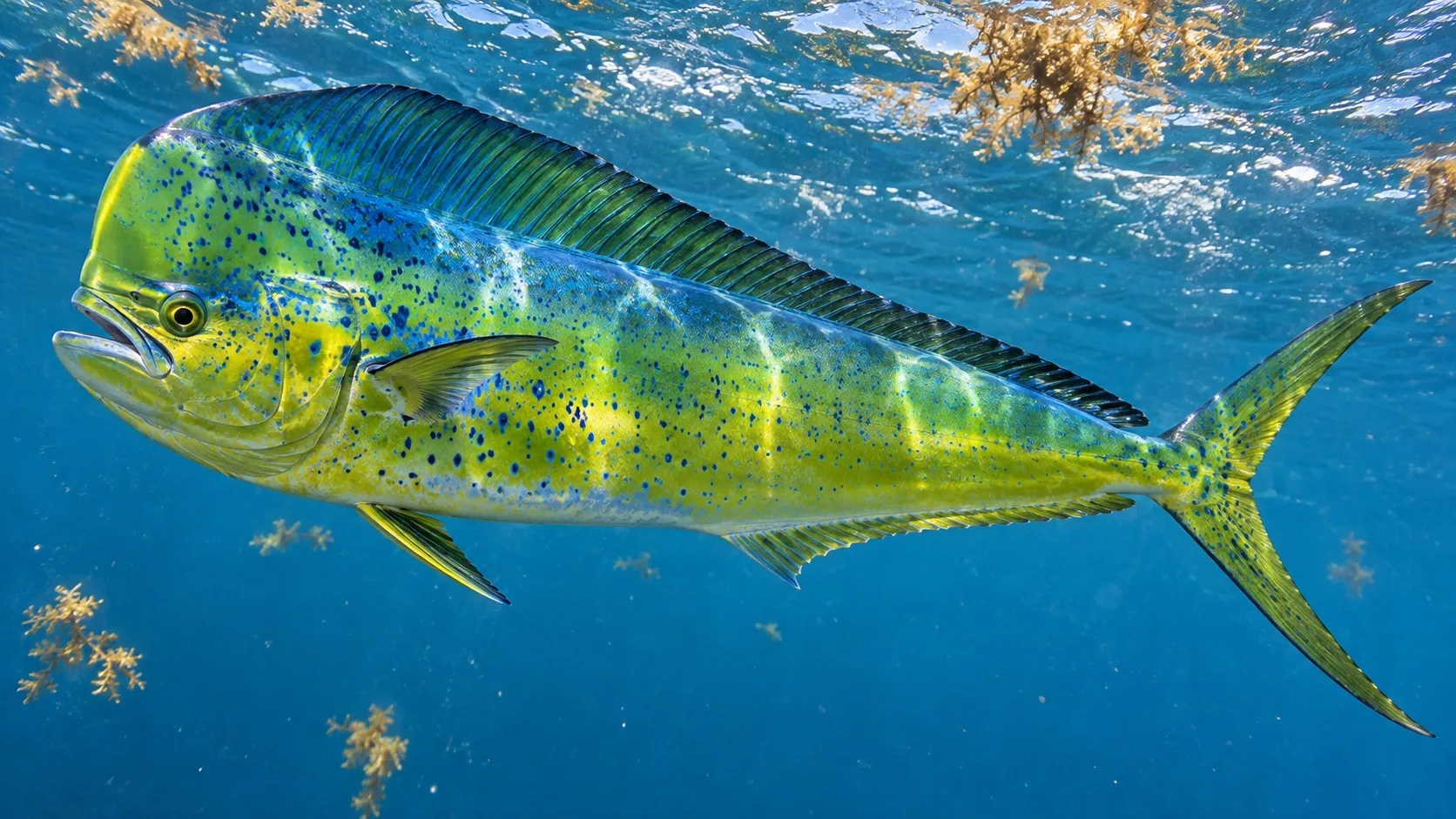
Season in October according to the catch calendar, an estimate and not a guarantee of a catch. The fish pictures are reduced natural-history plates and AI-generated.
Best time
In August, mainly during the day.
In January: PossibleIn February: PossibleIn March: PossibleIn April: PossibleIn May: GoodIn June: Good, spawning seasonIn July: Good, spawning seasonIn August: Peak seasonIn September: GoodIn October: GoodIn November: PossibleIn December: Possible
Good spot
- Coast: just below the surface and open waterjust below the surface and open waterjust below the surface and open waterjust below the surface and open water
Top baits
Starter tackle
- Rod: boat rod for trolling
- Line: monofilament, easy to handle when trolling
- Rod: spinning rod that lets you cast a feather jig accurately to the weed edge
- Line: braid, usual for spinning for offshore sea fish
In short
In short: According to the catch calendar, the best time is August. Good spots on the coast: just below the surface and open water. Proven baits: trolled lures and natural baits. The bright colours fade shortly after capture. Despite the US name dolphin, the dolphinfish is not related to the dolphin, the marine mammal.
Quick to recognise
A colourful offshore fish, called dolphin in the USA and mahi-mahi in the trade, with a single dorsal fin running from the head almost to the tail. Alive, the back shimmers blue-green and the flanks gold, but the colours fade shortly after capture. Adult males have a steep forehead with a bony bump; around 100 centimetres is usual, and FishBase gives up to 210 centimetres and 40 kilograms.
When
In the Gulf Stream off North Carolina, May to October count as good, with August after the spawning season as the peak season; from November to April a catch is only possible. Spawning there takes place in June and July, which is when the warm shelf water brings them closer to land. In the tropics they spawn all year round.
- JanPossible
- FebPossible
- MarPossible
- AprPossible
- MayGood
- JunGood, spawning
- JulGood, spawning
- AugPeak season
- SepGood
- OctGood
- NovPossible
- DecPossible
Peak seasonGoodPossibleHardly any chanceSpawning season
Season in the destination
In the Gulf Stream off North Carolina, May to October is a good time, best in August. When the shallow water over the shelf warms up in summer, dolphinfish swim in to within about 16 kilometres of the beach. In the Florida Current young fish are present all year, most of all in summer, and in the tropics they spawn all year round.
Season and biting time
In January: PossibleIn February: PossibleIn March: PossibleIn April: PossibleIn May: GoodIn June: Spawning seasonIn July: Spawning seasonIn August: Peak seasonIn September: GoodIn October: GoodIn November: PossibleIn December: Possible
Where it sits now
On the coast
It usually stays out on the open sea, but in summer off North Carolina it comes closer to the coast, occasionally to about ten miles off the beach. Drifting mats of sargassum, driftwood and other floating debris give the most away, because it finds cover and food under them. Young fish travel in schools, large ones live alone or in pairs.
How to go about it: Dolphinfish live on the open sea and find shade and food under sargassum, driftwood and other floating objects. Females and smaller males stay mainly with flotsam, large males more in open water. Off North Carolina they come closer to the coast in summer.
| All year round | just below the surface, open water |
|---|
Biting time: mainly during the day. How this looks in the water is shown by the picture of the holding spots just below.
Holding spots in the picture
Choose a season and time of day: the picture shows where the species sits then. Tap a fish or a spot in the list to bring it closer. The picture is schematic and AI-generated, every water is different.
Catch chances in springpossible
Chance of a catch in summergoodSpawning, observe the closed seasons
Catch chance in autumngood
Catch chance in winterpossible
- J
- F
- M
- A
- M
- J
- J
- A
- S
- O
- N
- D
Spawning season
No main time Dolphinfish hunt mainly by day and by sight.
Active time Dolphinfish hunt mainly by day and by sight.
No main time Dolphinfish hunt mainly by day and by sight.
No main time Dolphinfish hunt mainly by day and by sight.
On the coast
Open water, mid-water
Dolphinfish (mahi-mahi) are found here all year round.
Just below the surface
Dolphinfish (mahi-mahi) are found here all year round.
The dolphinfish usually lives on the open sea but occasionally comes closer to the coast. It stays under drifting weed fields, driftwood and other floating objects, where it finds cover and food.
Spring: catch chances according to the catch calendar are possible in March and April, good in May.
Summer: catch chances according to the catch calendar are good in June and July, with August the peak season. The spawning season falls in this period, so observe the closed seasons.
Autumn: catch chance according to the catch calendar good in September and October, possible in November.
Winter: catch chance according to the catch calendar possible.
Depth: They live from the surface down to about 85 metres.
Size comparison: AI-generated drawing, schematic.
How
It is caught mainly by trolling from a boat, on artificial and natural baits. Pull the baits along the edges of the weed mats. In so-called bailing, you leave the first fish on the hook in the water until the rest of the school is at the boat and feeding greedily, and then you can catch more.
Easiest way
To start, you troll small skirted lures or soft plastic octopus lures along a sargassum line or beside floating debris. When the first dolphinfish is hooked, leave it in the water, because it often draws the whole school to the boat.
Trolling along weed lines and flotsam
The most widespread method: artificial and natural baits run behind the boat along drifting sargassum, driftwood and other floating objects.
- Search the weed lines
Currents push the sargassum together into long lines, and small dolphinfish stand in schools in their shade. Experienced anglers work every visible weed line thoroughly.
- Check every piece of flotsam
Dolphinfish are also drawn to driftwood, buoys, fish aggregating devices and even large ships. Under floating objects they find shade and food.
- Small octopus on mono
For dolphinfish a simple trolling lure made from a soft plastic octopus of 15 to 20 centimetres on a mono hooklength of 0.9 to 1.2 millimetres is enough. Crankbaits that tolerate fast speeds catch as well.
- Spread the lines
Run several lines at different distances behind the boat, the outer ones from outriggers so that they don’t tangle.
- Adjust your speed
Boats trolling off Hawaii usually pull artificial lures at 7 to 8.5 knots. For home-made soft plastic octopus lures Blinker gives 6 to 9 knots. With live bait you go much slower.
- Leave the first fish in the water
Don’t haul the first dolphinfish straight aboard. The hooked fish draws its fellows to the boat and puts them in a feeding mood, and then more often bite.
- Plan for jumps
Dolphinfish love to jump during the fight. Large males with the steep bump on the forehead fight particularly hard.
Feather jig at the weed edge
If dolphinfish are visibly holding at the weed or already beside the boat, you cast a feather jig or lure right at the edge of the sargassum.
- Find the school
Young dolphinfish travel in schools of a few to over 50 fish and often hunt in pairs or small groups. Large ones move alone or in pairs.
- Feather jig
Off Texas, anglers catch many small dolphinfish on a feather jig presented at the edge of a dense mat of weed.
- Close to the weed
Cast the lure right at the edge of the sargassum. That is where the fish sit in the shade of the weed.
- Work it in jerks
Work the jig unevenly with short jerks instead of winding it in steadily.
- Keep the school at the boat
Once a fish is hooked, it stays in the water. The others follow it right to the boat and feed greedily, so you can toss them more baits.
- Hold them with fish pieces
Chopped fish pieces thrown overboard keep dolphinfish at the boat. This is also how fishermen fish at FADs in the Pacific, with bait and a hand line.
- Jumper
After the bite, expect many jumps. Even the smaller females put up a strong fight on the hook.
What with
Among offshore trolling lures, skirted heads and fast crankbaits work, as do natural baits. Its diet includes squid, crabs, flying fish and small inhabitants of the sargassum.
- Offshore trolling lureswhen trolling along weed lines and flotsam, large fish farther out
According to the North Carolina fisheries authority (Fischereibehörde), anglers catch dolphinfish mostly by trolling artificial and natural baits, and off Texas large fish often take skirted lures trolled for marlin.
Tackle
A sea rod for trolling from a boat. Choose the reel and line with the line calculator and the page on fishing line.
Trolling along weed lines and flotsam
- Rod
- Boat rod for trolling
- Line
- Monofilament, easy to handle when trolling
- Leader
- Monofilament 0.9 mm (octopus 15 cm) to 1.2 mm (octopus 20 cm), about 2 to 3 m long
- Weight, float, lead
- Soft plastic octopus 15 to 20 cm with a small lead head
Feather jig at the weed edge
- Rod
- Spinning rod that lets you cast a feather jig accurately to the weed edge
- Line
- braid, usual for spinning for offshore fish
Common mistakes
- Landing the first fish at once: That often makes the whole school disappear. Leave the hooked fish in the water, because it keeps the others at the boat.
- Ignoring flotsam: Dolphinfish hold under almost anything that drifts. Run up to every weed line, every piece of driftwood and every buoy you see.
- Looking for big fish only at the weed: Large males live more in open water. Off Texas the big bulls are usually caught far out, often when trolling for marlin.
- Fishing for dolphinfish at night: Dolphinfish hunt mainly by day and by sight. Plan the trip for the daytime; at night they feed at most in bright moonlight.
Rules
For dolphinfish, the rules of the country where you fish apply, not German fisheries law. Each country, and often each water, sets its own licence, closed seasons, minimum sizes and rules on taking fish.
What the species profile says: The bright colours fade shortly after capture. Despite the US name dolphin, the dolphinfish is not related to the dolphin, the marine mammal.
The fisheries authority (Fischereibehörde) of the country you travel to is what counts. Ask about the current rules before the trip and read in the profile how threatened the species is.
After the catch
Playing and landing
Expect many jumps; large males fight particularly hard. In bailing, the hooked fish stays in the water until you have caught the other fish of the school. Fish you are not keeping you unhook quickly, ideally while they are still in the water. The rules, licence and taking of fish are set by the country where you fish.
In the federal waters off the south-east coast of the USA, a dolphinfish that is kept must come ashore with head and fins attached. For landing, unhooking, killing or releasing, the linked fish welfare pages will help.
Frequently asked questions
What is bailing with dolphinfish?
A hooked fish stays in the water and draws the other fish of its school to the boat, where they feed greedily. Then you can offer them more baits and catch several fish one after another.
How fast do you troll for mahi-mahi?
Boats trolling off Hawaii usually pull artificial lures at 7 to 8.5 knots. For home-made octopus lures Blinker gives 6 to 9 knots; with live bait it is slower.
Which baits do you use for dolphinfish?
When trolling, artificial and natural baits, for example skirted lures, small soft plastic octopus lures or crankbaits that tolerate high speeds. At the weed, feather jigs that you work unevenly catch fish.
Where do you find dolphinfish?
Under sargassum, driftwood and other floating objects on the open sea. Off North Carolina they sometimes come to within about 16 kilometres of the coast in summer.
How do you catch big dolphinfish?
Off Texas, fish from about 14 kilograms usually take far out at sea, often when large skirted lures are trolled for marlin. Large ones travel alone or in pairs.
Do dolphinfish bite at night?
Hardly; it feeds mainly by day and finds its prey by sight and the lateral line. In bright moonlight there are hints that it also feeds at night.
Similar species
If you catch dolphinfish, you can use similar tackle for these species too:
 Blue marlin fishingSpawning season
 Yellowfin tuna fishingSpawning season
 Sailfish fishingGood
 Wahoo fishingGood
Sources
As of October 2026. The practical knowledge comes from 10 sources, summarised in our own words.
See all 10 sources
- Dolphinfish (Species Profile) · North Carolina Department of Environmental Quality, Division of Marine Fisheries
- Mahi Mahi (Species Directory, Atlantic) · NOAA Fisheries
- Coryphaena hippurus – Dolphinfish (Discover Fishes) · Florida Museum of Natural History, University of Florida
- Coryphaena hippurus, Common dolphinfish (Species Summary) · FishBase
- Wild Blue Water (Abschnitt Dolphin) · Texas Parks and Wildlife Magazine (Texas Parks and Wildlife Department), L. Bozka
- Großfischköder einfach selber bauen: Big Game zum Spartarif · Blinker (Redaktion)
- Köder beim Hochseeangeln: Erfolg auf hoher See · Blinker (Redaktion)
- Thunfisch angeln im Geschwindigkeitsrausch · Blinker (Redaktion)
- Hawaii Troll Fishery (MMPA List of Fisheries) · NOAA Fisheries
- Trolling for Artisanal Fishers (2nd Workshop on Development and Management of FAD Fishery) · Vanuatu Fisheries Department mit Japan International Cooperation Agency (JICA)
Text AI-assisted, based on the sources named and these pages: Dolphinfish (profile), Sea fishing, Offshore trolling lures, Landing and unhooking a fish.