
Knowledge – Fish
Gurnard fishing
Fishing for gurnard means fishing over sand and gravel with a small natural bait right on the bottom, best in the evening. Here is the way there in nine steps, each with a link to the detailed page.
 Choose another fish117 fish with guides
 EelOff-peak season
 EelpoutPossible
 IdePossible
 ArapaimaGood
 GraylingPeak season
 Atlantic salmonSpawning time, please spare
 Brown troutSpawning time, please spare
 Brook troutSpawning time, please spare
 BarbelOff-peak season
 BarramundiSpawning season
 Greater amberjackGood
 Topmouth gudgeonOnly as bycatch
 Blue marlinSpawning season
 BonefishSpawning season
 BonitoGood
 BreamOff-peak season
 Dusky grouperOnly as bycatch
 CobiaPossible
 Spiny dogfishOnly as bycatch
 CodPeak season
 ChubPeak season
 MinnowOnly as bycatch
 European sturgeonOnly as bycatch
 FlounderPeak season
 PerchPeak season
 Largemouth bassGood
 Ballan wrasseOnly as bycatch
 Yellowfin tunaSpawning season
 Giant trevallyGood
 Prussian carpPossible
 BrillPossible
 Gilthead breamSpawning time, please spare
 Golden doradoSpawning season
 Golden mahseerOnly as bycatch
 Dolphinfish (mahi-mahi)Good
 Grass carpPossible
 Great barracudaGood
 GudgeonPossible
 White breamPossible
 DaceOff-peak season
 PikePeak season
 HalibutOff-peak season
 HerringPossible
 GarfishOut of season
 Huchen (Danube salmon)Possible
 Crucian carpOnly as bycatch
 CarpOff-peak season
 RuffeOff-peak season
 VendaceOnly as bycatch
 DabPeak season
- GurnardPossible
 Coley (saithe)Peak season
 Chinook salmonHardly any chance
 King mackerelSpawning season
 LingPeak season
 TuskOff-peak season
 MackerelPossible
 Bighead carpOut of season
 WhitefishPossible
 Conger eelOff-peak season
 Sea troutSpawning time, please spare
 Grey mulletPossible
 Murray codSpawning season
 MuskellungeGood
 Common nasePossible
 Nile perchPossible
 PayaraPossible
 Peacock bassPeak season
 PermitGood
 WeeverOnly as bycatch
 PollackOff-peak season
 BurbotOff-peak season
 AspPossible
 Red snapperSpawning season
 Rainbow troutPeak season
 RoosterfishGood
 RoachPeak season
 RedfishOut of season
 Bluefin tunaOnly as bycatch
 RuddPossible
 Russian sturgeonOnly as bycatch
 HaddockOff-peak season
 SnakeheadPossible
 TenchOff-peak season
 SpirlinOnly as bycatch
 PlaiceOff-peak season
 Greenland halibutOnly as bycatch
 Round gobyOnly as bycatch
 SwordfishGood
 Lake troutSpawning time, please spare
 HakeSpawning time, please spare
 Alpine charSpawning time, please spare
 MonkfishPossible
 SoleOff-peak season
 SailfishGood
 Silver carpOut of season
 SnookPeak season
 PumpkinseedOnly as bycatch
 SpratOnly as bycatch
 Atlantic wolffishSpawning time, please spare
 TurbotPeak season
 SterletOnly as bycatch
 SmeltOnly as bycatch
 Horse mackerelPossible
 TaimenGood
 TarponGood
 TigerfishSpawning season
 BleakPossible
 WahooGood
 Wels catfishOff-peak season
 WhitingPeak season
 Sea bassOff-peak season
 ZanderPeak season
 White-eye breamOnly as bycatch
 Blue breamOnly as bycatch
 Brown bullheadPossible
 VimbaOnly as bycatch
Season in October according to the catch calendar, an estimate and not a guarantee of a catch. The fish pictures are reduced natural-history plates and AI-generated.
Best time
From May to September, mainly in the evening.
In January: Slim chancesIn February: Slim chancesIn March: Slim chancesIn April: Possible, spawning timeIn May: Good, spawning timeIn June: Good, spawning timeIn July: Good, spawning timeIn August: Good, spawning timeIn September: GoodIn October: PossibleIn November: Slim chancesIn December: Slim chances
Good spot
- Coast: sandy bottom, stony mixed bottom and deep watersandy bottom, stony mixed bottom and deep watersandy bottom, stony mixed bottom and deep watersandy bottom, stony mixed bottom and deep water
Starter tackle
- Rod: light tackle as for plaice fishing; from the shore a light surf, bass or spinning rod
- Line: monofilament of about 0,25 mm; from the shore main line of 6–15 lb (about 2,7–6,8 kg) with a shock leader
- Hook: small, long-shanked sea hooks, size 1–2, or flatfish hooks (Butthaken)
- Rod: jigging rod, 2,70 m, with 7–28 g casting weight
- Line: abrasion-resistant braid, 0,12–0,16 mm
- Hook: offset hook in the soft lure
In short
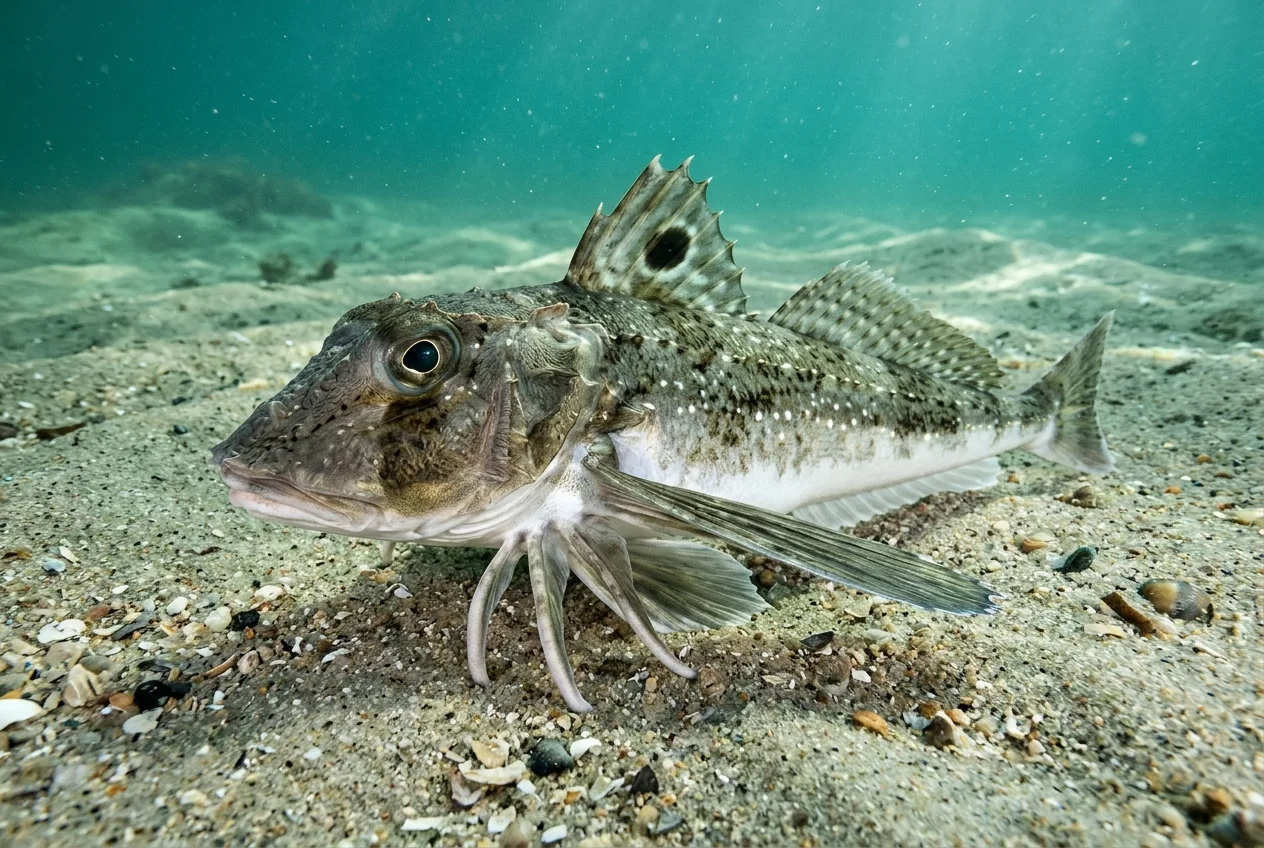
In short: you catch gurnard best from May to September, mainly in the evening. Good spots on the coast: sandy bottom, stony mixed bottom and deep water. Proven baits: lugworm, small pieces of herring or mackerel and shrimps on the bottom, red gurnard occasionally on small pirks. The grey gurnard has a dark spot on its first dorsal fin. The fish make growling sounds with their swim bladder.
Quick to recognise
A bottom fish with an armoured head that feels the ground with free, finger-like pectoral fin rays and growls with its swim bladder. The North Sea is home mainly to the grey and the red gurnard; typically around 30 centimetres, the red can reach over 80.
When
You have good chances from May to September, with July regarded as the peak month; in April and October a catch is possible, and on the British coasts it starts as early as April. When the water cools noticeably in autumn, the fish leave the North Sea. The grey gurnard spawns from April to August, close to the coast.
- JanHardly any chance
- FebHardly any chance
- MarHardly any chance
- AprPossible, spawning season
- MayGood, spawning
- JunGood, spawning
- JulGood, spawning
- AugGood, spawning
- SepGood
- OctPossible
- NovHardly any chance
- DecHardly any chance
Peak seasonGoodPossibleHardly any chanceSpawning season
Spring tactics
In early spring the fish still stay deeper, and attempts from a boat over sandy bottom then have better chances than from the shore. Around the British Isles things get busy earlier than in the North Sea.
Summer tactics
Now the gurnards move into shallow water, and piers, rocks and jetties become interesting. Off the Isle of Wight in mid-June a large red one took a rubber sand eel, and in Dover they are part of the usual summer catch.
Autumn tactics
In Norwegian fjords anglers catch particularly many in autumn, often on twisters. The fish leave the North Sea as soon as the water cools markedly, westwards into the warmer areas around Ireland and Scotland.
Winter tactics
From the German coast gurnards are hardly to be expected now. In the Scottish harbour of Ayr too, the time after Christmas is generally regarded as a dead period.
Is it biting today?
In January: Off seasonIn February: Off seasonIn March: Off seasonIn April: Spawning time, please spare themIn May: Spawning time, please spare themIn June: Spawning time, please spare themIn July: Spawning time, please spare themIn August: Spawning time, please spare themIn September: Shoulder seasonIn October: PossibleIn November: Off seasonIn December: Off season
Today’s catch index needs JavaScript. Season and spawning time are in the catch calendar.
Where it is now
On the coast
Its ground is sand, mud or a mix of sand and gravel; good stocks of the grey gurnard are found around Helgoland and everywhere in the southern North Sea. In summer it comes into the shallows, and then you can reach it from the shore too: at rocks, piers and harbours where the water is not too shallow. In the German Baltic Sea the grey gurnard turns up only as bycatch.
How to go about it: Sand, gravel and mixed bottom are their grounds, in the southern North Sea especially around Helgoland, where gurnards bite from the boat as well as from the piers. In western Norwegian fjords they stand in sandy bays between 25 and 45 m. At British piers such as Blackpool, Dover or Ayr they are part of the usual catch.
| All year round | sandy bottom, stony mixed bottom, deep water |
|---|
Biting time: mainly in the evening. What that looks like on the water is shown by the picture of the holding spots just below.
Holding spots in the picture
Choose a season and time of day: the picture shows where the species sits then. Tap a fish or a spot in the list to bring it closer. The picture is schematic and AI-generated, every water is different.
Catch chance in springpossibleSpawning season, observe closed seasons
Chance of a catch in summergoodSpawning, observe the closed seasons
Catch chance in autumnpossible
Catch chance in winterhardly any
- J
- F
- M
- A
- M
- J
- J
- A
- S
- O
- N
- D
Spawning season
No main time It bites best in the evening, hardly at all in glaring sun.
No main time It bites best in the evening, hardly at all in glaring sun.
Active time It bites best in the evening, hardly at all in glaring sun.
No main time It bites best in the evening, hardly at all in glaring sun.
On the coast
Sandy bottom
Gurnard (grey and red gurnard) is found here all year round.
Stony mixed ground
Gurnard (grey and red gurnard) is found here all year round.
Deep, colder water
Gurnard (grey and red gurnard) is found here all year round.
Gurnards live on sand, mud or mixed bottom of sand and gravel. If you fish for plaice, you often have them on the hook. From the shore you reach them only where the water is reasonably deep.
Spring: chances according to the catch calendar are slim in March, possible in April, good in May. This is the spawning time; observe the closed seasons.
Summer: chances according to the catch calendar are good. This is the spawning time; observe the closed seasons. In summer they come into the shallows, and then it works from the shore too.
Autumn: chances according to the catch calendar are good in September, possible in October, slim in November. When the water cools noticeably in autumn, they leave the North Sea.
Winter: chances according to the catch calendar are slim. In winter gurnards are hardly to be expected on the German North Sea coast; most have withdrawn westwards with the colder water.
Depth: the grey gurnard lives mostly at depths of 10 to 150 metres, in Norway most often in the upper 50 metres.
Size comparison: AI-generated drawing, schematic.
How
Hardly anyone fishes for it on purpose; it usually bites on the side when you go for flatfish or cod, typically when fishing for plaice over sand. If a red gurnard hooks up while you are jigging for cod or pollack, you can switch to natural bait at that spot. The evening hours bring the best bites; on glaring sunny days it goes badly.
Easiest way
The easiest way to catch gurnards is in summer from a pier with deeper water or from a boat over sandy bottom, for example around Helgoland. A light running lead is enough, behind it one or two small hooks of size 1 to 2 and a piece of lugworm. Stay until the evening, when the bites usually pick up.
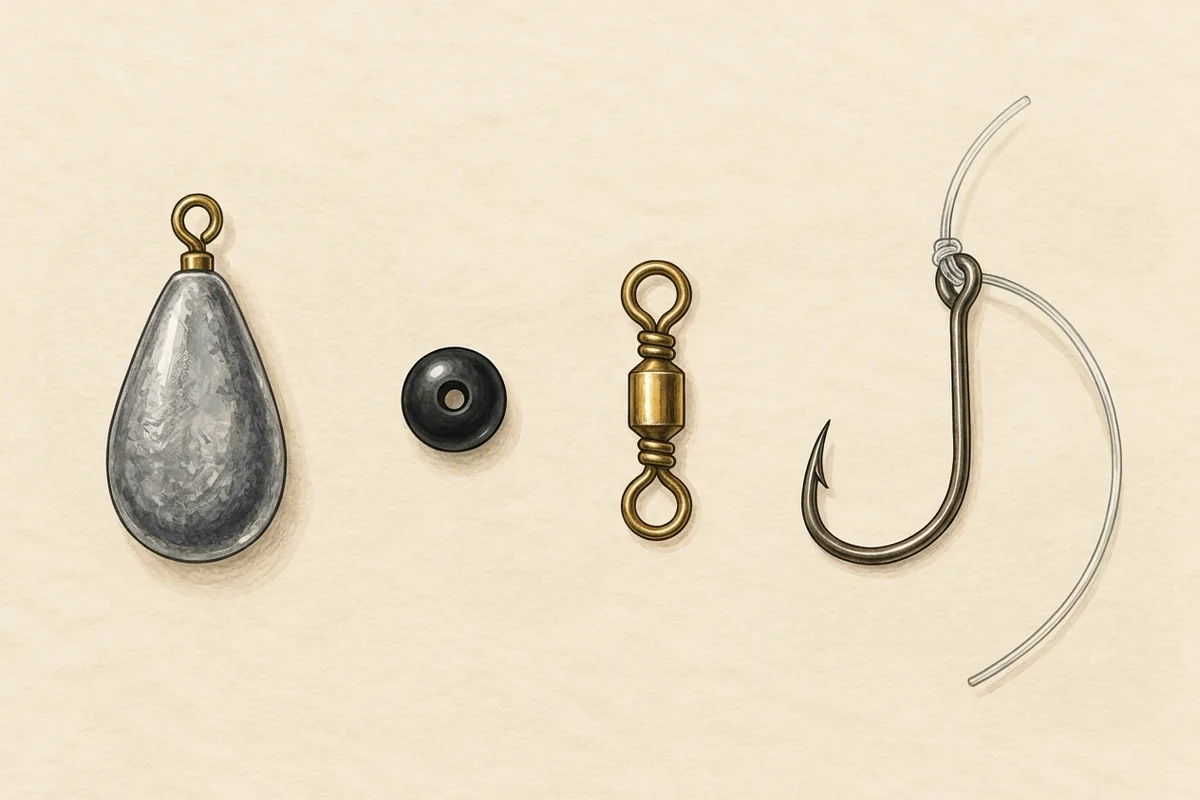
Running lead over sandy bottom
The usual way to the gurnard: a small natural bait lying quietly on the bottom, from a boat over sand and gravel or from piers with deeper water.
- Look for sand and gravel
From a boat you head for bays with sandy or gravelly bottom. In one western Norwegian fjord gurnards bit at 25 to 45 m together with flatfish, whiting and haddock. From the shore you need piers or rocks with reasonably deep water in front of them.
- Light running rig
Thread a light running lead onto the thin main line and tie on behind it a hooklength with one or two small, long-shanked hooks. Because the lead slides freely, every tug reaches the rod tip at once.
- Bait small
A piece of lugworm, a scrap of herring or mackerel the size of a thumbnail, or a shrimp is enough. The fish also take peeled North Sea shrimps.
- On clean ground
From a boat you lower the rig to the bottom and keep contact. From the shore you cast onto open sandy areas instead of straight into the rocks; British locals recommend this, for example at the harbour of Ilfracombe.
- After the first fish
Gurnards travel in groups. Once one has bitten, you put fish scraps into a net or a piece of gauze, weigh it down and lower it on a line to the bottom. The scent trail keeps more fish in place.
- Watch the spines
Handle the fish with care when landing and unhooking. The long spiny rays carry no venom, but with the wrong grip they cause painful wounds.
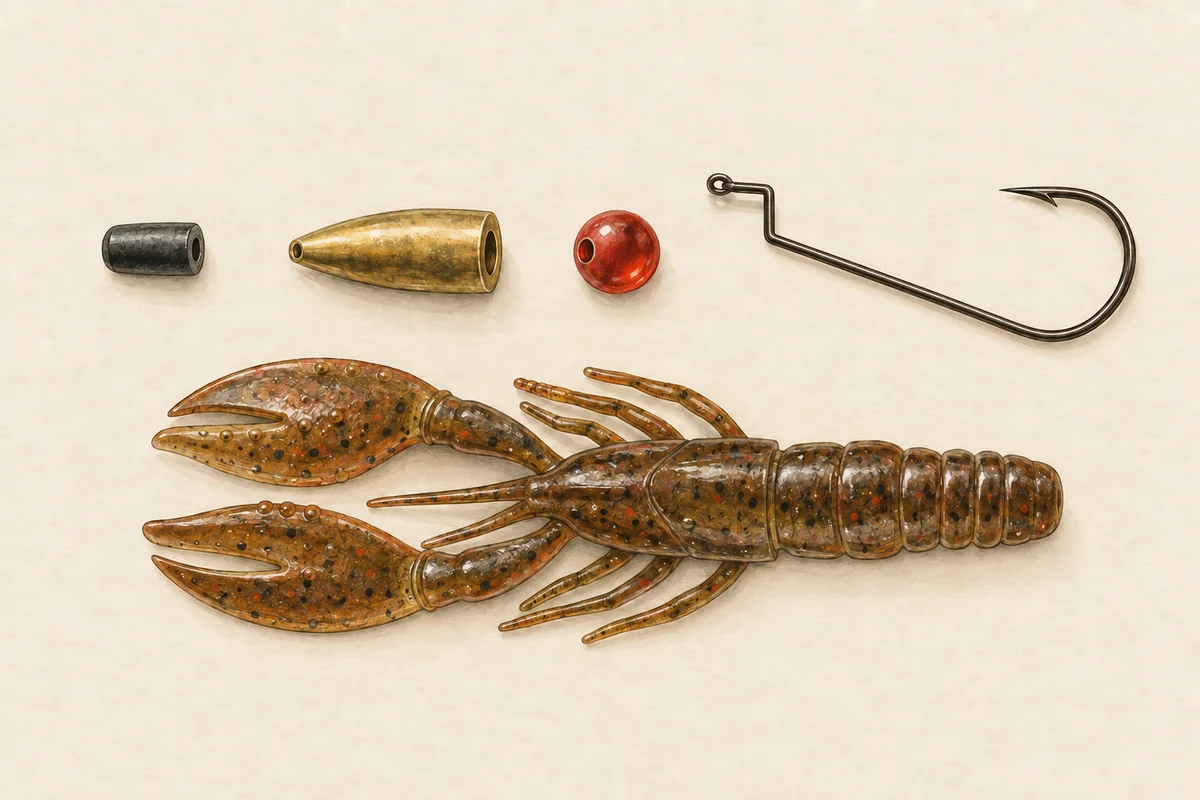
Soft lure over sand
Artificial lures catch gurnards mainly as bycatch, but in Norwegian fjords in autumn often in numbers.
- Sand next to rock
Look for places where sand borders rocks or piers. At Cherbourg a red gurnard bit at a rocky ledge in a sandy bay, and on Helgoland pier anglers caught them with spoons and spinners.
- Hidden hook
In Normandy the anglers fished soft lures of 7 to 12 cm on a Texas rig, that is with an offset hook in the lure and a bullet weight in front. A long fluorocarbon hooklength of 0,40 mm protects against sharp rocks there.
- Twister or sand eel
In Norwegian fjords you catch many gurnards on twisters in autumn. Off the Isle of Wight an unusually large red gurnard took a 16 cm rubber sand eel over a sandbank.
- Weight by distance
For casts close to the shore 7 to 10 g is enough. If you have to reach further out in wind or rising water, a bullet weight of around 21 g helps, as it flies slim.
- Along the bottom
Let the lure sink to the bottom and drag it slowly across the ground. That is how the anglers fished at Cherbourg when a red gurnard grabbed it as bycatch.
- Release or smoke
Many fjord anglers release gurnards, and fish that are too small you unhook in the water anyway. If you keep a larger fish, remove the head and dorsal spines before smoking.
What with
A light running lead with one or two small sea hooks or flatfish hooks (Butthaken) with a long shank has proved its worth. As bait you offer lugworm, shrimp or small pieces of herring or mackerel about the size of a thumbnail, right on the bottom.
- Lugwormfrom spring to autumn, from the shore and from a boat over sand
When fishing for plaice with worm, grey gurnards regularly bite along with them, and British bait lists also name lugworm for them.
- Cut baitthe whole fishing year, mainly from a boat
These not very choosy fish gladly take small strips of herring or mackerel, even if you are actually fishing for flatfish.
- Crustaceans & musselsin summer over sandy and gravelly bottom
Shrimps and crabs are part of their main food on the bottom, so a shrimp or peeled crabs suit well.
Tackle
The rig stays light. The page on the sea rod shows which sea rod is meant for the beach, jigging or a boat.
Running lead over sandy bottom
- Rod
- light tackle as for plaice fishing; from the shore a light surf, bass or spinning rod
- Line
- monofilament of about 0,25 mm; from the shore main line of 6–15 lb (about 2,7–6,8 kg) with a shock leader
- Leader
- short hooklength with one or two hooks
- Hooks
- small, long-shanked sea hooks, size 1–2, or flatfish hooks (Butthaken)
- Weight, float, lead
- light running lead
Soft lure over sand
- Rod
- jigging rod, 2,70 m, with 7–28 g casting weight
- Reel
- fixed-spool reel size 3000–4000
- Line
- abrasion-resistant braid, 0,12–0,16 mm
- Leader
- long fluorocarbon, 0,40 mm
- Hooks
- offset hook in the soft lure
- Weight, float, lead
- bullet weight 7–10 g close to the shore, 21 g for long casts; soft lure 7–12 cm
Common mistakes
- Hook and bait too big: Small, long-shanked hooks of size 1 to 2 or flatfish hooks (Butthaken) are enough for gurnards. Keep the bait small too, for example a scrap the size of a thumbnail.
- Heavy and fixed rig: With thick tackle and a fixed lead many bites go unnoticed. A light running lead rig with line of about 0,25 mm shows every tug.
- Cast straight into the rocks: From the shore, aim at clean sandy areas next to the rocks. In the rocks you lose rigs, while the fish are searching further out over sand.
- Spines underestimated: The long spiny rays are not venomous but sting painfully. Handle the fish with care and cut off the dorsal spines before you process it.
- Searched for in the North Sea in late autumn: When the water cools noticeably, the fish move west. Rather plan targeted attempts for the warm months.
Rules
Our overview of the states has no figures for gurnard on minimum size (Mindestmaß) or closed season (Schonzeit). That does not mean there are no rules: individual states and water regulations protect the species or set their own limits.
On the coast the rules of the coastal states apply, partly with their own catch restrictions: North Sea coast, Baltic coast of Schleswig-Holstein and Baltic coast of Mecklenburg-Western Pomerania.
The regulation and your fishing permit (Erlaubnisschein) are what count. Lake Constance, the Rhine and the coast, for example, have their own rules: Fishing waters in Germany.
After the catch
Playing and landing
Thanks to the running rig you feel the bite directly; then make a calm strike and bring the fish up steadily. When landing and unhooking, watch out for the long, sharp spiny rays. A gurnard of legal size that you may keep is stunned and killed straight away; fish that are too small or protected are unhooked in the water and put back.
A fish of legal size that you may take is stunned and killed straight away; protected or undersized fish go back with wet hands, unhooked while still in the water. Closed seasons (Schonzeiten) and minimum sizes (Mindestmaße) are set by the federal states (Bundesländer) and by the fisheries authorities (Fischereibehörden) of neighbouring countries such as Denmark, Norway or Poland; what binds you is your state regulation (Landesverordnung) and your fishing permit (Erlaubnisschein).
Frequently asked questions
Which bait is good for gurnard?
Lugworm, small pieces of herring or mackerel and shrimps catch reliably, and peeled North Sea shrimps work too. Among artificial lures, twisters and small soft lures are documented, and from piers also spoons and spinners.
Can you fish for gurnard from the shore?
Yes, mainly in summer, when the fish move into the shallows. Piers, rocks and harbour structures with deeper water are good, for example on Helgoland or at British piers.
Which hook size for gurnard?
Small, long-shanked sea hooks of size 1 to 2 or ordinary flatfish hooks (Butthaken). One or two of them on a light running rig are enough.
Is the gurnard venomous?
No. Its spiny rays, unlike those of the weever, contain no venom, but they can cause painful puncture wounds if handled wrongly.
How deep does the gurnard live?
The grey gurnard lives mostly between 10 and 150 m. In Norwegian fjords you often catch it at 25 to 45 m over sand, and in summer it also comes into the shallow water at piers and rocks.
Can you smoke gurnard?
Yes, larger fish are well suited to it. Gut them, cut off the head and dorsal spines and, because of the thick skin, put them into a strong brine for at least twelve hours.
Similar species
If you catch gurnard, you can fish for these species with similar tackle too:
 Cod fishingPeak season
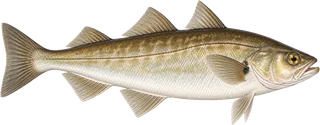 Whiting fishingPeak season
 Fishing for garfishOut of season
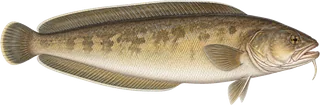 Tusk fishingShoulder season
Sources
As of October 2026. The practical knowledge comes from 10 sources, summarised in our own words.
See all 10 sources
- Steckbrief Knurrhahn: Wissenswertes über diesen Meeresfisch · BLINKER (Redaktion)
- Knurrhähne: stachelige Gesellen, aber gut für die Räuchertonne · BLINKER (Ralf Scheipers)
- Farbenfrohe Fänge beim Spinnfischen an der Küste der Normandie · BLINKER (Christopher Chew)
- Norwegen: Angeln im Fjord – Technik, Taktik und Traumreviere · BLINKER (Redaktion)
- Knurrhahn auf Gummi-Sandaal · FISCH & FANG (Redaktion)
- Helgoland · FISCH & FANG (Hans Egidius)
- Ayr Harbour & Pier Sea Fishing Marks · Sea Angler (Redaktion)
- Dover Southern Breakwater Sea Fishing Mark · Sea Angler (Redaktion)
- Top 10 sea angling baits · Sea Angler (Redaktion)
- 30 Sea fishing spots to try · Angling Times (Redaktion)
AI-assisted text, based on the sources listed and these pages: Gurnard (profile), Jigging, Crustaceans & shellfish, Sea rod.