
Knowledge – Fish
Fishing for snakehead
Fishing for snakehead means working a rubber frog across water lilies and weed mats in shallow, weedy water and not striking too early at the swirl. Here is the way there in nine steps, each with a link to the detailed page.
The USA have listed snakeheads as injurious wildlife since 2002: live fish may not be imported, transported or acquired there without a permit, and in Maryland you may only possess a fish if it was killed immediately after the catch. Since August 2022 the species has been on the EU’s list of invasive alien species of Union concern. You therefore may not take live fish or viable eggs into the EU.
 Choose another fish117 fish with guides
 EelOff-peak season
 EelpoutPossible
 IdePossible
 ArapaimaGood
 GraylingPeak season
 Atlantic salmonSpawning time, please spare
 Brown troutSpawning time, please spare
 Brook troutSpawning time, please spare
 BarbelOff-peak season
 BarramundiSpawning season
 Greater amberjackGood
 Topmouth gudgeonOnly as bycatch
 Blue marlinSpawning season
 BonefishSpawning season
 BonitoGood
 BreamOff-peak season
 Dusky grouperOnly as bycatch
 CobiaPossible
 Spiny dogfishOnly as bycatch
 CodPeak season
 ChubPeak season
 MinnowOnly as bycatch
 European sturgeonOnly as bycatch
 FlounderPeak season
 PerchPeak season
 Largemouth bassGood
 Ballan wrasseOnly as bycatch
 Yellowfin tunaSpawning season
 Giant trevallyGood
 Prussian carpPossible
 BrillPossible
 Gilthead breamSpawning time, please spare
 Golden doradoSpawning season
 Golden mahseerOnly as bycatch
 Dolphinfish (mahi-mahi)Good
 Grass carpPossible
 Great barracudaGood
 GudgeonPossible
 White breamPossible
 DaceOff-peak season
 PikePeak season
 HalibutOff-peak season
 HerringPossible
 GarfishOut of season
 Huchen (Danube salmon)Possible
 Crucian carpOnly as bycatch
 CarpOff-peak season
 RuffeOff-peak season
 VendaceOnly as bycatch
 DabPeak season
 GurnardPossible
 Coley (saithe)Peak season
 Chinook salmonHardly any chance
 King mackerelSpawning season
 LingPeak season
 TuskOff-peak season
 MackerelPossible
 Bighead carpOut of season
 WhitefishPossible
 Conger eelOff-peak season
 Sea troutSpawning time, please spare
 Grey mulletPossible
 Murray codSpawning season
 MuskellungeGood
 Common nasePossible
 Nile perchPossible
 PayaraPossible
 Peacock bassPeak season
 PermitGood
 WeeverOnly as bycatch
 PollackOff-peak season
 BurbotOff-peak season
 AspPossible
 Red snapperSpawning season
 Rainbow troutPeak season
 RoosterfishGood
 RoachPeak season
 RedfishOut of season
 Bluefin tunaOnly as bycatch
 RuddPossible
 Russian sturgeonOnly as bycatch
 HaddockOff-peak season
- SnakeheadPossible
 TenchOff-peak season
 SpirlinOnly as bycatch
 PlaiceOff-peak season
 Greenland halibutOnly as bycatch
 Round gobyOnly as bycatch
 SwordfishGood
 Lake troutSpawning time, please spare
 HakeSpawning time, please spare
 Alpine charSpawning time, please spare
 MonkfishPossible
 SoleOff-peak season
 SailfishGood
 Silver carpOut of season
 SnookPeak season
 PumpkinseedOnly as bycatch
 SpratOnly as bycatch
 Atlantic wolffishSpawning time, please spare
 TurbotPeak season
 SterletOnly as bycatch
 SmeltOnly as bycatch
 Horse mackerelPossible
 TaimenGood
 TarponGood
 TigerfishSpawning season
 BleakPossible
 WahooGood
 Wels catfishOff-peak season
 WhitingPeak season
 Sea bassOff-peak season
 ZanderPeak season
 White-eye breamOnly as bycatch
 Blue breamOnly as bycatch
 Brown bullheadPossible
 VimbaOnly as bycatch
Season in October according to the catch calendar, an estimate and not a guarantee of a catch. The fish pictures are reduced natural-history plates and AI-generated.
Best time
From April to September, especially in the morning and in the evening.
In January: Hardly any chanceIn February: Hardly any chanceIn March: PossibleIn April: Good, spawningIn May: Good, spawningIn June: Good, spawningIn July: Good, spawningIn August: Good, spawningIn September: GoodIn October: PossibleIn November: Hardly any chanceIn December: Hardly any chance
Good spot
- Lake: weed bed, reed edge and surfaceweed bed, reed edge and surfaceweed bed, reed edge and surfaceweed bed, reed edge and surface
- River: quiet bayquiet bayquiet bayquiet bay
Starter tackle
- Rod: a strong spinning rod that can pull a fish out of dense weed
- Line: strong, abrasion-resistant line that withstands weed and teeth
- Hook: single hooks rigged weedless, point lying against the bait
In short
In short: According to the catch calendar the best time is April to September. Good spots on a lake: weed bed, reed edge and surface; on a river: quiet bay. Proven baits: weedless rubber frogs for the surface, paddle-tail soft plastics on a weighted weed hook and live baitfish under a float. An air-breathing predator from East Asia, introduced in the USA. It is on the EU list of invasive alien species of Union concern: live animals may not be imported, kept or released.
Quick to recognise
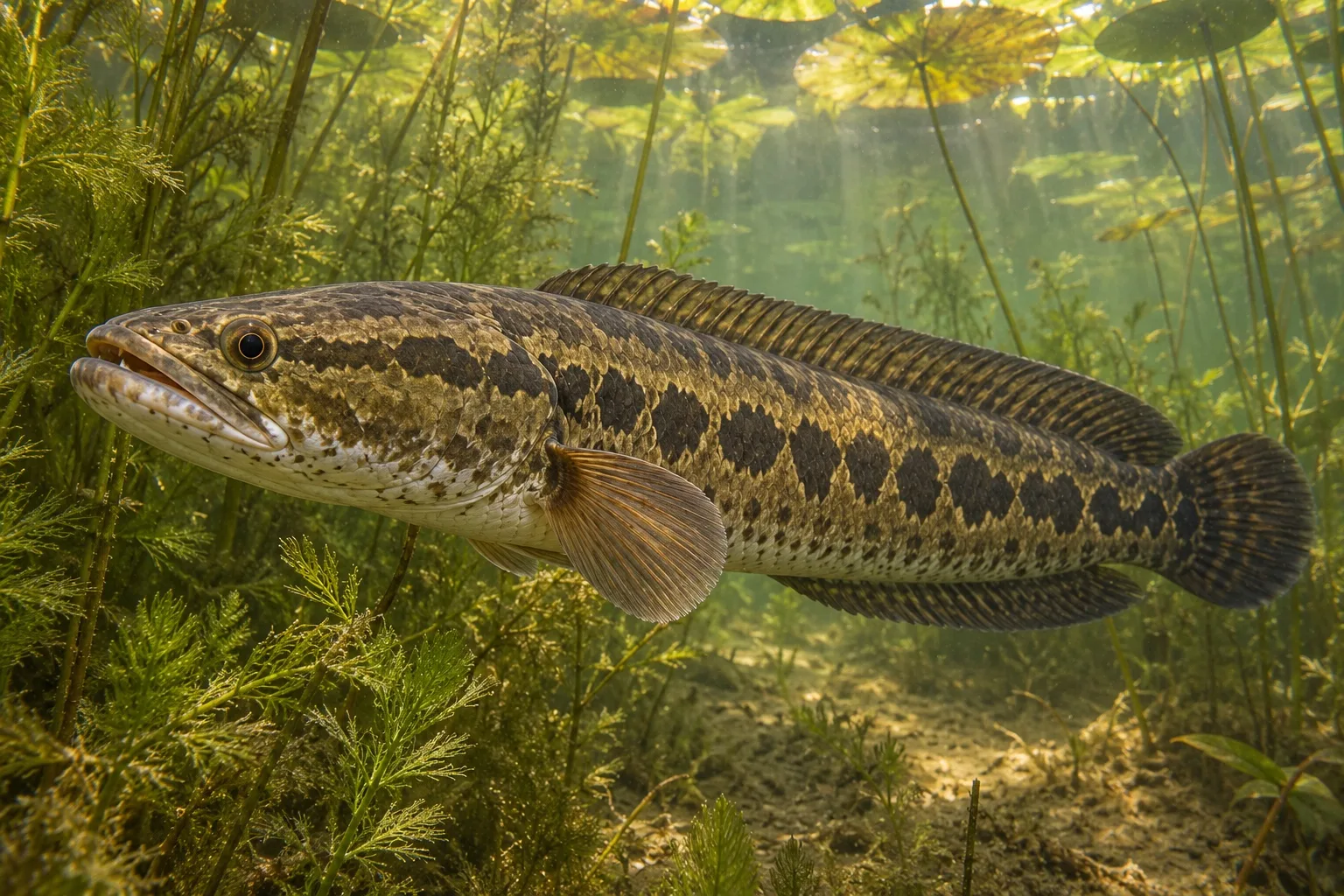
An air-breathing predator from East Asia with an almost cylindrical body, a flat, scaled snake-like head and large dark blotches on a brown background. The dorsal and anal fins are very long, and the pelvic fins sit right behind the pectoral fins. In Virginia the fish reach about 90 centimetres in length.
When
On the Potomac April to September are the good months, March and October are possible. The season begins as soon as the shallows warm up in spring; in winter the fish retreat to deeper water. In the USA they spawn from late April to August, most in June.
- JanHardly any chance
- FebHardly any chance
- MarPossible
- AprGood, spawning
- MayGood, spawning
- JunGood, spawning
- JulGood, spawning
- AugGood, spawning
- SepGood
- OctPossible
- NovHardly any chance
- DecHardly any chance
Peak seasonGoodPossibleHardly any chanceSpawning season
Season in the destination
In the Potomac area April to September are the good months; in March and October it takes some luck. Early in the season, before the underwater plants grow up, the fish are easier to find; in the Rappahannock system they gather from mid-April to early May below a mill weir on the Rapidan before spawning. From late April to August they spawn and guard their brood in weedy shallows; in winter they move into deeper water.
Season and biting time
In January: Hardly any chanceIn February: Hardly any chanceIn March: PossibleIn April: SpawningIn May: SpawningIn June: SpawningIn July: SpawningIn August: SpawningIn September: GoodIn October: PossibleIn November: Hardly any chanceIn December: Hardly any chance
Where it is now
In the lake
Look for shallow, still water with a muddy bottom and dense vegetation, such as ponds and swamps. The snakehead lurks in the weed or on the bottom and often gives itself away with a swirl at water lilies, yellow water lilies, reed and weed mats.
How to go about it: Look for shallow, still waters under about 2 metres deep with a muddy bottom and plants, and in winter rather the deeper spots. In reservoirs of northern Virginia where snakeheads were illegally introduced, such as the Occoquan Reservoir, they lie in the bank stands of water willow. Virginia’s agency asks that every snakehead caught in these lakes be removed.
| All year round | weed bed, reed edge, surface |
|---|
In the river
In the Potomac and its tributaries it lies in slow-flowing, weedy stretches, in canals and in tidal side arms. From late April to August the fish stay in weedy shallows to spawn and care for their brood.
How to go about it: In the tidal area of the Potomac and Rappahannock they lie in calm side arms, not in fast current. Once underwater plants have spread, any weed bed can hold fish, especially hydrilla. In spring many migrate upstream into fresh water and gather at the foot of weirs and small dams.
| All year round | calm bay |
|---|
Biting time: mainly in the morning and in the evening. What that looks like at the water is shown by the picture of the holding spots just below.
Holding spots in the picture
Choose a season and time of day: the picture shows where the species sits then. Tap a fish or a spot in the list to bring it closer. The picture is schematic and AI-generated, every water is different.
Chance of a catch in springgoodSpawning, observe the closed seasons
Chance of a catch in summergoodSpawning, observe the closed seasons
Catch chance in autumnpossible
Catch chance in winterhardly any
- J
- F
- M
- A
- M
- J
- J
- A
- S
- O
- N
- D
Spawning season
Active time According to FishBase it hunts mainly in the morning and in the evening.
Not the main time According to FishBase it hunts mainly in the morning and in the evening.
Active time According to FishBase it hunts mainly in the morning and in the evening.
Not the main time According to FishBase it hunts mainly in the morning and in the evening.
In the lake
reed edge
Northern snakehead is present here all year round.
Water lilies and weed bed
Northern snakehead is present here all year round.
Just below the surface
Northern snakehead is present here all year round.
The snakehead lurks in shallow, still waters with a muddy bottom and dense plants, for example in ponds and swamps. It waits in the weed or on the bottom until prey comes close. At water lilies, reed and weed mats it often gives itself away with a swirl at the surface.
Spring: catch chance according to the catch calendar possible in March, good in April and May. This is the spawning period, so observe the closed seasons (Schonzeit).
Summer: chance of a catch good according to the catch calendar. This is when spawning falls, so observe the closed seasons.
Autumn: catch chance according to the catch calendar good in September, possible in October, hardly any in November.
Winter: catch chance according to the catch calendar hardly any.
In the river
Calm bay with aquatic plants
Northern snakehead is present here all year round.
In the Potomac and its tributaries it stays in sluggish, weedy areas, in canals and tidal side arms. In spring, as soon as the shallows warm up, it moves upstream as far as weirs and similar obstacles. The fish spend the spawning period and brood care, late April to August, in weedy shallows.
Spring: catch chance according to the catch calendar possible in March, good in April and May. This is the spawning period, so observe the closed seasons (Schonzeit).
Summer: chance of a catch good according to the catch calendar. This is when spawning falls, so observe the closed seasons.
Autumn: catch chance according to the catch calendar good in September, possible in October, hardly any in November.
Winter: catch chance according to the catch calendar hardly any.
Depth: It prefers shallow water down to about two metres; in winter, according to the USGS, it moves to deeper areas.
Size comparison: AI-generated drawing, schematic.
How
Fishing is usually done with a spinning rod and artificial lures in shallow, weedy water. Cast parallel to the bank, first close to plants and marsh edges, then further out step by step. A baitfish under a float serves as natural bait.
Easiest way
Start in spring in a shallow, tidal side arm of the Potomac while the water plants are still low; then the fish are easier to find. Cast a weedless-rigged soft lure to submerged wood, jetties and flooded bank plants. Once weed and water lilies stand thick in summer, switch to a rubber frog.
Weedless lures in the shallows
The usual way in the Potomac area: you work through shallow, weedy side arms and choose the lure according to the state of the water plants.
- Choosing a side arm
Snakeheads are most common in the tidal tributaries of the Potomac south of Washington, such as Aquia, Quantico or Pohick Creek. The tidal Rappahannock between Fredericksburg and Port Royal also offers good prospects.
- Planning around the tide
Early in the year the fish lie at flooded wood, jetties and in flooded bank plants on the rising tide. Once the yellow water lilies have come up, you fish their edges rather at low water.
- Lure according to the weed
In spring weedless-rigged soft lures catch fish, in summer surface lures such as the rubber frog. Open hooks snag in dense weed, which is why the hook point lies against the bait.
- Gaps and inner edges
Cast into gaps in water lily fields and onto the bank side of weed strips. The fish sometimes lie there in water only a few centimetres deep.
- Close to cover
Work the lure close to wood, plant edges and through holes in the weed. The snakehead lurks under cover for prey and hunts mainly in the morning and in the evening.
- Landing net and pliers
Net the fish and remove the hook with pliers; the mouth is full of sharp teeth. If you keep it, kill it at the water, because in Maryland and Virginia you may only possess it dead.
What with
Weedless rubber frogs that you pull over water lilies and weed in short pulls with pauses. If the fish are shy, smaller, more slowly worked frogs or paddle-tail soft plastics on a weighted weed hook bring more bites. Cloudy water is better than clear.
- Rubber frogSummer, over water lilies and weed mats
Once the plants stand thick, Virginia’s fisheries agency advises surface lures, and a biologist from Maryland caught her fish in August on an artificial frog in a gap in the water lily field.
- Soft plastic (shad)Spring, while the weed is still low
For this time the agency in Virginia names weedless-rigged soft lures that you work along wood, jetties and flooded plants.
- Baitfishwhen artificial lures fail and natural bait is allowed
Adult snakeheads feed almost only on fish, so Maryland’s fisheries agency considers small live baitfish promising, even though hardly anyone has used them so far.
Tackle
A short, stiff spinning rod works the frog cleanly, plus braid to pull the fish out of the weed. A bottom rod is suitable for the baitfish under the float.
Weedless lures in the shallows
- Rod
- a strong spinning rod that can pull a fish out of dense weed
- Line
- strong, abrasion-resistant line that withstands weed and teeth
- Hooks
- single hooks rigged weedless, point lying against the bait
More on tackle
Common mistakes
- Searching the main current: Virginia’s agency reports most fish from the tidal tributaries of the Potomac. Concentrate on shallow, calm side arms with plants and wood rather than on flowing, open water.
- Ignoring the tide: In the side arms the water level decides where the fish lie. Early in the year rising water at wood and flooded plants pays off, while at the edges of yellow water lilies low water is better.
- Searching the shallows in winter: In the cold the fish move into deeper water and rest on the bottom. Plan the trip between spring and early autumn, when they lie in weedy shallows.
- Mistaking a bowfin for a snakehead: The native bowfin looks similar. Look at the head: on a snakehead there are scales in a mosaic pattern like a snake’s, on a bowfin they are missing.
- Taking the fish away alive: In Maryland, Virginia and Pennsylvania you may neither possess nor transport live snakeheads. Kill a fish you keep at the place where you caught it.
Rules
For the snakehead the rules of the country where you fish apply, not the German fisheries laws. Licence, closed seasons, minimum sizes and keeping fish are set by each country, often by each water.
What the profile says: An air-breathing predator from East Asia, introduced in the USA. It is on the EU list of invasive alien species of Union concern: live animals may not be imported, kept or released.
The fisheries authority (Fischereibehörde) of the country you travel to is what counts. Ask about the current rules before the trip and read in the profile how threatened the species is.
After the catch
Playing and landing
The mouth carries many sharp, fang-like teeth: net the fish and unhook it with pliers, not with your fingers. It may not be taken away alive in Maryland, Virginia and Pennsylvania; if you keep it, you kill it at once, and the authorities there ask that caught snakeheads not be released again. Never put a fish into another water; Virginia prosecutes illegal releases as a criminal offence.
In Virginia you may release the fish at the place where you caught it. A fish you keep you kill straight away, because alive it has no business in a keep net or cool box in either Maryland or Virginia; Virginia names cutting off the head, severing the gill arches or removing the entrails for this, after which the fish goes quickly onto ice. In Virginia you report kept fish to the Department of Wildlife Resources.
Frequently asked questions
When is the best time for snakehead fishing?
On the Potomac from April to September. Early in the season, when the weed is still missing, the fish are easier to find. During the day they hunt mainly in the morning and in the evening.
May you release a snakehead?
Each US state decides this for itself. Virginia allows immediate release at the place of capture but asks that every fish be killed where possible. Pennsylvania advises against releasing, and Maryland asks that caught fish be killed and eaten.
Which bait catches snakeheads?
Weedless artificial lures: soft lures in spring, surface lures such as rubber frogs in summer. Maryland’s agency also names spinners, depending on the season.
Where do you catch snakeheads on the Potomac?
In the tidal tributaries on the Virginia side, such as Aquia, Quantico, Neabsco or Pohick Creek. For 2026 the agency expects average catches in Aquia Creek and weaker ones in many other creeks below Washington.
Do you have to report a snakehead you have caught?
In Virginia you report every fish you keep to the fisheries authority (Fischereibehörde), giving your surname, the date, the place of capture and the size. Pennsylvania asks that every catch be reported.
Can you eat snakehead?
Yes, Virginia’s fisheries agency calls it an excellent food fish. Kill it straight after the catch and chill it as quickly as possible.
Similar species
If you catch snakehead, you can fish for these species with similar gear:
 Fishing for largemouth bassGood
 Fishing for muskellungeGood
 Fishing for peacock bassPeak season
 Fishing for Murray codSpawning
Sources
As of October 2026. The practical knowledge comes from 10 sources, summarised in our own words.
See all 10 sources
- Northern Snakehead (Fishing) · Virginia Department of Wildlife Resources (DWR)
- 2026 Virginia Tidal Rivers Fishing Forecast · Virginia Department of Wildlife Resources (DWR)
- 2026 Large Reservoir Fishing Forecasts · Virginia Department of Wildlife Resources (DWR)
- Snakeheads (Invasive Species) · Virginia Department of Wildlife Resources (DWR)
- All About Snakehead · Pennsylvania Fish and Boat Commission
- Northern Snakehead (Channa argus) – Species Profile · U.S. Geological Survey, Nonindigenous Aquatic Species Database
- Maryland Angler's Log: Mattawoman Snakehead (Bericht einer DNR-Biologin, 10.08.2020) · Maryland Department of Natural Resources, Fisheries
- Maryland Angler's Log: Snakehead Tips (Antwort der DNR, 09.04.2015) · Maryland Department of Natural Resources, Fisheries
- Channa argus, Snakehead (Species Summary) · FishBase
- Chesapeake channa (Northern snakehead) – Field Guide · Chesapeake Bay Program (Partnerschaft von US-Umweltbehörde EPA und Bundesstaaten)
Text AI-assisted, based on the sources named and on these pages: Northern snakehead (profile), Spinning, Rubber frog, Soft plastic shad, Float rig.