
Knowledge – Fish
Fishing for topmouth gudgeon
You will not be fishing for topmouth gudgeon on purpose; at most one will end up on your hook by chance. This small fish from East Asia counts as invasive. Here you can read how to recognise it, where it lives and why you remove it after catching it.
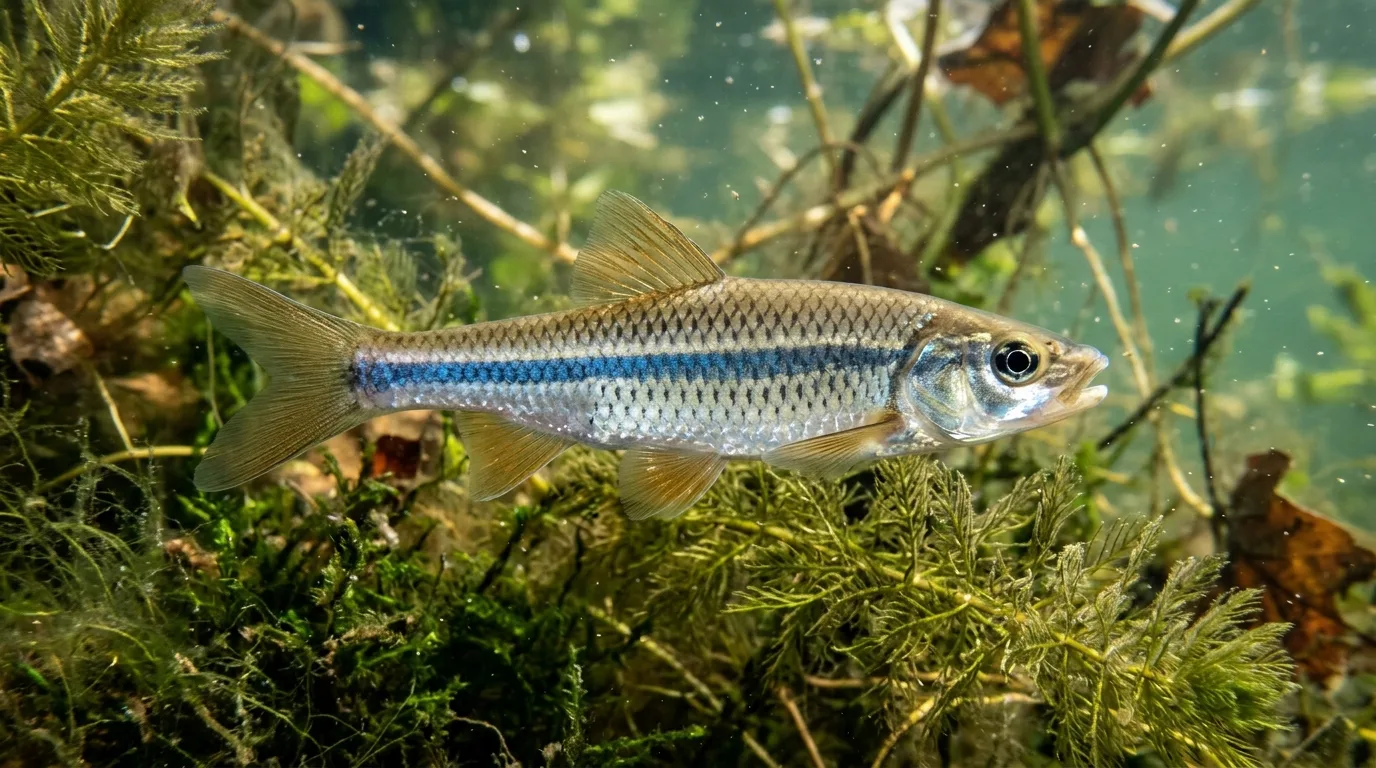
The topmouth gudgeon is not protected; it is an introduced species, which the EU lists as invasive and alien. That is why it must not be released: a topmouth gudgeon you catch does not go back into the water, not even into the same water, and is never taken away alive (correct as of October 2026).
Quick to recognise
A slender, silvery-grey to greenish small fish with a small, upturned mouth without barbels. A dark band runs along the middle of the whole flank. It is usually about 8 centimetres long.
Why it is not a target fish
It multiplies strongly, eats the spawn and fry of native fish and competes with their young for food. As a species on the EU Union list it must not, among other things, be deliberately kept, transported or released, and the authorities must take action against it. The Red List of Germany does not assess it as an alien species.
Where it lives
In the lake
Typical are shallow, weedy ponds, ditches and small lakes whose water gets warm in summer. It tolerates warm, oxygen-poor water well and often forms mass stocks there.
| All year round | weed bed, reed edge |
|---|
In the river
In rivers and canals it colonises calm stretches with little current, such as bays and areas between stones. Along such waterways it keeps spreading without any help.
| All year round | calm bay, behind stones |
|---|
Holding spots in the picture
Choose a season and time of day: the picture shows where the species sits then. Tap a fish or a spot in the list to bring it closer. The picture is schematic and AI-generated, every water is different.
In the lake
reed edge
The topmouth gudgeon is found here all year round.
Water lilies and weed bed
The topmouth gudgeon is found here all year round.
The topmouth gudgeon mainly colonises ponds, ditches and small lakes that heat up strongly in summer and are densely overgrown. It tolerates warm or oxygen-poor water well and often forms mass stocks there.
Spring: This is when spawning takes place. From April the female sticks the eggs to the roof of hollows under stones, and the male guards them.
Summer: This is when spawning takes place. Until mid-July the females spawn several times, and the males keep watch over their clutches.
In the river
Slack water behind rocks
The topmouth gudgeon is found here all year round.
Calm bay with aquatic plants
The topmouth gudgeon is found here all year round.
In running waters it lives in stretches with little current, for example in calm bays and in the shelter of stones. Along rivers and canals it keeps spreading on its own.
Spring: This is when spawning takes place. In spring the males clean hollows under stones and guard the eggs there.
Summer: This is when spawning takes place.
Size comparison: AI-generated drawing, schematic.
Do not confuse
In the native sunbleak the longitudinal stripe is bluish silver and usually clearly visible only towards the tail. The lateral line gives more certainty: in the sunbleak it stops after only 8 to 12 scales. The gudgeon has spots on its sides and two short barbels at the corners of the mouth, and the bleak grows larger and has no dark longitudinal band. If you are unsure, photograph it from the side so that the mouth and the band on the flank can be seen.
If it bites anyway
It does not belong back in the water, not even in the same water, and you never take it away alive. The EU regulation on invasive species forbids releasing it, and under the measures sheet of the federal states bycatch is to be removed. You stun and kill it straight away. You report the find to the club or the fisheries authority (Fischereibehörde), especially from waters where it was not previously known.
Rules
With the topmouth gudgeon it is not about closed seasons or minimum sizes, but about the fact that you must not put it back after catching it.
The EU lists the species on the Union list of invasive species, so it must not be released again (VO (EU) 1143/2014, Art. 7).
What individual states lay down on this:
Baden-Württemberg
Our overview for Baden-Württemberg does not list the topmouth gudgeon. What applies there is covered on the page Fishing in Baden-Württemberg, with the waters of the state.
Bavaria
- Minimum size
- –
- Closed season
- none
- Note
- not in the annex: do not put back, remove
As of October 2026. All rules, exceptions and sources: Fishing in Bavaria.
Berlin
- Minimum size
- –
- Closed season
- none
- Note
- alien species: do not put back (§ 9 para. 4)
Correct as of October 2026. All rules, exceptions and sources: Fishing in Berlin.
Brandenburg
Our overview for Brandenburg does not list the topmouth gudgeon. What applies there is covered on the page Fishing in Brandenburg, with the waters of the state.
Bremen
Our overview for Bremen does not list the topmouth gudgeon. What applies there is covered on the page Fishing in Bremen, with the waters of the state.
Hamburg
Our overview for Hamburg does not list the topmouth gudgeon. What applies there is covered on the page Fishing in Hamburg, with the waters of the state.
Hesse
Our overview for Hesse does not list the topmouth gudgeon. What applies there is covered on the page Fishing in Hesse, with the waters of the state.
Mecklenburg-Western Pomerania
Our overview for Mecklenburg-Western Pomerania does not list the topmouth gudgeon. What applies there is covered on the page Fishing in Mecklenburg-Western Pomerania, with the waters of the state.
Lower Saxony
Our overview for Lower Saxony does not list the topmouth gudgeon. What applies there is covered on the page Fishing in Lower Saxony, with the waters of the state.
North Rhine-Westphalia
Our overview for North Rhine-Westphalia does not list the topmouth gudgeon. What applies there is covered on the page Fishing in North Rhine-Westphalia, with the waters of the state.
Rhineland-Palatinate
Our overview for Rhineland-Palatinate does not list the topmouth gudgeon. What applies there is covered on the page Fishing in Rhineland-Palatinate, with the waters of the state.
Saarland
Our overview for Saarland does not list the topmouth gudgeon. What applies there is covered on the page Fishing in Saarland, with the waters of the state.
Saxony
Our overview for Saxony does not list the topmouth gudgeon. What applies there is covered on the page Fishing in Saxony, with the waters of the state.
Saxony-Anhalt
Our overview for Saxony-Anhalt does not list the topmouth gudgeon. What applies there is covered on the page Fishing in Saxony-Anhalt, with the waters of the state.
Schleswig-Holstein
Our overview for Schleswig-Holstein does not list the topmouth gudgeon. What applies there is covered on the page Fishing in Schleswig-Holstein, with the waters of the state.
Thuringia
Our overview for Thuringia does not list the topmouth gudgeon. What applies there is covered on the page Fishing in Thuringia, with the waters of the state.
The regulation and your fishing permit (Erlaubnisschein) are what count. Lake Constance, the Rhine and the coast, for example, have their own rules: Fishing waters in Germany.
Text AI-assisted, summarised from these pages: Topmouth gudgeon (profile), Stunning and killing a fish.