
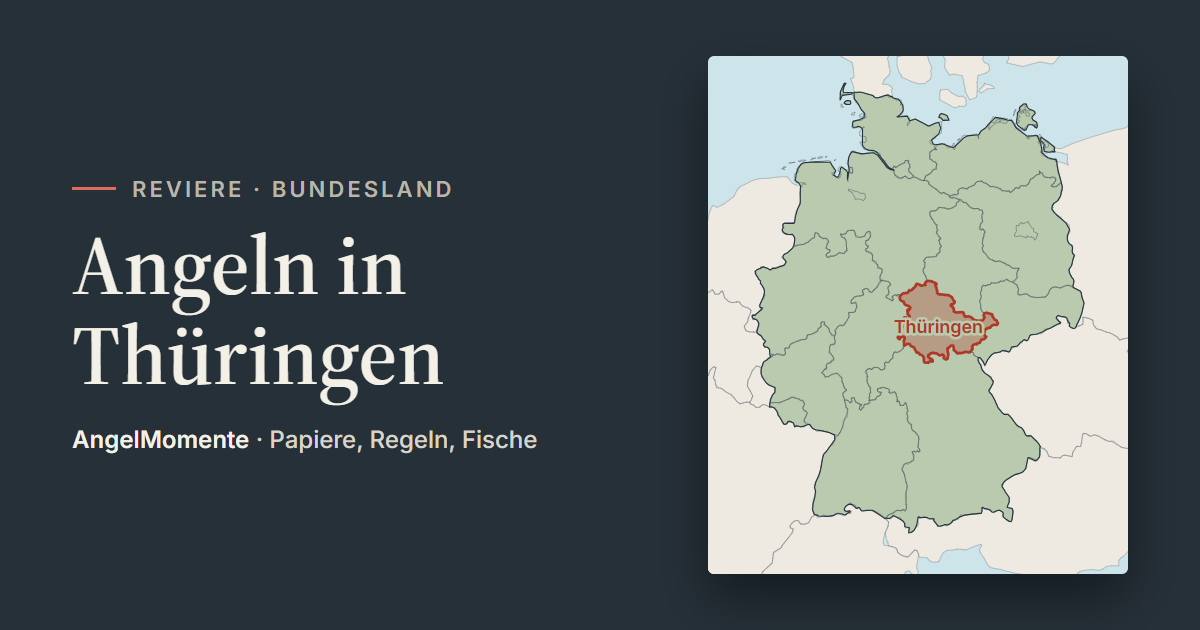
Waters · Federal state
Fishing in Thuringia: Fishing licence, rules, closed seasons and waters
Fishing in Thuringia takes you to reservoirs, gravel pits and trout streams. You need the fishing licence (Fischereischein, colloquially Angelschein) and the fishing permit (Erlaubnisschein) for the water. If you have no exam, you can get a three-month licence at the municipality.
- Papers
- Fishing licence (Fischereischein) and fishing permit (Erlaubnisschein) from the fishing rights holder
As of October 2026
At a glance
- Papers
- Fishing licence (Fischereischein) and fishing permit (Erlaubnisschein) from the fishing rights holder
| Fish | Minimum size | Closed season | Catch limit |
|---|---|---|---|
| Pike | 50 cm | 15.2.–30.4. | – |
| Zander | 45 cm | 1.4.–31.5. | – |
| Wels catfish | 50 cm | none | – |
| Carp | 35 cm | none | – |
| Tench | 25 cm | none | – |
| Eel | 50 cm | 1.11.–28.2. | 2 per day |
| Brown trout | 30 cm | 1.10.–31.3. | – |
| Grayling | 35 cm | 1.2.–31.5. | – |
| Barbel | 40 cm | 1.4.–31.8. | – |
| Burbot | 30 cm | 1.11.–31.3. | – |
| Chub | 20 cm | none | – |
| Asp | – | protected all year round | – |
| Common nase | – | protected all year round | – |
| Ide | – | protected all year round | – |
| Vimba | – | protected all year round | – |
State law of Thuringia (ThürFischAVO §§ 1 and 3); the fishing permit (Erlaubnisschein) may be stricter. Status: October 2026. What counts is the regulation and your fishing permit.
The key points in brief
- Two papers: fishing licence (Fischereischein) with photo and the fishing permit (Erlaubnisschein) of the fishing-rights holder or leaseholder. You carry both when fishing.
- Without an exam: From 14, any municipality gives you the quarterly fishing licence (Vierteljahresfischereischein), but only once per calendar year.
- Fishing levy (Fischereiabgabe): You pay it together with the fishing licence at the municipality.
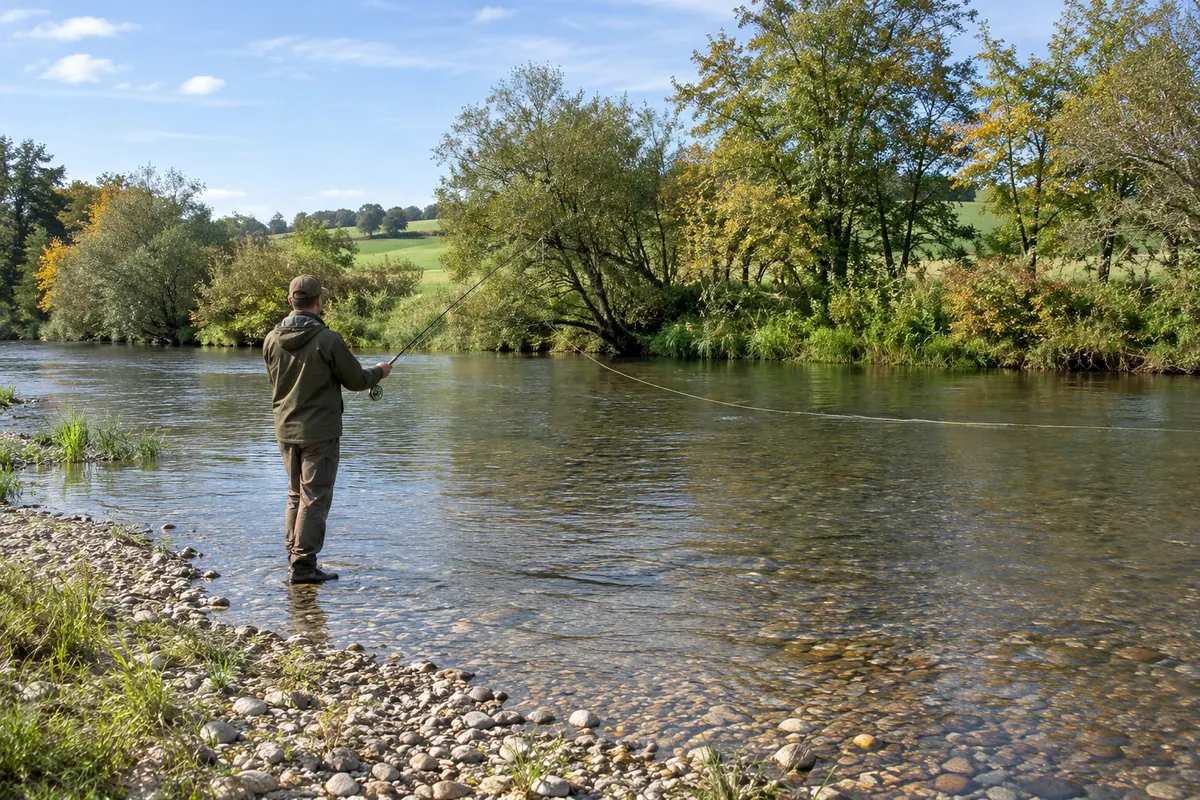
- Rods: at most two hand rods, and only one when spinning or fly fishing.
Fishing licence and exam Fishing licence in Thuringia, exam and recognition
Anyone fishing in Thuringia carries a fishing licence in their own name with a photo. You get the first licence only after passing the angling exam (Fischerprüfung) (Thüringer Fischereigesetz, §§ 26 und 29). Licences from other federal states and European countries are also valid here if they are based on a proven qualification. Exam-free licences from other states are excluded (ThürFischAVO, § 34).
- Course: Before the exam you attend a preparation course of at least 30 hours. It may take place on site or online.
- Admission: from the age of 10. You apply at least four weeks before the date at the lower fisheries authority (untere Fischereibehörde), that is, at the district (Landkreis) or the independent city.
- Dates: The authorities set them as needed and announce them at least three months ahead. The Landesanglerverband collects the dates on its exam dates page.
- Format: written, ten questions each from six subjects with three answers each to tick, 90 minutes at most. You pass with 45 of 60 points and at least six points in each subject.
- Fee and resits: The exam costs 35 euros. If you fail, you can sit it again.
The licence is issued by the municipal administration where you live. If you live outside Thuringia, you go to the municipality where you want to fish (§ 30 ThürFischG). It is available for one calendar year, for five or ten calendar years and for life. The official amounts under § 37 ThürFischAVO, each fee plus fishing levy (Fischereiabgabe):
- Annual fishing licence: 8 euros and 10 euros
- Five-year fishing licence: 15 euros and 30 euros
- Ten-year fishing licence: 20 euros and 50 euros
- Lifetime fishing licence: 45 euros and 200 euros
Without an exam: guests, holidaymakers, children Quarterly fishing licence (Vierteljahresfischereischein) without an exam
For holidaymakers and beginners there is the quarterly fishing licence (Vierteljahresfischereischein). You get it from the age of 14 without an exam at the municipality, it is valid for three months and allows fishing with a hand rod. It is available only once per calendar year per person and cannot be extended. It costs a 10 euro fee and 15 euros fishing levy. Because it has no photo, it is valid only together with your identity card or passport.
The quarterly licence is valid only in Thuringia. Not every leaseholder issues fishing permits to its holders (Landesanglerverband Thüringen). The association itself has day tickets specifically for holders of the quarterly licence, for the Saalekaskade and for the waters of its network of clubs (Verbund). The quarterly licence is also intended for the angling ponds of professional fishers. You do not fish there entirely without a licence, because the fisheries act applies equally to artificially created waters and fish ponds.
- Guests from abroad: If you have no residence in Germany and hold a foreign fishing licence, you can be exempted from the exam. You then get only the annual fishing licence (§ 29 Abs. 3 ThürFischG).
- Children from 8 to 13: They get the youth fishing licence (Jugendfischereischein) without an exam, for a 5 euro fee and 7 euros levy. With it they may fish only when accompanied by an adult holder of a fishing licence. A quarterly licence is not enough for accompanying. Anyone who has already passed the angling exam may go alone (§ 27 ThürFischG).
Fishing permit and fishing levy Fishing permit (Erlaubnisschein) and the Thuringian Gewässerverbund
The fishing permit (Erlaubnisschein) is issued by the fishing-rights holder or leaseholder of the water, for one calendar year at most and only to holders of a fishing licence (§ 14 ThürFischG). The Landesanglerverband Thüringen has leased the Saalekaskade since 2007 and runs the Thuringian Gewässerverbund, an association of angling clubs. For both it sells fishing tickets online and through sales points, and the waters are in the waters register.
A catch record card (Fangkarte) comes with the fishing permit. In it you enter species, number and length of the fish kept and returned, plus your fishing time. You hand it in at the latest when the fishing permit expires, even with no catch as a nil return (§ 9 ThürFischAVO).
The municipality collects the fishing levy (Fischereiabgabe) straight away when issuing the fishing licence; the amounts are above. The state uses it to promote fisheries (§ 33 ThürFischG).
Closed seasons and minimum sizes Asp, common nase and ide protected all year
The values in the „At a glance“ box come from § 1 of the implementing regulation to the Thüringer Fischereigesetz (ThürFischAVO). Fish are measured from the tip of the head to the end of the naturally spread tail fin. Protected all year, besides asp and common nase, are ide, vimba, salmon and sea trout. You may not keep these species. Undersized fish and those that bite by accident during the closed season you return at once and gently.
A statewide catch limit exists only for eel: two per day of fishing. The leaseholders‘ limits come on top. On the Saalekaskade, for example, you take at most three fish per fishing day from carp, tench, pike, zander and eel combined (LAVT, Saalekaskade). Non-native species for which neither a closed season nor a minimum size applies, you may not return. Closed seasons and minimum sizes do not apply to fish from farm ponds.
Special rules Two rods, bait fish from your own water
- Rods: two hand rods, one when spinning or fly fishing. You supervise rods that are set out yourself at all times.
- Bait fish: only from the water where you fish, only for your own needs and only species that are not currently protected or are of legal size. Keeping them in a keepnet is banned. Instead of the rod you may use a drop net of at most 1,2 by 1,2 metres with a mesh size of at least 14 millimetres. Live vertebrates as bait are banned.
- Keepnet (Setzkescher): roomy and made of knotless fabric. Trout and other salmonids never go in, and kept fish are not returned any more. You then stun and kill them, otherwise straight after the catch.
- Light: Artificial light is banned when fishing (§ 35 ThürFischG). What is allowed at the water at night, ask the issuer of your fishing permit (Erlaubnisschein).
- Distance and bank: Keep at least 50 metres away from fish traps and gill nets. You do not walk on or drive into the shallow, plant-covered bank zone. In fish passes any catch is banned.
- Events: Competition fishing is banned. The organiser registers stock-management and group fishing events with the fisheries authority four weeks ahead.
Status: October 2026. What counts are the Thüringer Fischereigesetz in the 2008 version, last amended in 2018, and the implementing regulation of 2020, last amended in 2024. At the water, the terms of your fishing permit (Erlaubnisschein) come on top.
Waters in the state Saalekaskade, Saale and reservoirs
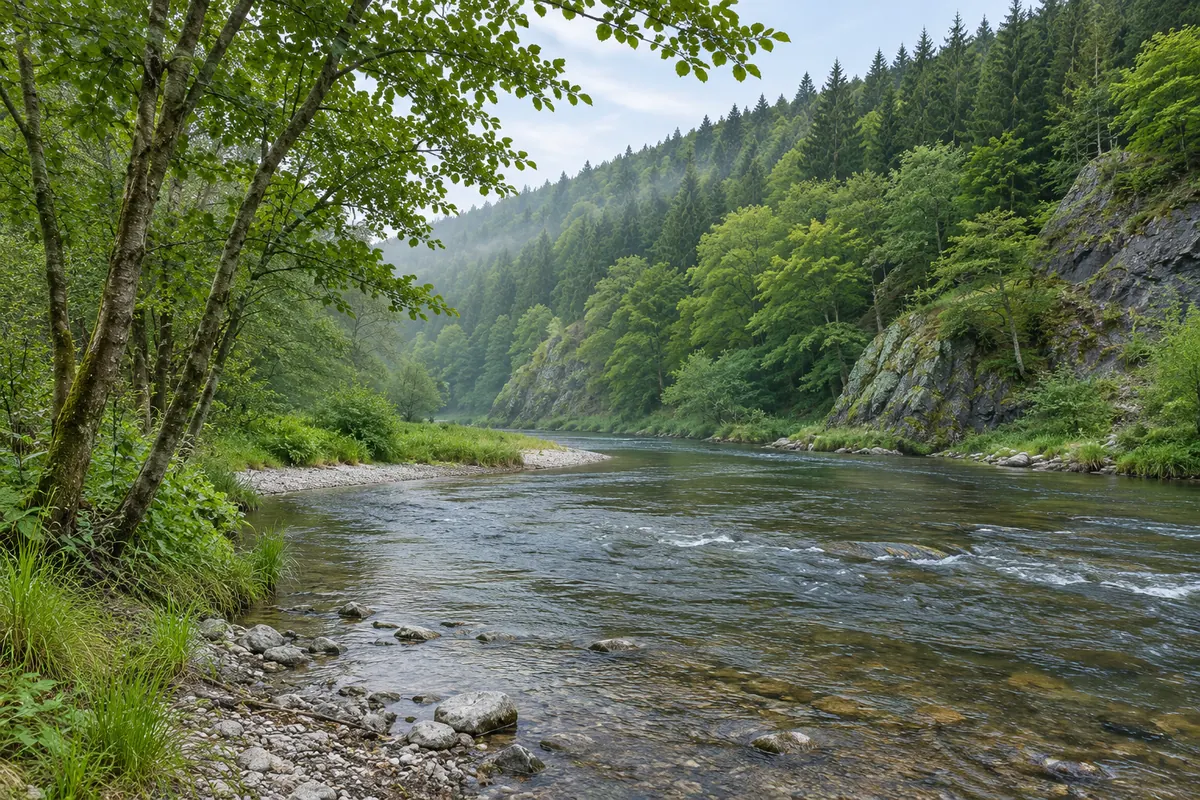
In the east, five large reservoirs dam the upper Saale over more than 80 kilometres between Blankenstein and Eichicht, together over 2.000 hectares of water. In the reservoirs the leaseholder names zander, pike, wels catfish, perch and carp, and in the Saale and the balancing basins brown trout and rainbow trout. Across the state there are also storage lakes, gravel pits and ponds. In the Apfelstädt, Gera and Ilm there are brown trout and grayling, and fly fishing has a long tradition in Thuringia (LAVT). How to go about reservoirs and rivers is covered on Fishing at a reservoir and Fishing on a river. The Waters atlas of Germany shows every stream and lake in the state, and the rules of the other states are on Fishing in Germany.
Related
- Fishing licence and angling exam and Fishing permit and water map
- Closed season and minimum size explained and the catch calendar
- Neighbouring states: Saxony-Anhalt, Saxony, Bavaria, Hesse and Lower Saxony
- Fishing ponds and trout lakes in and around Thuringia: search by postcode and radius, also across the state border
Sources
- Thüringer Fischereigesetz (ThürFischG) in der Fassung vom 18. September 2008, zuletzt geändert am 18. Dezember 2018
- Ausführungsverordnung zum Thüringer Fischereigesetz (ThürFischAVO) vom 11. August 2020, zuletzt geändert am 2. Juli 2024
- Portal Fischerei von Bund und Ländern: Thüringen
- Landesanglerverband Thüringen: Vierteljahresfischereischein und Gesetzliche Grundlagen zum Angeln
- Landesanglerverband Thüringen: Angelkarten und Saalekaskade
- Landesanglerverband Thüringen: Prüfungstermine
A guide with no guarantee, as of October 2026. What counts are the Thüringer Fischereigesetz, the implementing regulation to the Thüringer Fischereigesetz and the terms of your fishing permit (Erlaubnisschein).