
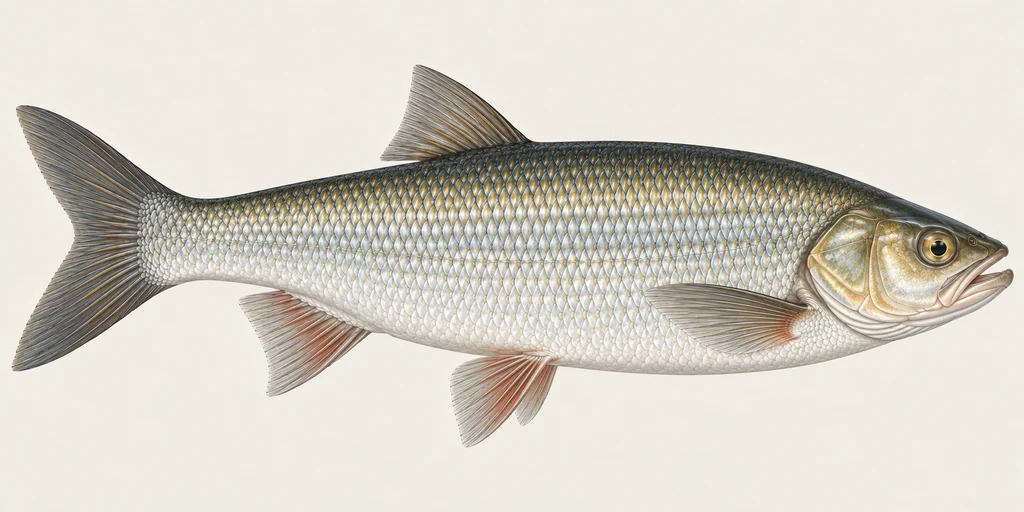
Knowledge – Fish
Asp: Features, lies and lures
The asp (Leuciscus aspius), also called Schied in German, is a cyprinid that hunts fish as an adult. It holds in the current of large rivers and flow-through lakes and gives itself away in summer with loud strikes at the surface. In Germany it is regarded as not threatened.
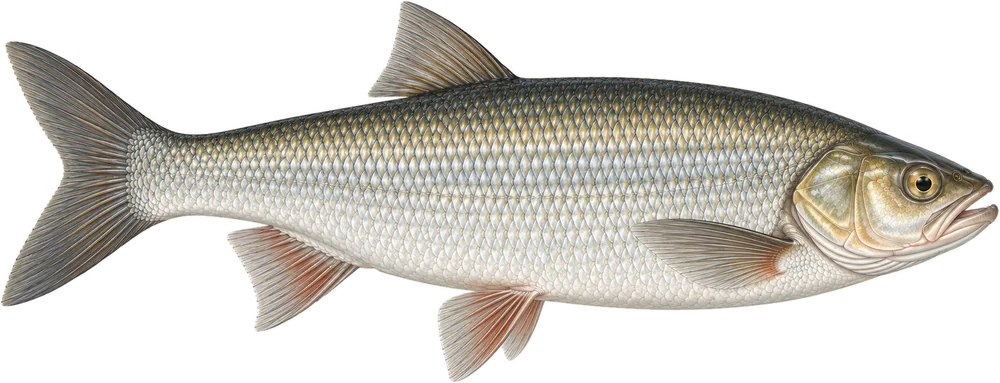
In short: The best time to catch asp is July to August, in the morning, during the day and in the evening. Good spots in a river: current edge, main current and calm bay; in a lake: open water. Proven lures: slim spinners, spoons, small pilkers and coastal plugs, retrieved fast; with a bubble float also streamers. Depending on the water, spawning runs from March or April into June, and it is often over by May. From June the asp hunts close to the surface, and the main season is July and August. Step by step: Fishing for asp.
- Wide mouth opening reaching below the eye; a knob on the lower jaw that fits into a notch in the upper jaw
- Slim, elongated, streamlined body
- Long, pointed pectoral fins and a deeply forked tail fin
Catch chances through the year
- Hardly any chance
- Possible
- Good
- Peak season
- Spawning (observe the closed season)
Editorial assessment for waters in Germany, not a measured value and no guarantee. Spawning time is not the same as the legal closed season.
Species profile and sources in the catch calendarAll species compared month by monthThe rules of your federal state
How to recognise it
The asp is slim, elongated and flattened from the side. The head tapers to a point, and the wide gape reaches below the eye. The strong lower jaw bears a knob that fits into a notch in the upper jaw. The asp has no teeth in the mouth, only hooked pharyngeal teeth set deep in the throat.
The eyes and scales are small; along the lateral line you count 64 to 76 scales. A sharp keel covered with scales runs between the pelvic fins and the vent. The back shimmers greenish, the flanks are silvery with a yellowish-green sheen. The pectoral, pelvic and anal fins look reddish, and the anal fin is clearly indented.
According to the Landesfischereiverband Bayern, asp grow 40 to 80 cm long on average. FishBase gives 55 cm as a common length. 120 cm, 9 kg and a maximum age of 11 years count as exceptions.
Young fish are easily confused with the chub, which is called Aitel in some regions. In the asp the outer edge of the dorsal and anal fins is always curved inwards; this is the surest feature. The wide gape with the knob on the lower jaw and the scaled keel in front of the vent also point to an asp.
According to FishBase the asp can hybridise with the ide. Individual fish with mixed features are therefore possible.
Side by side
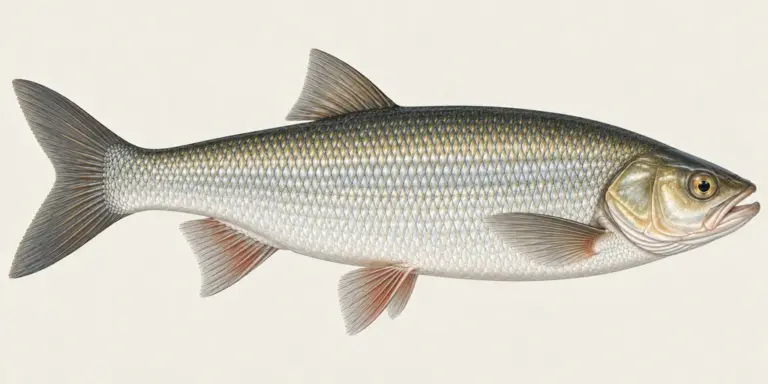
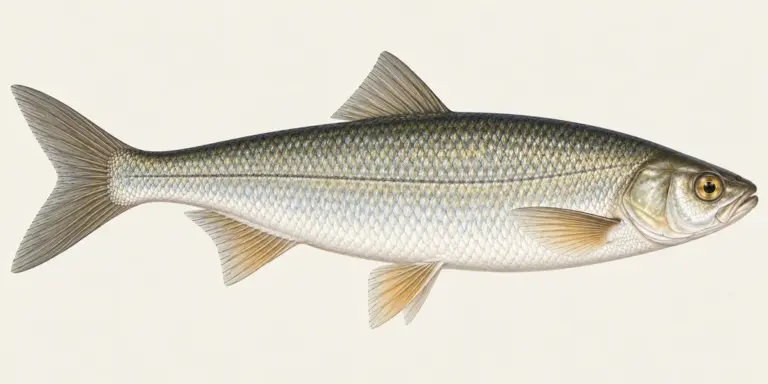
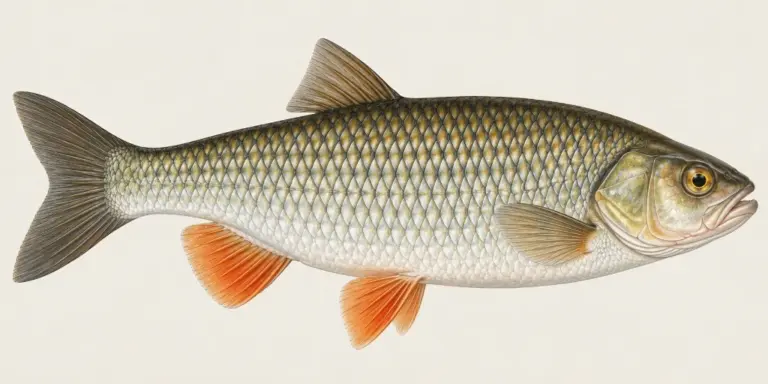
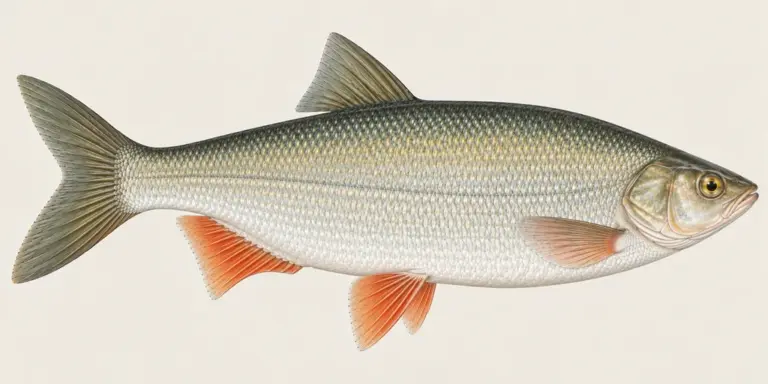
AI-generated illustrations.
Where it holds
The asp lives in larger rivers from the barbel zone downstream – the name in fisheries biology for a river stretch named after its characteristic species, the barbel – and also in lakes and lagoons (Haff). It colonises still waters only if they are connected to fast-flowing stretches, because that is where its spawning ground lies. Its natural range in Germany extends to the Elbe and Weser. Occurrences west of the Weser, for example in the Rhine, are not native.
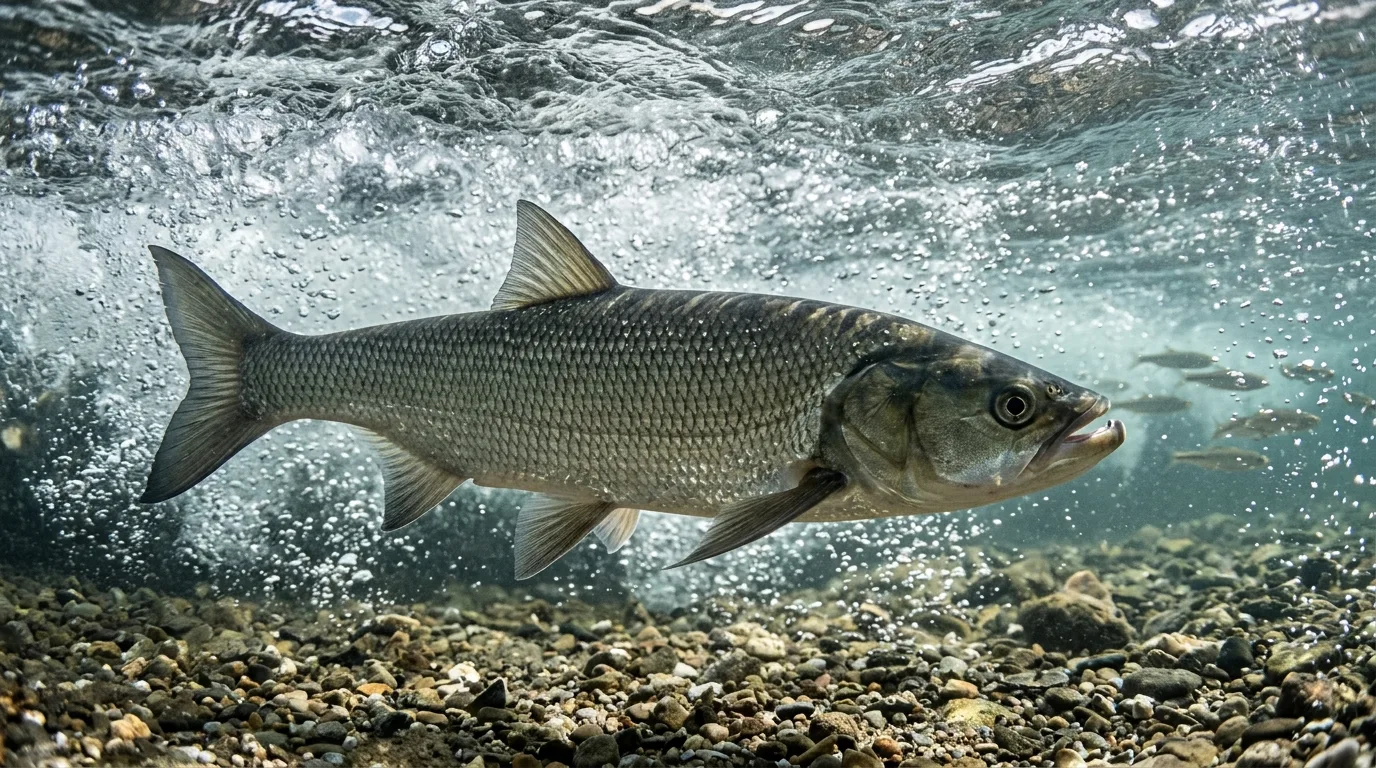
Young fish live in small shoals near the bank and move into open water towards the end of their first summer. Older asp are mostly solitary and stay mainly in mid-river. In strong current they like to hold on current edges, for example behind groynes. According to FishBase these also include bridge piers, tributary mouths, deep channels with flow, vegetated banks and calm bays in river bends. Anglers report good catches at groyne heads, below weirs and at outfalls with a sharp current.
The asp also copes with canalised rivers. On shipping waterways such as the Main, stone riprap on the bank is enough for it as spawning substrate.
Holding spots in the picture
Choose the season and time of day: the picture shows where the species stands then. Spots outlined in red apply only in the chosen season. Tap a fish or a spot in the list to bring it closer. The picture is schematic and AI-generated, every water is different.
Catch chance in springpossibleSpawning season, observe closed seasons
Catch chance in summerPeak season
Catch chance in autumnpossible
Catch chance in winterhardly any
- J
- F
- M
- A
- M
- J
- J
- A
- S
- O
- N
- D
Spawning season
Active time Hunting is mostly in the early morning and late in the evening. But asp also bite during the day, even in the midday sun, and at hot spots for two to three hours after sunset.
Active time Hunting is mostly in the early morning and late in the evening. But asp also bite during the day, even in the midday sun, and at hot spots for two to three hours after sunset.
Active time Hunting is mostly in the early morning and late in the evening. But asp also bite during the day, even in the midday sun, and at hot spots for two to three hours after sunset.
No peak time Hunting is mostly in the early morning and late in the evening. But asp also bite during the day, even in the midday sun, and at hot spots for two to three hours after sunset.
In the river
Gravelly shallow (riffle)
Asp are found here only in spring.
Current seam
Asp are found here all year round.
Calm bay with aquatic plants
Asp are found here only in spring, summer and autumn.
Free current in mid-river
Asp are found here only in spring, summer and autumn.
The asp holds in sharp current in front of groyne heads, below weirs and at outfalls. Big asp like to stay far out in the middle of the river. Bridge piers, confluences and quiet bays in river bends are also mentioned.
Spring: catch chance according to the catch calendar: possible. The spawning season falls in this period, so observe closed seasons (Schonzeit). From April to June the asp moves upriver to spawn. The eggs are laid over strongly flowing gravel.
Summer: catch chance according to the catch calendar: possible in June, main season in July and August. After spawning it hunts near the surface among shoals of small fish and gives itself away by loudly slapping with its tail fin.
Autumn: catch chance according to the catch calendar: good in September, possible in October, hardly any in November. As the water cools the asp retreats into the depths at the edge of the current. It is caught there until late autumn.
Winter: catch chance according to the catch calendar: hardly any. In the cold season the asp sits deep at the edge of the current.
In the lake
reed edge
Asp are found here only in summer.
Open water
Asp are found here all year round.
plateau, underwater hump
Asp are found here only in summer.
Just below the surface
Asp are found here only in summer.
The asp also lives in lakes with water flowing through and in large lakes. There it stays in open water, old fish singly or in small groups.
Spring: catch chance according to the catch calendar: possible. The spawning season falls in this period, so observe closed seasons (Schonzeit). To spawn, asp move from lakes into the inflowing streams.
Summer: catch chance according to the catch calendar: possible in June, main season in July and August. After spawning the asp usually sits in the upper layers of water, where the shoals of small fish gather in summer. When the small fish move over sandbanks and into the shallows in front of the reeds, the asp follow them into very shallow water.
Autumn: catch chance according to the catch calendar good in September, possible in October, hardly any in November.
Winter: catch chance according to the catch calendar hardly any.
Depth: After spawning the asp usually sits in the upper layers of water. In the cold season it retreats into the depths.
Size comparison: AI-generated drawing, schematic.
How it hunts and spawns
Young asp eat small animals of all kinds and later switch to fish. Adult asp live mainly on fish. That makes them the only native cyprinids with this diet. Bleak, dace and roach, here called Plötze, are preferred; according to the Landesfischereiverband frogs, mice and small birds are added.
In summer asp charge into shoals of small fish close to the surface. In doing so they slap loudly with the tail fin. Anglers report that they hunt mostly early in the morning and late in the evening, occasionally at midday too.
To spawn, asp seek out flowing stretches with gravel and rubble. The migrations are of medium length: distances of over 100 km have been recorded in the Elbe. The males carry spawning tubercles at spawning time. A female can lay 80.000 to 100.000 eggs. The larvae hatch after 10 to 27 days. Asp become sexually mature at four to five years. The sources give the time of spawning differently, from March and April to June. According to FishBase, reproduction succeeds particularly well at low water levels and in a warm spring.
When it bites
After spawning the asp stands in the upper water layers in summer. Good catches are often possible from June, where no closed season applies any more: in Berlin and Brandenburg the asp is protected until 30 June (as of October 2026). In the catch calendar July and August are the peak season. According to anglers, asp are most active in the early morning hours and late in the evening. They also bite during the day, even in the midday sun, and at hot spots into the first hours of the night.
In autumn asp withdraw into deeper water at the edge of the current. There they can still be caught until late autumn with heavy spinning lures or baitfish. FishBase gives a temperature range of 4 to 20 °C for the species.
Today’s catch index needs JavaScript. Season and spawning time are in the catch calendar.
You will find the monthly overview of all species and the water temperature check in the catch calendar.
From the blog: Freshwater fish in Germany: which species you catch where · Roach or rudd, bream or silver bream: how to tell these silver fish apart reliably
What you catch it with
Step by step: Fishing for asp: tips on bait, rig and tackle – season, lies, lures, tackle and rules on one page.
You catch asp mainly with the spinning rod. The lure has to fly far and run fast. Blinker names coastal plugs, small pilkers, slim spoons and spinners with an elongated blade. You start reeling as soon as it lands so the lure does not sink. It may run so fast that it skips out of the water now and then. Red and white are considered particularly enticing colours.
A fixed-spool reel with a high gear ratio helps. Because the bite comes as a jerk, the rod should not be too stiff and the line not thinner than 0,20 mm. If big asp stand far out in mid-river, spinning anglers need tackle for long casts.
The bubble float works more slowly. It provides the casting weight. The lure runs 50 cm to 1 m behind it: dead small fish, small twisters on single hooks, wet flies or streamers. This also works with the fly rod; the source names lines of class 6 and above.
In the fight, hooks easily pull out of the mouth if you force the fish too hard. You land more safely with the landing net than by hand. How to unhook and what applies to fish you have to return is covered under Landing and unhooking fish and Returning fish.
Search the current edges: Cast lures to groyne heads, weir outflows, outfalls and bridge piers. That is where the asp is most likely to hold.
Sit ready to cast: Scattering small fish and strikes at the surface show hunting asp. The hunt often ends as quickly as it began, so in summer a spinning rod lies ready.
Do not force the fight: Asp easily lose the hook in the fight. Choose a rod that absorbs the jerk and give line on runs.
Suitable lures
Slim spinners, spoons, small pilkers and coastal plugs, retrieved fast; with a bubble float also streamers.
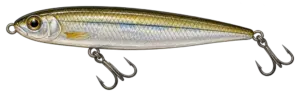
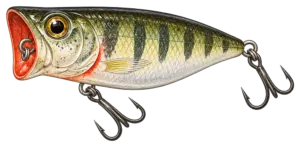
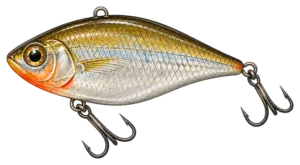
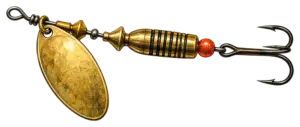
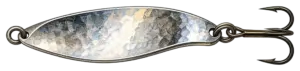

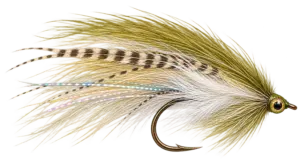
AI-generated illustrations. A click opens the lure’s page.
Rigs for these lures: sbirolino rig.
What the asp offers in the kitchen
In taste the asp has a good reputation, but it is one of the boniest fish in Central Europe. About 140 fine intermuscular bones sit in its flesh, which is why it is little sought after as a food fish. On the back there are rows of Y-bones on both sides, with more long bones in the rear part of the body. They are laborious to remove, and what stays in the fillet is a nuisance when eating.
Anyone who keeps an asp should therefore expect some work. Hot-smoked fillets can, from anglers‘ experience, be put to good use despite the bad reputation. How to free the fillets cleanly from the backbone is shown by filleting fish. Elsewhere, by the way, the species is fished commercially and also kept in aquaculture.
What you need to observe
The asp is listed in Annex II of the Habitats Directive (FFH). In Germany’s Red List of 2023 it is regarded as not threatened. The Rote-Liste-Zentrum describes the stock as rare, with a moderate decline in the long term and a clear increase in the short term. The Bundesamt für Naturschutz names dams, water pollution and water-level regulation as threats.
Closed seasons (Schonzeit), minimum sizes (Mindestmaß) and harvest windows are set by the federal states (Bundesland), and on many waters additionally by the club or leaseholder. They differ depending on the water and the time of year. We give figures only with a date and a source; always binding are the fisheries regulation of your federal state and your fishing permit (Erlaubnisschein). You will find a list of links to the official sources in the catch calendar.
A fish of legal size that you want to keep you stun and kill at once, in line with animal welfare rules. Protected, undersized fish or fish too large under a harvest slot you unhook, if possible still in the water and with wet hands, and release gently. What exactly applies is regulated by state law and your fishing permit (Erlaubnisschein).
What closed season, minimum size and harvest slot mean and where to find them is explained on the page Closed season and minimum size explained.
What state law prescribes for the closed season (Schonzeit) and minimum size (Mindestmaß) of this species is given in the “At a glance” box on the state pages for Berlin, Brandenburg, Bremen, Hamburg, Lower Saxony, Saxony, Saxony-Anhalt and Thuringia. For the other states our overview does not list this species; there the state fisheries regulation (Landesfischereiverordnung) is decisive.
Frequently asked questions (FAQ)
Where does the asp hold in a river?
On current edges, for example behind groynes, below weirs and at outfalls, as well as at bridge piers and in mid-river. In summer, hunting strikes at the surface give it away.
How can I tell an asp from a chub?
In the asp the outer edge of the dorsal and anal fins is curved inwards. Added to that are the wide gape reaching below the eye and the knob on the lower jaw.
Why do I lose so many fish in the fight with asp?
The bite comes as a jerk, and hooks pull out easily if the fish is played too hard. A rod that is not too stiff and line from 0,20 mm absorb the jerk better.
Sources
The rating of catch chances is an editorial assessment. The facts come from these sources, and the text is worded in our own words. The illustration is an original design by Angel Momente in the style of a natural history plate (AI-generated, see the AI notice).
- Landesfischereiverband Bayern: Fischlexikon (Laichzeit, Lebensraum, Nahrung, Aktivität)
- FishBase: Leuciscus aspius (Höchstlänge, Höchstalter, Schuppenzahl, Lebensweise)
- Bundesamt für Naturschutz: Artenporträt Leuciscus aspius (Verbreitung, Geschlechtsreife, Nahrung, FFH-Anhang II)
- Rote-Liste-Zentrum: Rapfen (Rote Liste der Süßwasserfische Deutschlands 2023: ungefährdet)
- Blinker: Steckbrief Rapfen (Standplätze, Jagdverhalten, Köder, Gerät)
- Landesamt für Umwelt, Naturschutz und Geologie Mecklenburg-Vorpommern: Artensteckbrief FFH-Art Rapfen (Aspius aspius)
- Sächsisches Landesamt für Umwelt und Geologie: Kartier- und Bewertungsschlüssel FFH-Art Rapfen (Stand März 2008)
- Hessen-Forst FENA: Artensteckbrief Rapfen (Stand 2003)
- Blinker: Angeln auf Rapfen, die besten Tipps und Tricks (Laichzeit, Beißzeiten, Standplätze, 2023)
- Blinker: Zielfisch Rapfen, so klappt’s mit den rasenden Räubern (Laichzeit bis Mai, beste Zeit ab Juni, 2012)
- Brandenburg: Fischereiordnung (BbgFischO), Schonzeiten
- NÖ Landesfischereiverband: Fischarten in Niederösterreich, Schied/Rapfen (Kennzeichen, Fleisch, Gräten)
- Wikipedia: Rapfen (Größe, Maul, Ernährung, Laichzeit, Gräten, FFH-Anhang II)
- Anglerverband Niedersachsen: Rapfen (Lebensraum, Standplätze in starker Strömung)
- FISCH & FANG: Zielfisch Rapfen, Fünf Richtige (Jagd über Sandbänken und im Flachwasser vor dem Schilf)
Created with AI support from the sources listed. Figures only appear in the text if a source gives them. Last updated: 8 November 2026. Found a mistake? Write to us. Who is behind this site: About me.
More in the lexicon
- All fish species at a glance
- Catch calendar – month, water temperature and profile for 93 species
- Line calculator – breaking strain after the knot, drag guideline, backing
- Angling methods