
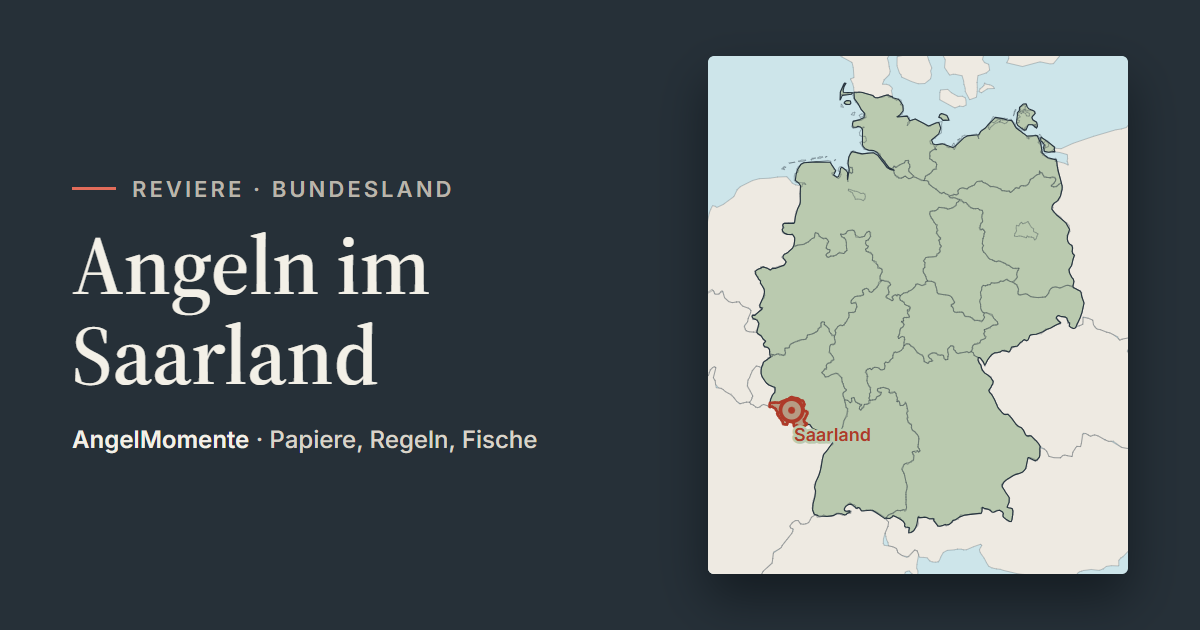
Waters · Federal state
Angling in Saarland: Fishing licence, rules, closed seasons and waters
Angling in Saarland requires a fishing licence (Fischereischein, colloquially Angelschein) and the fishing permit (Erlaubnisschein) for the water. The licence is issued by the municipality or the Fischereiverband Saar, which also holds the exam. On top of that there are strict rules: fishing at night and deliberately releasing fish is banned.
- Papers
- Fishing licence (Fischereischein) (levy included) and fishing permit (Erlaubnisschein)
- Fishing seasons
- no night fishing: Nov.–Mar. 7 pm–7 am, Apr.–Oct. 11 pm–5 am
As of October 2026
At a glance
- Papers
- Fishing licence (Fischereischein) (levy included) and fishing permit (Erlaubnisschein)
- Licence and permit
- Fishing seasons
- no night fishing: Nov.–Mar. 7 pm–7 am, Apr.–Oct. 11 pm–5 am
| Fish | Minimum size | Closed season | Note |
|---|---|---|---|
| Pike | 50 cm | 15.2.–31.5. | border stretch of the Moselle 1.1.–14.6., 1 per day |
| Zander | 45 cm | 15.2.–31.5. | Border Moselle 1.1.–14.6. |
| Barbel | 40 cm | 15.3.–15.6. | border Moselle (Grenzmosel) 35 cm |
| Common nase | 35 cm | 15.3.–15.6. | |
| Eel | 50 cm | none | |
| Carp | 35 cm | none | Grenzmosel 1.3.–14.6. |
| Tench | 25 cm | none | Grenzmosel 1.3.–14.6. |
| Brown trout | 25 cm | 1.10.–31.3. | |
| Grayling | 30 cm | 1.3.–30.4. | |
| Atlantic salmon | – | protected all year round | |
| Burbot | – | protected all year round |
Landesfischereiordnung Saarland (§§ 2, 4 and 5); on the border Moselle the Grenzfischereiverordnung. The fishing permit can be stricter. As of October 2026. The regulation and your fishing permit are what count.
The key points in brief
- Documents: Fishing licence and fishing permit. You pay the fishing levy at the same time when you get or renew the licence.
- Fishing licence: as an annual or five-year licence, issued by the municipality, city or Fischereiverband Saar. Licences from other federal states are also valid here.
- Children and young people: Under 16 there is a junior fishing licence without an exam; with it you fish only under the supervision of an adult licence holder.
- Guests: Adults without a place of residence in Germany get a licence without an exam, valid for up to three months a year.
- Banned: night fishing, more than two rods, live baitfish and catch and release.
- Border Moselle: Here you need a fishing permit of its own instead of the fishing licence, issued in Perl or online.
As of October 2026. The Saarland fisheries act (Fischereigesetz) and the Landesfischereiordnung were last amended in 2021. The act, the regulation and the provisions of your fishing permit are what count.
Fishing licence and exam Annual fishing licence in Saarland
When fishing you carry a fishing licence in your name. Fishing licences from other federal states are treated the same as the Saarland one, whereas licences and exams from abroad are not recognised by Saarland. The licence comes as an annual licence for one calendar year or as a five-year licence, and you can renew both. The local police authority (Ortspolizeibehörde) of your place of residence is responsible, or the one at the place of fishing if you do not live in Saarland, plus the Fischereiverband Saar. In practice that means you apply at any municipal or city administration or at the office of the Fischereiverband Saar.
The angling exam is held by an examination board of the Fischereiverband. The association sets dates as needed, at least once a year, and may require a minimum of 20 participants. You are admitted from the age of 13 and after a preparatory course run by the association or a body commissioned by it, online or in person according to the Fischereiverband. The regulation also requires a club placement; ask the association when you can complete it. The exam is written: 60 questions in two hours, and you pass with at least 45 correct answers. The fee is set by the Landesfischereiordnung: 100 euros for adults and 50 euros for minors. You get the normal fishing licence after passing, from the age of 14. If you do not live in Saarland, check beforehand whether your home state recognises the exam and licence from here. The association itself points out that states with a residence principle may refuse this.
Without an exam: guests, holidaymakers, children Junior fishing licence and guests from abroad
- Junior fishing licence: Under 16 you get it without an exam. It is valid for a calendar year and only if an adult licence holder supervises. From which age the municipality or association issues it, you can ask there.
- Guests from abroad: Anyone who is an adult and has no place of residence in Germany is exempt from the exam. The licence is valid for a year, but only in three months at most, which you choose yourself and which are entered on the licence. The Fischereiverband Saar sells it as a tourist licence.
- People with disabilities: An adult who has an intellectual disability of degree 50 or more, or who proves with a severe disability card and a specialist medical certificate that they cannot pass the exam, does not need the exam. Fishing is then done under the supervision of an adult licence holder.
- Border Moselle: On the Moselle along the border with Luxembourg a fishing permit under the Grenzfischereiverordnung is enough; a fishing licence is not needed. It officially costs 15 euros a year, 10 euros a month or 5 euros for a week. In Saarland it is issued by the Perl municipal administration and also online via the Luxembourg citizens‘ portal. Under 14 you fish there only under the supervision of an adult permit holder.
Fishing permit and fishing levy Fishing permit as a day or annual permit
Where you are not yourself the fishing rights holder or leaseholder, you additionally need their fishing permit. It can be issued electronically, is valid for one year at most and ends with the calendar year. It is issued by the fishing rights holders and leaseholders. According to the Fischereiverband Saar, day and annual permits are available on the spot and online.
The fishing levy is charged together with the fee when you get or renew the licence. It is 8 euros for the annual licence, 40 euros for the five-year licence and 2.50 euros for the junior fishing licence. For people with disabilities it is 5 or 25 euros. 80 per cent of the revenue goes to the Fischereiverband Saar.
Closed seasons and minimum sizes Landesfischereiordnung of Saarland
The values in the „At a glance“ box come from the Landesfischereiordnung of Saarland (§§ 2, 4 and 5). They apply in open and closed waters. Protected all year round are, among others, salmon, sea trout, burbot, bullhead, minnow and sunbleak. After stocking with catchable fish you may not fish for the stocked species for two weeks. You release undersized and protected fish immediately and carefully. Invasive species with neither a minimum size nor a closed season, however, you must land. The border Moselle has its own law: from 1 March to 14 June all fishing is suspended there, pike and zander are protected from 1 January to 14 June, and a maximum of three trout or grayling and one pike a day is allowed.
Special rules Night fishing ban, two rods and releasing
- Night fishing: banned. Night means 7 pm to 7 am from November to March and 11 pm to 5 am from April to October. On enclosed waters the ban applies from an area of 5 hectares, and the Fischereiverband can allow exceptions in justified cases.
- Rods: two at most at the same time.
- Catch and release: Fishing geared from the outset to releasing the fish is banned.
- Bait: only dead baitfish from the water in which you fish. Dyed maggots, dyed groundbait and bloodworms are banned.
- Keepnet: only for fish that you want to eat or relocate, and you may not release them afterwards. Knotless textile nets of 3.5 m in length or more with rings of at least 50 cm are allowed, with at most 5 kg of fish for eating and not in choppy water.
- Light and events: Artificial light as a fishing aid is banned. Group fishing must be registered with the Fischereiverband.
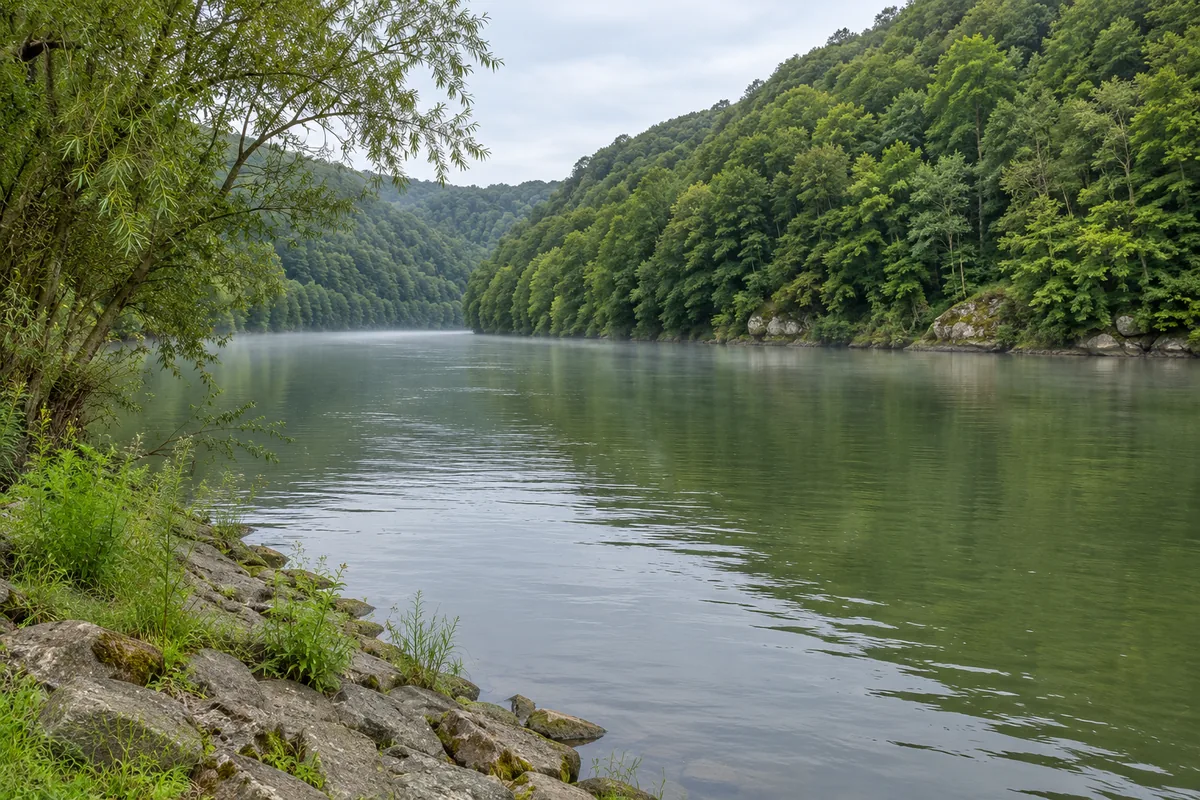
Waters in the state Moselle, Saar, streams and ponds
From Schengen to the border with Rhineland-Palatinate the Moselle is a shared border water of Luxembourg and Saarland, with its own fishing permit and its own closed seasons. In the rest of the state you fish on the Saar and on smaller rivers, streams and ponds. The Fischereiverband Saar breeds its own brown trout for stocking rivers and streams. How things continue downstream is described on Fishing in Rhineland-Palatinate. The Bostalsee in the north of the state has its own profile. You will find every stream and lake in the Water Atlas Germany, and an overview of all states on Fishing in Germany.
Related
- Fishing licence and angling exam and Fishing permit and water map
- Closed season and minimum size explained and the catch calendar
- Stunning and killing fish and trout in the fish lexicon
- Neighbouring state: Rhineland-Palatinate
- Fishing ponds and trout lakes in and around Saarland: search by postcode and radius, also across the state border
Sources
- Saarländisches Fischereigesetz (SFischG), §§ 27 bis 36
- Landesfischereiordnung Saarland (LFO), §§ 2 bis 14, 27 bis 36 und 46
- Grenzfischereiverordnung Saarland und Vertrag über die Grenzgewässer mit Luxemburg und Rheinland-Pfalz
- Leistungsbeschreibung Angelerlaubnisschein Grenzgewässer (FIM-Portal) und Guichet.lu: Fischereierlaubnisschein für die Grenzgewässer
- Fischereiverband Saar: Fragen und Antworten, Fischerprüfung und Gewässer und Zuchtanlage
A guide with no guarantee, as of October 2026. What counts is the Saarland fisheries act (Saarländische Fischereigesetz), the state fisheries ordinance (Landesfischereiordnung), the border fisheries regulation (Grenzfischereiverordnung) and the terms of your fishing permit (Erlaubnisschein).