
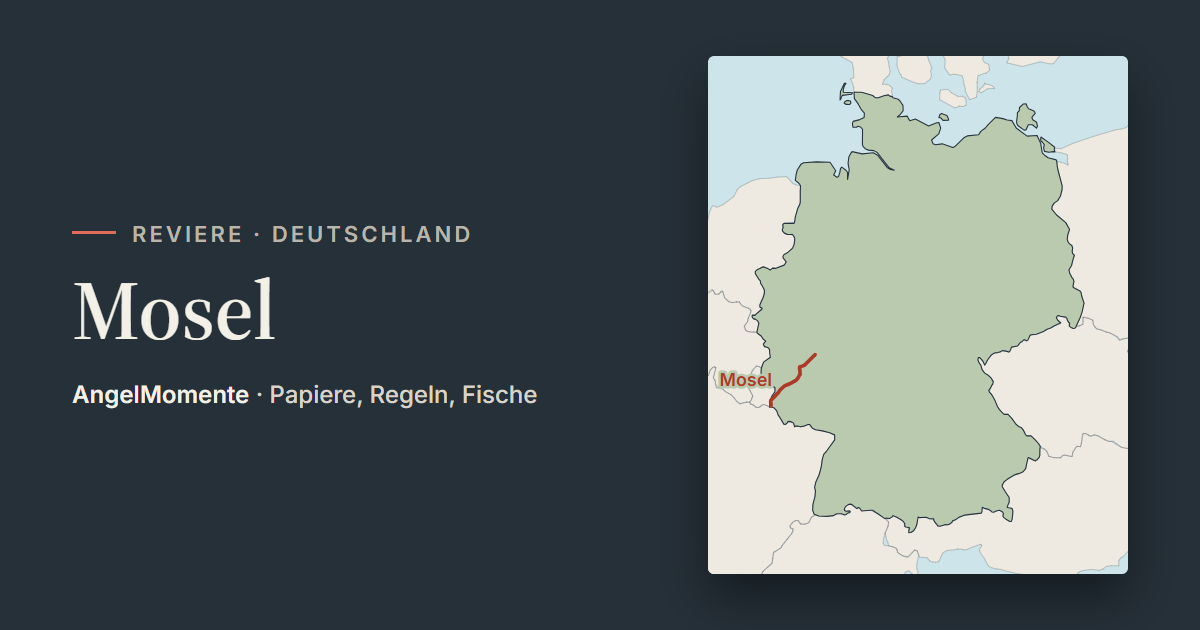
Waters · Germany
Fishing on the Moselle
The Moselle enters Germany at the tripoint near Perl and flows into the Rhine at Koblenz after about 242 kilometres. For the first 36 kilometres it forms the border with Luxembourg, then it flows through Rhineland-Palatinate. Both sections have their own papers and their own closed seasons.
- Papers
- Fishing licence + fishing permit, border stretch fishing permit only
- Season
- Border stretch: fishing ban 1.3.–14.6.; rest of the Moselle all year, 15.4.–31.5. no artificial lures
As of October 2026
At a glance
- Papers
- Fishing licence + fishing permit, border stretch fishing permit only
- Licence and permit
- Season
- Border stretch: fishing ban 1.3.–14.6.; rest of the Moselle all year, 15.4.–31.5. no artificial lures
- Fishing seasons
- Border stretch: no night fishing (April to October 23–5 hrs, otherwise 19–7 hrs)
| Fish | Minimum size | Closed season | Catch limit | Note |
|---|---|---|---|---|
| Zander | 45 cm | 15.3.–15.5. | – | Border stretch: 1.1.–14.6. |
| Pike | 50 cm | 1.2.–31.5. | Border stretch: 1 a day | Border stretch: 1.1.–14.6. |
| Barbel | 35 cm | 1.5.–15.6. | – | Border stretch: 1.3.–14.6. |
| Eel | 50 cm | none | – | Border stretch: fishing ban 1.3.–14.6. |
| Wels catfish | – | none | – | RLP: landing obligation (§ 21 LFischO); border stretch: fishing ban 1.3.–14.6. |
| Asp | – | none | – | RLP: landing obligation (§ 21 LFischO); border stretch: fishing ban 1.3.–14.6. |
| Carp | 35 cm | none | – | Border stretch: 1.3.–14.6. |
| Roach | 15 cm | none | – | Border stretch: 1.3.–14.6. |
State fisheries regulation of Rhineland-Palatinate for the Moselle below the border stretch; on the border stretch itself the border fisheries regulation applies. The fishing permit may be stricter. Status: October 2026. What counts are the regulation and your fishing permit.
Location and waters Border stretch and the German Moselle to Koblenz
As a federal waterway, the Moselle runs from the French border at Apach to the Rhine (Bundeswasserstraßengesetz, Anlage 1). From the border to the mouth of the Sauer at Wasserbillig lies the German-Luxembourg stretch with two barrages. After that come 206 kilometres of German stretch with ten barrages as far as Koblenz (WSA Mosel-Saar-Lahn).
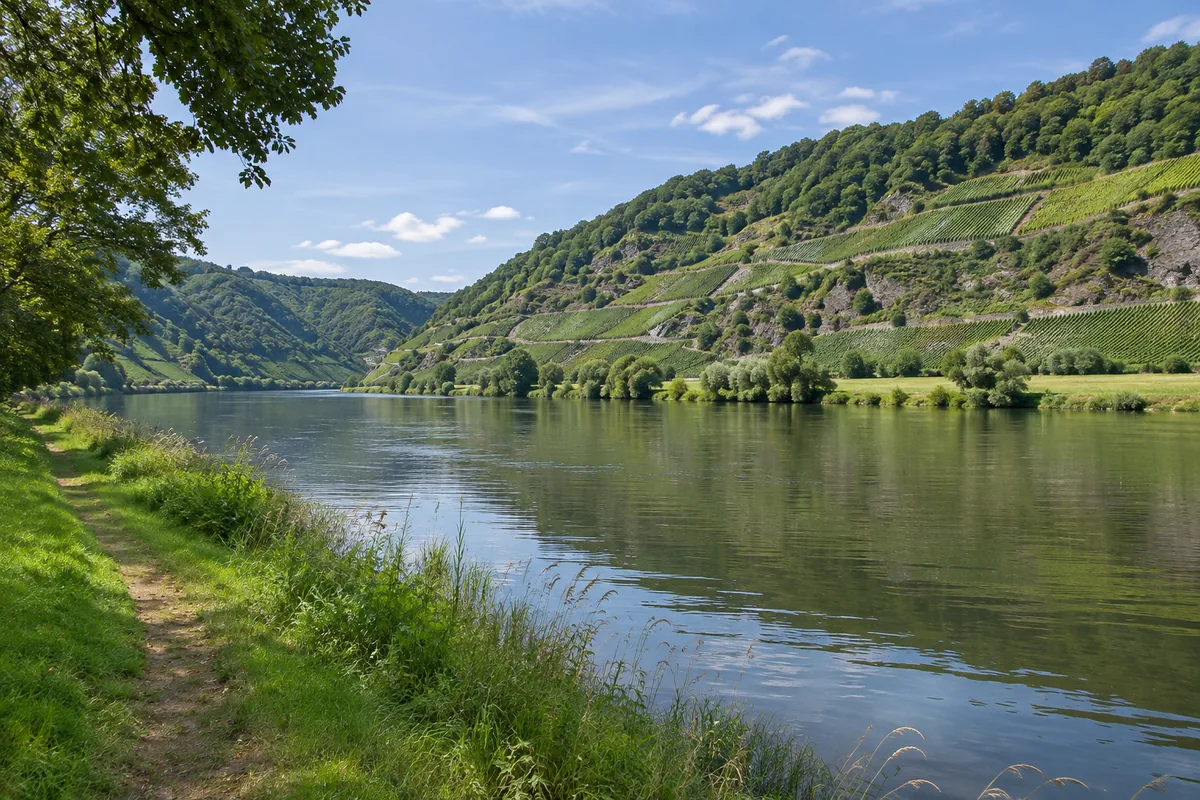
The barrages divide the river into impounded reaches. Each has a lock for shipping, and at seven there are also boat passes for small boats. The valley is narrow and winding, and the tightest bend for shipping is the Bremmer Bogen.
The border stretch is under the joint sovereignty of Luxembourg and Germany. On the German side its upper part belongs to Saarland and the lower part, as far as Wasserbillig, to Rhineland-Palatinate. The riparian states hold the fishing rights there jointly (Staatsvertrag über die Grenzgewässer).
Fish and best time Zander, pike, wels catfish, asp and barbel
In the fish pass at the Koblenz barrage, the Bundesanstalt für Gewässerkunde counted over 230.000 ascending fish of 28 species in 2015. Most were young roach and asp, plus chub, dace and common nase (BfG, 10.04.2017).
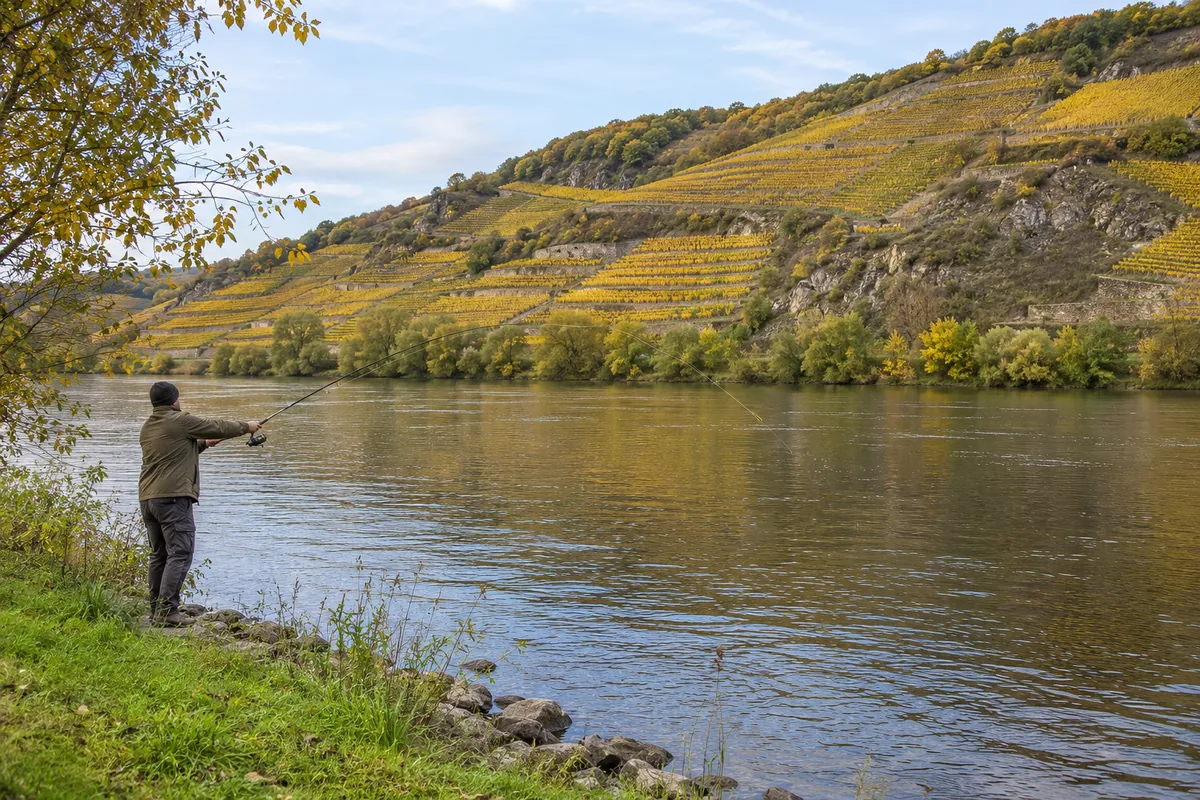
For the impounded reaches from Koblenz to Trier, the state’s fishing permits list these target fish (Angelkarten-Verkauf im Auftrag der SGD Nord):
- Predators: zander, pike, wels catfish, asp and perch
- Coarse fish and eel: barbel, eel, carp, common nase, ide, chub and tench
You may not catch salmon, sea trout and burbot anywhere on the Moselle. The catch calendar shows when each species bites. The closed seasons in the box always come first.
Papers and permit Fishing licence, guest permit and fishing permit
On the Rhineland-Palatinate stretch you need the fishing licence (Fischereischein, colloquially Angelschein), proof of the fishing levy (Fischereiabgabe), an official photo ID and the fishing permit (Erlaubnisschein). If you live in another federal state, you fish with its fishing licence. If you do not live in Germany, you can get a guest permit (Gastkarte) for up to 30 days, twice a year at most. Children from the age of seven fish without a licence of their own if an adult with a fishing licence is with them (Landesfischereigesetz, §§ 33, 36, 37 and 41).
- Koblenz to Trier: The stretches are managed by the Struktur- und Genehmigungsdirektion Nord on behalf of the state. Since 1 June 2025 fishing permits have been available online as a PDF, and the outlets on site still sell them (SGD Nord).
- Border stretch Perl to Wasserbillig: Here the fishing permit is enough; a state fishing licence is not needed (Land Rheinland-Pfalz). You need the permit from age 14; younger people fish under the supervision of an adult permit holder. It is also valid on the Sauer and Our.
- Issue on the border stretch: bank permit (Uferschein) or boat permit (Nachenschein), each for a year, a month or a week. The annual bank permit costs 15 euros, the annual boat permit 40 euros. They are issued by the Verbandsgemeinden Arzfeld, Südeifel, Konz and Trier-Land, and in Saarland by the municipality of Perl (Grenzfischereiverordnung Rheinland-Pfalz, §§ 1 and 2). Online it works through the Luxembourg portal MyGuichet (Guichet.lu).
Special rules Spring closed season and bait rules
- Spring closed season: Below the border stretch, the spring closed season (Schonzeit) runs from 15 April to 31 May. Spinners, spoons and other lures are banned then; only artificial fly remains allowed (Landesfischereiordnung, § 18). According to the SGD Nord leaflet, this also applies to deadbait and strips of fish.
- Bait and keepnets: In Rhineland-Palatinate you may not fish with live baitfish. On waters with shipping traffic, keeping fish in a keepnet (Setzkescher) is banned (Landesfischereiordnung, §§ 26 and 29). The state’s fishing permits allow two rods at most.
- Protected zones: There are fish sanctuaries at the weirs and locks where you may not fish at all during the year. In the spawning sanctuaries, fishing is suspended from 15 March to 15 June. Several harbours have a fishing or entry ban, and the Reiherschussinsel near Lehmen is completely closed as a nature reserve (SGD Nord, Merkblatt zum Erlaubnisschein).
- Border stretch: From 1 March to 14 June all fishing is banned. At night the rods rest: between 23:00 and 5:00 from April to October, otherwise between 19:00 and 7:00. Two hand lines are allowed, which you must not leave unattended, and one pike a day. With the bank permit (Uferschein) you fish from the bank only; bridges, jetties, locks and weirs do not count as bank. There are closed stretches at the Palzem and Grevenmacher locks (Grenzfischereiverordnung, §§ 4 bis 7).
Correct as of October 2026. The exact limits of the sanctuaries, harbours and closed stretches are in the leaflet that comes with the fishing permit (Erlaubnisschein). Whether you may fish at night on the Rhineland-Palatinate stretch is set by your permit. The regulations and the fishing permit are what count.
Safety
- Locks and weirs: You may not enter federally owned locks, weirs and refuge harbours for any purpose other than their intended use (§ 2 WaStrBAV).
- Water level: PEGELONLINE shows the gauges of the waterway from Perl to Koblenz, for example the Cochem gauge. The values are raw data from the current day, unchecked. More under Banks and waders and, if you fish from a punt, under Boat and life jacket.
Related
- Fishing on rivers: reading current, eddies and weir pools
- Fishing in Rhineland-Palatinate and Fishing in Saarland: fishing licence, exam and levy
- Rhine: the river the Moselle flows into at Koblenz
- In the fish encyclopaedia: zander, barbel, wels catfish, asp and eel
- Closed season and minimum size explained
Sources
- Landesrecht Rheinland-Pfalz: Landesfischereigesetz (geändert am 11.02.2026), Landesfischereiordnung und Landesverordnung über die Fischerei in den Grenzgewässern Mosel, Sauer und Our
- Landesrecht Saarland: Grenzfischereiverordnung vom 11. Mai 2020 und Vertrag mit Luxemburg über die Grenzgewässer
- SGD Nord: Angelkarten für die Mosel online, mit Merkblatt zum Erlaubnisschein
- Guichet.lu: Fischereierlaubnisschein für Grenzgewässer zu Deutschland
- Wasserstraßen- und Schifffahrtsamt Mosel-Saar-Lahn: Die Mosel und PEGELONLINE
- Bundesanstalt für Gewässerkunde: Fischaufstiegsanlage Koblenz (10. April 2017)
Guide without guarantee, correct as of October 2026. What counts are the state fisheries act (Landesfischereigesetz) and the Landesfischereiordnung of Rhineland-Palatinate, the Grenzfischereiverordnungen of Rhineland-Palatinate and Saarland, the regulations for the waterway and the conditions in the fishing permit.