
Waters · Germany
Fishing on the Rhine
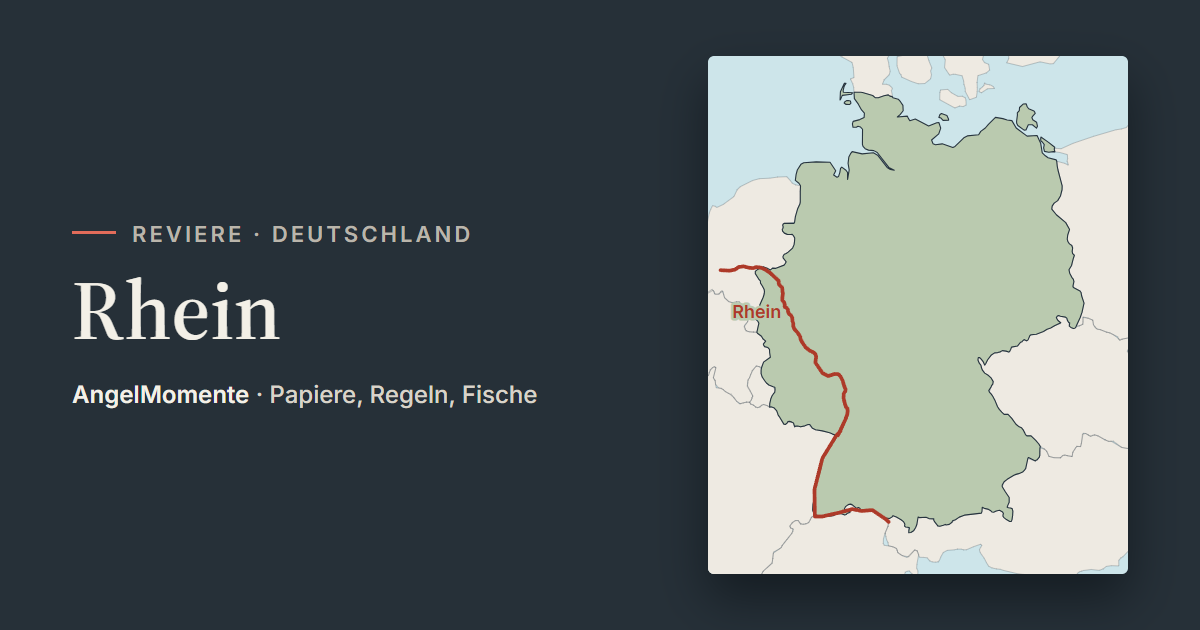
The Rhine accompanies Germany from the High Rhine (Hochrhein) on the Swiss border to the Lower Rhine (Niederrhein) before the Netherlands. From Rheinfelden it is a waterway for large shipping, with groynes, harbours and wash. The permit (Erlaubnisschein) is issued by a different body in each state.
- Papers
- Fishing licence (Fischereischein) and permit (Erlaubnisschein) for the state stretch
- Fishing seasons
- NRW: night fishing allowed all year, banned from a boat
As of October 2026
At a glance
- Papers
- Fishing licence (Fischereischein) and permit (Erlaubnisschein) for the state stretch
- Licence and permit
- Fishing seasons
- NRW: night fishing allowed all year, banned from a boat
| Fish | Minimum size | Closed season | Catch limit | Note |
|---|---|---|---|---|
| Zander | 40 cm | 1.4.–31.5. | 3 per day | |
| Pike | 45 cm | 15.2.–30.4. | 3 per day | |
| Barbel | 35 cm | 15.5.–15.6. | – | |
| Eel | 50 cm | 1.10.–1.3. | 3 per day | Closed season (Schonzeit) in the main Rhine stream |
| Common nase | 30 cm | 1.3.–30.4. | – | |
| Carp | 35 cm | none | 3 per day | |
| Asp | – | none | – | |
| Wels catfish | – | none | – | |
| Atlantic salmon | – | protected all year round | – | Report the catch within 7 days |
| Sea trout | – | protected all year round | – | Report the catch within 7 days |
State law of North Rhine-Westphalia (LFischVO NRW) and the permit (Erlaubnisschein) of the Rheinfischereigenossenschaft; in Hesse, Rhineland-Palatinate and Baden-Württemberg other values apply. Correct as of October 2026. What counts are the regulation and your permit.
Location and waters High Rhine, Upper Rhine, Middle Rhine and Lower Rhine
- High Rhine (Hochrhein): begins at Stein am Rhein at the outflow of the Untersee and reaches Basel. Here the river is the border with Switzerland, and fishing is on both sides.
- Upper Rhine (Oberrhein): from Basel to Bingen through the Upper Rhine Plain. From the tripoint near Basel to Au am Rhein near Karlsruhe it is the border with France (WSA Oberrhein).
- Middle Rhine (Mittelrhein): from Bingen to Bonn in the narrow valley through the Rhenish Slate Mountains.
- Lower Rhine (Niederrhein): from Bonn to the Dutch border (IKSR).
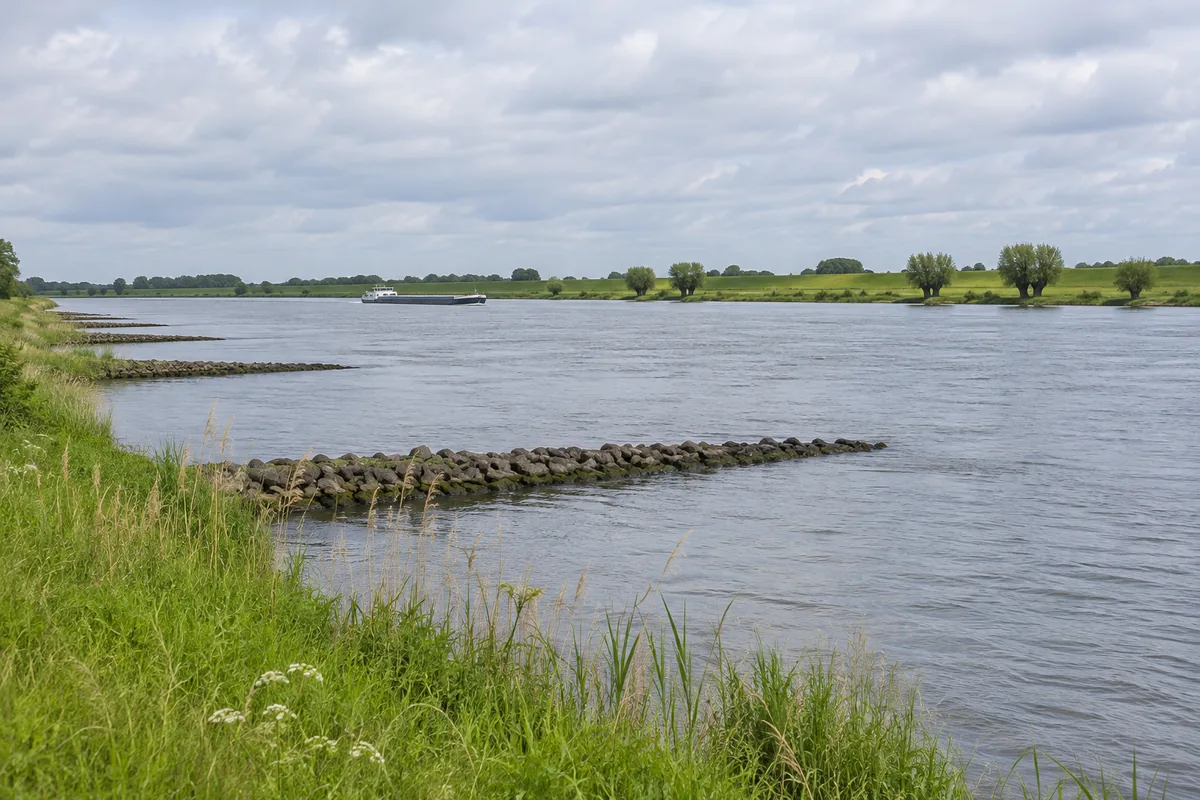
From the mouth to Basel and Rheinfelden the river has been developed for large shipping over about 800 km (IKSR). Groynes control the current: between them the water flows more slowly, towards the middle of the river faster (DLRG Rhein-Sieg).
Fish and best time Barbel, chub, wels catfish, asp, salmon and sea trout
The International Commission for the Protection of the Rhine counts 71 fish species in the river, lampreys included. Salmon and sea trout have returned (IKSR). From its report on the years 2018 and 2019:
- Barbel and chub made up the most fish in the catch on the High Rhine. Barbel plays a dominant role only there now.
- Wels catfish and asp have increased in recent decades.
- Zander, asp and common nase reproduce in the Lower Rhine (Niederrhein), where juvenile fish have been recorded.
- Gobies: Several species have migrated in via the Main-Danube Canal (IKSR). In the northern Upper Rhine (Oberrhein) the round goby made up 40,8 per cent of the catch.
What bites when is shown by the catch calendar.
Papers and permit Fishing licence and fishing permit for each stretch
You need the fishing licence (Fischereischein) and a permit (Erlaubnisschein) for your stretch:
- North Rhine-Westphalia: The Rheinfischereigenossenschaft issues a permit for the main stream of the whole state stretch. When buying you show a valid German fishing licence. Harbours, oxbow lakes, gravel pits and tributaries are not included. Since 1 July 2026 children from their 10th birthday to the day before their 16th birthday do not need a fishing licence if a holder of a fishing licence accompanies them (§ 31 Landesfischereigesetz NRW). They still need a permit (Erlaubnisschein), and on the Rhine they get the reduced permit (Rheinfischereigenossenschaft).
- Hesse: The Hessian stretch runs on the right bank of the Rhine from Rhine km 437 to 544. The permit (Erlaubnisschein) is available via the Hessische Landgesellschaft, online only since 2025.
- Rhineland-Palatinate: In the Palatinate and Rhenish Hesse the Struktur- und Genehmigungsdirektion Süd issues the permits itself, via issuing points whose lists it publishes (SGD Süd). On the Middle Rhine near Koblenz the Landesfischereiverband Rheinland-Pfalz is one of the tenants. For one Rhine stretch the SGD Nord also sells permits online (SGD Nord). Since 19 February 2026 new rules apply in the fisheries act: fishing licences from other states are recognised if you do not live in Rhineland-Palatinate. Children from 7 to 17 years fish without a licence if an adult with a fishing licence is present. Visitors without residence in Germany get a guest permit (Gästeschein) at most twice a year for up to 30 days (Landesfischereigesetz RLP, §§ 33 und 37).
- Baden-Württemberg: The state leases out its fishing rights. On the High Rhine near Reckingen the tenants are clubs, and the state also issues its own permits (Erlaubnisschein). On the Swiss side the cantons lease out the waters and the tenants issue the permits (Fachbericht für das Regierungspräsidium Freiburg). On the Upper Rhine near Philippsburg the Landesfischereiverband Baden-Württemberg is the tenant, and association members get its guest permits for the main Rhine stream (LFV Baden-Württemberg).
- Border Rhine with France: On the French bank separate rules apply, with a separate fishing permit. The fisheries federation of the Bas-Rhin département explains them in German (Fédération de pêche du Bas-Rhin, Stand 2024).
Special rules Salmon and sea trout protected, rules in each state
- Salmon and sea trout: In North Rhine-Westphalia neither may be taken home at any time of year. You report a catch to the lower fisheries authority (Fischereibehörde) within seven days (Landesfischereiverordnung NRW). In Hesse salmon is protected all year and may not be fished for. Atlantic trout over 60 cm are put back there immediately (Regelungen am hessischen Rhein 2026).
- Catch limit and eel: With the Rhine permit in North Rhine-Westphalia you may catch at most three each of eel, trout, pike, carp or zander per day (Ausübungsbestimmungen). Because of pollutants the Bundesinstitut für Risikobewertung advises not to eat eels from German rivers.
- Night, boat and tackle: On the Rhine in North Rhine-Westphalia you may fish at night all year round. Fishing from a boat is banned there, as are keepnets and live baitfish (Ausübungsbestimmungen). In Hesse a boat is allowed if it is moored or has a GPS anchor.
- Ban zones: In North Rhine-Westphalia protected areas restrict the permit, often without a sign. The ban zones are shown on an information map of the Rheinfischereigenossenschaft. In Hessian harbours with a hazard-prevention regulation fishing is banned unless the harbour authority allows it. The Regierungspräsidium Karlsruhe regularly prosecutes fishing near fish passes (Meldung vom 20.05.2025).
- Federal waterway: You must not enter federal groynes, weirs and dykes except for their intended purpose. Bankside plots and service roads are allowed on foot, at your own risk (§ 2 WaStrBAV). Exceptions are granted by the Wasserstraßen- und Schifffahrtsamt, also by sign (§ 3, § 6).
Correct as of October 2026. The values in the box apply in North Rhine-Westphalia. If you fish in Hesse, Rhineland-Palatinate, Baden-Württemberg or on the French bank, read the closed seasons and sizes on your permit (Erlaubnisschein) or ask the body that issues it. The fishing rights in the Palatinate and Rhenish Hesse are currently being re-awarded, so the issuer may change there. What counts are the regulations and the conditions on your permit.
Safety
- Suction and waves: A ship first pulls the water towards the middle of the river, then the wave hits the bank (DLRG Rhein-Sieg). The Landesfischereiverband Rheinland-Pfalz advises not to step onto groynes.
- Gauge level: Rising levels make the current faster. Even at low water currents can shift and become more dangerous. Near hydroelectric plants the water level changes suddenly (WSA Oberrhein, 29.06.2026). The current water levels of the federal waterways are shown by PEGELONLINE, check there before you set off.
- Emergency call: Dial 112 and give the Rhine kilometre from the nearest sign on the bank. More under Bank and waders.
Related
- Fishing a river and Fishing in Germany
- The states on the Rhine: North Rhine-Westphalia, Hesse, Rhineland-Palatinate and Baden-Württemberg
- On the same river: Lake Constance, Switzerland and the Netherlands, plus the tributaries Moselle and Main
- Species in the Rhine: zander, barbel, asp, wels catfish, eel
- Closed season and minimum size explained and Returning fish
Sources
- IKSR: Fische im Rhein 2018/2019, Bericht Nr. 279 (2021) und IKSR: Fische im Rhein
- Rheinfischereigenossenschaft NRW: Erlaubnisscheine und Neuerungen im Landesfischereigesetz (02.07.2026)
- Landesfischereiverordnung Nordrhein-Westfalen (gültig ab 03.07.2026) und Landesfischereigesetz Nordrhein-Westfalen (Neufassung ab 01.07.2026)
- Hessisches Landwirtschaftsministerium: Fischereiliche Regelungen am hessischen Rhein, gültig ab 2026
- Landesfischereigesetz Rheinland-Pfalz (geändert am 11.02.2026, GVBl. S. 44), SGD Süd: Fischereierlaubnisscheine, SGD Nord: Angelkarten online und Landesfischereiverband Rheinland-Pfalz: Pachtgewässer
- Wasserstraßen-Betriebsanlagenverordnung
- WSA Oberrhein: Baden im Rhein bleibt lebensgefährlich (29.06.2026); DLRG Bezirk Rhein-Sieg: Gefahren an Flüssen; PEGELONLINE
Guide without guarantee, correct as of October 2026. What counts are the fisheries acts and regulations of the states on the Rhine, the conditions of your permit (Erlaubnisschein) and the Wasserstraßen-Betriebsanlagenverordnung as currently in force.