
Knowledge – Fish
Monkfish fishing
Fishing for monkfish means patiently working deep sand flats and dragging the bait along the bottom, because catching one on purpose is considered almost impossible. Here is the way there in nine steps, each with a link to the detailed page.
 Choose another fish117 fish with guides
 EelOff-peak season
 EelpoutPossible
 IdePossible
 ArapaimaGood
 GraylingPeak season
 Atlantic salmonSpawning time, please spare
 Brown troutSpawning time, please spare
 Brook troutSpawning time, please spare
 BarbelOff-peak season
 BarramundiSpawning season
 Greater amberjackGood
 Topmouth gudgeonOnly as bycatch
 Blue marlinSpawning season
 BonefishSpawning season
 BonitoGood
 BreamOff-peak season
 Dusky grouperOnly as bycatch
 CobiaPossible
 Spiny dogfishOnly as bycatch
 CodPeak season
 ChubPeak season
 MinnowOnly as bycatch
 European sturgeonOnly as bycatch
 FlounderPeak season
 PerchPeak season
 Largemouth bassGood
 Ballan wrasseOnly as bycatch
 Yellowfin tunaSpawning season
 Giant trevallyGood
 Prussian carpPossible
 BrillPossible
 Gilthead breamSpawning time, please spare
 Golden doradoSpawning season
 Golden mahseerOnly as bycatch
 Dolphinfish (mahi-mahi)Good
 Grass carpPossible
 Great barracudaGood
 GudgeonPossible
 White breamPossible
 DaceOff-peak season
 PikePeak season
 HalibutOff-peak season
 HerringPossible
 GarfishOut of season
 Huchen (Danube salmon)Possible
 Crucian carpOnly as bycatch
 CarpOff-peak season
 RuffeOff-peak season
 VendaceOnly as bycatch
 DabPeak season
 GurnardPossible
 Coley (saithe)Peak season
 Chinook salmonHardly any chance
 King mackerelSpawning season
 LingPeak season
 TuskOff-peak season
 MackerelPossible
 Bighead carpOut of season
 WhitefishPossible
 Conger eelOff-peak season
 Sea troutSpawning time, please spare
 Grey mulletPossible
 Murray codSpawning season
 MuskellungeGood
 Common nasePossible
 Nile perchPossible
 PayaraPossible
 Peacock bassPeak season
 PermitGood
 WeeverOnly as bycatch
 PollackOff-peak season
 BurbotOff-peak season
 AspPossible
 Red snapperSpawning season
 Rainbow troutPeak season
 RoosterfishGood
 RoachPeak season
 RedfishOut of season
 Bluefin tunaOnly as bycatch
 RuddPossible
 Russian sturgeonOnly as bycatch
 HaddockOff-peak season
 SnakeheadPossible
 TenchOff-peak season
 SpirlinOnly as bycatch
 PlaiceOff-peak season
 Greenland halibutOnly as bycatch
 Round gobyOnly as bycatch
 SwordfishGood
 Lake troutSpawning time, please spare
 HakeSpawning time, please spare
 Alpine charSpawning time, please spare
- MonkfishPossible
 SoleOff-peak season
 SailfishGood
 Silver carpOut of season
 SnookPeak season
 PumpkinseedOnly as bycatch
 SpratOnly as bycatch
 Atlantic wolffishSpawning time, please spare
 TurbotPeak season
 SterletOnly as bycatch
 SmeltOnly as bycatch
 Horse mackerelPossible
 TaimenGood
 TarponGood
 TigerfishSpawning season
 BleakPossible
 WahooGood
 Wels catfishOff-peak season
 WhitingPeak season
 Sea bassOff-peak season
 ZanderPeak season
 White-eye breamOnly as bycatch
 Blue breamOnly as bycatch
 Brown bullheadPossible
 VimbaOnly as bycatch
Season in October according to the catch calendar, an estimate and not a guarantee of a catch. The fish pictures are reduced natural-history plates and AI-generated.
Best time
From May to September, mostly at night.
In January: PossibleIn February: PossibleIn March: PossibleIn April: Possible, spawning seasonIn May: Good, spawning seasonIn June: Good, spawning seasonIn July: GoodIn August: GoodIn September: GoodIn October: PossibleIn November: PossibleIn December: Possible
Good spot
- Coast: sandy bottomsandy bottomsandy bottomdeep water
Top baits
Starter tackle
- Rod: sturdy boat rod
- Line: strong braid, around 20 kg breaking strain off Hitra
- Rod: 30 lb class boat rod
- Line: braid of around 20 kg breaking strain
- Hook: stainless single hook, 5/0 to 11/0
In short
In short: The best time to catch monkfish is from May to September, mostly at night. Good spots on the coast: sandy bottom. Proven baits: pirk, strips of fish or a soft plastic on a jig head, dragged slowly across sandy ground.
Quick to recognise
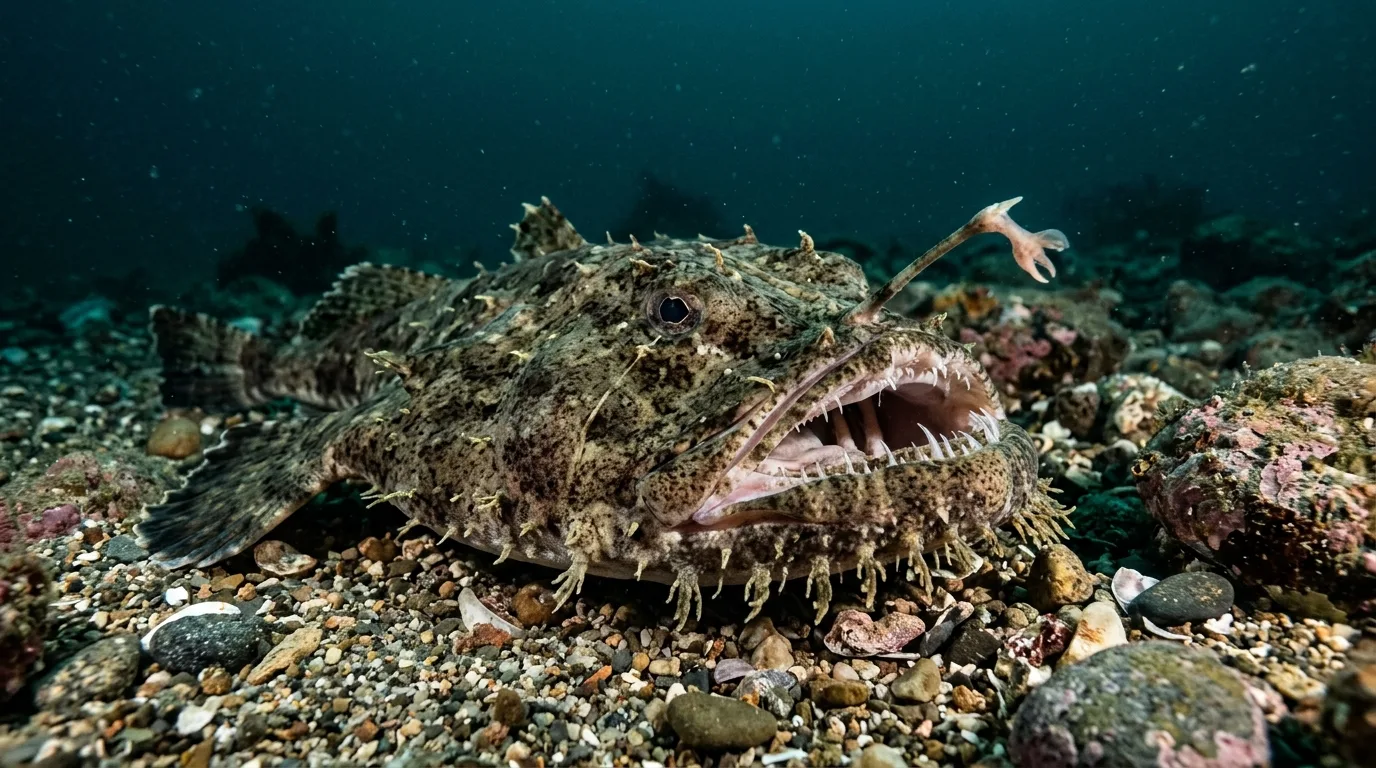
An ambush predator with a huge mouth and a lure on its head, lying half buried on the bottom, also called anglerfish or lotte. The skin has no scales; a typical length is about a metre, two at most.
When
Monkfish have no fixed fishing months; the place matters more than the season. In the catch calendar May to September count as good and the other months as possible. Spawning runs from April to June, according to Swedish sources into July; spawning takes place west of the British Isles on the continental slope, 1000 to 1800 metres deep, and also in Norwegian fjords.
- JanPossible
- FebPossible
- MarPossible
- AprPossible, spawning season
- MayGood, spawning
- JunGood, spawning
- JulGood
- AugGood
- SepGood
- OctPossible
- NovPossible
- DecPossible
Peak seasonGoodPossibleHardly any chanceSpawning season
Spring tactics
Some of the biggest angling catches in Norway date from spring: in April a fish of about 50 Pfund (500 g each) took off Flatanger, and at the beginning of May one of 1,26 m in the Masfjord north of Bergen.
Summer tactics
Off Iceland at the end of June, a fish of 45 Pfund (500 g each) took a bait at a depth of 50 m while the group drifted over the bottom from the boat.
Autumn tactics
In September catches came off Senja at 50 to 90 m and off Hitra at a steeply sloping reef, both as by-catch alongside cod and ling.
Winter tactics
No catch reports from anglers were found for winter. Monkfish migrate between feeding and spawning grounds, but a chance catch is still possible.
Is it biting today?
In January: PossibleIn February: PossibleIn March: PossibleIn April: Spawning season, please spare the fishIn May: Spawning season, please spare the fishIn June: Spawning season, please spare the fishIn July: Off-peakIn August: Off-peakIn September: Off-peakIn October: PossibleIn November: PossibleIn December: Possible
Today’s catch index needs JavaScript. Season and spawning time are in the catch calendar.
Where it is now
On the coast
Look for sand and mud bottoms, above all sand flats at greater depth; it is less common on rock. Tagged monkfish off the Faroes stayed at depths of less than 200 metres from May to September and moved down below 300 metres from November to February. Off the German coast it turns up only irregularly. In Swedish waters it lives mainly in the Skagerrak and Kattegat, in Norway from the shallow shore zone to deep fjords.
How to go about it: The documented catches come from Norway, from Senja via Hitra and Flatanger to the Masfjord, plus one from Iceland. The fish mostly bit at 50 to 90 m, over sand as well as on rocky edges. One big fish bit at the mouth of a fjord, another at the drop-off edge of a reef.
| Spring | Sandy bottom |
|---|---|
| Summer | Sandy bottom |
| Autumn | Sandy bottom |
| Winter | deep water |
Biting time: mostly at night. What this looks like in the water is shown by the picture of the holding spots just below.
Holding spots in the picture
Choose the season and time of day: the picture shows where the species stands then. Spots outlined in red apply only in the chosen season. Tap a fish or a spot in the list to bring it closer. The picture is schematic and AI-generated, every water is different.
Catch chance in springpossibleSpawning season, observe closed seasons
Catch chance in summergood
Catch chance in autumnpossible
Catch chance in winterpossible
- J
- F
- M
- A
- M
- J
- J
- A
- S
- O
- N
- D
Spawning season
No main time Tagged large monkfish off the Faroes moved mainly at night and settled down shortly after sunrise; overall they lay still on the bottom most of the time.
No main time Tagged large monkfish off the Faroes moved mainly at night and settled down shortly after sunrise; overall they lay still on the bottom most of the time.
No main time Tagged large monkfish off the Faroes moved mainly at night and settled down shortly after sunrise; overall they lay still on the bottom most of the time.
Active time Tagged large monkfish off the Faroes moved mainly at night and settled down shortly after sunrise; overall they lay still on the bottom most of the time.
On the coast
Sandy bottom
Monkfish are found here only in spring, summer and autumn.
Deep, colder water
Monkfish are found here only in winter.
The monkfish lies half buried on the bottom, usually on sand or mud. It is less common on rocky ground. There it waits for prey as an ambush predator.
Spring: according to the catch calendar, chances are possible in March and April and good in May. Spawning falls in this period, so observe closed seasons. On the Norwegian coast mature females are seen in shallow water in spring. Around the British Isles spawning lasts from April to June.
Summer: chances according to the catch calendar are good. In summer large monkfish stay on shallower feeding grounds above 200 metres.
Autumn: according to the catch calendar, the chance of a catch is good in September and possible in October and November.
Winter: chances according to the catch calendar are possible. In winter large monkfish move into deeper water below 300 metres, where the spawning grounds lie.
Depth: Monkfish occur at depths from about 20 to 1000 metres. Tagged large fish stayed shallower than 200 metres in summer and deeper than 300 metres in winter.
Size comparison: AI-generated drawing, schematic.
How
From the boat you drag the bait across the bottom with rod movements. The monkfish hunts passively, so the bait has to come almost right in front of its mouth. Expect many snags and take enough spare tackle.
Easiest way
Do not plan on monkfish as a target fish, but as possible by-catch on a boat trip in Norway. Your best chance is to pull a soft plastic on a jig head or a pirk along close to the bottom over deep sand flats. Pack plenty of spare lures; over such ground something often gets stuck.
Pirk or soft plastic close to the bottom
From a drifting boat in Norway, when you fish for cod, ling or tusk and deliberately keep the bait on the bottom.
- Deep sand flats
Use a sea chart and echo sounder to look for sand flats at greater depth. Documented catches came off Senja at 50 to 90 m and off Flatanger at around 90 m at the mouth of a fjord.
- Weight to suit the drift
Take a soft plastic on a jig head or a pirk. The weight depends on depth and drift: off Hitra anglers needed pirks of 450 to 600 g in a brisk drift over 35 to 70 m.
- Dragging along the bottom
Keep the bait on the sand with slow rod movements and do not let it jump far upwards. The monkfish waits motionless and takes only what passes close to its head.
- Apparent snag
The bite often feels like a solid snag. An angler off Flatanger first took his fish for an old crab pot; only when he pumped it up did it start to move.
- Pump steadily
The fish hardly runs; it hangs on the line mainly with its weight and broad fins. Pump it up calmly and without a pause; with a big one this can take half an hour.
Whole fish on the bottom
Natural baits from the boat at deep edges, when you are hoping for a monkfish as well as ling and tusk.
- Steep edges
Choose a reef or edge that drops steeply into the depths. Off Hitra a monkfish bit at a reef that runs steeply from 20 m down to 180 m; when deep-sea fishing at 140 to 300 m it is also part of the by-catch.
- Weight with a breaking point
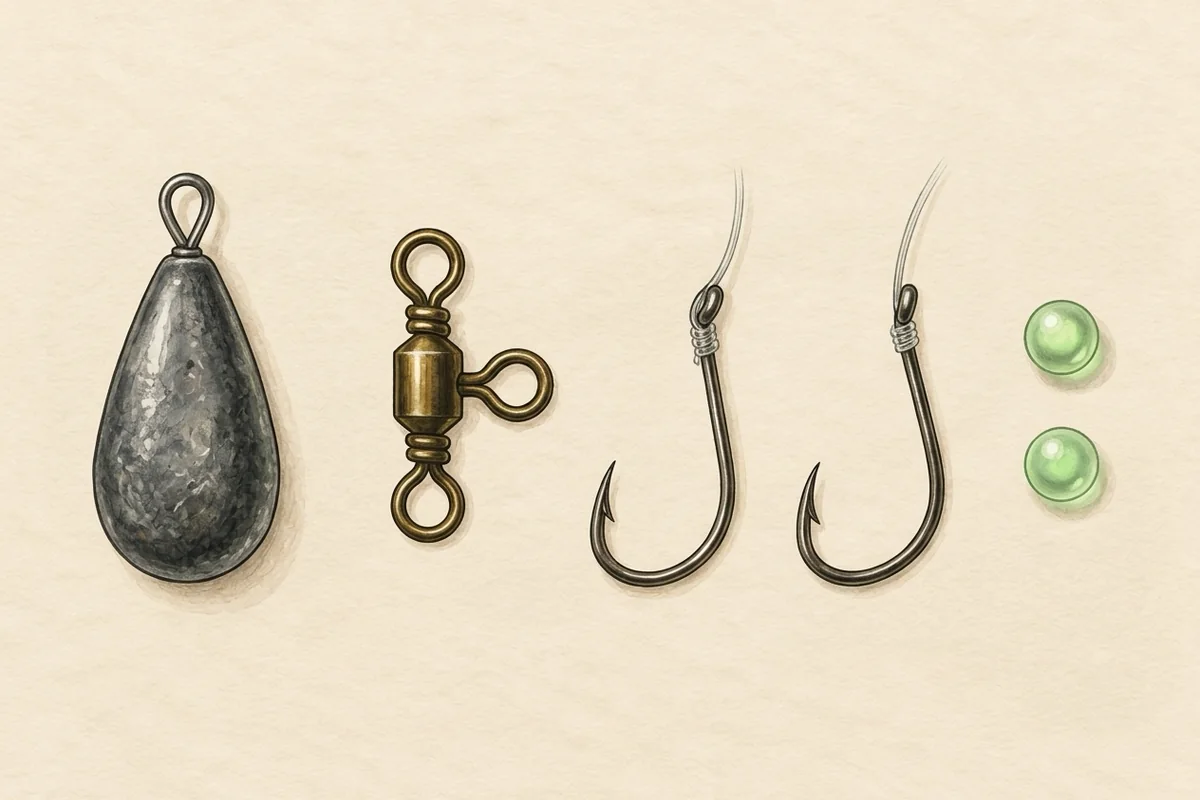
Thread a sliding boom for natural baits onto the main line and tie the bottom weight on with thinner 0,45 mm monofilament. If you snag, only the weight breaks off, not the whole rig.
- Big mouthfuls
For monkfish the bait can be big: a whole side of mackerel, a whole mackerel, a herring or a whole coley. In the dark depths the predator finds it mainly by scent.
- Lower right down to the bottom
Lower the rig vertically until the weight touches down and keep contact with the bottom. Some deep-sea anglers also use luminous beads on the hooklength, but the scent remains decisive.
- Check the snag
With an apparent snag, pull slowly and evenly first before you break off. Off Hitra a stuck bait came free this way, and at the other end hung a monkfish of about 6 kg.
- No runs
Do not expect fast runs; the fish brakes with its weight and spread fins. The monkfish off Hitra was at the surface after about ten minutes.
What with
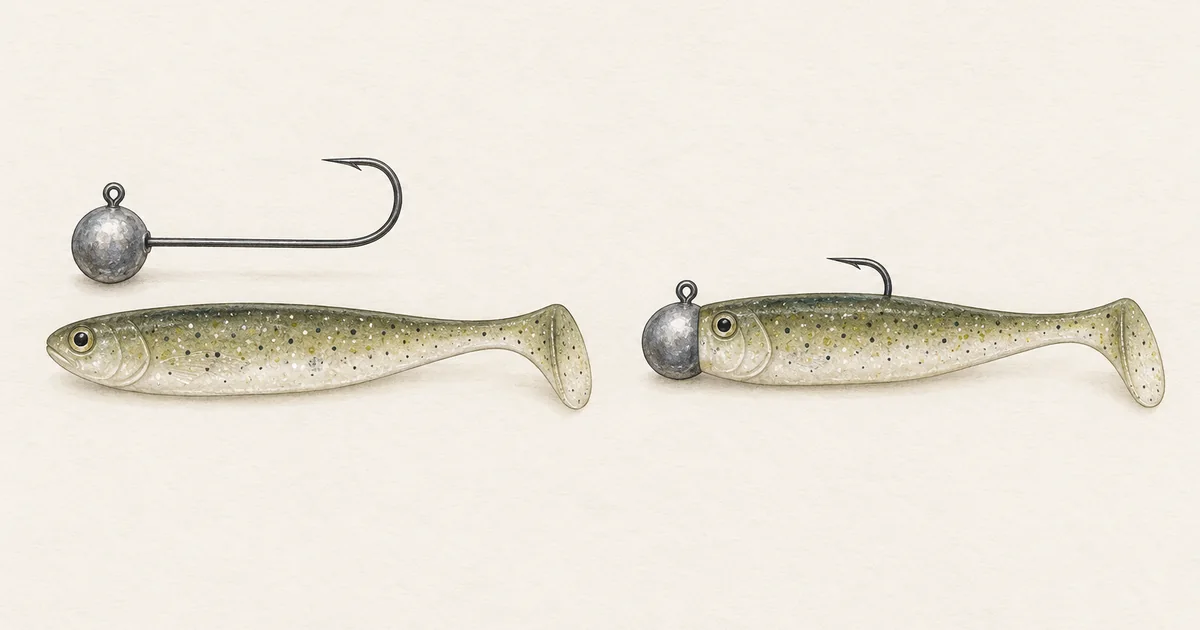
Pirks, strips of fish and soft plastics on jig heads are named, each dragged across the bottom.
- Soft plastic (shad)when drifting over sand and along edges
The monkfish of about 50 Pfund (500 g each) off Flatanger took a soft plastic; led slowly along the bottom, it stays in front of the lurking predator for a long time.
- Cut baitwhen fishing natural baits in the depths
In the dark, scent counts, and a whole side of mackerel is not too big for this large predator.
- Pilkerwhen pirking for cod and ling in Norway
Most chance catches happen when pirking, provided the pirk is worked close above the sand.
Tackle
You fish from the boat with sea tackle that suits the pirk and jig head; the page on the sea rod shows the differences between boat rod and pirk rod. Expect a heavy fish; for a big one up to 60 kilograms are quoted.
Pirk or soft plastic close to the bottom
- Rod
- sturdy boat rod
- Reel
- robust multiplier reel
- Line
- strong braided line, around 20 kg breaking strain off Hitra
- Weight, float, lead
- Pirk 450–600 g in a fast drift over 35–70 m; soft plastic on a jig head
Whole fish on the bottom
- Rod
- 30 lb class boat rod
- Reel
- robust multiplier reel
- Line
- Braid of around 20 kg breaking strain
- Leader
- a good 1 m of 0,80 mm monofilament with a sturdy sea swivel; weight on 0,45 mm monofilament
- Hooks
- stainless single hook, 5/0 to 11/0
- Weight, float, lead
- Bottom weight on the sliding boom for natural baits, weight to suit depth and drift
Common mistakes
- Bite mistaken for a snag: Do not break off straight away. Pull evenly first; more than once the supposed snag turned out to be a monkfish.
- Bait working too high: The fish waits motionless on the bottom and hardly chases the bait. Drag the soft plastic or pirk just above the sand instead of jigging it high.
- Whole rig lost on a snag: Tie the bottom weight on with thinner line than the hooklength, for example 0,45 mm monofilament. Then only the weight breaks if it comes to it.
- Strips too small in the depths: Small strips suit redfish, not monkfish. Use a whole side of mackerel or a whole fish so that enough scent reaches the bottom.
- Tackle too light: A monkfish of over a metre quickly weighs 16 kg and more. To pump one up from 90 m you need a sturdy boat rod and a robust multiplier reel.
Rules
In our overview of countries there are no figures for the minimum size (Mindestmaß) or closed season (Schonzeit) for monkfish. That does not mean there are no rules: individual countries and water regulations protect the species or set their own limits.
On the coast the rules of the coastal states apply, partly with their own catch restrictions: North Sea coast, Baltic coast of Schleswig-Holstein and Baltic coast of Mecklenburg-Western Pomerania.
The regulation and your fishing permit (Erlaubnisschein) are what count. Lake Constance, the Rhine and the coast, for example, have their own rules: Fishing waters in Germany.
After the catch
Playing and landing
A bite often feels like a snag, so pull evenly before you cut the line. Pump the fish up with constant pressure; it fights with weight rather than runs. A fish of legal size that you may keep you stun and kill at once; one that is too small you free with pliers or a hook remover and put back.
Never put your hand into the mouth, the sharp fangs point backwards; use a long hook remover or pliers. A fish of legal size that you may take you stun and kill at once, gut quickly and chill, because the flesh spoils fast. Apart from the backbone it has no bones, and the firm flesh is good for grilling.
Frequently asked questions
Can you fish for monkfish on purpose?
Hardly. Almost all catches are by-catch when pirking or fishing with natural baits from a boat. Anyone who still tries drags the bait patiently across deep sand flats.
Where do you catch monkfish in Norway?
Catches are documented off Senja, Hitra and Flatanger and in the Masfjord north of Bergen. The fish mostly bit at 50 to 90 m, at the mouth of a fjord or at steeply sloping reefs.
Which bait catches monkfish?
They were caught on soft plastics, pirks and big natural baits such as a whole herring. More important than the bait is that it stays close to the bottom.
Which hook size for monkfish?
For a whole-fish bait a catch report from Norway names stainless single hooks from 5/0 to 11/0.
How heavy do monkfish get on rod and line?
Fish of 6 kg off Hitra, 16 kg at 114 cm off Senja and 26 kg at 1,26 m in the Masfjord have been reported. Fish over a metre are rare.
Does the monkfish also swim in open water?
Occasionally, probably when it migrates and lets the current carry it. Most of the time, though, it lies on the bottom, which is why the bait belongs there.
Similar species
Anyone who catches monkfish can also fish for these species with similar tackle:
Sources
As of October 2026. The practical knowledge comes from 8 sources, summarised in our own words.
View all 8 sources
- Steckbrief Seeteufel: Wissenswertes über den Anglerfisch · BLINKER (Redaktion)
- Schroffe Felsen, starke Fische · BLINKER (Fredi Schmidt)
- Tiefseeangeln: Ab in die Tiefe · RUTE&ROLLE (Jesco Peschutter)
- Norwegen: 50-pfündiger Seeteufel · FISCH & FANG (Redaktion)
- Norwegen: Das Monster von Masfjordnes · FISCH & FANG (Redaktion)
- Anglerin fängt 114 cm langen Seeteufel in Norwegen · BLINKER (Redaktion)
- Ein Teufelsfisch aus Island · BLINKER (Redaktion)
- Tema: Breiflabb · Havforskningsinstituttet (Norwegen)
Text AI-assisted, based on the sources named and these pages: Monkfish (profile), Pirking, Soft plastic (shad), Fish strips.