
Knowledge – Fish
Monkfish: Features, catching, cooking
The monkfish (Lophius piscatorius), also called anglerfish or Lotte, lies in wait for prey on the seabed. With a modified fin ray it lures prey in front of its huge mouth. Anglers catch it in Norway almost only by chance.
In short: You catch the monkfish best from May to September, above all at night. Good spots on the coast: sandy ground. Proven baits: pirk, fish strips or soft plastic (shad) on a jig head, dragged slowly over sandy ground. Step by step: monkfish fishing.
- Very large, broad and flattened head with a wide mouth and pointed, backward-facing teeth
- First dorsal fin ray as a movable fishing rod (illicium) with a skin flap as a lure (esca)
- Loose, scaleless skin with fringed skin flaps on the lower jaw, head and sides of the body
Catch chances through the year
- Hardly any chance
- Possible
- Good
- Peak season
- Spawning (observe the closed season)
Editorial assessment for waters in Germany, not a measured value and no guarantee. Spawning time is not the same as the legal closed season.
Species profile and sources in the catch calendarAll species compared month by monthThe rules of your federal state
How to recognise it
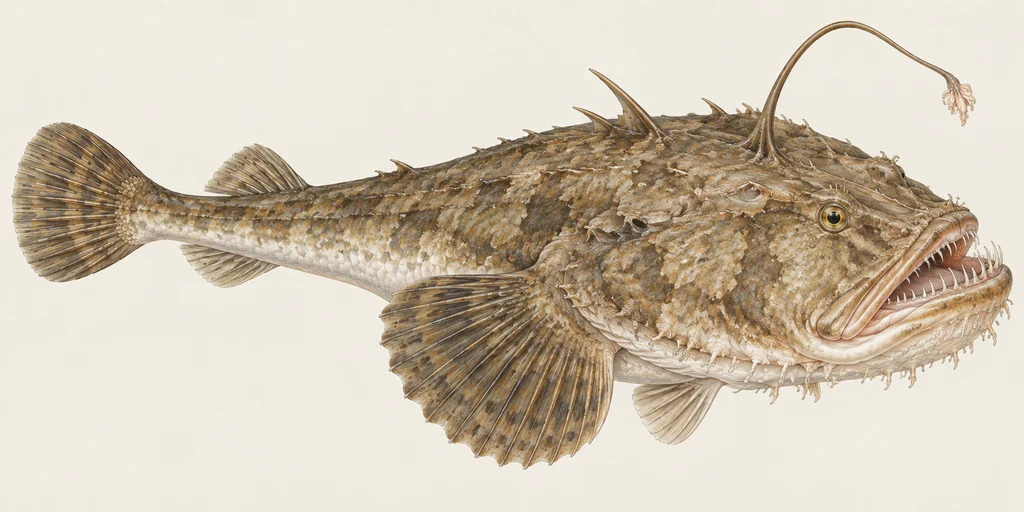
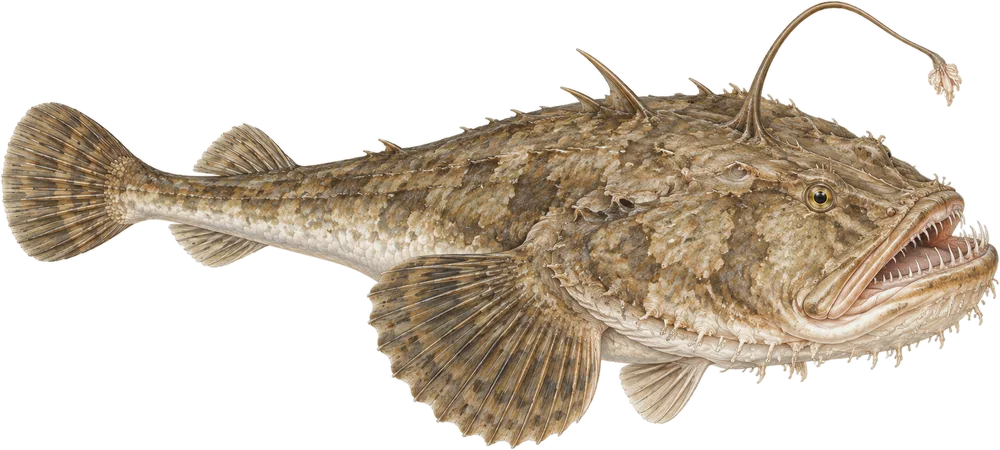
Head and body are flattened, and the trunk tapers to a point towards the rear. The head looks huge and, according to Blinker, corresponds to almost half the body length. The small eyes sit on top of the head. The wide mouth carries sharp canine teeth that point backwards and can fold inwards. So prey slides in but not back out.
The first dorsal fin ray is modified into a movable rod, the illicium. At its tip sits a fleshy flap of skin as bait. In this species it is split in two, with two broad, leaf-shaped flaps (FishBase). When the fish moves the rod back and forth in front of its mouth, small pressure waves arise.
The skin is thin, loose and scaleless. The back is brown with irregular dark blotches, the belly whitish. Like a plaice, it partly matches its colour to the bottom. Many skin flaps along the sides add to the effect: buried in the seabed, the fish looks like an algae-covered stone.
FishBase gives a typical length of about one metre and a maximum of 200 centimetres and 57,7 kilograms. The Swedish authority Havs- och vattenmyndigheten gives up to 40 kilograms. Two metres is therefore the exception. In the North Atlantic the animals grow larger than off West Africa.
Side by side: monkfish or black-bellied angler?
| Feature | Monkfish | Black-bellied angler |
|---|---|---|
| Belly lining | pale | black, visible only once the fish is gutted |
| Size according to FishBase | usually around 1 m, up to 2 m | usually around 50 cm, up to 1 m |
| Range | from the south-western Barents Sea to Gibraltar, plus the Mediterranean and the Black Sea | from the British Isles to Senegal, plus the Mediterranean |
| In Norwegian catches | almost every fish | roughly one in a thousand |
The only fish you can confuse it with is the black-bellied angler (Lophius budegassa). The reliable difference is inside the belly cavity: the lining is white in the monkfish and black in the black-bellied angler. So you only see it when gutting. The black-bellied angler stays smaller: FishBase gives one metre at most, with about 50 centimetres typical.
In practice this hardly matters. According to the Havforskningsinstituttet, only about one in a thousand fish in Norwegian catches is a black-bellied angler, and the two species are not distinguished in the trade.
Where it holds
The monkfish lives on the bottom, mostly on sand and mud, less often on rock. FishBase gives depths from the coast at about 20 metres down to 1000 metres. Its range runs from the Barents Sea to West Africa, plus the Mediterranean and the Black Sea.
In Norway it occurs from the shore zone to deep fjords. Catches there have risen since 2001, especially north of Halten. The Havforskningsinstituttet considers warmer seawater a possible cause, because this stretch of coast lies at the edge of its range.
On the German coast it is not a regular visitor. The Swedish authority sees it mainly in the Skagerrak and the Kattegat and lists the Öresund and the south-western Baltic Sea only as occasional habitat.
Holding spots in the picture
Choose the season and time of day: the picture shows where the species stands then. Spots outlined in red apply only in the chosen season. Tap a fish or a spot in the list to bring it closer. The picture is schematic and AI-generated, every water is different.
Catch chance in springpossibleSpawning season, observe closed seasons
Catch chance in summergood
Catch chance in autumnpossible
Catch chance in winterpossible
- J
- F
- M
- A
- M
- J
- J
- A
- S
- O
- N
- D
Spawning season
No main time Tagged large monkfish off the Faroes moved mainly at night and settled down shortly after sunrise; overall they lay still on the bottom most of the time.
No main time Tagged large monkfish off the Faroes moved mainly at night and settled down shortly after sunrise; overall they lay still on the bottom most of the time.
No main time Tagged large monkfish off the Faroes moved mainly at night and settled down shortly after sunrise; overall they lay still on the bottom most of the time.
Active time Tagged large monkfish off the Faroes moved mainly at night and settled down shortly after sunrise; overall they lay still on the bottom most of the time.
On the coast
Sandy bottom
Monkfish are found here only in spring, summer and autumn.
Deep, colder water
Monkfish are found here only in winter.
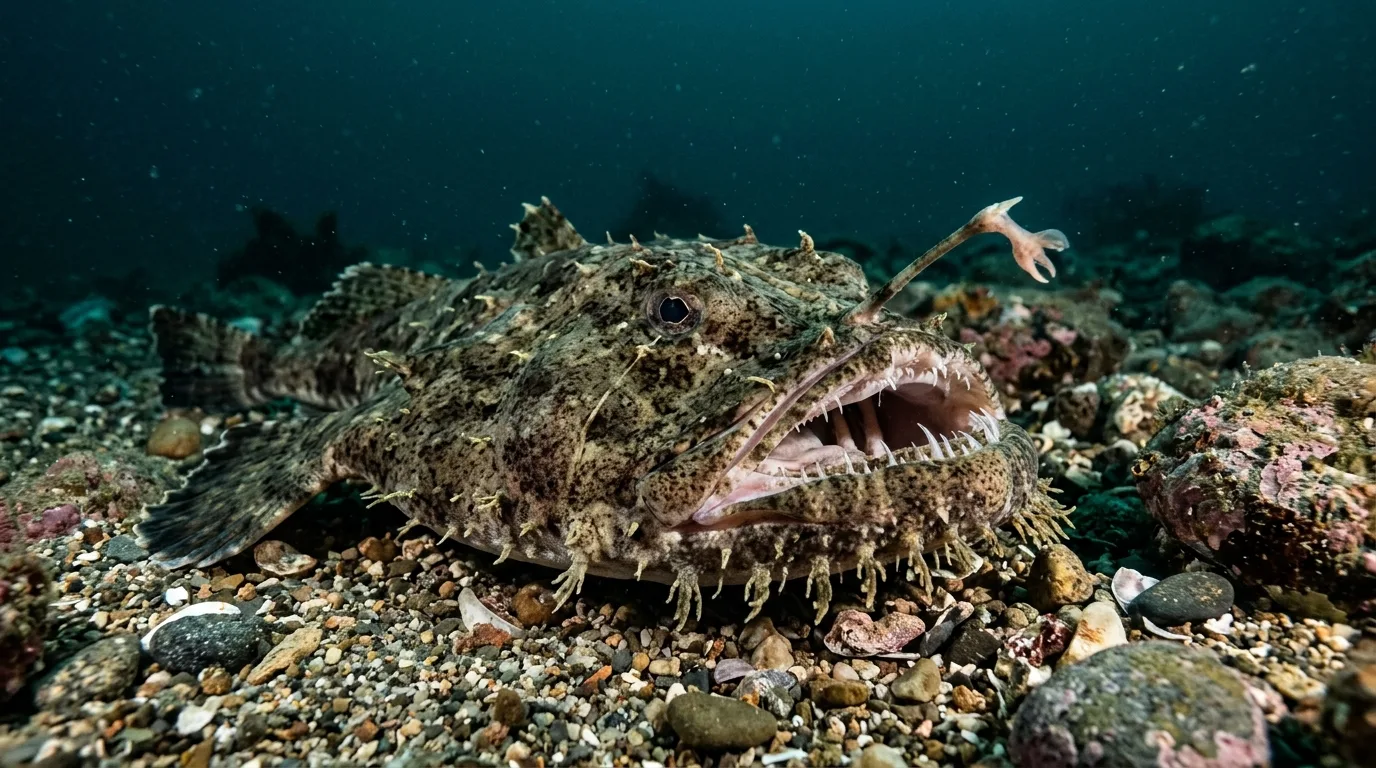
The monkfish lies half buried on the bottom, usually on sand or mud. It is less common on rocky ground. There it waits for prey as an ambush predator.
Spring: according to the catch calendar, chances are possible in March and April and good in May. Spawning falls in this period, so observe closed seasons. On the Norwegian coast mature females are seen in shallow water in spring. Around the British Isles spawning lasts from April to June.
Summer: chances according to the catch calendar are good. In summer large monkfish stay on shallower feeding grounds above 200 metres.
Autumn: according to the catch calendar, the chance of a catch is good in September and possible in October and November.
Winter: chances according to the catch calendar are possible. In winter large monkfish move into deeper water below 300 metres, where the spawning grounds lie.
Depth: Monkfish occur at depths from about 20 to 1000 metres. Tagged large fish stayed shallower than 200 metres in summer and deeper than 300 metres in winter.
Size comparison: AI-generated drawing, schematic.
How it hunts and spawns
The monkfish lies half buried in the sediment, and according to Havs- och vattenmyndigheten also hidden among plants and snail shells. When a fish swims close enough, it flings its mouth open and sucks the prey in. It can swallow animals as big as itself.
It eats mainly bottom fish, including, according to the Thünen-Institut, smaller fish and sand eels, but also gurnards, scad and rays. The Havforskningsinstituttet even found seabirds and otters in stomachs.
It is not a resident fish. Tagged animals travelled from the North Sea to the Faroe Islands, Iceland and as far as the Vesterålen. According to Havs- och vattenmyndigheten, large animals move from shallow to deeper water in winter, presumably to spawn.
Spawning takes place from April to June, and according to Swedish data into July. The spawning grounds lie on the continental slope west of the British Isles at depths of 1000 to 1800 metres, but also in Norwegian fjords. The eggs hang in a violet ribbon of mucus eight to ten metres long that drifts freely in the water and can contain over a million eggs. The larvae live in open water and move to a life on the bottom at 6 to 8 centimetres.
Males mature at about 40 and females at about 70 centimetres. According to Havs- och vattenmyndigheten, that is at four and six years respectively. The maximum age is 24 years according to FishBase and more than 25 according to the Havforskningsinstituttet.
When it bites
There is no fixed fishing season. The monkfish hunts passively, so catching one depends more on the spot than on the time of year. What the season changes is where it stays: large animals retreat to deeper water in winter and spawn there. In a tagging study off the Faroe Islands they stayed shallower than 200 metres from May to September and deeper than 300 metres from November to February.
The catch calendar therefore rates May to September as “good” and the remaining months as “possible”. This is an editorial estimate based on migration and spawning time, not a measured catch statistic.
Today’s catch index needs JavaScript. Season and spawning time are in the catch calendar.
You will find the monthly overview of all species and the water temperature check in the catch calendar.
What you catch it with
Step by step: Fishing for monkfish: tips on bait, rigs and tackle – season, spots, bait, tackle and rules on one page.
According to Blinker, catching one on purpose is considered almost impossible. The fish hunts passively, so you have to put the bait almost in front of its mouth. If you try anyway, look for sandy areas in deeper water and drag the bait over the bottom with the rod.
Blinker recommends pirks, cut bait or soft plastics on a jig head (jig head rig) for this. This kind of fishing carries a high risk of snags. You will find more on fishing from a boat under Pirking and Fishing from a charter boat and dinghy.
Expect a heavy fish. Blinker gives up to 60 kilograms for a large one. How to land a powerful fish safely and unhook it is explained under Landing and unhooking fish.
Keep your hands away from the mouth: The fangs are sharp and point backwards. Never reach into the mouth; use a long disgorger or pliers instead.
Look for sandy areas: Blinker recommends sandy areas in deep water and still expects plenty of snags. Take enough spare tackle with you.
Process it quickly: The flesh spoils fast. Gut the fish promptly and keep it cool until you prepare it.
Suitable lures
Pirk, cut bait or soft plastic on a jig head, dragged slowly over sandy ground.

AI-generated illustrations. A click opens the lure’s page.
Rigs for these baits: natural bait rig for the sea.
Hard to target: the bait has to land almost in front of the mouth.
How monkfish gets onto the plate
The flesh is lean, firm and aromatic. The Thünen-Institut writes that connoisseurs rate the meat quality and flavour highly. It does not fall apart easily and is therefore, according to Blinker, particularly good for grilling, and also for frying, steaming or a stock. Apart from the backbone the fish has no bones.
In the shops you usually find only the skinned tail without the head. If you catch one yourself, fillet it like this: cut off the fins, remove the layers of skin and lift one fillet from each side along the central bone. More on the technique under Scaling and skinning and Filleting fish.
According to Blinker, the flesh spoils quickly. Prepare the fish promptly, or before freezing gut it thoroughly, wash it and remove skin and bones. Tips on cooling are under Storage and hygiene.
What you need to observe
Closed seasons, minimum sizes and harvest slots are set by the federal states (Bundesländer) and by the fisheries authorities of the neighbouring countries on the coast (Denmark, Norway, Poland). They vary by type of water, stretch of coast and time of year. We only give figures together with the date and source; the fisheries regulation of your federal state and your fishing permit (Erlaubnisschein) are always what is binding. You will find a list of links to the official sources in the catch calendar.
A fish of legal size that you want to keep you stun and kill at once, in line with animal welfare rules. Protected, undersized fish or fish too large under a harvest slot you unhook, if possible still in the water and with wet hands, and release gently. What exactly applies is regulated by state law and your fishing permit (Erlaubnisschein).
In Norway all sea anglers must observe minimum sizes (Mindestmaß). You return fish below the limit as gently as possible. According to Fiskeridirektoratet, the full table is only available in Norwegian. The monkfish is not on the list of species protected all year round; the rules change, so check them before your trip. There is also a quantity limit in kilograms for exporting fish.
The IUCN lists the monkfish worldwide as least concern and the black-bellied angler as data deficient (Thünen-Institut).
What closed season, minimum size and harvest slot mean and where to find them is explained on the page Closed season and minimum size explained.
Frequently asked questions (FAQ)
How does the monkfish’s fishing rod work?
The first dorsal fin ray is elongated and freely movable, with a flap of skin at the tip. The fish waves it in front of its mouth, lures prey that way and sucks it in in a flash.
Can I target monkfish?
Hardly. It lies passively on the bottom and the bait has to be placed almost in front of its mouth. Most monkfish in Norway are accidental catches.
How do I tell a monkfish from a black-bellied angler?
By the lining of the body cavity: it is white in the monkfish and black in the black-bellied angler. In Norwegian catches only about one fish in a thousand is a black-bellied angler.
Sources
The rating of catch chances is an editorial assessment. The facts come from these sources, and the text is worded in our own words. The illustration is an original design by Angel Momente in the style of a natural history plate (AI-generated, see the AI notice).
- FishBase: Lophius piscatorius
- FishBase: Lophius budegassa (Schwarzer Seeteufel)
- Thünen-Institut, Fischbestände online: Seeteufel
- Havforskningsinstituttet: Breiflabb (Seeteufel)
- Blinker: Steckbrief Seeteufel
- Havs- och vattenmyndigheten: Marulk (Laichzeit, Laichgebiet, Wanderung)
- Fiskeridirektoratet: Sea angling in Norway, regulations (geschonte Arten, Ausfuhrquote)
- Fiskeridirektoratet: Minimum sizes for salt water species
- Ofstad et al. 2022, Frontiers in Marine Science: Horizontal and Vertical Migration of Anglerfish Lophius piscatorius in Relation to Hydrography in Faroese Waters
- Wikipedia: Seeteufel
- Havforskningsinstituttet: Klimastatus på bestander, Anglerfish (Nedreaas 2020, PDF)
Created with AI support from the sources listed. Figures only appear in the text if a source gives them. Last updated: 27 October 2026. Found a mistake? Write to us. Who is behind this site: About me.
More in the lexicon
- All fish species at a glance
- Catch calendar – month, water temperature and profile for 93 species
- Line calculator – breaking strain after the knot, drag guideline, backing
- Angling methods