
Knowledge – Fish
Carp fishing
Carp fishing means reading the water first, then laying the bait calmly on the bottom where the fish feed. Here is the way there in nine steps, each with a link to the detailed page.
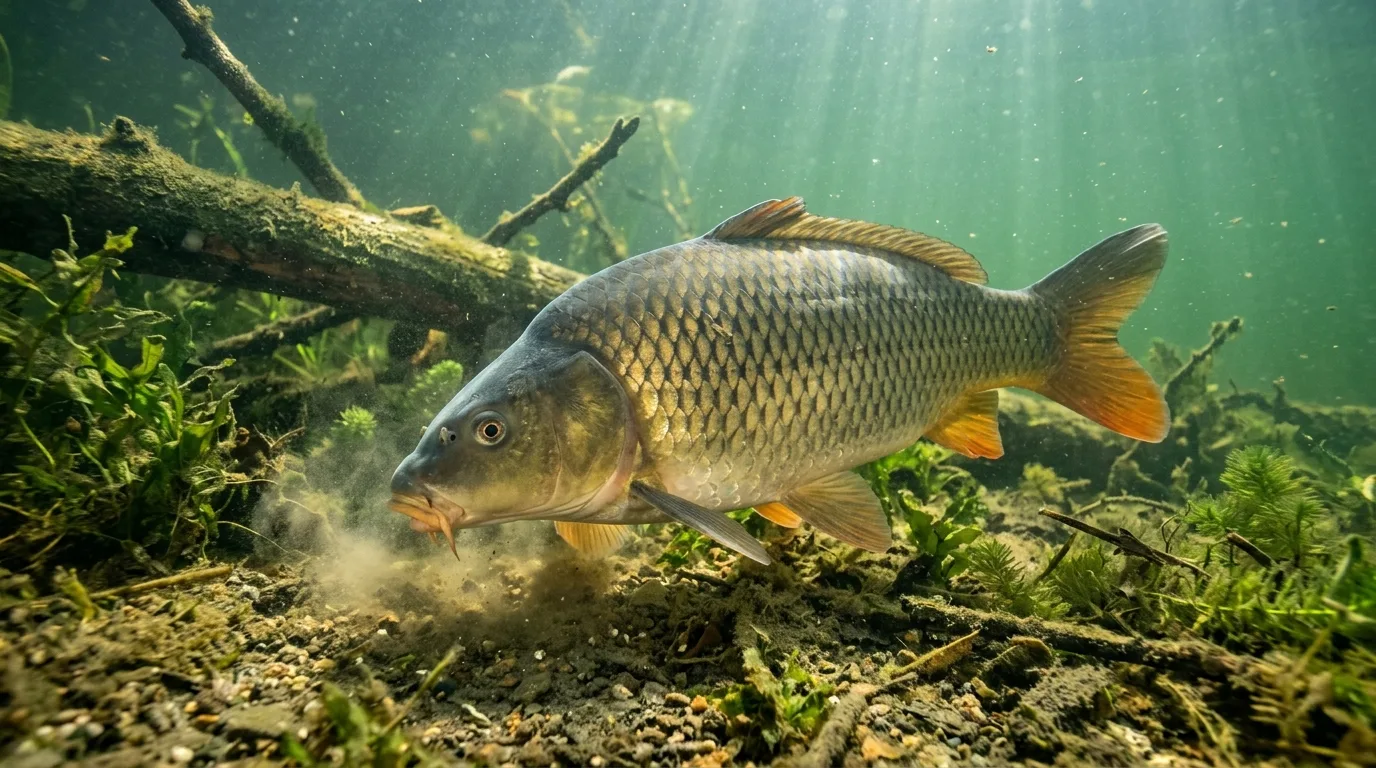
 Choose another fish117 fish with guides
 EelOff-peak season
 EelpoutPossible
 IdePossible
 ArapaimaGood
 GraylingPeak season
 Atlantic salmonSpawning time, please spare
 Brown troutSpawning time, please spare
 Brook troutSpawning time, please spare
 BarbelOff-peak season
 BarramundiSpawning season
 Greater amberjackGood
 Topmouth gudgeonOnly as bycatch
 Blue marlinSpawning season
 BonefishSpawning season
 BonitoGood
 BreamOff-peak season
 Dusky grouperOnly as bycatch
 CobiaPossible
 Spiny dogfishOnly as bycatch
 CodPeak season
 ChubPeak season
 MinnowOnly as bycatch
 European sturgeonOnly as bycatch
 FlounderPeak season
 PerchPeak season
 Largemouth bassGood
 Ballan wrasseOnly as bycatch
 Yellowfin tunaSpawning season
 Giant trevallyGood
 Prussian carpPossible
 BrillPossible
 Gilthead breamSpawning time, please spare
 Golden doradoSpawning season
 Golden mahseerOnly as bycatch
 Dolphinfish (mahi-mahi)Good
 Grass carpPossible
 Great barracudaGood
 GudgeonPossible
 White breamPossible
 DaceOff-peak season
 PikePeak season
 HalibutOff-peak season
 HerringPossible
 GarfishOut of season
 Huchen (Danube salmon)Possible
 Crucian carpOnly as bycatch
- CarpOff-peak season
 RuffeOff-peak season
 VendaceOnly as bycatch
 DabPeak season
 GurnardPossible
 Coley (saithe)Peak season
 Chinook salmonHardly any chance
 King mackerelSpawning season
 LingPeak season
 TuskOff-peak season
 MackerelPossible
 Bighead carpOut of season
 WhitefishPossible
 Conger eelOff-peak season
 Sea troutSpawning time, please spare
 Grey mulletPossible
 Murray codSpawning season
 MuskellungeGood
 Common nasePossible
 Nile perchPossible
 PayaraPossible
 Peacock bassPeak season
 PermitGood
 WeeverOnly as bycatch
 PollackOff-peak season
 BurbotOff-peak season
 AspPossible
 Red snapperSpawning season
 Rainbow troutPeak season
 RoosterfishGood
 RoachPeak season
 RedfishOut of season
 Bluefin tunaOnly as bycatch
 RuddPossible
 Russian sturgeonOnly as bycatch
 HaddockOff-peak season
 SnakeheadPossible
 TenchOff-peak season
 SpirlinOnly as bycatch
 PlaiceOff-peak season
 Greenland halibutOnly as bycatch
 Round gobyOnly as bycatch
 SwordfishGood
 Lake troutSpawning time, please spare
 HakeSpawning time, please spare
 Alpine charSpawning time, please spare
 MonkfishPossible
 SoleOff-peak season
 SailfishGood
 Silver carpOut of season
 SnookPeak season
 PumpkinseedOnly as bycatch
 SpratOnly as bycatch
 Atlantic wolffishSpawning time, please spare
 TurbotPeak season
 SterletOnly as bycatch
 SmeltOnly as bycatch
 Horse mackerelPossible
 TaimenGood
 TarponGood
 TigerfishSpawning season
 BleakPossible
 WahooGood
 Wels catfishOff-peak season
 WhitingPeak season
 Sea bassOff-peak season
 ZanderPeak season
 White-eye breamOnly as bycatch
 Blue breamOnly as bycatch
 Brown bullheadPossible
 VimbaOnly as bycatch
Season in October according to the catch calendar, an estimate and not a guarantee of a catch. The fish pictures are reduced natural-history plates and AI-generated.
Best time
From August to September, especially in the evening.
In January: PossibleIn February: PossibleIn March: Slim chancesIn April: PossibleIn May: Good, spawning seasonIn June: Good, spawning seasonIn July: GoodIn August: Peak seasonIn September: Peak seasonIn October: GoodIn November: PossibleIn December: Possible
Good spot
- Lake: underwater hump, drop-off and weed bedsunderwater hump, drop-off and weed bedsunderwater hump, drop-off and weed bedsdeep water
- River: quiet bayquiet bay, main current and current seamquiet bay, stone embankment and deep poolsquiet bay, deep pools and stone embankment
Top baits
Starter tackle
- Rod: 3,60–3,90 m with 2,75–3 lb test curve, on small waters without big fish 1,75–2,25 lb
- Line: monofilament 0,30–0,40 mm; braid only for long casts, then with 10–20 m of 0,40–0,50 mm shock leader
- Hook: size 2–6, very sharp; size 4 suits boilies of 18–20 mm
- Rod: 3,00–3,60 m, casting weight up to 60 g
- Line: monofilament 0,25 mm, 0,30–0,35 mm where big carp occur
- Hook: size 2–8
In short
In short: You will catch carp best from August to September, especially in the evening. Good spots on a lake: underwater hump, drop-off and weed beds; on a river: quiet bay. Tried and tested baits: boilies, hard-boiled sweetcorn, particles, soaked wheat or bread.
Quick to recognise
A powerful, warmth-loving bottom feeder that you can recognise by two pairs of barbels on the upper lip. Typically 35 to 90 centimetres, rarely growing up to 120 centimetres long and over 40 kilos in weight.
When
It goes best in August and September, and May to July and October are also good. Spawning takes place in May and June on shallow, warm, weedy spots. Whether a closed season (Schonzeit) applies then is set by your federal state (Bundesland). Most bites come in the late afternoon and early evening.
- JanPossible
- FebPossible
- MarHardly any chance
- AprPossible
- MayGood, spawning
- JunGood, spawning
- JulGood
- AugPeak season
- SepPeak season
- OctGood
- NovPossible
- DecPossible
Peak seasonGoodPossibleHardly any chanceSpawning season
Spring tactics
Shallow areas of 0,5 to 1 m warm up first in the sun, so fish them during the day. After cold nights the fish drop back into the adjacent deeper water. Feed sparingly and use small boilies of 12 to 15 mm or conspicuous bright hookbaits.
Summer tactics
In hot weather you do better fishing early in the morning and in the evening. Close to weed and water lilies, fresh brown bread crust on a free line, with no float and no weight, is also worth a go. Then feed only a little, because leftover feed uses up oxygen. Keep the fight short and the fish out of the air as much as possible.
Autumn tactics
Autumn counts as a strong time alongside spring. As the temperature falls, the fish move to deeper, calm areas, in rivers for example into harbour basins and in front of weirs, where the water cools more slowly.
Winter tactics
Bites are rare, but carp keep feeding even now, just more slowly. Feed very little and use sweet baits or tinned sweetcorn, which bream and roach hardly touch in the cold. On mild, sunny days from the end of January the shallows warm up faster than the depths.
Is it biting today?
In January: PossibleIn February: PossibleIn March: Out of seasonIn April: PossibleIn May: Spawning time, please spare themIn June: Spawning time, please spare themIn July: Off-peak seasonIn August: Peak seasonIn September: Peak seasonIn October: Off-peak seasonIn November: PossibleIn December: Possible
Today’s catch index needs JavaScript. Season and spawning time are in the catch calendar.
From the blog: Fish of the Year 2027: the crucian carp and what anglers can do for it · Carp in autumn: where I fish and how much I feed · More bites from the bank: what I adjust, from swim to hook
Where it is now
In the lake
In deep lakes look for plateaus, drop-offs and underwater humps, in shallow lakes for hollows, channels and weed beds. Sunken trees and water lilies give cover. In summer carp also cruise near the surface under overhanging branches, in winter they gather deeper.
How to go about it: Put the bait on drop-offs, plateaus and shallow margins, in weed beds into open holes and onto gravel patches. If there is no obvious spot, pick the bank the wind is blowing onto.
| Spring | Underwater hump, drop-off, weed bed, sunken tree |
|---|---|
| Summer | Underwater hump, drop-off, weed bed, sunken tree, surface, reed edge |
| Autumn | Underwater hump, drop-off, weed bed, sunken tree |
| Winter | deep bottom |
In the river
In rivers, calm, shallow bays with water lilies are worth fishing, as are the ends of bends and the mouths of tributaries.
How to go about it: The current keeps carp on the move, so look for calm stretches such as bays and the mouths of side arms. Feed only boilies there so that bream and bleak do not clear your bait, and use thick mono with a shock leader.
| All year round | calm bay |
|---|---|
| Summer extra | main current, current seam, riprap |
| Autumn extra | riprap, pools |
| Winter extra | Deep pools, stone embankment |
At the pond
How to go about it: On a small pond a light carp rod of 1,75 to 2,25 lb is enough, because you cast short. In warm weather feed especially carefully, as oxygen runs short in shallow ponds in summer.
Biting time: mainly in the evening. What that looks like on the water is shown by the picture of the holding spots just below.
Waters with rules for carp
Holding spots in the picture
Choose the season and time of day: the picture shows where the species stands then. Spots outlined in red apply only in the chosen season. Tap a fish or a spot in the list to bring it closer. The picture is schematic and AI-generated, every water is different.
Catch chances in springpossible
Catch chance in summergood
Catch chance in autumngood
Catch chance in winterpossible
- J
- F
- M
- A
- M
- J
- J
- A
- S
- O
- N
- D
Spawning season
Not the main time Bites are mostly to be expected in the late afternoon and early evening.
Not the main time Bites are mostly to be expected in the late afternoon and early evening.
Active time Bites are mostly to be expected in the late afternoon and early evening.
Not the main time Bites are mostly to be expected in the late afternoon and early evening.
In the lake
reed edge
Carp are found here only in summer.
Water lilies and weed bed
Carp are found here only in spring, summer and autumn.
Shelf edge
Carp are found here only in spring, summer and autumn.
Sunken tree
Carp are found here only in spring, summer and autumn.
Deep bottom
Carp are found here only in winter.
plateau, underwater hump
Carp are found here only in spring, summer and autumn.
Just below the surface
Carp are found here only in summer.
In gravel pits and reservoirs carp hold on plateaus, drop-offs and underwater humps, in shallow lakes on hollows, channels and weed beds. Sunken trees and water lily fields are safe refuges.
Spring: catch chance according to the catch calendar hardly any in March, possible in April, good in May. From a water temperature of about 8 °C carp become active. In a warm wind they follow it to the bank it is blowing onto.
Summer: catch chance according to the catch calendar good in June and July, peak season in August. In the warm summer months carp are often found at the surface, usually under overhanging branches, and cruise through the shallows.
Autumn: catch chance according to the catch calendar peak season in September, good in October, possible in November. Fishing stays good well into late autumn.
Winter: catch chance according to the catch calendar possible. In winter carp mostly gather in deeper areas and feed little. On sunny days from the end of January they also move into the shallows, which warm up faster.
In the river
Pools, deep spot
Carp are found here only in autumn and winter.
riprap, sheet piling, harbour
Carp are found here only in summer, autumn and winter.
Current seam
Carp are found here only in summer.
Calm bay with aquatic plants
Carp are found here all year round.
Free current in mid-river
Carp are found here only in summer.
In rivers carp are found in shallow bays with water lilies, at the ends of bends and at the mouths of tributaries.
Spring: catch chance according to the catch calendar hardly any in March, possible in April, good in May. In spring carp avoid the current. They sit in shallow, calm areas away from the flow, for example in oxbow lakes, where the water warms up first.
Summer: catch chance according to the catch calendar good in June and July, peak season in August. In summer carp move into the main current, because they find more oxygen and food there, such as mussels. Good spots are the edge of the navigation channel and the foot of rock armouring.
Autumn: catch chance according to the catch calendar peak season in September, good in October, possible in November. In autumn carp look for deep, calm areas that cool more slowly: harbour basins with sheet piling and the deep zones in front of weirs and barrages.
Winter: catch chance according to the catch calendar possible. In winter they gather in deep stretches sheltered from the current, such as outside bends, harbours and weir areas. They feed less, but can be caught.
Size comparison: AI-generated drawing, schematic.
How
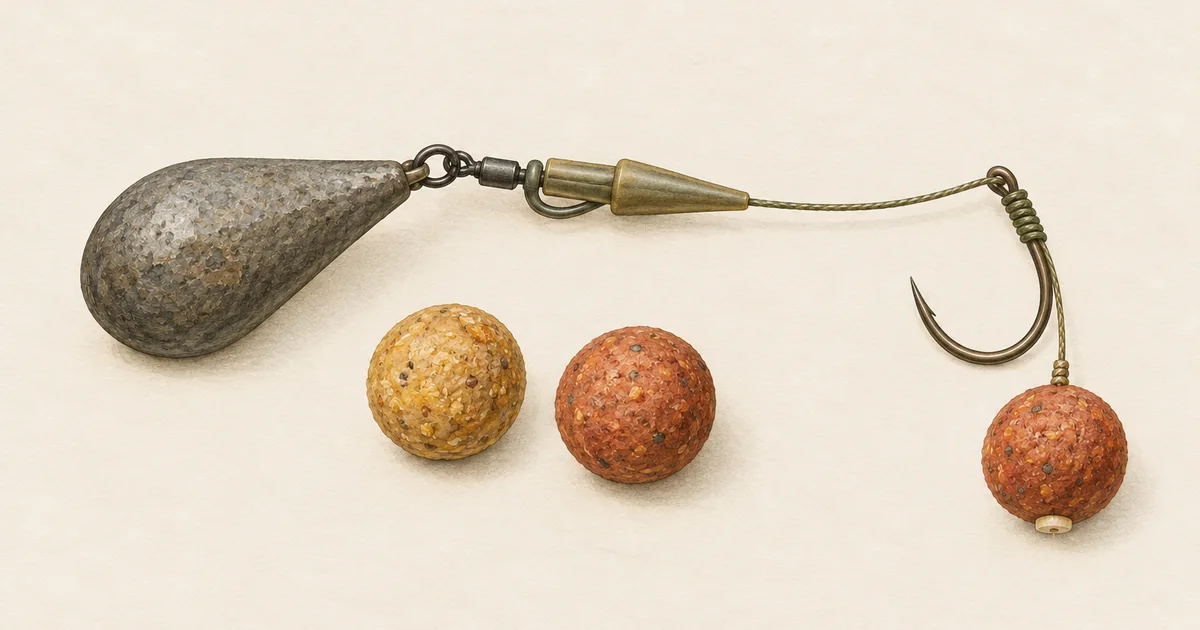
The usual approach is sit-and-wait fishing with a fixed lead and a hair rig: the bait hangs on the hair next to the bare hook, and the bolting fish hooks itself on the heavy lead. It is easier with a float: fishing to fish you can see, or over several baited spots, you sometimes catch more in one afternoon than in a long session.
Easiest way
To start with, a float rod with 0,25 to 0,30 mono and sweetcorn on the hook is enough. Find a small club lake or pond and fish close to the bank, where reeds or water lilies grow and you can see fish. A handful of corn as feed is plenty.
Session with fixed lead and hair
The standard for targeting carp from May, when you stay in one place for several hours or nights.
- Find the fish
First find the spot where carp are feeding. A short session in the right place usually brings more than a long one in an empty spot. Cloudy water and bubbles show feeding fish.
- Check the bottom first
Plumb the depth and mark the spot ideally a few days before the session, because noise drives the fish off. If the bottom is soft, use a longer hooklength or a buoyant bait.
- Little and accurate
Put small amounts exactly on the spot with a throwing stick or PVA bag. In some waters baiting is limited or a baited spot without a rod is banned; this is in the water rules (Gewässerordnung).
- Tie the rig
A soft, braided hooklength of 15 to 30 cm is enough for most spots. The hook must be very sharp, because it takes hold by itself as soon as the fish swims against the lead.
- Sink the line
After the cast, lay the first metres of main line on the bottom too, for example with putty or a small running lead. A line running taut through the water spooks carp that touch it.
- Just pick up
Usually the fish is already hooked when the bite alarm sounds. Pick up the rod and engage the clutch. If it swims towards you, the line goes slack, so wind in line quickly.
- Away from snags
Keep the fish away from dead wood and mussel beds, where the line breaks quickly. In such places a thick shock leader of 0,60 to 0,70 mm protects it.
- Big landing net
A landing net with an arm spread of at least 70 cm and a rubberised mesh is a must. Guide the carp over the net with the rod and only then lift.
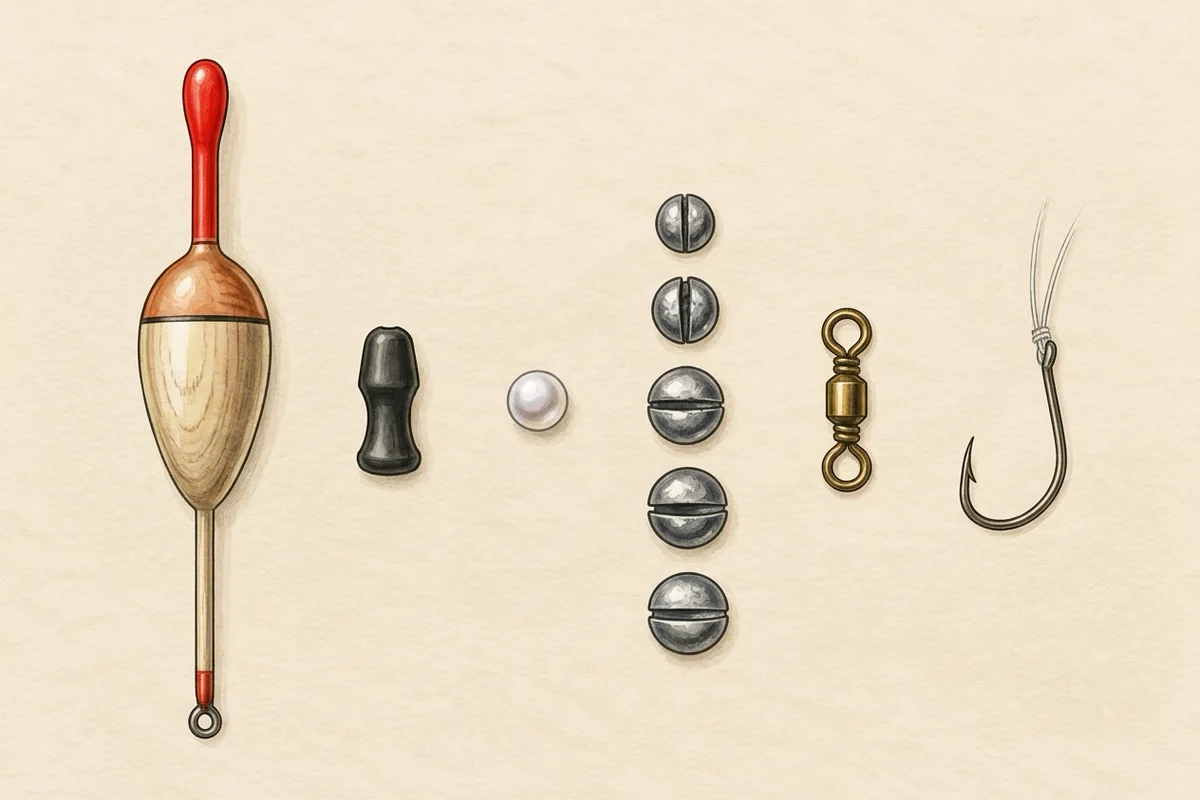
Float at the bank
For short sessions close to the bank, on small waters and anywhere you can see the fish.
- Shallow and close
Look for spots near the bank along reed edges, water lilies or overhanging bushes. Carp find plenty of natural food there, in cloudy water often at depths of less than a metre.
- Set the depth
Set the float so that the bait lies on the bottom or hovers just above it.
- A handful
Throw a little corn, particles or pellets exactly where the float sits. Too much feed fills the fish up before they find your hook.
- Fine hooklength
The hooklength is about 50 cm long and thinner than the main line. The float may carry more than when fishing for roach, so that it holds the heavier bait.
- Point free
Put corn or paste on so that the hook point stays free, otherwise the strike will not take.
- Strike gently
After the bite carp often first move off a short way. Strike gently, not with full force.
- Out of the weed
Keep the fish away from water lilies and sunken branches. Zebra mussels on old wood cut through the line.
- Wet mat
Net it with a large net and lay it on a unhooking mat that you have wetted beforehand.
What with
Boilies are the standard; hard corn, tiger nuts, chickpeas and pellets also catch fish. In heavily fished waters a smaller hook with the bait size unchanged and a lead in the colour of the bottom help. Worms also suit float fishing.
- Boiliesall year round, small in spring (12–15 mm)
The hard balls survive small fish and can be presented safely on the hair.
- Sweetcorn & particlesspring to winter, tinned sweetcorn especially in the cold
Hard corn is tough enough for the hair; tinned sweetcorn releases sugar quickly in cold water.
- Pelletsspring to autumn, as feed around the hook
They dissolve slowly and spread scent over the spot as they do.
Tackle
For sit-and-wait fishing, a carp rod that casts the heavy fixed lead; for fishing to fish you can see, a float rod. Which length and test curve suit is explained on the carp rod page.
Session with fixed lead and hair
- Rod
- 3,60–3,90 m with a 2,75–3 lb test curve, on small waters without big fish 1,75–2,25 lb
- Reel
- Freespool or fast-drag reel holding 200 m of mono or more
- Line
- Mono 0,30–0,40 mm; braid only for long casts, then with 10–20 m of shock leader 0,40–0,50 mm
- Leader
- 15–30 cm, soft braid with a breaking strain of 15–25 lb
- Hooks
- Size 2–6, very sharp; size 4 suits boilies of 18–20 mm
- Weight, float, lead
- Fixed lead from 60 g, usually 120–160 g
Float at the bank
- Rod
- 3,00–3,60 m, casting weight up to 60 g
- Reel
- medium fixed-spool reel
- Line
- Mono 0,25 mm, where big carp live 0,30–0,35 mm
- Leader
- about 50 cm, thinner than the main line
- Hooks
- Size 2–8
- Weight, float, lead
- Float with more carrying capacity than for roach
More on tackle
- Carp rod: length, test curve and action
- Float rod: match, Bolognese and pole
- Line calculator
- Fishing line: monofilament, braid or fluorocarbon?
- Spooling a reel properly – without line twist
- Landing net: mesh, size and handle
- Unhooking mat: lay the fish down softly, unhook gently
- Disgorger: unhooking quickly and gently
Common mistakes
- Too much feed in spring: The water is still cold and the fish eat little. About 500 g of boilies or particles per feed is enough; small balls keep them on the spot longer.
- Noise at the swim: plumbing the depth, marking and spods scare carp away. So plumb and mark before the session and keep quiet afterwards. Whether you may already feed on the days before is governed by the state and the water rules; see the question on prebaiting.
- The line stands in the water: Carp that bump into a taut line leave the spot. Sink the line with putty or a running lead so that it lies on the bottom.
- A landing net that is too small: A small net costs you fish and injures them. Use a carp net with an arm spread of at least 70 cm.
- The lead is too light: Under 60 g the carp often does not hook itself on a fixed lead. Use a heavier lead, which also shows drop-backs better.
Rules
Each federal state (Bundesland) sets its own closed season (Schonzeit) and minimum size (Mindestmaß). Choose your state; the values come from our state pages.
Baden-Württemberg
- Minimum size
- 35 cm
- Closed season
- none
As of October 2026. All rules, exceptions and sources: Fishing in Baden-Württemberg.
Bavaria
- Minimum size
- 35 cm
- Closed season
- none
As of October 2026. All rules, exceptions and sources: Fishing in Bavaria.
Berlin
- Minimum size
- 35 cm
- Closed season
- none
Correct as of October 2026. All rules, exceptions and sources: Fishing in Berlin.
Brandenburg
- Minimum size
- 35 cm
- Closed season
- none
As of October 2026. All rules, exceptions and sources: Fishing in Brandenburg.
Bremen
Our overview for Bremen does not list the carp. What applies there is given on the page Fishing in Bremen with the state’s spots.
Hamburg
- Minimum size
- 35 cm
- Closed season
- none
- Note
- no upper size limit
As of October 2026. All rules, exceptions and sources: Fishing in Hamburg.
Hesse
- Minimum size
- 45 cm
- Closed season
- 15.3.–31.5.
- Note
- slot limit 45–60 cm
As of October 2026. All rules, exceptions and sources: Fishing in Hesse.
Mecklenburg-Western Pomerania
- Minimum size
- 40 cm
- Closed season
- none
As of October 2026. All rules, exceptions and sources: Fishing in Mecklenburg-Western Pomerania.
Lower Saxony
- Minimum size
- –
- Closed season
- none
As of October 2026. All rules, exceptions and sources: Fishing in Lower Saxony.
North Rhine-Westphalia
- Minimum size
- 35 cm
- Closed season
- none
As of October 2026. All rules, exceptions and sources: Fishing in North Rhine-Westphalia.
Rhineland-Palatinate
- Minimum size
- 35 cm
- Closed season
- none
- Note
- observe the general closed seasons (Schonzeit)
As of October 2026. All rules, exceptions and sources: Fishing in Rhineland-Palatinate.
Saarland
- Minimum size
- 35 cm
- Closed season
- none
- Note
- Grenzmosel 1.3.–14.6.
As of October 2026. All rules, exceptions and sources: Fishing in Saarland.
Saxony
- Minimum size
- 40 cm
- Closed season
- none
Correct as of October 2026. All rules, exceptions and sources: Fishing in Saxony.
Saxony-Anhalt
- Minimum size
- 35 cm
- Closed season
- none
As of October 2026. All rules, exceptions and sources: Fishing in Saxony-Anhalt.
Schleswig-Holstein
- Minimum size
- 35 cm
- Closed season
- none
As of October 2026. All rules, exceptions and sources: Fishing in Schleswig-Holstein.
Thuringia
- Minimum size
- 35 cm
- Closed season
- none
As of October 2026. All rules, exceptions and sources: Fishing in Thuringia.
The regulation and your fishing permit (Erlaubnisschein) are what count. Lake Constance, the Rhine and the coast, for example, have their own rules: Fishing waters in Germany.
After the catch
Playing and landing
On a fixed lead the carp usually hooks itself; you just pick up the rod and engage the clutch. Keep the line taut, guide it over a large landing net and lift it level with both hands onto a wet unhooking mat. Handle it only with wet hands and keep it out of the air for as short a time as possible.
Carp that are in closed season, under the minimum size or too big for the slot limit you return carefully with wet hands. If you keep one, you stun and kill it properly. After that it is scaled or skinned, gutted and, because of the many small bones, filleted carefully.
Frequently asked questions
What hook size for carp?
Size 2 to 6 is usual; for a boilie of 18 to 20 mm size 4 fits. Around snags and with big fish you tend to take a larger hook.
How heavy does the lead have to be for carp fishing?
For the self-hooking effect at least 60 g; most people fish 120 to 160 g. In spring 60 to 80 g is often enough.
What line for carp fishing?
Mono of 0,30 to 0,40 mm is the standard; its stretch prevents hook pulls. Braid only pays off on long casts and then needs a mono shock leader.
How long before should you bait up for carp?
Two to three days of prebaiting often helps, ideally always at the same time. It is not compulsory, and it is not allowed everywhere. In § 18 Abs. 4 LFischO, Berlin prohibits “introducing groundbait in advance, in the sense of baiting fish before the fishing day” and allows at most 500 grams of groundbait per person and fishing day. Saxony-Anhalt only permits fishing in Natura 2000 areas “without baiting fish in advance” (§ 11 Abs. 2 Nr. 5 N2000-LVO), and throughout the state the fisheries authority (Fischereibehörde) can restrict groundbaiting there (§ 15 FischO LSA). In Saarland, under § 10 Abs. 1 Nr. 3 LFO, “the use of dyed maggots and dyed groundbait as well as bloodworm” is prohibited. Without a permit, Rhineland-Palatinate only allows introducing “natural attractants in small quantities for groundbaiting” (§ 24 LWG). On top of that come many water rules; more on this in the glossary under groundbaiting. What counts are your fishing permit (Erlaubnisschein) and the water rules.
Do carp bite in winter?
Rarely, but they keep feeding. The best chance is in rivers in calm, deep stretches and on mild days in the late afternoon.
What test curve for a first carp rod?
A 12-foot rod, that is 3,60 m, with 2,75 to 3 lb covers most lakes. For short distances on small waters less is enough.
Similar species
Anyone who catches carp can fish for these species with similar tackle:
 Fishing for tenchShoulder season
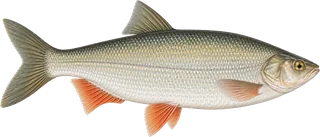 Ide fishingPossible
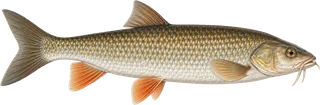 Barbel fishingMinor season
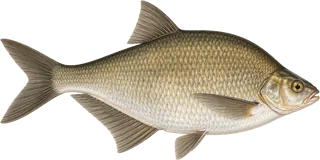 Fishing for breamShoulder season
Sources
As of October 2026. The practical knowledge comes from 14 sources, summarised in our own words.
See all 14 sources
- Karpfenangeln: Tipps für eine erfolgreiche Fangstrategie · BLINKER (Redaktion)
- Karpfenmontage: Die besten Rigs im Überblick · BLINKER (Redaktion)
- Karpfen-Kickstart: Angeln auf Karpfen von 0 auf 100 · BLINKER (Johannes Müller)
- Fehlerfrei ins Karpfen-Frühjahr: Vermeiden Sie diese 9 Dinge · BLINKER (Johannes Müller)
- Karpfen im Fluss finden: So fängst Du die Wanderer · BLINKER (Sascha Legenbauer)
- Karpfen im Winter: 10 Mythen auf dem Prüfstand · BLINKER (Robin Illner)
- Fische landen: Wie nutze ich Kescher, Lip-Grip und Co.? · BLINKER (Redaktion)
- Was Hitze mit unseren Fischen macht · Deutscher Angelfischerverband (DAFV)
- Frequently Asked Questions · Landesfischereiverband Westfalen und Lippe
- Berliner Landesfischereiordnung (LFischO), § 18 Abs. 4 · Land Berlin (Landesrecht Berlin)
- Begleitdokument Angelfischerei zur N2000-LVO LSA (§ 11 Abs. 2 Nr. 5) · Landesverwaltungsamt Sachsen-Anhalt (Natura-2000-Portal)
- Fischereiordnung des Landes Sachsen-Anhalt (FischO LSA), § 15 · Land Sachsen-Anhalt (Landesrecht Sachsen-Anhalt)
- Landesfischereiordnung Saarland (LFO), § 10 Abs. 1 Nr. 3 · Saarland (Bürgerservice Saarlandrecht)
- Landeswassergesetz Rheinland-Pfalz (LWG), § 24 · Land Rheinland-Pfalz (Landesrecht Rheinland-Pfalz)
Text AI-assisted, based on the sources named and these pages: Carp (profile), Carp fishing, Float fishing, Worms, Carp rod.