
Waters · Germany
Fishing on the Mittellandkanal
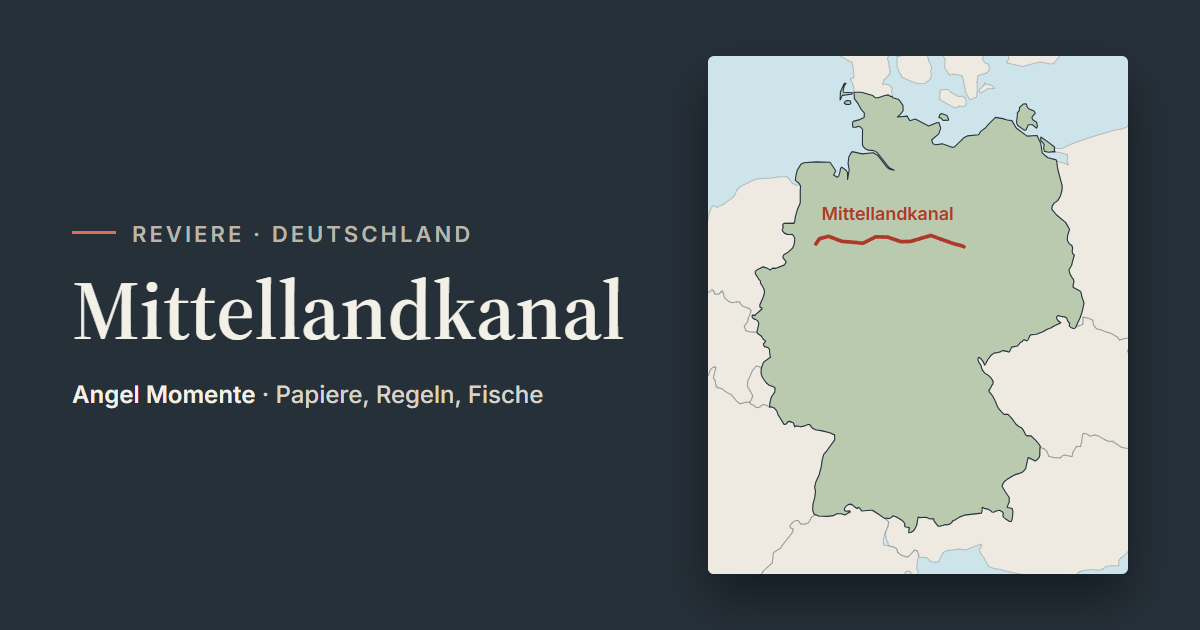
The Mittelland Canal runs for 325 kilometres from the Dortmund-Ems Canal at Hörstel to the Elbe near Magdeburg. It is the longest artificial waterway in Germany and lies in three federal states (Bundesland). So before you put a rod out, there is one thing above all to clear up: who issues the permit on your stretch.
- Papers
- Fishing permit (Erlaubnisschein) and proof of the exam, NRW and ST: fishing licence (Fischereischein)
As of October 2026
At a glance
- Papers
- Fishing permit (Erlaubnisschein) and proof of the exam, NRW and ST: fishing licence (Fischereischein)
| Fish | Minimum size | Closed season | Catch limit | Note |
|---|---|---|---|---|
| Zander | 45 cm | 1.3.–31.5. | 2 per day | harvest slot up to 70 cm, 20 a year |
| Pike | 50 cm | 1.2.–31.5. | 1 per day | harvest slot up to 85 cm, 10 a year |
| Eel | 50 cm | none | 5 a day | 50 a year |
| Perch | – | none | 10 per day | return fish over 40 cm, 70 a year |
| Bream | 25 cm | none | – | over 45 cm: 3 a day, 40 a year |
| Carp | 40 cm | none | 2 per day | |
| Roach | – | none | – | |
| Burbot | 35 cm | none | – | NRW: protected all year |
| Round goby | – | none | – | must be kept |
Values from the Gewässerordnung 2026 of the Anglerverband Niedersachsen for its stretches, otherwise the Niedersächsische Binnenfischereiordnung; the deviation in the NRW part of the AVN stretch is given in the note. On the other sections and in Saxony-Anhalt, state law and the rules of the respective issuer apply. Status: October 2026. What counts is the regulation and your fishing permit.
Location and waters From Bergeshövede via Minden and Hanover to Hohenwarthe
The canal branches off the Dortmund-Ems Canal at Bergeshövede and runs east along the Teutoburg Forest and the Wiehengebirge. At Minden it crosses the Weser, at Seelze the Leine, and then it passes through the north of Hanover. Shortly before the Sülfeld lock near Wolfsburg, the Elbe Lateral Canal branches off. At the outer harbour of the Hohenwarthe lock the Mittelland Canal ends and becomes the Elbe-Havel Canal (Generaldirektion Wasserstraßen und Schifffahrt). Since 2003 it has crossed the Elbe on a canal bridge 918 metres long near Magdeburg (GDWS, Wasserstraßenkreuz Magdeburg).
The Mittelland Canal is a federal waterway. This includes the branch canals to Ibbenbüren, Osnabrück, Hannover-Linden, Misburg, Hildesheim and Salzgitter, as well as the link canals to the Weser and the Leine and the Rothenseer Verbindungskanal to the Elbe (Bundeswasserstraßengesetz, Anlage 1). With these side branches the network comes to 392 kilometres. The authority responsible is the Wasserstraßen- und Schifffahrtsamt Mittellandkanal/Elbe-Seitenkanal.
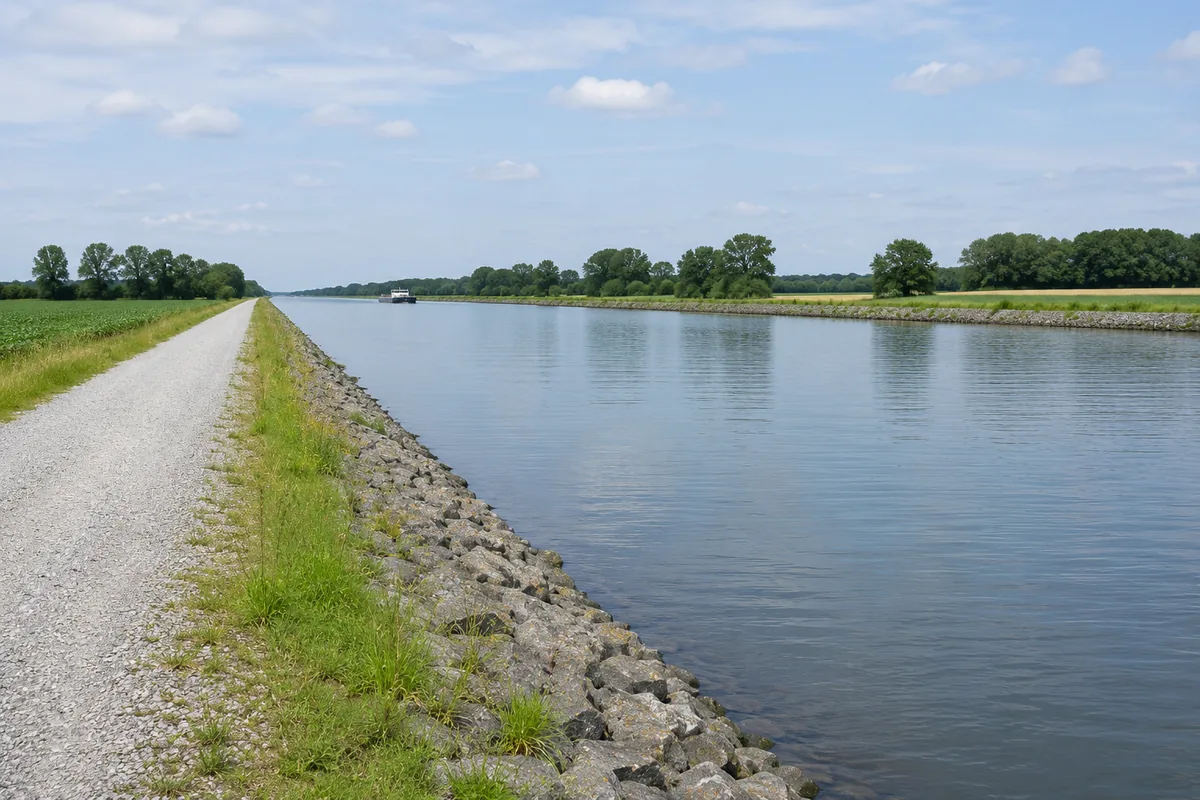
Most of it lies in Lower Saxony, the start in North Rhine-Westphalia and the end in Saxony-Anhalt (Anglerverband Niedersachsen). Fisheries biologists describe the canal as a long, mostly uniform channel about four metres deep.
Fish and best time Eel, perch, roach and zander
In September 2025 the Anglerverband Niedersachsen (AVN) electrofished more than 23 kilometres of bank on the canal and three branch canals (AVN, September 2025):
- Eel: an excellent stock throughout the canal, with many fish well over 80 centimetres.
- Round goby: the most common species.
- Perch and roach: also very common.
- Zander: electrofishing mainly covers the bank, so it rarely picks up larger zander. The AVN nevertheless counts the zander among the main species, together with bream and carp.
- Volga zander: It has colonised the whole Lower Saxon canal and its branch canals. During the 2025 survey, however, not a single one went into the net.
The biologists found particularly many fish in the branch canals. The protected areas serve as a nursery for young fish. When each species bites well is shown in the catch calendar.
Papers and permit Day or week permit from the AVN as the fishing permit (Erlaubnisschein)
On the whole canal you need a fishing permit (Erlaubnisschein). Which one applies depends on the stretch:
- Anglerverband Niedersachsen: It has leased two stretches. The western one runs from canal kilometre 8 to 68,5 in the Osnabrücker Land, the eastern one from kilometre 128,1 at Sachsenhagen to 247,8 at Wolfsburg (Gewässerordnung 2026). The branch canals Osnabrück, Linden with the Leine link canal, Misburg, Hildesheim and Salzgitter are added. Guests without membership buy day or week permits; annual permits are for members only (AVN, Mittellandkanal). You carry proof of the angling exam (Fischerprüfung) together with your ID card, or a fishing licence (Fischereischein), plus the fishing permit (Erlaubnisschein), the water rules and a catch log. You enter the fishing day before the first cast.
- AVN stretch in North Rhine-Westphalia: From kilometre 8 at Obersteinbeck to the state border at about kilometre 28, the AVN stretch lies in NRW. A fishing licence (Fischereischein) is compulsory there. Since July 2026 you also pay the North Rhine-Westphalian fishing levy (Fischereiabgabe), even if you already pay one in your own state (AVN, Juni 2026). Without this proof the licence is not valid in NRW (Landesfischereigesetz NRW, § 31).
- Other sections in NRW and Lower Saxony: The first eight kilometres from Bergeshövede, the stretch between the Osnabrücker Land and Sachsenhagen including the Weser crossing at Minden, and the canal east of Wolfsburg up to the state border are not part of the AVN area. Local clubs issue fishing permits for these sections. Ask the state fisheries association or the municipality on the canal who holds the lease there.
- Saxony-Anhalt: You need a fishing licence and an angling card (Landesverwaltungsamt). In the waters directory 2022 to 2026 of the Landesanglerverband, the canal areas near Oebisfelde, Haldensleben and Wolmirstedt are listed with a note that a separate canal permit is required. A few short stretches on the north bank before Magdeburg are entered without that note. Where to get the canal permit, you can find out from the Landesanglerverband or the club that looks after the stretch.
In the Lower Saxon inland area the state does not require a fishing licence (Fischereischein) (Ausführungsbestimmungen), but you must carry ID and a fishing permit (Nds. Fischereigesetz, § 57). What else the three states require is set out on the pages Lower Saxony, North Rhine-Westphalia and Saxony-Anhalt.
Special rules Predator closed season, baits in spring, harvest slot
On the AVN stretches the Gewässerordnung 2026 applies. Minimum sizes, harvest slots and catch limits are shown in the box „At a glance“. In addition:
- Predators in spring: Pike are protected from 1 February to 31 May, zander from 1 March to 31 May. Dead baitfish and fish strips are banned from 1 February, lures from 1 March, in each case until the end of May. Live baitfish are banned all year.
- Rods: At most three rods, each with one hook, two of them for predators. When spinning, no further rod is left out. All rods stay close to you, spread over no more than five metres of bank (AVN).
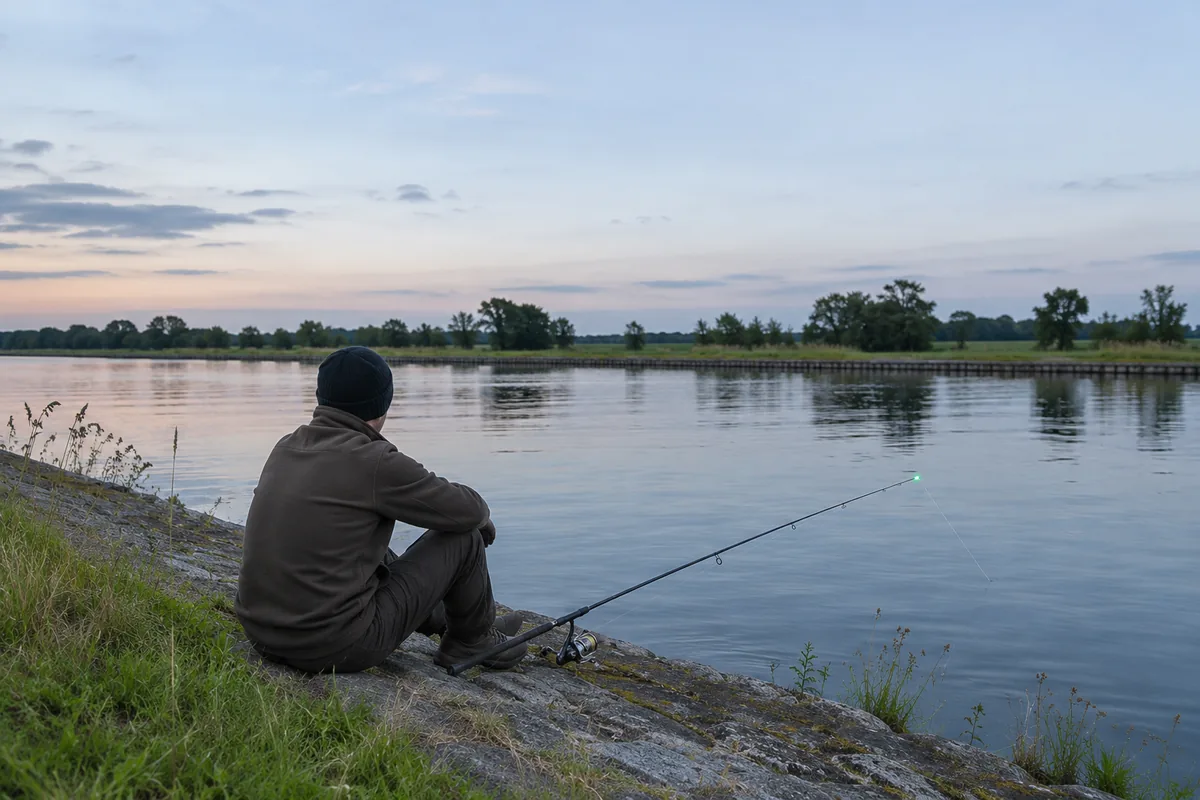
- Space on the bank: You fish only from the service track or from the berm in the bank protection. Boats, belly boats and keepnets are banned, as are ice fishing and drones. You must not obstruct shipping or the installations.
- Gobies: Gobies, Volga zander and other non-native species you take with you instead of returning them.
- Closed areas: Closed stretches and fish protection areas are off limits to everyone. The mouths of the branch canals and adjoining canals may be fished only by annual permit holders. Since 2026 the AVN permit no longer covers the mouth funnel of the Elbe Lateral Canal.
- NRW stretch: Burbot are protected there all year, and baitfish must come from the canal itself.
- Structures: You enter embankments, groynes and other federal installations only within their intended purpose (§ 2 WaStrBAV).
Status: October 2026. The AVN Gewässerordnung applies for 2026 and may change at the turn of the year. On the other sections the terms of the respective issuer and state law apply. What counts is the set of rules you receive with your permit.
Safety
A cargo ship pushes a bow wave ahead of it. First it sucks the water away from the bank, then it surges back with force. There are no shallow margins, and often vertical steel sheet piling drops straight into deep water. The ladders on it are rescue aids for people who have fallen in (WSA Mittellandkanal/Elbe-Seitenkanal). On arrival, make a note of the nearest ladder.
On the AVN stretches, a drop net or sheet-pile landing net, a priest for stunning fish, a knife, a disgorger, a measuring tape and an unhooking mat are compulsory equipment. More on standing safely at the water under The bank and waders.
Related
- Fishing on a canal: the type of water at a glance
- Hanover region with the Leine, Maschsee and Steinhuder Meer; also the rivers at both crossings, the Weser and the Elbe
- Methods: feeder fishing, bottom fishing, spinning and groundbaiting
- In the fish lexicon: zander, eel, perch, bream and burbot
- Closed season and minimum size explained and Returning fish
Sources
- Wasserstraßen- und Schifffahrtsverwaltung des Bundes: GDWS, Der Mittellandkanal, Wasserstraßenkreuz Magdeburg, WSA Mittellandkanal/Elbe-Seitenkanal, Fragen und Antworten
- Bundesrecht: Bundeswasserstraßengesetz, Anlage 1 und Wasserstraßen-Betriebsanlagenverordnung, § 2
- Anglerverband Niedersachsen e.V. als Pächter: Mittellandkanal und Stichkanäle, Gewässerordnung 2026, Befischung 2025 (12. September 2025), Fischereiabgabe NRW (30. Juni 2026)
- Niedersachsen (NI-VORIS): Niedersächsisches Fischereigesetz und Ausführungsbestimmungen; Nordrhein-Westfalen: Landesfischereigesetz (Fassung ab 1. Juli 2026)
- Sachsen-Anhalt: Landesverwaltungsamt, Fischereischein und Fischerprüfung; Landesanglerverband Sachsen-Anhalt e.V.: Gewässerverzeichnis 2022 bis 2026 mit Änderungen
A guide without guarantee, status October 2026. What counts are the fisheries acts and regulations of North Rhine-Westphalia, Lower Saxony and Saxony-Anhalt, the rules for the federal waterways and the terms of your fishing permit (Erlaubnisschein).