
Knowledge – Fish
Round goby: Identification, spread and rules
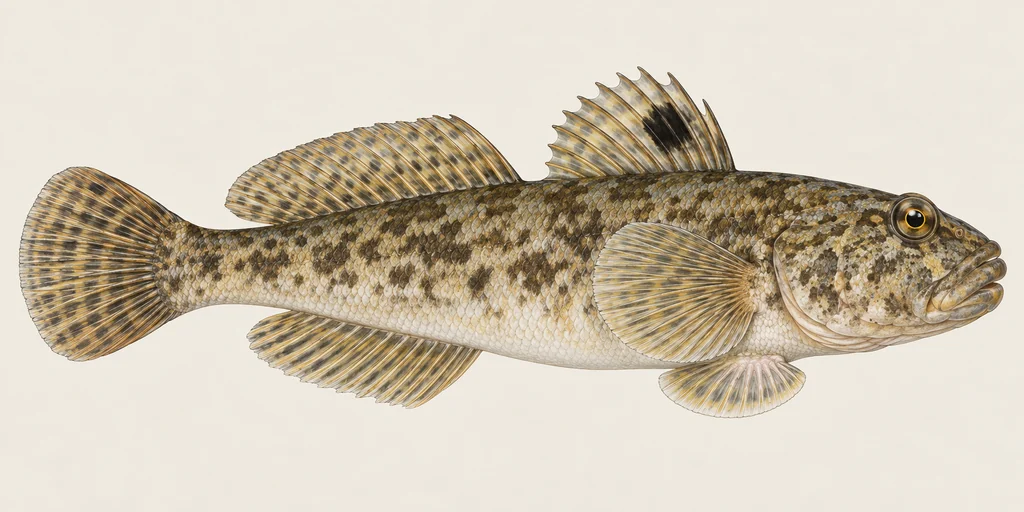
The round goby (Neogobius melanostomus) comes from the Black Sea region and reached German rivers with shipping. In the Rhine and other large rivers it has multiplied massively and in many places is the most common species on the bottom there. It is considered invasive and feeds, among other things, on the spawn of native fish.
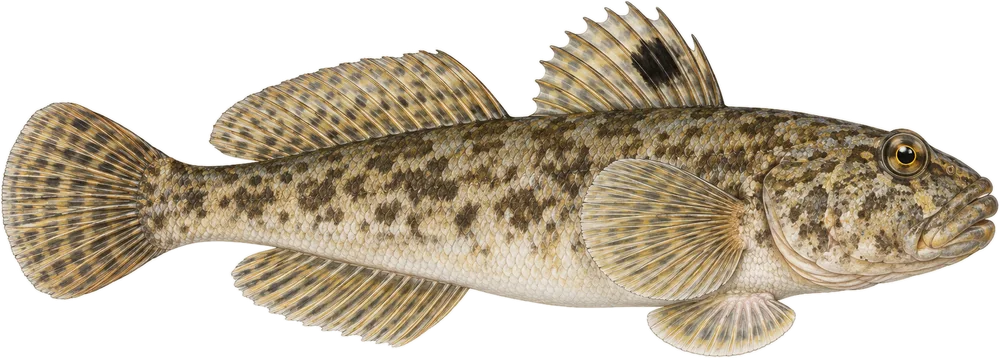
In short: Invasive species from the Black Sea region, recognisable by the black spot on the first dorsal fin and the sucker disc on the belly. After catching it, keep and kill it, do not release it and never take it away alive. What to do with bycatch: round goby as bycatch.
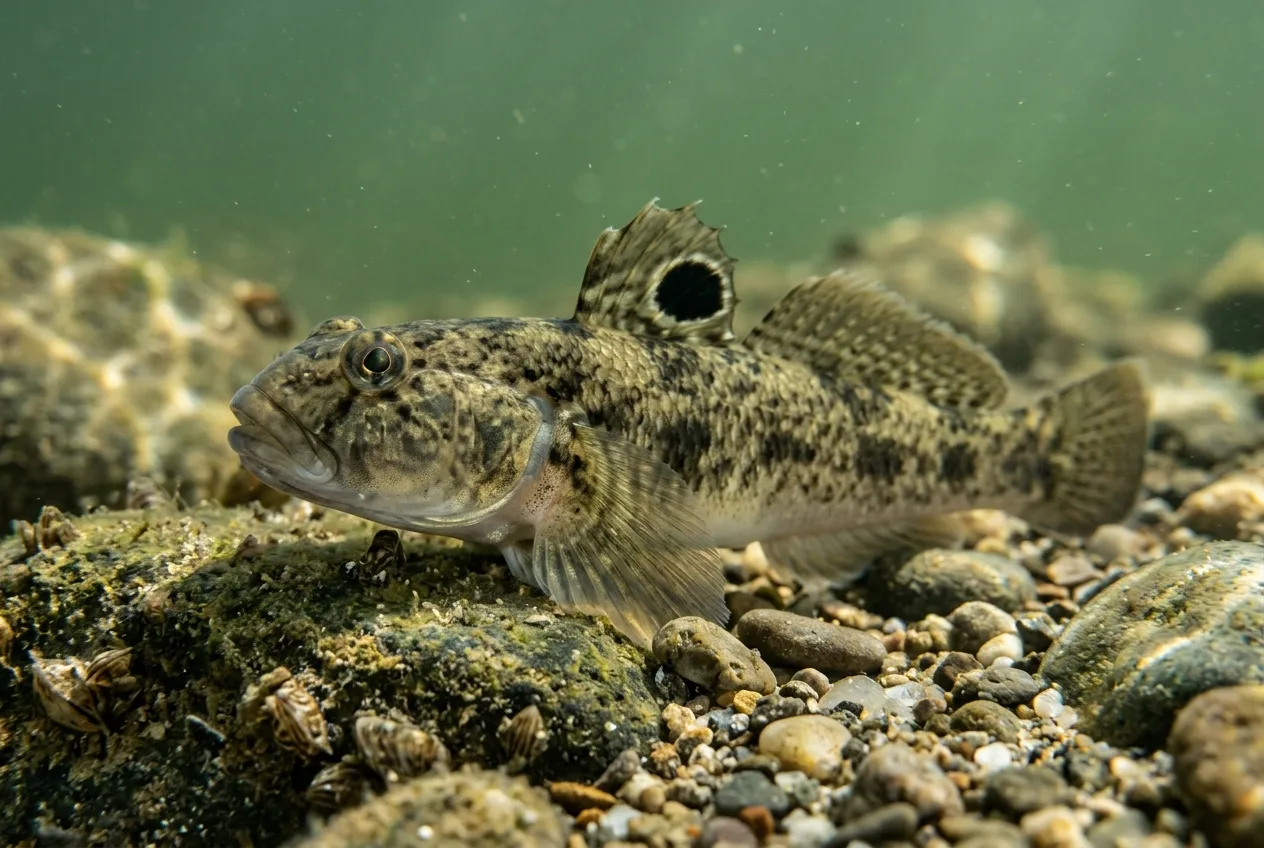
- Large black spot in the rear part of the first dorsal fin
- Pelvic fins fused into a sucking disc on the underside
- Two-part dorsal fin behind the broad head
Catch chances through the year
- Hardly any chance
- Possible
- Good
- Peak season
- Spawning (observe the closed season)
Editorial assessment for waters in Germany, not a measured value and no guarantee. Spawning time is not the same as the legal closed season.
Species profile and sources in the catch calendarAll species compared month by monthThe rules of your federal state
How to recognise it
The round goby is a sturdy bottom fish with a broad head and a two-part dorsal fin. Its surest feature is a large black spot in the rear part of the first dorsal fin. That is also how it differs from related gobies that live with it in the rivers.
Like all gobies, it has no separate pelvic fins. They are fused into a sucker disc with which the fish can hold on to the bottom. At spawning time the males turn almost completely black.
In Basel the fish are usually 10 to 20 centimetres long and weigh up to 400 grams. The Saxon fisheries authority (Fischereibehörde) gives 25 centimetres as the maximum length, FishBase even 35 centimetres. They do not live longer than six years.
Small and medium-sized round gobies are easily mistaken for the native bullhead. The bullhead, however, has separate, thoracic pelvic fins instead of a sucker disc, no black spot in the dorsal fin and a strong spine on the gill cover.
The Rhine is also home to other introduced gobies, such as Kessler’s goby. Here the black spot at the back of the first dorsal fin, typical of the round goby, helps. If you are unsure, take a photo from the side and one from above of the dorsal fin.
Side by side
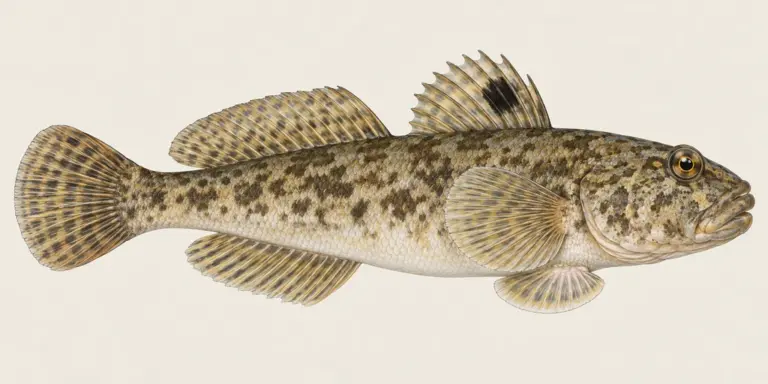
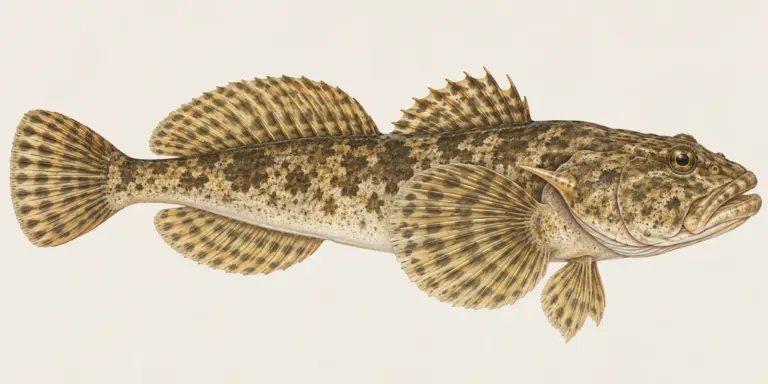
AI-generated illustrations.
Where it lives
The round goby originally lives in the Sea of Azov, the Black Sea and the Caspian Sea. It prefers shallow brackish water, but also occurs in lagoons, lakes, large rivers and harbours. It likes to sit on stones, sand or overgrown bottom. It tolerates temperatures between 0 and 30 °C as well as a few days with little oxygen.
It reached Central Europe on cargo ships. Larvae travel in ballast water, and egg clutches stick to ship hulls. It was first recorded in the Rhine at Basel in 2012. Today Black Sea gobies make up more than three quarters of the fish on the bottom there.
In the Rhine, Weser and Oder the species multiplied massively after its arrival. In the Elbe catchment it was at first known from the Mittellandkanal and from the Czech Republic. In 2016, during a survey of the Elbe near Schmilka, the Saxon state office caught several specimens in Saxony for the first time.
Holding spots in the picture
Choose a season and time of day: the picture shows where the species sits then. Tap a fish or a spot in the list to bring it closer. The picture is schematic and AI-generated, every water is different.
In the river
Slack water behind rocks
The round goby is found here all year round.
riprap, sheet piling, harbour
The round goby is found here all year round.
In the Rhine, Weser, Oder and Elbe the round goby sits on the bottom, preferably on stones and in harbours, but also on sand or weedy bottom. In the Rhine near Basel gobies now make up the majority of bottom fish.
Spring: This is when spawning takes place.
Summer: This is when spawning takes place. From April to September the black-coloured males guard their clutches on stones and mussel shells.
On the coast
Seagrass, gravel and stones in the shallows
The round goby is found here all year round.
Sandy bottom
The round goby is found here all year round.
Stony mixed ground
The round goby is found here all year round.
In its native range it lives mainly in shallow brackish water and lagoons. There it sits on stony, sandy or weedy bottom.
Spring: This is when spawning takes place.
Summer: This is when spawning takes place.
Size comparison: AI-generated drawing, schematic.
How it lives and breeds
The goby eats a wide range of invertebrates and small fish, above all mussels and snails. As a spawn predator it harms native species. The authorities in Saxony also point to its aggressive territorial behaviour.
It owes its spread to a long spawning season. It spawns from April to September, and in that time a female can spawn again every 18 to 20 days. The sticky eggs are attached to stones, mussel shells or aquatic plants. The male guards the clutch until hatching and usually dies after the spawning season.
When it spawns
Because the spawning season runs from April to September, the black-coloured males can be seen on stony ground all summer.
There is no closed season (Schonzeit) or angling season for this species. In Bavaria it is not listed in the fisheries regulation (Fischereiverordnung) at all and so may not be released again after being caught.
You will find the monthly overview of all species and the water temperature check in the catch calendar.
What to do if you catch one
As bycatch: Fishing for round goby? – how to recognise the species and why a catch must not go back into the water.
The round goby is rarely fished for deliberately. Because in the Rhine, Weser and Mittellandkanal it is in many places the most common species on the bottom, it can end up on your hook at any time when you are bottom fishing. If you catch one, you keep it: it does not belong back in the water.
In Bavaria, caught fish of species that are not listed in the fisheries regulation (Fischereiverordnung) may not be released again. That also applies to the round goby. In its state fisheries ordinance (Landesfischereiordnung), Berlin expressly bans releasing alien species after they are caught, and on the Mittellandkanal the water rules (Gewässerordnung) of the Anglerverband Niedersachsen require the fish to be kept. A fish you keep is stunned and killed humanely straight away. Never transport gobies alive and do not use them as bait fish.
The Saxon fisheries authority (Fischereibehörde) asks anglers to report catches with the place, date, number and, if possible, a photo. Such reports help to track the spread.
Check the sucker disc: Briefly turn a small bottom fish over: a round sucker disc on the belly means a goby, two separate pelvic fins point to the native bullhead.
Do not carry anything over: Empty bait-fish buckets and keepnets at the same water and clean your boat and gear before you move to another water. Spawn and young fish are easy to overlook.
Suitable lures
We deliberately show no baits for this species.
Invasive species, mostly bycatch when bottom fishing: do not take it alive into other waters; whether it may be released is regulated by the federal state (Bundesland) (not in Bavaria).
What to do in the kitchen with a goby you have kept
A round goby that you keep anyway does not have to be thrown away. Its flesh is lean all year round, only slightly fattier than cod. In spring it is softer; towards autumn the fat content and firmness rise noticeably, and then the texture resembles that of farmed trout.
For filleting, the fish are small and slimy, the flesh falls apart easily, and the bones are hard, sharp and numerous. It makes sense to remove the head and entrails, see gutting a fish, and to cook the goby whole. In a tasting, fried goby came out best; in Latvia it also goes on sale on the coast hot-smoked. If you are put off by the bones, you can strip the flesh off and make fish balls from it.
What the law says
The round goby is an alien species and is not assessed in the German Red List of 2023. In the nature conservation assessment by Nehring and others (2015) it is considered invasive and is on the so-called management list there. It is not on the EU list of invasive alien species, so the EU ban on releasing it does not apply to it (as of October 2026).
In Bavaria, caught fish of species that are not named in the annex to the fisheries regulation (Fischereiverordnung) may not be released again. The round goby is one of them. The Berlin state fisheries ordinance (Landesfischereiordnung) also bans releasing alien species after they are caught, in § 9 para. 4. On the Mittellandkanal the Gewässerordnung 2026 of the Anglerverband Niedersachsen requires gobies to be kept (as of October 2026).
Other federal states have their own rules. The fisheries regulation (Fischereiverordnung) of your federal state (Bundesland) and your fishing permit (Erlaubnisschein) are always binding. You will find a list of links to the official sources in the catch calendar.
What closed season, minimum size and harvest slot mean and where to find them is explained on the page Closed season and minimum size explained.
What state law specifies on the closed season (Schonzeit) and minimum size (Mindestmaß) for this species is in the “At a glance” box on the state pages for Bavaria and Berlin. For the other states our overview does not list this species; there the state fisheries regulation (Landesfischereiverordnung) applies.
Frequently asked questions (FAQ)
May I release a round goby?
No, it does not belong back in the water. In Bavaria and Berlin state law bans releasing it, and on the Mittellandkanal the water rules (Gewässerordnung) require it to be kept. Where nothing is regulated, the Swiss Bundesamt für Umwelt, for example, advises killing gobies straight away after they are caught.
How do I tell a goby from a bullhead?
The goby has a sucker disc on its belly and a black spot in the first dorsal fin. The bullhead has separate pelvic fins and a spine on the gill cover.
How did the goby get into the Rhine?
With cargo ships from the Black Sea region, as larvae in ballast water or as spawn on the hull. It was first recorded near Basel in 2012.
Sources
The rating of catch chances is an editorial assessment. The facts come from these sources, and the text is worded in our own words. The illustration is an original design by Angel Momente in the style of a natural history plate (AI-generated, see the AI notice).
- FishBase: Neogobius melanostomus (Größe, Alter, Merkmale, Lebensraum, Fortpflanzung, Nahrung)
- Rote-Liste-Zentrum: Schwarzmundgrundel (Rote Liste 2023: nicht bewertet; invasiv, Managementliste)
- Landesamt für Umwelt, Landwirtschaft und Geologie Sachsen, Fischereibehörde: Schwarzmundgrundel, Bitte um Meldungen (Erstnachweis Elbe 2016, Merkmale)
- Kanton Basel-Stadt, Amt für Umwelt und Energie: Schwarzmeergrundeln (Einschleppung, Merkmale, Anteil am Bestand)
- Bayerische Staatskanzlei: Verordnung zur Ausführung des Bayerischen Fischereigesetzes (AVBayFiG), Aussetzverbot für nicht gelistete Arten
- Landesfischereiverband Bayern: Fischlexikon, Mühlkoppe (Abgrenzung zur Groppe)
- Land Berlin, Fischereiamt: Berliner Landesfischereiordnung (Fassung vom 27.10.2025), § 9 Abs. 4 Zurücksetzverbot für gebietsfremde Arten
- Anglerverband Niedersachsen: Gewässerordnung Mittellandkanal, Stand 2026 (Nr. 8: gebietsfremde Arten wie Grundeln sind zu entnehmen)
- Bundesamt für Umwelt (BAFU), JFK und Universität Basel: Merkblatt invasive Grundeln (2018, nach dem Fang sofort töten, nicht als Köderfisch)
- Bundesamt für Naturschutz: Unionsliste der Verordnung (EU) Nr. 1143/2014 (114 Arten, Schwarzmundgrundel nicht gelistet)
- FAO AGRIS: Seasonal patterns in round goby (Neogobius melanostromus) catch rates, catch composition, and dietary quality (Fisheries Research 222, Westliche Ostsee/Dänemark)
- Interreg Baltic Sea Region, Projekt RoundGoby: Deliverable 1.2, Overview of round goby products and processing methods (2025)
Created with AI support from the sources listed. Figures only appear in the text if a source gives them. Last updated: 27 October 2026. Found a mistake? Write to us. Who is behind this site: About me.
More in the lexicon
- All fish species at a glance
- Catch calendar – month, water temperature and profile for 93 species
- Line calculator – breaking strain after the knot, drag guideline, backing
- Angling methods