
Knowledge – Fish
Fishing for arapaima
Fishing for arapaima means: in the dry season, watch the remnant lakes of the floodplain until the fish surfaces to breathe, then cast a big fly onto the swirl. Here is the way there in nine steps, each with a link to the detailed page.
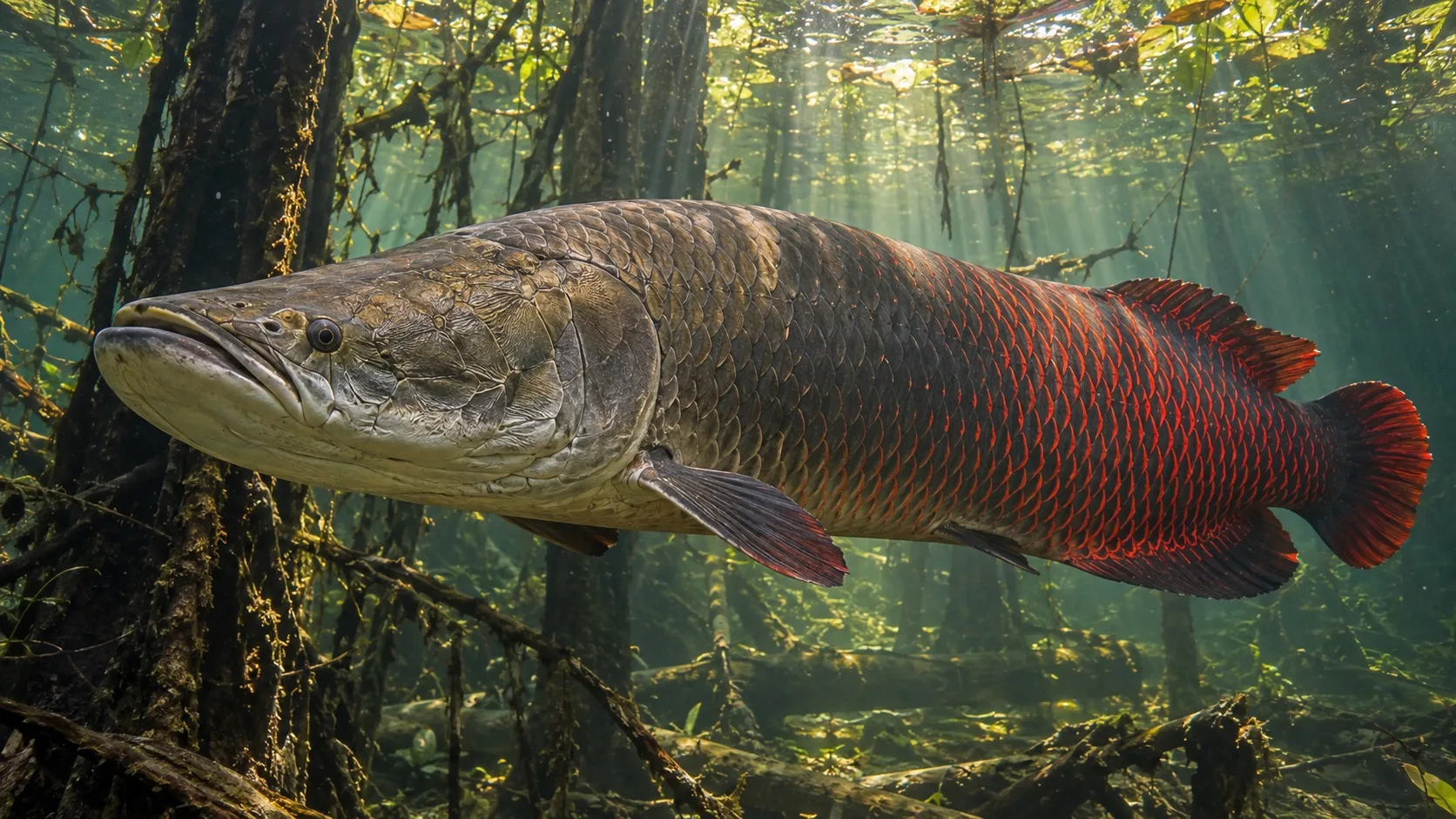
Because of overfishing, the arapaima is listed in Appendix II of the Washington Convention on endangered species (CITES). In several Brazilian states fishing for it is banned by the environment agency IBAMA, in the state of Amazonas since 1996; IBAMA has also set a minimum size and a closed season in Brazil. In Guyana it is on the list of protected aquatic animals; you may catch it there only with a licence from the fisheries authority (as of October 2026). Where you may fish is decided by the authority and the communities on the spot.
 Choose another fish117 fish with guides
 EelOff-peak season
 EelpoutPossible
 IdePossible
- ArapaimaGood
 GraylingPeak season
 Atlantic salmonSpawning time, please spare
 Brown troutSpawning time, please spare
 Brook troutSpawning time, please spare
 BarbelOff-peak season
 BarramundiSpawning season
 Greater amberjackGood
 Topmouth gudgeonOnly as bycatch
 Blue marlinSpawning season
 BonefishSpawning season
 BonitoGood
 BreamOff-peak season
 Dusky grouperOnly as bycatch
 CobiaPossible
 Spiny dogfishOnly as bycatch
 CodPeak season
 ChubPeak season
 MinnowOnly as bycatch
 European sturgeonOnly as bycatch
 FlounderPeak season
 PerchPeak season
 Largemouth bassGood
 Ballan wrasseOnly as bycatch
 Yellowfin tunaSpawning season
 Giant trevallyGood
 Prussian carpPossible
 BrillPossible
 Gilthead breamSpawning time, please spare
 Golden doradoSpawning season
 Golden mahseerOnly as bycatch
 Dolphinfish (mahi-mahi)Good
 Grass carpPossible
 Great barracudaGood
 GudgeonPossible
 White breamPossible
 DaceOff-peak season
 PikePeak season
 HalibutOff-peak season
 HerringPossible
 GarfishOut of season
 Huchen (Danube salmon)Possible
 Crucian carpOnly as bycatch
 CarpOff-peak season
 RuffeOff-peak season
 VendaceOnly as bycatch
 DabPeak season
 GurnardPossible
 Coley (saithe)Peak season
 Chinook salmonHardly any chance
 King mackerelSpawning season
 LingPeak season
 TuskOff-peak season
 MackerelPossible
 Bighead carpOut of season
 WhitefishPossible
 Conger eelOff-peak season
 Sea troutSpawning time, please spare
 Grey mulletPossible
 Murray codSpawning season
 MuskellungeGood
 Common nasePossible
 Nile perchPossible
 PayaraPossible
 Peacock bassPeak season
 PermitGood
 WeeverOnly as bycatch
 PollackOff-peak season
 BurbotOff-peak season
 AspPossible
 Red snapperSpawning season
 Rainbow troutPeak season
 RoosterfishGood
 RoachPeak season
 RedfishOut of season
 Bluefin tunaOnly as bycatch
 RuddPossible
 Russian sturgeonOnly as bycatch
 HaddockOff-peak season
 SnakeheadPossible
 TenchOff-peak season
 SpirlinOnly as bycatch
 PlaiceOff-peak season
 Greenland halibutOnly as bycatch
 Round gobyOnly as bycatch
 SwordfishGood
 Lake troutSpawning time, please spare
 HakeSpawning time, please spare
 Alpine charSpawning time, please spare
 MonkfishPossible
 SoleOff-peak season
 SailfishGood
 Silver carpOut of season
 SnookPeak season
 PumpkinseedOnly as bycatch
 SpratOnly as bycatch
 Atlantic wolffishSpawning time, please spare
 TurbotPeak season
 SterletOnly as bycatch
 SmeltOnly as bycatch
 Horse mackerelPossible
 TaimenGood
 TarponGood
 TigerfishSpawning season
 BleakPossible
 WahooGood
 Wels catfishOff-peak season
 WhitingPeak season
 Sea bassOff-peak season
 ZanderPeak season
 White-eye breamOnly as bycatch
 Blue breamOnly as bycatch
 Brown bullheadPossible
 VimbaOnly as bycatch
Season in October according to the catch calendar, an estimate and not a guarantee of a catch. The fish pictures are reduced natural-history plates and AI-generated.
Best time
From October to March.
In January: GoodIn February: GoodIn March: GoodIn April: Possible, spawningIn May: Hardly any chance, spawningIn June: Hardly any chanceIn July: Hardly any chanceIn August: Hardly any chanceIn September: PossibleIn October: GoodIn November: GoodIn December: Good
Good spot
- Lake: Surface and sunken treeSurface and sunken treeSurface and sunken treeSurface and sunken tree
Top baits
Starter tackle
- Rod: fly rod, class 12
- Line: fly line of class 12, to match the rod
- Hook: big fly with hook 6/0–8/0
In short
In short: According to the catch calendar the best time is October to March. Good spots in the lake: surface and sunken tree. Proven baits: big flies on hooks 6/0 to 8/0; adult arapaima eat almost only fish. Listed in CITES Appendix II. In Guyana it is listed as a protected aquatic animal and may be caught there only with a licence from the fisheries authority; sport fishing releases every fish.
Quick to recognise
One of the largest freshwater fish on earth, called pirarucu in Brazil, with a red edge on the scales and fins set far back. It can grow to 3 metres long; fish over 2,4 metres are rare today.
When
Fishing takes place mainly in the Rupununi in Guyana, where sport anglers catch and release the fish. There the savannah and forest lie under water in the rainy season from May to August; from September to April the level drops and the fish are stranded in the remnant lakes of the floodplain. October to March is best; September and April also work. FishBase gives April and May as the spawning time; in the central Amazon it spawns on rising water between December and May.
- JanGood
- FebGood
- MarGood
- AprPossible, spawning season
- MaySlim chances, spawning season
- JunHardly any chance
- JulHardly any chance
- AugHardly any chance
- SepPossible
- OctGood
- NovGood
- DecGood
Peak seasonGoodPossibleHardly any chanceSpawning season
Season in the destination
Fishing is done in the dry season, when the water is falling and the fish are stranded in the remnant lakes of the floodplain. In Guyana’s Rupununi area the rainy season lasts from May to August, when savannah and forest are flooded; from September to April the water falls again. In a study there, all the fish caught and released in November survived; the few deaths came only late in the dry season, though this difference is not yet confirmed. With rising water the fish move back to the higher flooded areas.
Season and biting time
In January: GoodIn February: GoodIn March: GoodIn April: SpawningIn May: SpawningIn June: Hardly any chanceIn July: Hardly any chanceIn August: Hardly any chanceIn September: PossibleIn October: GoodIn November: GoodIn December: Good
Where it is now
In the lake
In the lakes and channels of the floodplains of turbid Amazon rivers the fish gather in a small space at low water. Because it has to surface every 5 to 15 minutes, its audible gulping of air gives it away; when the water rises, it spreads out in the flooded forest.
How to go about it: Look for the cut-off floodplain lakes at the edge of the rivers, where the fish spend the dry season and probably build nests. How many fish stand in a lake varies greatly; very deep, turbid or densely overgrown lakes are almost impossible to fish with a fly.
| All year round | Surface, sunken tree |
|---|
Holding spots in the picture
Choose a season and time of day: the picture shows where the species sits then. Tap a fish or a spot in the list to bring it closer. The picture is schematic and AI-generated, every water is different.
Catch chance in springpossibleSpawning season, observe closed seasons
Catch chance in summerhardly any
Catch chance in autumngood
Catch chance in wintergood
- J
- F
- M
- A
- M
- J
- J
- A
- S
- O
- N
- D
Spawning season
In the lake
Sunken tree
The arapaima (pirarucu) is found here all year round.
Just below the surface
The arapaima (pirarucu) is found here all year round.
The arapaima lives in the floodplains of turbid, sediment-rich Amazon rivers. In the dry season with low water, in the central Amazon roughly September to January, many fish gather in a small space in lakes and channels. When the water rises they spread out in the flooded forest and spawn in shallow hollows, mostly on sand.
Spring: catch chance according to the catch calendar good in March, possible in April, hardly any in May. Spawning falls in this period, observe closed seasons.
Summer: catch chance according to the catch calendar hardly any.
Autumn: catch chance according to the catch calendar possible in September, good in October and November.
Winter: good chance of a catch according to the catch calendar.
Depth: As an air breather it surfaces every 5 to 15 minutes. The gulping of air can be heard and shows where it stands.
Size comparison: AI-generated drawing, schematic.
How
Sport anglers are drawn mainly to Guyana; for the North Rupununi, protocols and a draft law on catch and release have been in place there since 2016. Fishing there is done with the fly rod: watch a remnant lake for a while until you see where a fish takes air, and place the fly in that spot.
Easiest way
The best-studied method is fly fishing with release in Guyana: a class 12 fly rod and big flies with hooks measuring 6/0 to 8/0. Fishing is done in the dry season in the remnant lakes of the floodplain, where many fish stand in a small space.
Big fly in a remnant lake
The method of sport fishing in Guyana: in the dry season you cast a big fly in cut-off floodplain lakes, and the fish is released afterwards.
- Choose a dense remnant lake
Find a floodplain lake where many arapaima stand. In lakes with only a few fish, even one dead fish can weaken the small stock there for years, because there is no exchange with the river.
- Class 12 rod
Take a class 12 fly rod, the matching line and a big fly on a hook of size 6/0 to 8/0.
- Cast onto the swirl
Watch for the loud gulping and the swirl on the surface when a fish takes air. That tells you where an arapaima stands, and you place the fly in that spot.
- Bite at the surface
The arapaima grabs with its strongly upturned mouth just below the surface. When you feel the fish, strike hard.
- Short and hard fight
Expect powerful runs and high leaps out of the water. In the study in Guyana a fight lasted from a good 2,5 to just under 10 minutes; the longer the fish, the longer the fight.
- Hold at the surface
Hold the fish in the water so that it can take three to four breaths at the surface before you release it. It is best to let it go in shallow water and watch until it takes air again.
What with
A big fly that imitates a prey fish, on a hook of 6/0 to 8/0, as in a study in Guyana. Adult arapaima eat almost only fish, including armoured catfish, knifefish and characins.
- Streamerdry season, in remnant lakes where you have seen fish take air
In the study in Guyana, researchers caught the fish on big flies with hooks measuring 6/0 to 8/0. They imitate prey, because it hunts fish, birds and insects at the surface.
Tackle
A class 12 fly rod with matching line, as the researchers used in Guyana. Plan the landing for a fish that can weigh well over 100 kilograms; the pages on fly rods and line help with the choice.
Common mistakes
- Releasing the fish at once: The fish that died in the study drowned shortly after release because they no longer came up to breathe. Hold it at the surface until it has taken three to four breaths.
- Releasing in deep water: An exhausted fish has to reach the surface under its own power. The researchers in Guyana therefore advise releasing it in shallow water.
- Underestimating the tail: Even a landed arapaima still strikes with great force; one angler took the tail fin in the face while holding it. Keep your distance from the tail.
- Fishing lakes with few fish: The remnant lakes are cut off from the river, and a lost fish will not be replaced there soon. Avoid lakes with few fish.
- Long photo pauses in the air: Long handling in the air is one of the stresses the researchers in Guyana name. Keep photos short and leave the fish in the water for them.
Rules
For the arapaima the rules of the country where you fish apply, not the German fisheries laws. Each country, often each water, sets its own licence, closed seasons, minimum sizes and rules on keeping fish.
What the profile says: Listed in CITES Appendix II. In Guyana it is listed as a protected aquatic animal and may be caught there only with a licence from the fisheries authority; sport fishing releases every fish. In the Brazilian state of Amazonas, open fishing has been banned since 1996; fishing there takes place under officially regulated community management.
The fisheries authority (Fischereibehörde) of the country you travel to is what counts. Ask about the current rules before the trip and read in the profile how threatened the species is.
After the catch
Playing and landing
Strike firmly and play the fish quickly. After the fight an arapaima must be able to take air or it can drown: hold it in the water at the surface, give it three to four breaths and preferably release it in shallow water. Stay nearby afterwards until it surfaces to breathe again, and keep your distance from the powerful tail. In Guyana the genus is protected by law, and sport fishing there releases every fish; rules, licence and keeping fish are set by the country where you fish.
Researchers in Guyana are studying how strongly the fight strains metabolism and survival. So keep the fight short and leave the fish in the water when releasing it.
Frequently asked questions
How long does the fight with an arapaima last?
In the study in Guyana with class 12 fly rods, between a good 2,5 and just under 10 minutes, about 5,5 minutes on average. Larger fish took longer.
Does an arapaima survive being released?
Of 27 fish observed, 24 survived the observation period of 11 to 155 minutes, so about 89 per cent. The three dead fish stayed motionless on the bottom after release and did not come up to breathe again.
How often does an arapaima have to take air?
Fully grown fish surface about every ten minutes, young fish clearly more often. After release, fish in Guyana took air on average a little more than every six minutes, some after only three minutes.
What tackle do you need for arapaima?
For fly fishing, a class 12 rod and flies with hooks 6/0 to 8/0. For spinning, the trade press names rods with a casting weight of around 300 grams and robust multiplier reels.
When is the best time for arapaima fishing?
In the dry season, when the fish are trapped in the floodplain lakes; in the Rupununi in Guyana the water falls from September to April. Early in this period, all released fish survived in a study, though the advantage is not statistically confirmed.
Similar species
Anyone who catches the arapaima can fish for these species with similar tackle too:
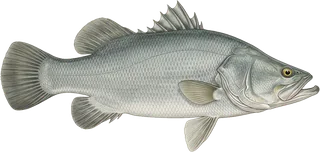 Nile perch fishingPossible
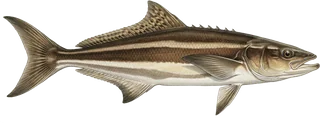 Cobia fishingPossible
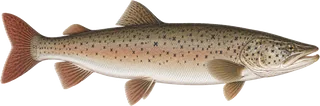 Fishing for taimenGood
 Bonefish fishingSpawning season
Sources
As of October 2026. The practical knowledge comes from 4 sources, summarised in our own words.
See all 4 sources
- Post-release behaviour and survival of recreationally-angled arapaima (Arapaima cf. arapaima) assessed with accelerometer biologgers · Fisheries Research 207 (2018), Lennox, Brownscombe, Cooke, Danylchuk; Carleton University und University of Massachusetts Amherst
- Arapaima: Alles über den größten Raubfisch des Amazonas · BLINKER (Redaktion)
- Arapaima holen synchron Luft · FISCH & FANG, Pressemitteilung des Leibniz-Instituts für Gewässerökologie und Binnenfischerei (IGB)
- Arapaima gigas (Pirarucu), Species Summary · FishBase
Text AI-assisted, based on the sources named and these pages: Arapaima (profile), Fly fishing, Streamer, Releasing a fish.